

A lab supply account requires more than completing a registration form: your organization must provide purchasing details and complete any internal vendor approval needed for its ordering process. To understand how to set up a lab supply account, identify the purchasing organization, submit the supplier’s application with accurate billing and delivery information, and prepare for procurement onboarding. For university purchase-order ordering, vendor approval typically takes 1-3 weeks.
Setting up a lab supply account can seem straightforward until payment terms, purchase orders, and receiving procedures involve different teams. Preparing the right information in advance helps avoid delays and route orders correctly.
This guide explains who may apply, what information an application may request, how to submit it, and what to expect during supplier onboarding. It also covers practical ways to align the account with your organization’s purchasing and receiving workflows.
Key Takeaways
- Gather your organization’s purchasing, billing, and delivery details before starting an application to make submission more straightforward.
- Plan for review time to depend on the supplier’s process and your organization’s purchasing requirements.
- Identify who handles vendor approval, purchase orders, receiving, and invoice processing so onboarding can fit your procurement workflow.
- Use the account for research purchasing that aligns with your organization’s work, and clarify internal approval steps before placing an order.
Business account application process
Unlike guest checkout, a lab supply account can connect purchases to organizational billing and procurement records. Buying through a distributor may consolidate orders, while a direct account links transactions to a single supplier.
Payment terms, credit limits, and fees depend on the supplier’s approved account arrangement. Before applying, review the written terms, including due dates, spending limits, late charges, and account fees.
Reduce the risk of fraud or misuse by limiting account access to authorized buyers. Match order confirmations and invoices to approved requests, and route unfamiliar charges through your finance process.
- Define the account’s purpose and responsible staff. Record the organization’s legal name, laboratory or department, billing and delivery locations, buyer, and finance contact. Identify who can approve purchases and who will manage invoices, so supplier records reflect your actual purchasing workflow.
- Prepare a purchasing request for planned items. Include product specifications, quantity, pack size, supplier or quote, price, delivery location, financial code, and required delivery date. For example, distinguish a requested tube size and pack quantity rather than listing only “centrifuge tubes.”
- Complete the supplier’s application using consistent organization and contact details. Provide the information requested for billing, delivery, purchasing, and payment arrangements. If your organization uses purchase orders, identify that process and the staff authorized to issue or approve them.
- Align the request with your budget and internal approvals before submission. Confirm that the requested items, quantities, and delivery date match the approved purchasing plan. Assign account access according to purchasing responsibilities, rather than sharing one login across the laboratory.
- Save the submitted application and related purchasing records. Once an order is placed, compare the supplier’s confirmation with the approved request. Check the item, quantity, price, shipping details, and estimated delivery date, then share receiving information with finance for invoice matching.
Application review time
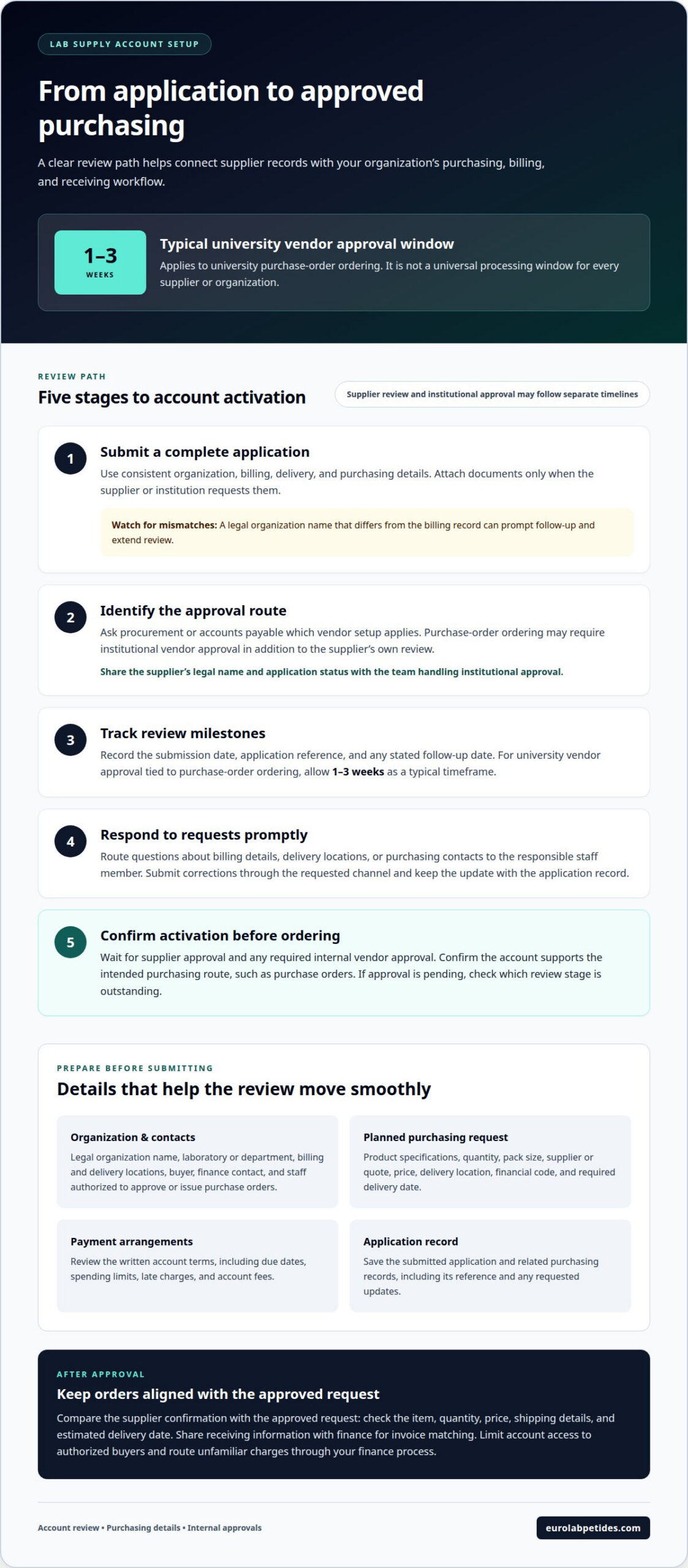
For university purchase-order ordering, vendor approval typically takes 1-3 weeks. The review period covers supplier onboarding and the university’s procurement checks, so the supplier account and institutional approval may move on separate timelines.
- Submit a complete application. Enter consistent organization, billing, delivery, and purchasing details. Attach documents only when the supplier or institution requests them. A mismatch between the legal organization name and billing record can prompt follow-up, extending the review beyond the initial submission.
- Identify the approval route. Ask your organization’s procurement or accounts-payable team which vendor setup applies. A university purchase-order account may require institutional vendor approval in addition to the supplier’s own review. Share the supplier’s legal name and application status with the team handling that approval.
- Track review milestones. Record the submission date, application reference, and any stated follow-up date. For university vendor approval tied to purchase-order ordering, allow 1-3 weeks as a typical timeframe. This estimate is not a universal processing window for every organization or supplier.
- Respond to requests promptly. Route questions about billing details, delivery locations, or purchasing contacts to the responsible staff member. If procurement asks for a correction, submit the revised information through the requested channel and keep the update with the application record.
- Confirm activation before ordering. Wait for the supplier’s account approval and any required internal vendor approval. Then confirm that the account supports your intended purchasing route, such as purchase orders, before submitting an order. If approval remains pending, check which review stage is outstanding with the relevant team.
Eligible organizations
Eligibility depends on the supplier’s account criteria and the organization’s purchasing purpose. Universities, research institutes, biotechnology companies, and independent laboratories may apply for institutional purchasing accounts. To set up a lab supply account, first identify which legal entity will make the purchases.
- Identify the purchasing entity. Use the legal name of the organization that will place orders and pay invoices. For example, a university department may purchase through its parent institution rather than under a researcher’s personal name. This distinction helps align supplier records with procurement and billing workflows.
- Describe the scientific purpose. State whether the account supports academic research, commercial research, or laboratory operations. A biotechnology company purchasing reagents for research has a different organizational context from an individual buying supplies for personal use. Suppliers may assess account requests according to their stated customer and product policies.
- Confirm the organization’s purchasing authority. Identify the staff member authorized to request or approve orders. A principal investigator may select research materials, while a procurement office controls purchase orders. Naming the correct roles clarifies who can transact and who handles financial approval.
- Match account details to the organization. Prepare consistent legal, billing, and delivery information. For example, a research institute may use a central billing address and a separate laboratory receiving location. Add the department or laboratory name where the application provides a field for it.
- Separate institutional and personal requests. Keep research purchases under the organization’s process, rather than mixing them with personal transactions. A university laboratory, for instance, should follow its procurement route for institution-funded orders. This helps maintain clear records for approvals, receiving, and invoice reconciliation.
- Resolve eligibility through the application criteria. Review the supplier’s stated account requirements before submission. Understanding how to set up a lab supply account includes accurately describing the organization and its purchasing purpose. Do not misclassify an organization to fit criteria; accurate details allow the supplier to assess the request against its account policy.
Supplier onboarding and approvals
Onboarding connects supplier records with your organization’s purchasing, payment, and receiving controls. In the United States, orders for hazardous, controlled, or restricted supplies must follow applicable product-specific rules and institutional procedures. The product’s classification determines which controls apply.
Complete supplier onboarding
Submit the supplier’s onboarding materials through its stated process, then review the account details. Confirm that the account name, billing arrangement, delivery locations, and authorized purchasing contacts match your organization’s records. Account activation does not automatically approve every product or purchasing method. For example, a laboratory that uses purchase orders should ensure its supplier setup supports that route.
Secure required approvals
Route vendor documentation to the staff responsible for procurement, finance, and laboratory operations. University purchase-order ordering typically requires vendor approval, which takes 1-3 weeks. Keep that institutional review distinct from the supplier’s account activation. Confirm that the approved purchasing route, financial coding, and receiving process are in place before the first order enters the workflow.
- Assign onboarding responsibilities. Identify who handles supplier records, purchase orders, invoice processing, and receipt of goods. A named contact for each task helps resolve questions without delaying approval.
- Submit required vendor information. Provide the organization’s requested onboarding details through the designated channel. Keep the supplier name consistent across procurement and finance records to support accurate vendor matching.
- Complete internal review. Send vendor materials to the relevant approval teams. For university purchasing, include the procurement office’s vendor setup process and allow its typical 1-3-week review period.
- Confirm readiness to order. Check that the account is active and internal approvals are complete. Match the first order confirmation to the approved purchasing record, including item, quantity, price, shipping details, and estimated delivery date.
EuroLab Peptides
EuroLab Peptides supplies research-grade peptides for scientific work involving longevity, weight management, tissue repair, and cognitive function. Its products are for in-vitro research and laboratory development, not human consumption or clinical use. Supplier onboarding remains separate from your organization’s account approval and purchasing controls.
If your laboratory’s research requires peptide supplies, include EuroLab Peptides in your procurement planning. Its quality control combines in-house testing with independent third-party laboratory testing to assess product purity and consistency. Research teams can consider this information alongside their purchasing requirements and internal review procedures.
Contact EuroLab Peptides to discuss research supply needs and account-related questions.
Put your account to work
A supplier account is most useful when it supports a defined research plan. Before ordering, align purchasing authority, scientific purpose, and internal approval so every transaction has a clear organizational basis. This keeps account administration connected to the research rather than treating setup as a standalone task.
Setting up a lab supply account is one part of procurement readiness. Next, identify the research materials your program requires and route purchases through your organization’s approved process. EuroLab Peptides supplies research peptides for longevity and vitality, weight management, and tissue repair and recovery studies. All products are for in-vitro research and laboratory development only.
For teams considering research-grade peptides in these areas, discuss your research supply needs directly with EuroLab Peptides. Contact EuroLab Peptides to discuss your needs and determine whether its research offerings fit your planned work. A clear research objective gives the conversation a useful starting point.
Frequently Asked Questions
What information is needed to open a laboratory supply account?
Prepare the organization’s legal name, account contact, billing details, and intended delivery location. The application may also ask how you will place orders, such as by purchase order or another payment method. For example, a university department may need to provide both its central billing office and the laboratory receiving shipments, distinguishing the payer from the delivery location.
How do businesses set up an account with a laboratory supply vendor?
Businesses generally choose the appropriate account application, provide organizational and purchasing details, and submit it through the supplier’s process. Before starting, decide which staff member will manage orders and who will handle finance questions. Keep a copy of the application with your purchasing records so you can refer to it when account details or authorized contacts need updating.
How do universities and research labs set up laboratory purchasing accounts?
Universities and research laboratories typically coordinate supplier account setup with institutional procurement. The laboratory identifies its receiving location and purchasing contact, while the institution’s authorized team handles vendor setup and purchase-order procedures. For example, a principal investigator may define research needs, while the university procurement office determines the approved purchasing route.
What documents are required for a lab supply account, such as tax-exempt forms or resale certificates?
Required documents depend on the supplier’s application and the organization’s circumstances. Tax-exempt forms or resale certificates may apply when the organization seeks the corresponding purchasing treatment, but they are not universal account documents. Submit only current, relevant documents in the requested format so the supplier’s records match the application.
How do lab supply vendors verify a business or institution before approving an account?
Suppliers may review the organization’s identity and account details, including whether the purchasing contact and billing information align. They may also request supporting documents or clarification before completing their review. Keep the organization’s legal name consistent across the application and supporting records. Mismatched details can prompt follow-up and delay a decision.
How long does laboratory supplier account approval take?
University vendor approval for purchase-order ordering typically takes 1-3 weeks. This refers to university vendor approval, not necessarily the supplier’s separate account review. The timelines can overlap or proceed separately, depending on the organization’s workflow. Track each approval with its responsible team, and confirm that both the supplier account and required purchasing route are ready before ordering.
