

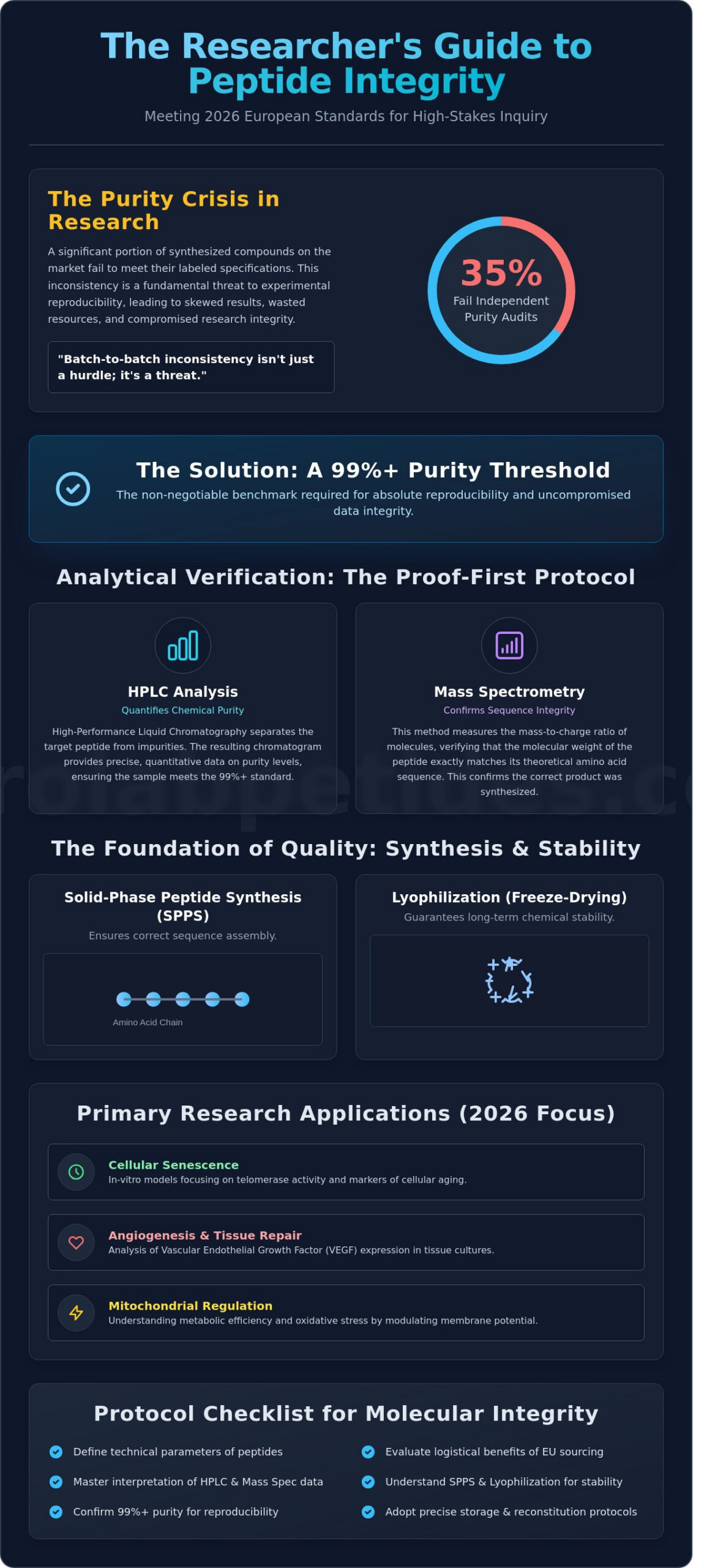
In a global market where an estimated 35% of synthesized compounds fail to meet their labeled specifications upon independent audit, the integrity of your research depends entirely on the analytical chain of custody. Most investigators recognize that batch-to-batch inconsistency isn’t just a logistical hurdle; it’s a fundamental threat to experimental reproducibility. When sourcing onderzoekspeptiden, the difference between a successful study and a failed trial often rests on a single percentage point of purity. You’ve likely encountered the frustration of opaque third-party testing data or the degradation of sensitive sequences during unmonitored transit.
This technical guide establishes a rigorous protocol for the selection and handling of research peptides according to 2026 European standards. We’ll provide a comprehensive overview of analytical verification methods, including HPLC and mass spectrometry, to ensure your materials meet the uncompromising 99%+ purity threshold required for high-stakes inquiry. By the end of this analysis, you’ll understand how to implement a reliable sourcing framework that prioritizes chemical integrity over market convenience. We’ll examine the specific requirements for sequence validation, lyophilization stability, and the stringent logistical protocols necessary to prevent thermal degradation during delivery.
Key Takeaways
- Define the technical parameters of synthetic amino acid polymers to distinguish high-grade research reagents from clinical pharmaceuticals.
- Master the interpretation of HPLC and mass spectrometry data to confirm 99%+ purity levels, ensuring the absolute reproducibility of your experimental outcomes.
- Evaluate the logistical benefits and stringent quality standards of sourcing onderzoekspeptiden within the European market to minimize supply chain risk.
- Gain insights into the role of Solid-Phase Peptide Synthesis (SPPS) and lyophilization in maintaining the long-term chemical stability of your laboratory samples.
- Adopt precise storage and reconstitution protocols to protect molecular integrity and prevent the degradation of sensitive peptide sequences during handling.
What are Research Peptides? Defining the Chemical Tools of Modern Science
Research peptides are precisely engineered amino acid polymers, typically consisting of 2 to 50 individual monomers linked via covalent peptide bonds. These synthetic compounds serve as fundamental reagents in biochemical analysis and molecular modeling. Unlike clinical pharmaceuticals, these substances are classified strictly as in-vitro research tools. They aren’t intended for human consumption or therapeutic use; instead, they provide a controlled medium for investigating cellular signaling and protein interactions. Within the European scientific community, onderzoekspeptiden are utilized to map the complex landscapes of signal transduction and metabolic pathways with a level of accuracy that standard chemical grades cannot achieve.
The distinction between a laboratory reagent and a clinical drug lies in the intended application and the stringency of the manufacturing environment. In a controlled setting, researchers use these peptides to observe biological responses without the confounding variables present in live organisms. High-stakes precision is the baseline requirement. When purity levels fluctuate, experimental reproducibility vanishes. This is why a 99%+ purity threshold is maintained through rigorous synthesis protocols. Every batch undergoes validation to ensure the molecular sequence matches the theoretical design exactly.
The Molecular Architecture of Synthetic Peptides
The functionality of a peptide is dictated by its primary sequence. During Solid-Phase Peptide Synthesis (SPPS), side-chain protection is vital to prevent branched chains or incorrect bonding. This process ensures that the carboxyl group of one amino acid reacts exclusively with the amino group of the next. Molecular weight, often ranging from 500 to over 5,000 Daltons, directly dictates solubility and molarity calculations. Researchers must account for these weights when designing reconstitution protocols, as a peptide’s hydrophobicity influences its behavior in aqueous buffers. Onderzoekspeptiden with high molecular weights often require specific pH adjustments to reach full dissolution for precise assays.
Primary Research Applications in 2026
As of 2026, the trajectory of peptide research has shifted toward highly specialized metabolic and regenerative models. The laboratory landscape currently prioritizes several key areas of inquiry:
- Cellular Senescence: Models utilizing Epitalon focus on telomerase activity and the potential for slowing cellular aging markers in-vitro.
- Angiogenesis and Tissue Repair: Studies involving BPC-157 analyze the peptide’s influence on vascular endothelial growth factor (VEGF) expression in isolated tissue cultures.
- Mitochondrial Regulation: Researchers examine peptides that modulate mitochondrial membrane potential to understand metabolic efficiency and oxidative stress.
Purity is verified through High-Performance Liquid Chromatography (HPLC) and Mass Spectrometry. These analytical methods provide the “proof-first” data required by modern institutions. By adhering to these stringent European standards, the integrity of the data remains uncompromised, allowing for the objective analysis of biochemical phenomena.
Analytical Verification: Ensuring 99%+ Purity and Sequence Integrity
Precision in biochemical research is non-negotiable. The integrity of experimental data depends entirely on the chemical consistency of the reagents. Purity is the fundamental variable that dictates reproducibility in every study. When utilizing onderzoekspeptiden, a deviation as small as 2% can introduce exogenous variables that compromise cellular assays or metabolic simulations. These contaminants may induce off-target effects, leading to false positives or unintended toxicity. It’s essential to recognize that even products labeled as high-grade that fail the 99% threshold can skew results and waste laboratory resources.
HPLC Analysis: Quantifying Chemical Purity
Reverse-phase High-Performance Liquid Chromatography (RP-HPLC) is the industry standard for quantifying chemical purity. The process passes the peptide through a C18 hydrophobic stationary phase under high pressure. Separation occurs based on the peptide’s affinity for the mobile phase. In a professional chromatogram, the primary peak is measured at wavelengths of 214nm to identify peptide bonds. Any secondary peaks, often referred to as “noise,” represent residual solvents or truncated sequences. A 99% purity threshold is the mandatory baseline for elite research; it ensures the experimental environment remains controlled.
Mass Spectrometry: Confirming Molecular Identity
While HPLC measures quantity, Mass Spectrometry (MS) validates identity. This technique determines the molecular mass of the sample by measuring the mass-to-charge (m/z) ratio of ionized particles. Researchers compare the resulting data against the theoretical molecular weight of the peptide sequence. MS is sensitive enough to detect a single amino acid deletion or an incorrect coupling that HPLC might overlook. Third-party laboratory verification provides an objective layer of scrutiny. This ensures that the onderzoekspeptiden delivered to the bench match the requested sequence with absolute certainty.
Interpreting a Certificate of Analysis (CoA) requires a focus on several critical metrics. The CoA acts as a technical passport for the peptide, confirming that the lyophilized powder contains the specific sequence intended for the study. A standard report includes:
- Purity Rating: The percentage of the target peptide relative to impurities, verified by HPLC.
- Molecular Weight: The actual mass measured by MS versus the theoretical calculated mass.
- Batch Consistency: Verification that the specific lot number has undergone individual testing.
You can examine the analytical documentation provided with our batches to see how these stringent standards are applied in practice. This level of transparency is essential for maintaining the requirements of modern pharmacology and biochemistry. By relying on cold, hard data rather than anecdotal claims, researchers can proceed with their inquiry knowing the molecular foundation of their work is secure.
Synthesis and Lyophilization: The Science of Stability
Solid-Phase Peptide Synthesis (SPPS) serves as the primary methodology for producing high-caliber onderzoekspeptiden. This technique allows for the sequential addition of amino acids with uncompromising precision. Each coupling cycle is monitored to ensure conversion rates exceeding 99.5%. Once synthesis is complete, the crude peptide requires rigorous purification. High-Performance Liquid Chromatography (HPLC) is employed to isolate the target sequence from truncated or incomplete chains. Purity is verified through mass spectrometry to confirm that the molecular weight matches the theoretical sequence exactly.
Residual solvents used during the synthesis process, such as acetonitrile or piperidine, are removed through vacuum evaporation. Trifluoroacetic acid (TFA) is a common byproduct of the cleavage process from the resin and must be meticulously monitored. High TFA concentrations can interfere with biological assays, particularly when working with sensitive cell lines. Researchers must also account for moisture content, which typically represents 5% to 10% of the total lyophilized weight. This variable is critical for researchers calculating molar concentrations. Accurate dosing depends on understanding the net peptide content versus the gross weight of the powder.
The Lyophilization Process Explained
The transition from a liquid solution to a stable solid is achieved through lyophilization. This process involves freezing the peptide solution at temperatures below -40°C and reducing the surrounding pressure. This allows the frozen water to sublimate directly from the ice phase to the gas phase. Structural integrity is maintained because the peptide doesn’t pass through a liquid phase, which prevents degradation. Lyophilized onderzoekspeptiden are significantly more stable for international logistics. They maintain their biochemical properties during transit across various climate zones, ensuring that the integrity of the research isn’t compromised by thermal fluctuations.
Counter-Ion Management in Research
Peptides are usually delivered as TFA salts because of the reagents used during HPLC purification. While TFA is suitable for most biochemical studies, certain cell culture applications require acetate or HCl salt exchanges to avoid potential cytotoxicity. TFA is a common byproduct of synthesis that must be monitored. Researchers should verify the counter-ion type to ensure compatibility with their specific experimental parameters. Eurolab Peptides ensures that counter-ion levels are documented in the certificate of analysis for every batch. This transparency allows for precise adjustments in laboratory protocols where even minute chemical variances can alter results.
- Purity levels: Consistently verified at 99%+ via HPLC.
- Stability: Lyophilized powders remain stable for 24 months when stored at -20°C.
- Solubility: Post-lyophilization powders show improved reconstitution characteristics in sterile water or bacteriostatic buffers.
Sourcing Research Peptides in Europe: Reliability and Logistics
Procuring high-purity biochemicals requires a supply chain that eliminates variables of degradation and regulatory interference. For laboratories utilizing onderzoekspeptiden, the geographic origin of the compound dictates the ultimate integrity of the data. EU-based sourcing provides a controlled environment where chemical synthesis aligns with stringent European Chemical Agency (ECHA) guidelines. This proximity ensures that the transition from lyophilization to laboratory bench occurs within a compressed timeframe, preserving the structural stability of the peptide sequence.
The European Quality Advantage
European manufacturing facilities operate under rigorous quality management systems, often exceeding ISO 9001:2015 specifications. These standards mandate that every synthesis cycle undergoes validated analytical procedures. When reagents are sourced outside the EU, they frequently face extended transit times and unpredictable customs inspections. These delays expose sensitive lyophilized powders to temperature fluctuations that compromise the peptide’s secondary structure. By maintaining a localized supply chain, researchers minimize these risks. Detailed protocols for identifying reputable sources are outlined in our guide on how to buy research peptides safely in Europe.
Logistical precision is centered on cold chain management. While lyophilized peptides are stable at room temperature for short durations, long-term viability is best maintained at -20°C. EuroLab Peptides utilizes expedited shipping protocols that target 48-hour delivery windows across the Netherlands and Belgium. This efficiency prevents the accumulation of moisture within the vial, a common cause of peptide hydrolysis. Every shipment is treated as a critical laboratory component, not merely a commercial product.
Evaluating Supplier Integrity
Supplier transparency is quantified through the availability of batch-specific documentation. A significant red flag in the onderzoekspeptiden market is the use of “representative” COAs (Certificates of Analysis) rather than data from the specific lot being purchased. At EuroLab Peptides, integrity is maintained through a multi-level quality control process:
- Sequence Validation: Mass spectrometry confirms the molecular weight matches the theoretical sequence.
- Purity Quantification: High-Performance Liquid Chromatography (HPLC) ensures a 99%+ purity profile.
- Contaminant Screening: Analysis for residual solvents and TFA (Trifluoroacetic acid) content is performed.
Regulatory compliance for in-vitro laboratory chemicals in the EU is governed by Regulation (EC) No 1272/2008. This framework ensures that all compounds are correctly classified, labeled, and packaged. EuroLab Peptides adheres to these legal requirements, providing researchers with the necessary safety data sheets (SDS) to maintain laboratory safety standards. This commitment to technical accuracy supports the high-stakes precision required in modern biochemistry.
Laboratory Handling: Storage and Reconstitution Protocols
Maintaining the structural integrity of onderzoekspeptiden requires strict adherence to thermodynamic and mechanical protocols. While lyophilized peptides exhibit relative stability, the transition into a liquid state introduces variables that can rapidly compromise purity levels. Researchers must prioritize the preservation of the peptide’s secondary structure to ensure that experimental data remains reproducible and valid. Any deviation from standardized handling procedures often results in the irreversible aggregation or hydrolysis of the sample.
The process begins before the vial is even opened. Vials should be allowed to equilibrate to room temperature for approximately 15 to 30 minutes before reconstitution. This step prevents atmospheric moisture from condensing on the lyophilized powder, which can lead to immediate hygroscopic degradation. Once the vial reaches ambient temperature, the introduction of a diluent must be handled with clinical precision to maintain the 99%+ purity standards expected in high-level biochemistry.
Reconstitution Guidelines for Researchers
Precise concentration levels are fundamental to the success of any laboratory model. Researchers should utilize a peptide reconstitution calculator to determine the exact volume of solvent required for their specific molarity targets. The choice of diluent is equally critical. Sterile water is suitable for immediate, single-use applications, but bacteriostatic water containing 0.9% benzyl alcohol is the standard for multi-use vials as it inhibits the growth of most contaminants.
- Mechanical Stress: Never shake the vial. Introduce the diluent slowly down the side of the glass wall and use a gentle swirling motion to dissolve the powder.
- Stability Windows: Most reconstituted onderzoekspeptiden remain stable at 2-8°C for a period of 7 to 14 days; however, this window varies significantly based on the specific amino acid sequence.
- Bioactivity: Avoid repeated freeze-thaw cycles. Each cycle can cause mechanical shear stress on the peptide bonds, reducing the effective concentration of active molecules.
Long-term Storage Best Practices
For multi-year stability, lyophilized peptides must be stored in specialized laboratory freezers. While a standard -20°C environment is sufficient for many sequences, a temperature of -80°C is the unrivaled standard for maximum preservation. These temperatures slow down the kinetic energy of the molecules, effectively pausing the natural degradation processes that occur at room temperature. It’s essential to use desiccants within the storage containers to further mitigate the risks of moisture infiltration.
Peptide stability is sequence-dependent, with some being more prone to oxidation. Sequences containing Cysteine, Methionine, or Tryptophan residues are particularly vulnerable to oxidative damage if exposed to air or light for extended periods. To ensure the integrity of the research, each batch should be stored in an airtight, light-protected environment. By following these stringent European laboratory standards, researchers can guarantee that their chemical tools remain potent and reliable throughout the duration of their study.
Advancing Scientific Discovery Through Analytical Precision
The integrity of your biochemical data depends entirely on the chemical tools utilized during experimentation. Achieving a 99%+ purity threshold isn’t a luxury; it’s a fundamental requirement for valid, reproducible results. Each batch of our onderzoekspeptiden undergoes rigorous third-party verification using HPLC and mass spectrometry to confirm both sequence identity and absolute purity. By maintaining centralized EU-based distribution, we ensure that logistical delays don’t compromise the cold-chain integrity of your sensitive compounds. These materials are strictly for in-vitro research use, adhering to the most stringent laboratory protocols.
High-stakes research demands a partner that prioritizes analytical data over marketing claims. When you source your materials from a reliable European facility, you eliminate variables that could otherwise destabilize months of laboratory work. Precision is the only path to discovery. We provide the technical documentation necessary to support your findings. Your project deserves the highest standard of chemical synthesis available in the modern market. Reliable data starts with reliable molecules. Explore our 99%+ pure research peptide catalog to secure the tools your laboratory requires for its next breakthrough.
Frequently Asked Questions
What are research peptides exactly?
Research peptides are chemical compounds composed of short chains of amino acids, typically numbering between 2 and 50 residues, synthesized for use in strictly controlled laboratory environments. These substances, often referred to as onderzoekspeptiden, serve as essential tools in biochemical assays. They allow researchers to investigate molecular pathways. Each sequence is manufactured via solid-phase peptide synthesis (SPPS) to ensure the precise arrangement of amino acids remains consistent across all batches.
Are research peptides intended for human consumption?
Research peptides aren’t intended for human or veterinary consumption under any circumstances. These chemicals are sold exclusively for in-vitro laboratory experimentation and professional research applications. Regulatory frameworks, including EU Regulation 2017/745, dictate that these substances lack approval for therapeutic use in humans. Researchers must handle these compounds within a qualified laboratory setting. They must also adhere to rigorous safety protocols and disposal guidelines established by local safety authorities.
How do I verify the purity of a research peptide?
It’s standard procedure to verify purity through a combination of High-Performance Liquid Chromatography (HPLC) and Mass Spectrometry (MS) analysis. A certificate of analysis (CoA) must confirm a purity level of 99% or higher. This is measured by the area under the curve in the HPLC chromatogram. Mass spectrometry confirms the molecular weight of the peptide, ensuring the synthesized sequence matches the theoretical mass within a 0.1% margin of error for every batch.
What is the best way to store peptides for long-term research?
Lyophilized peptides should be stored in a freezer at -20°C for short-term stability or -80°C for long-term preservation exceeding 24 months. Vials must remain hermetically sealed to prevent moisture ingress. Moisture causes peptide degradation through hydrolysis. Before opening, vials should reach room temperature over a 30-minute period to avoid condensation formation on the lyophilized powder, as moisture can compromise the integrity of the sample immediately.
Why is third-party testing so important for researchers?
Third-party testing provides an unbiased validation of chemical identity and 99%+ purity, removing the conflict of interest inherent in manufacturer-led reporting. Independent laboratories use standardized protocols to detect impurities. These include residual solvents, TFA, or truncated sequences. In a 2023 industry survey, third-party verification was cited as the primary factor in ensuring data reproducibility, as it guarantees that the onderzoekspeptiden used in a study meet the exact specifications required.
Can I buy research peptides legally in Europe?
Research peptides are legal to purchase in Europe when they’re intended for laboratory-based scientific inquiry and not for human consumption. EU regulations, specifically under the REACH framework established in 2006, allow the sale of these chemicals to institutions. Eurolab Peptides ensures compliance with these standards by utilizing EU-based shipping. This minimizes customs delays and ensures all documentation meets the requirements of internal trade laws.
What is the difference between lyophilized and solution peptides?
Lyophilized peptides are freeze-dried powders that offer superior stability and a shelf life of up to 3 years when stored correctly. Solution peptides are already reconstituted in a buffer. This makes them more susceptible to enzymatic degradation. It’s the industry standard to prefer the lyophilized format because it allows for precise control over the final concentration during reconstitution, ensuring that the molarity of the solution is exact for the intended experiment.
How long do peptides remain stable after reconstitution?
Reconstituted peptides typically remain stable for 7 to 14 days when stored at 4°C in a sterile environment. Stability decreases rapidly at room temperature. Some sequences lose 15% of their potency within 48 hours. For experiments requiring longer durations, researchers shouldn’t rely on a single vial. They should aliquot the solution and freeze it at -20°C to extend usability, though repeated freeze-thaw cycles must be avoided.
