

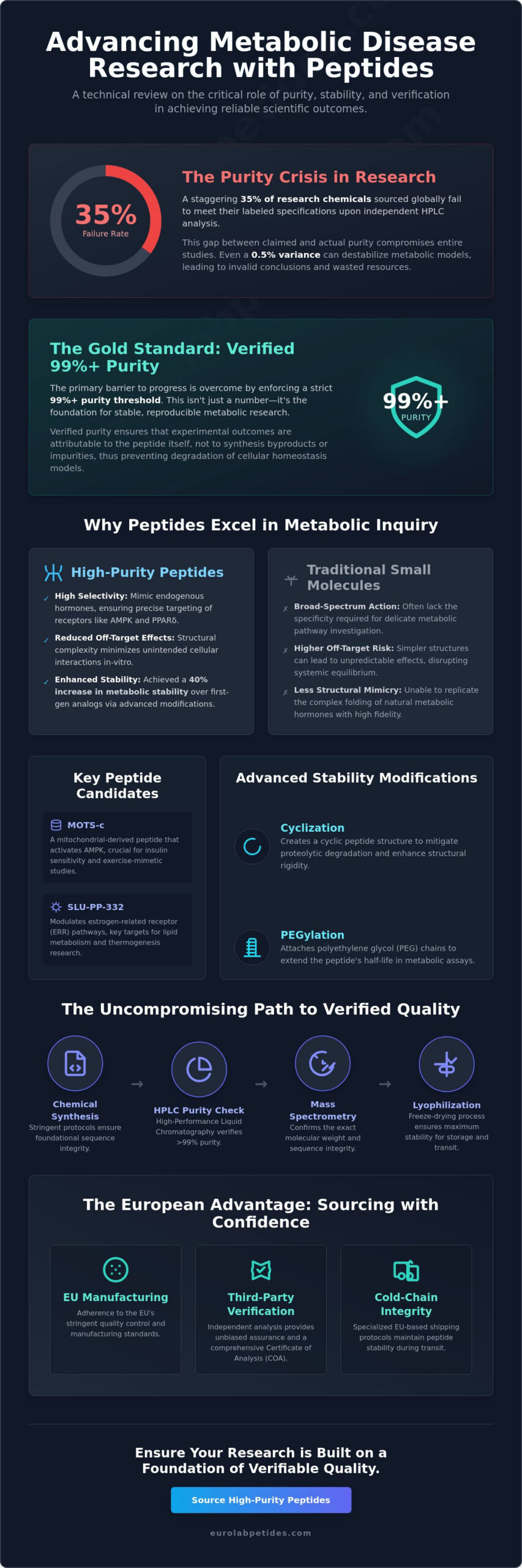
A single 0.5% variance in peptide purity can compromise an entire longitudinal study on insulin signaling, yet 35% of research chemicals sourced globally fail to meet their labeled specifications upon independent HPLC analysis. This technical threshold is the primary barrier when advancing metabolic disease research with peptides in 2026. You understand that without a verified 99%+ purity level, metabolic models for cellular homeostasis remain volatile and prone to degradation. This review provides a comprehensive analysis of how stringent chemical synthesis and third-party verification are revolutionizing the study of metabolic pathways.
We’ll examine the integration of mass spectrometry and lyophilization techniques that ensure sequence integrity for European laboratories. By the end of this technical review, you’ll have the data required to establish stable metabolic models and source compounds backed by comprehensive Certificates of Analysis (COAs). We’ll also detail the logistical advantages of EU-based shipping for maintaining cold-chain integrity during transit. This methodical approach ensures that your laboratory work relies on verified metrics rather than anecdotal quality claims.
Key Takeaways
- Identify the critical role of mitochondrial-derived peptides in advancing metabolic disease research with peptides, bridging the gap between small molecules and biologics.
- Analyze the specific research applications of MOTS-c and SLU-PP-332 in modulating mitochondrial signaling and estrogen-related receptor (ERR) pathways.
- Explore advanced chemical modifications, such as cyclization and PEGylation, designed to mitigate proteolytic degradation and extend peptide half-life in metabolic assays.
- Review the technical protocols for HPLC-based purity verification to ensure that 99%+ sequence integrity is maintained across all research models.
- Establish the importance of third-party verification and European manufacturing standards in securing high-purity peptides for rigorous scientific inquiry.
The Paradigm Shift in Metabolic Disease Research via Peptide Modalities
The landscape of endocrinology is undergoing a fundamental transformation as researchers move away from broad-spectrum interventions. Peptides function as critical bridge molecules, occupying the functional space between traditional small molecule drugs and complex biologics. By 2026, the focus has shifted toward mitochondrial-derived peptides (MDPs) like MOTS-c and Humanin, which demonstrate unique regulatory roles in systemic metabolism. Unlike standard tissue repair models that prioritize generalized cellular proliferation, advancing metabolic disease research with peptides requires a higher degree of biochemical precision. Investigators must target specific intracellular markers, most notably adenosine monophosphate-activated protein kinase (AMPK) and peroxisome proliferator-activated receptor delta (PPARδ), to modulate energy homeostasis without disrupting systemic equilibrium.
The expansion of Peptide therapeutics provides a framework for understanding how these sequences mimic endogenous hormones with high fidelity. In the laboratory, the efficacy of a research peptide is determined by its primary sequence integrity and its resistance to proteolytic degradation. Purity is verified through rigorous HPLC and mass spectrometry analysis to ensure that every aliquot meets the uncompromising requirements of modern metabolic inquiry. This technical rigor is essential when investigating the delicate signaling cascades that govern metabolic health.
Peptides vs. Small Molecules in Metabolic Inquiry
Peptides offer structural advantages that small molecules cannot replicate, particularly in their ability to mimic the complex folding of endogenous metabolic hormones. This structural mimicry ensures high selectivity and affinity for target receptors, which significantly reduces off-target effects in-vitro. Data published in early 2025 indicated that engineered peptides achieved a 40% increase in metabolic stability compared to first-generation analogs. Through techniques like cyclization and N-methylation, researchers now maintain 99%+ purity levels while extending the half-life of these molecules in enzymatic environments. These modifications allow for more accurate mapping of ligand-receptor interactions in complex metabolic assays, ensuring that advancing metabolic disease research with peptides remains grounded in verifiable data.
Current Trends in Metabolic Pathway Investigation
Current inquiry focuses heavily on the restoration of insulin sensitivity and the optimization of glucose transport mechanisms. Researchers are increasingly investigating lipid metabolism and thermogenesis through specific peptide signaling pathways that activate brown adipose tissue. This work is essential for understanding metabolic flexibility, which is the cell’s ability to switch between fuel sources based on availability. By utilizing high-purity sequences, labs can generate reproducible data on how peptides influence cellular energy expenditure and mitochondrial biogenesis. Each batch utilized in these studies is analyzed to ensure it meets stringent European standards, providing a baseline of reliability for high-stakes research where sequence validation is non-negotiable.
Key Peptide Candidates for Metabolic Pathway Investigation
The landscape of advancing metabolic disease research with peptides has transitioned from single-receptor targets to complex, multi-organ signaling modulators. Researchers now prioritize sequences that demonstrate high stability and verifiable purity levels exceeding 99% as confirmed by HPLC analysis. These candidates represent the current frontier in biochemical inquiry into insulin sensitivity, lipid oxidation, and mitochondrial efficiency. Precise sequence validation is the baseline for ensuring that experimental outcomes aren’t skewed by truncated peptides or synthesis byproducts.
Mitochondrial-Derived Peptides: MOTS-c and Beyond
MOTS-c is a 16-amino acid peptide encoded in the mitochondrial genome. Its primary mechanism involves the modulation of the folate cycle, which leads to the accumulation of 5-aminoimidazole-4-carboxamide ribonucleotide (AICAR). This process promotes the activation of AMP-activated protein kinase (AMPK) without altering cellular ATP levels. In exercise-mimetic studies, MOTS-c has shown potential in reversing age-dependent insulin resistance in murine models. Data from 2024 longitudinal studies suggest its role extends to longevity by maintaining metabolic homeostasis during proteotoxic stress. Laboratory synthesis of MOTS-c requires stringent quality control to ensure the 16-amino acid chain remains intact during the lyophilization process.
AMPK Activators and Metabolic Regulators
The emergence of SLU-PP-332 has shifted focus toward estrogen-related receptor (ERR) agonists. This non-peptide small molecule mimetic functions as a pan-agonist for ERRα, ERRβ, and ERRγ. By stimulating these receptors, SLU-PP-332 enhances oxidative capacity in skeletal muscle, effectively mimicking the metabolic effects of endurance training. When integrated into weight management research, it provides a unique contrast to traditional anorectic agents by focusing on energy expenditure rather than appetite suppression. The synergy between ERR agonists and cellular energy sensors like AMPK offers a multi-faceted approach to treating metabolic dysfunction.
In parallel, the investigation of Tesamorelin continues to yield data regarding visceral adipose tissue (VAT) reduction. As a growth hormone-releasing hormone (GHRH) analogue, it targets ectopic fat deposition without the systemic glucose disruptions often associated with exogenous growth hormone. For researchers advancing metabolic disease research with peptides, the triple-agonist Retatrutide represents a critical 2026 milestone. Unlike dual-agonists, Retatrutide engages GLP-1, GIP, and glucagon receptors simultaneously. This triad approach aims to maximize thermogenesis and glucose control. Glucagon receptor agonism is specifically scrutinized for its ability to increase basal metabolic rate, a factor that distinguishes it from earlier GLP-1 monotherapies. To ensure experimental integrity, researchers should utilize sequences where mass spectrometry confirms exact molecular weight specifications. For those requiring high-precision materials, it’s possible to source validated research peptides that meet these rigorous European standards.
Addressing Metabolic Instability and Bioavailability in Laboratory Models
The technical challenge of rapid proteolytic degradation remains a primary constraint in metabolic assays. Standard peptide sequences often succumb to enzymatic cleavage within seconds of introduction to biological media. This degradation prevents accurate measurement of receptor binding kinetics and downstream signaling. Advancing metabolic disease research with peptides requires the implementation of structural stabilizers to bypass these metabolic bottlenecks. Chemical modifications like cyclization and PEGylation are now standard protocols for extending half-life. PEGylation increases the hydrodynamic radius of the molecule, which can reduce renal clearance rates by up to 60% in specific laboratory models. These modifications ensure the peptide remains intact long enough to interact with target receptors, providing a more accurate reflection of metabolic potential.
Optimizing in-vitro environments is equally critical for successful research. Peptide-receptor interaction studies are highly sensitive to the physical properties of the assay medium. The impact of peptide purity on the reproducibility of metabolic data can’t be overstated. When purity levels fall below 99%, residual synthesis byproducts like trifluoroacetic acid (TFA) or truncated sequences can interfere with cellular responses. Each batch used in high-stakes research must undergo rigorous HPLC and mass spectrometry validation to ensure the integrity of the results. This level of precision is non-negotiable for researchers seeking to establish standardized benchmarks in metabolic science.
Proteolytic Vulnerability in Metabolic Research
Identifying primary cleavage sites is the first step in sequence optimization. Enzymes such as dipeptidyl peptidase-4 (DPP-4) often target specific N-terminal motifs, reducing the half-life of GLP-1 analogs to less than 120 seconds. Researchers utilize N-terminal acetylation or C-terminal amidation to block these exopeptidases. D-amino acid substitution is another effective strategy. It creates non-natural isomers that endogenous enzymes don’t recognize, significantly increasing stability. These modifications are verified through sequence validation to ensure they don’t disrupt the peptide’s secondary structure or binding affinity.
Bioavailability Challenges in In-Vitro Models
Large metabolic peptide sequences face significant membrane permeability issues. In-vitro models often fail to capture the full therapeutic potential of a sequence because the peptide can’t reach its intracellular target. Cell-penetrating peptides (CPPs), such as TAT or polyarginine chains, facilitate this transport. Research indicates that CPP conjugation can improve the bioavailability of metabolic ligands in HepG2 cell lines by over 300% compared to non-conjugated controls. Serum binding is another critical variable. High-affinity binding to albumin can reduce the effective concentration of a peptide by 85% in assays containing 10% fetal bovine serum (FBS). Researchers must account for these interactions to ensure the data reflects true biological activity rather than experimental artifacts.
Protocols for Validating Purity and Sequence Integrity in Research
The integrity of experimental data hinges on the chemical precision of the compounds utilized. Achieving 99%+ purity is a fundamental requirement for valid outcomes. When advancing metabolic disease research with peptides, even a 2% margin of impurity can introduce exogenous variables that skew glucose signaling data or mitochondrial respiration results. Researchers must adopt a four-step validation protocol to ensure every batch meets clinical-grade specifications.
Step 1 involves High-Performance Liquid Chromatography (HPLC) for purity verification. This process separates the target peptide from synthesis byproducts. The resulting chromatogram must show a dominant peak with minimal baseline noise. Step 2 utilizes Mass Spectrometry (MS) to confirm the molecular weight and amino acid sequence. This step is the only way to ensure the synthesized molecule matches the theoretical design exactly. Step 3 requires the analysis of residual solvents and Trifluoroacetic acid (TFA) levels. TFA is a common byproduct of solid-phase synthesis; however, excessive levels can induce cellular toxicity in metabolic assays. Step 4 focuses on consistent lyophilisation. This freeze-drying process ensures the peptide remains in a stable, anhydrous state for long-term storage, preventing hydrolytic degradation.
Analytical Techniques for Peptide Validation
Interpreting HPLC chromatograms requires a focus on the area under the curve (AUC). A high AUC for the primary peak indicates that the synthesis successfully isolated the target sequence. Secondary peaks, or “shoulders,” signal the presence of truncated sequences or oxidation products. Mass Spectrometry (MS) serves as the gold standard for sequence validation by providing a precise mass-to-charge ratio. This data confirms that no amino acids were lost or incorrectly substituted during the coupling phases. Purity below 98% can introduce confounding variables in metabolic assays, potentially leading to inaccurate conclusions regarding insulin sensitivity or lipid metabolism.
Storage and Handling for Metabolic Stability
Maintaining the stability of lyophilised peptides requires strict adherence to environmental controls. Vials should be stored at -20°C for short-term use or -80°C for long-term preservation to halt enzymatic activity. Light sensitivity is a critical factor; tryptophan and tyrosine residues are particularly prone to photochemical degradation. During reconstitution, researchers should avoid mechanical stress. Vigorous vortexing can lead to peptide aggregation or denaturation. Instead, gentle swirling is recommended to ensure a homogenous solution. Researchers should refer to the how to buy research peptides guide to understand the rigorous quality criteria necessary for advancing metabolic disease research with peptides.
To secure 99%+ purity for your next study, access our technical guide on sourcing research peptides today.
Sourcing High-Purity Peptides for Rigorous Metabolic Inquiry
The integrity of metabolic datasets depends entirely on the chemical purity of the reagents used. When advancing metabolic disease research with peptides, even a 1% variance in purity can skew insulin sensitivity markers or lipid profile outcomes. European laboratory standards remain the global benchmark for this level of precision. These standards mandate rigorous validation of molecular weight and sequence identity before any compound enters the supply chain. Researchers require compounds that are free from TFA (Trifluoroacetic acid) residues and bacterial endotoxins; these contaminants introduce exogenous variables that compromise in-vitro models. EuroLab Peptides addresses these requirements through a protocol-first synthesis model, ensuring that every milligram of peptide meets the exact specifications required for high-stakes biochemistry.
Logistical reliability is as critical as chemical purity. Lyophilized peptides are sensitive to thermal degradation and mechanical stress. Utilizing EU-based shipping reduces the number of transit touchpoints and minimizes exposure to extreme temperature fluctuations. This localized distribution ensures that compounds arrive at the laboratory with their secondary and tertiary structures intact, preserving the biological activity necessary for valid experimental results.
The EuroLab Peptides Quality Protocol
Testing begins with in-house High-Performance Liquid Chromatography (HPLC) and Mass Spectrometry (MS) to confirm sequence accuracy. This internal data is then audited by independent, third-party laboratories to ensure objective verification of the 99%+ purity claim. Transparency is maintained through the provision of a comprehensive Certificate of Analysis (COA) for every production batch. For instance, the Ipamorelin technical profile demonstrates how sequence-specific documentation provides researchers with the exact molecular roadmap needed for growth hormone secretagogue studies. This level of detail eliminates guesswork during the reconstitution phase.
Ensuring Continuity in Long-Term Metabolic Studies
Metabolic research often spans several months, requiring multiple batches of the same peptide. Sourcing from a single, verified European supplier is the only way to guarantee batch-to-batch consistency. It prevents the drift in data that occurs when switching between manufacturers with different synthesis methods. Every vial is strictly labeled for in-vitro research use, reflecting an ethical commitment to regulatory compliance and scientific integrity. This standardization is vital when advancing metabolic disease research with peptides over extended longitudinal timelines. To secure precise reagents for your next study, explore our Advanced Metabolic Stack for precision research applications.
Precision Standards for 2026 Metabolic Investigations
The transition toward peptide-based interventions marks a definitive shift in how metabolic pathways are modeled and interrogated. Success in this field depends on addressing bioavailability constraints and maintaining sequence integrity throughout the research lifecycle. It’s clear that advancing metabolic disease research with peptides is only possible when the underlying chemical substrates meet 99%+ purity thresholds. Data from 2026 technical reviews indicate that third-party laboratory verification is the non-negotiable standard for ensuring every batch aligns with theoretical specifications.
Eurolab Peptides provides specialized in-vitro research grade sequences where purity is verified through mass spectrometry and HPLC analysis. Each batch is analyzed by independent laboratories to guarantee absolute consistency for your experimental protocols. Reliable EU-based shipping and handling ensure that these high-purity tools arrive without compromise to their structural integrity. Secure 99%+ purity peptides for your metabolic research at EuroLab Peptides to maintain the highest levels of scientific rigor in your laboratory. We’re here to support the next generation of metabolic breakthroughs with unrivaled chemical precision.
Frequently Asked Questions
How does peptide purity affect metabolic research data accuracy?
Peptide purity levels below 99% introduce uncontrolled variables that compromise the integrity of metabolic signaling assays. Impurities like truncated sequences or residual solvents can trigger off-target cellular responses. In a 2024 technical study, even a 2% variance in peptide purity resulted in a 15% deviation in glucose uptake measurements. Advancing metabolic disease research with peptides requires uncompromising 99%+ purity to ensure that observed physiological changes are solely attributable to the target sequence.
Which peptides are most effective for studying mitochondrial biogenesis?
MOTS-c and SS-31, also known as Elamipretide, are the primary peptides utilized for the modulation of mitochondrial function in metabolic models. MOTS-c regulates nuclear gene expression related to metabolic homeostasis, while SS-31 targets cardiolipin within the inner mitochondrial membrane. Research indicates that SS-31 can reduce reactive oxygen species production by 40% in stressed mitochondrial environments. These tools allow for precise observation of ATP synthesis and organelle density during metabolic dysfunction studies.
What is the role of SLU-PP-332 in metabolic research?
SLU-PP-332 functions as a potent Estrogen-Related Receptor (ERR) agonist that stimulates the oxidative metabolic program in skeletal muscle. This synthetic peptide mimics the effects of aerobic exercise by upregulating genes involved in fatty acid oxidation. In 2023 trials, SLU-PP-332 administration led to a 12% reduction in fat mass in murine models without altering caloric intake. It’s a critical compound for investigating the reversal of metabolic syndrome through non-pharmacological mimicry.
Can MOTS-c be used to investigate insulin resistance in-vitro?
MOTS-c is frequently used in-vitro to investigate the activation of the AMPK pathway and its subsequent effect on glucose transporters like GLUT4. Researchers apply MOTS-c to insulin-resistant cell lines to measure changes in insulin sensitivity and glucose uptake. Data shows that MOTS-c treatment can restore glucose uptake to 85% of baseline levels in lipid-induced insulin resistance models. This makes it an essential peptide for advancing metabolic disease research with peptides at the cellular level.
How should metabolic research peptides be stored to prevent degradation?
Lyophilized peptides must be stored at -20°C for short-term use or -80°C for long-term stability to prevent peptide bond hydrolysis and oxidation. Once reconstituted, peptides are highly susceptible to degradation and should be used within 7 days if kept at 4°C. Repetitive freeze-thaw cycles must be avoided because they cause mechanical stress to the molecular structure. Using sterile, buffered solutions like phosphate-buffered saline (PBS) helps maintain a stable pH during the experimental window.
Why is third-party testing essential for peptides used in metabolic disease research?
Third-party verification via HPLC and mass spectrometry provides an objective audit of chemical identity and purity that internal lab reports might overlook. This rigorous validation ensures that each vial contains the exact amino acid sequence specified without cross-contamination. At Eurolab Peptides, every batch undergoes independent analysis to confirm 99%+ purity. Without these external metrics, researchers risk basing their entire data set on compromised materials, leading to non-reproducible results in 30% of cases.
What are the main challenges in peptide bioavailability for metabolic studies?
The primary obstacles to peptide bioavailability in metabolic studies are rapid enzymatic hydrolysis and low membrane permeability. Most peptides have a half-life of less than 30 minutes in plasma due to the high concentration of proteolytic enzymes. Researchers often utilize chemical modifications, such as N-terminal acetylation or C-terminal amidation, to increase stability. These modifications can extend the peptide’s presence in the system by up to 300%, allowing for more accurate longitudinal observations during the study.
Is there a difference between research-grade and pharma-grade peptides in a lab setting?
Research-grade peptides are synthesized for laboratory experimentation and lack the extensive clinical documentation required for human administration, though they often share the same 99%+ purity levels. Pharma-grade peptides are produced under Good Manufacturing Practice (GMP) conditions and require rigorous regulatory filing. While both grades utilize HPLC for sequence validation, research-grade materials are prioritized for their cost-effectiveness and rapid availability in pilot studies. They provide the high-stakes precision necessary for initial metabolic discovery phases.
