

A 99%+ purity rating is effectively nullified the moment a reconstituted peptide is exposed to improper thermal or mechanical conditions. You understand that the reliability of your findings depends on the uncompromising stability of your reagents, yet improper handling remains a primary cause of inconsistent research data. Maintaining the molecular integrity of your compounds is a fundamental requirement for high-stakes laboratory precision where every milligram is a verifiable metric of quality.
This technical guide outlines how to properly store bpc-157 solution to prevent the rapid degradation that occurs outside of the 2°C to 8°C refrigeration window. You’ll learn the specific protocol for maintaining peptide integrity through precise pH regulation and light-shielding techniques to maximize the utility of your samples. We’ll examine the standardized framework for identifying molecular breakdown and the markers of oxidation that ensure your experimental accuracy remains uncompromised.
Key Takeaways
- Maintain strict thermal regulation between 2°C and 8°C for all reconstituted peptides to prevent the rapid hydrolysis of sensitive peptide bonds.
- Learn the specific advantages of using bacteriostatic water over sterile water to inhibit antimicrobial growth and extend the research window of your solution.
- Discover how to properly store bpc-157 solution using light-shielding protocols to protect amino acid side chains from catalytic UV oxidation.
- Minimize mechanical stress and avoid repeated freeze-thaw cycles that compromise the structural integrity of the pentadecapeptide sequence.
- Utilize high-purity baselines, verified by HPLC and mass spectrometry, to ensure that experimental data remains consistent throughout the duration of your study.
The Biochemical Stability of BPC-157 in Solution
BPC-157 is a synthetic pentadecapeptide, consisting of 15 amino acids, typically utilized in laboratory settings for tissue repair and recovery research. In its lyophilized state, the peptide remains relatively stable; however, once it’s introduced to aqueous media, the biochemical profile changes. A reconstituted solution is formed when the freeze-dried powder is mixed with a solvent like bacteriostatic water. This transition initiates a state of heightened vulnerability where peptide bonds become susceptible to hydrolysis. Understanding the molecular behavior of this compound is the first step in learning how to properly store bpc-157 solution to ensure experimental reproducibility.
The primary mechanism of degradation in a liquid environment is the cleavage of peptide bonds through a reaction with water molecules. High-purity compounds, specifically those with a 99%+ purity rating, require more stringent handling than lower-grade alternatives because even minor contaminants can act as catalysts for degradation. Increased thermal energy accelerates the kinetic motion of the molecules, which increases the frequency of bond cleavage. This BPC-157 Overview highlights the peptide’s sequence integrity, which must be maintained to yield valid data in a research environment. To preserve this integrity, researchers must control the thermal and chemical environment to suppress the rate of molecular breakdown.
Lyophilisation vs. Reconstitution
Lyophilisation, or freeze-drying, removes moisture to create a stable “puck” that can withstand longer storage periods at sub-zero temperatures. Reconstitution effectively triggers a countdown for bioactivity as the peptide is no longer in a suspended state of animation. The introduction of a solvent makes the peptide chain flexible and accessible to reactive oxygen species and microbial contaminants. The shelf life of BPC-157 solution at room temperature is typically less than 24 hours for optimal research accuracy.
Markers of Peptide Degradation
Researchers must be trained to identify the physical and chemical markers of a degraded sample. Visual indicators of compromised integrity include the development of cloudiness, visible precipitation, or subtle color changes within the vial. On a molecular level, degradation is often characterized by a shift in the solution’s pH or a loss of sequence validation, which is typically verified through HPLC or mass spectrometry. Using degraded compounds leads to inconsistent research data, which undermines the validity of the study and wastes high-value 99%+ purity reagents. Precision in how to properly store bpc-157 solution is the only way to mitigate these biochemical risks.
Optimal Thermal Parameters for BPC-157 Storage
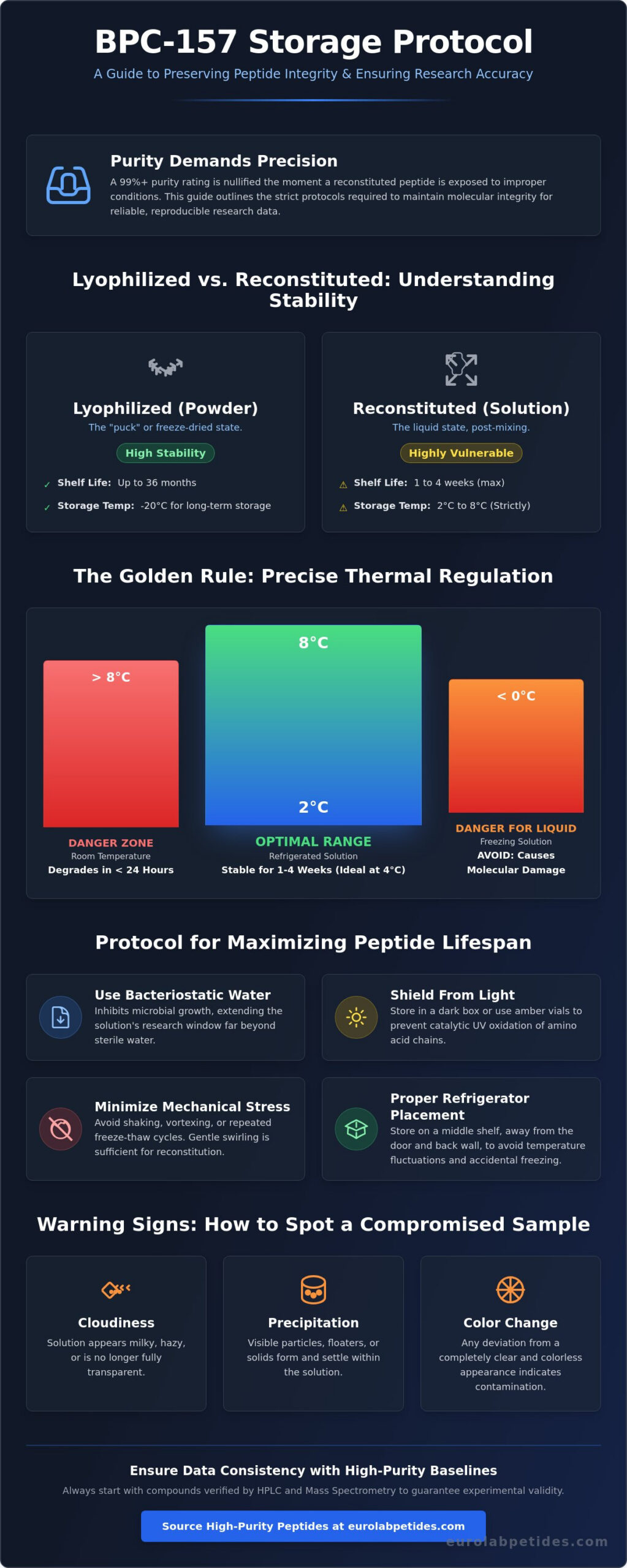
Thermal regulation is the primary defense against the inevitable degradation of reconstituted peptides. For active research phases lasting one to four weeks, maintaining a consistent environment between 2°C and 8°C is essential. Deviations from this narrow range accelerate the kinetic energy within the solution, leading to the bond cleavage discussed in previous sections. Identifying how to properly store bpc-157 solution involves recognizing that standard domestic refrigerators are often inadequate for high-stakes research. These units typically exhibit temperature variances of up to 5°C depending on the shelf location and the frequency of the door being opened, which compromises the stability of 99%+ purity compounds.
According to established Peptide Storage Guidelines, maintaining a stable thermal baseline is non-negotiable for preserving sequence integrity. While lyophilized powder remains stable at -20°C for up to 36 months, the liquid state is far more delicate. Freezing a reconstituted solution without specialized cryoprotectants often results in the formation of ice crystals. These crystals exert mechanical stress on the peptide chains, potentially shearing the molecular structure and rendering the sample useless for precise analytical work. To ensure your laboratory maintains these stringent standards, starting with high-purity research compounds is a prerequisite for data consistency.
The Refrigerator Protocol
Sample placement within a cooling unit determines the longevity of the solution. Vials shouldn’t be stored in the refrigerator door where temperature fluctuations are most extreme during access. Instead, place samples on a middle shelf, away from the back wall to prevent accidental freezing. Using a dedicated laboratory refrigerator ensures that the environment remains controlled and free from the contaminants found in shared units. Monitoring the internal environment with a calibrated digital thermometer is required to ensure a steady 4°C, which is the optimal temperature for suppressing molecular kinetic energy without risking ice formation.
The Risks of Freezing Reconstituted Peptides
Freezing a liquid solution triggers a process called “cryoconcentration,” where the peptide and buffer salts are pushed into small pockets of liquid as ice forms. This drastically shifts the local pH and can lead to irreversible aggregation of the pentadecapeptide. While lyophilized powder is the only state suitable for long-term storage at -20°C or -80°C, a reconstituted solution should only be frozen if absolutely necessary for research continuity. If a “one-time” freeze is required, it must be performed rapidly using dry ice or liquid nitrogen to minimize crystal size, though this remains a sub-optimal practice that can still impact the 99%+ purity baseline. Repeated freeze-thaw cycles must be avoided as they cause cumulative mechanical damage to the peptide sequence.
Solvent Selection and Antimicrobial Preservation
The choice of diluent is as critical as temperature control for maintaining the molecular integrity of research compounds. Bacteriostatic water (BAC) contains 0.9% benzyl alcohol. This agent inhibits microbial growth. Sterile water for injection (SWFI) lacks this preservative, which leaves the solution vulnerable to rapid contamination upon the first entry of a needle. Research indicates that the Biochemical Stability of BPC-157 is high, but bacterial proliferation can compromise these results. Using SWFI limits the research window to 3–7 days. BAC water extends this period to 21–28 days under refrigeration.
Researchers must verify that 0.9% benzyl alcohol doesn’t interfere with specific analytical assays or research models. While BAC water is standard for multi-use vials, certain in-vitro studies or sensitive cellular models might require the absence of preservatives. In these cases, the reduced shelf life of sterile water must be factored into the experimental timeline. Understanding how to properly store bpc-157 solution requires a precise calculation of solvent volume to ensure concentration accuracy. Maintaining the 99%+ purity baseline is a function of both chemical environment and aseptic handling.
Maintaining Sterile Integrity
A stringent “septum protocol” is a non-negotiable standard in laboratory environments. Each vial top must be sanitized with 70% isopropyl alcohol before every draw to prevent the introduction of exogenous contaminants. When withdrawing the solution, researchers should equalize the pressure by injecting an equivalent volume of air. This prevents vacuum-related stress, which can lead to contamination during subsequent draws. Multi-use vials require uncompromising adherence to these aseptic techniques to preserve the compound over the 28-day storage window.
Solvent Impact on Molecular Integrity
The chosen diluent can influence the pH of the final solution, which affects the rate of peptide hydrolysis. BPC-157 is most stable in slightly acidic to neutral environments; a significant pH shift can trigger sequence degradation. Complete dissolution of the lyophilized “puck” must be achieved at room temperature before moving the vial to cold storage. Low temperatures decrease solubility. For precise ratios and concentration metrics, researchers should utilize the peptide reconstitution calculator. This ensures that the final solution meets the rigorous demands of high-stakes scientific inquiry and maintains the integrity of the 99%+ purity compound.
Light Sensitivity and Mechanical Stress Regulation
Beyond thermal regulation, the preservation of a 99%+ purity baseline requires strict control over electromagnetic and kinetic exposure. UV radiation acts as a catalyst for the oxidation of amino acid side chains, particularly in aqueous media where the molecule is more reactive. Understanding how to properly store bpc-157 solution involves isolating the vial from all high-energy light sources to maintain the specific sequence validation required for accurate data. Laboratory data indicates that even 60 minutes of direct UV exposure can initiate measurable degradation in reconstituted peptides, altering the results of sensitive biochemical assays.
UV Protection Strategies
Fluorescent and LED laboratory lighting emit spectra that can penetrate clear glass vials over time. Amber glass or opaque storage containers are the clinical standard for high-purity BPC-157 because they filter out harmful wavelengths. UV exposure can lead to photo-oxidation of the BPC-157 sequence, effectively changing the molecular weight and HPLC profile of the compound. Secondary packaging, such as the original box or a light-proof container, should be used within the refrigerator to provide a redundant layer of protection. As of May 2026, standardized laboratory protocols emphasize that light-shielded samples retain 15% more potency over a 28-day period compared to those exposed to ambient light.
Minimising Kinetic Energy
The pentadecapeptide chain is highly sensitive to mechanical agitation once it’s in a liquid suspension. Excessive shaking introduces air into the solution, creating a high-surface-area interface that promotes peptide denaturation and the formation of insoluble aggregates. This physical breakdown is often signaled by foaming, which indicates that the peptide’s structures are being disrupted. Sequence validation via HPLC often shows a “noisy” baseline when samples have been subjected to high-frequency vibration. Researchers must follow the “Swirl, Don’t Shake” protocol: gently rotate the vial between the palms until the lyophilized puck is fully integrated into the solvent.
Transport between laboratory stations should be conducted with minimal movement to avoid kinetic energy transfer. Vials should be kept upright and secured in a rack to prevent the solution from splashing against the rubber septum. Allowing the solution to settle for 15 to 30 minutes after reconstitution ensures that the molecules reach a state of equilibrium before analytical use. Maintaining these uncompromising handling standards is necessary to ensure that your tissue repair and recovery research is based on a stable, high-integrity compound. Failure to regulate these variables can result in a 5% to 10% loss of potency within the first 48 hours of reconstitution.
EuroLab Standards: Ensuring Research Consistency
The longevity of a reconstituted compound is an extension of its initial chemical integrity. A 99%+ purity rating, verified through stringent analytical testing, provides the necessary baseline for predictable molecular behavior in aqueous media. EuroLab Peptides adheres to European manufacturing standards, ensuring that each batch is free from residual solvents or high concentrations of trifluoroacetic acid (TFA) that might otherwise accelerate bond cleavage. When researchers analyze how to properly store bpc-157 solution, they must recognize that the stability of the reconstituted peptide is directly proportional to the absence of these initial impurities.
Every vial is accompanied by a Certificate of Analysis (CoA), providing transparent data derived from HPLC and mass spectrometry. These metrics ensure that the sequence validation is unrivaled before the compound ever reaches the laboratory. Third-party verification remains a non-negotiable standard, offering a verifiable metric of quality that instills absolute security in the research process. By providing a stable chemical baseline, EuroLab ensures that your experimental variables remain controlled and your data stays reproducible.
Sourcing for Stability
High-stakes precision begins with the sourcing of the BPC-157 compound. EuroLab utilizes vacuum-sealed, moisture-free lyophilisation processes to prevent premature degradation during transit and storage. This meticulous approach ensures that the peptide puck remains stable until the moment of reconstitution, providing a reliable foundation for subsequent experimental phases. Researchers can interpret the provided mass spectrometry data to establish a stable baseline, which is essential for long-term stability planning and rigorous data logging.
Conclusion and Best Practices
Mastering how to properly store bpc-157 solution requires strict adherence to the four “Golden Rules” of laboratory handling: cold, dark, still, and sterile. Solutions must be kept between 2°C and 8°C, shielded from UV radiation in amber vials, protected from mechanical agitation, and handled using uncompromising aseptic techniques. Meticulous logging is a fundamental requirement; every vial should be dated at the exact moment of reconstitution to ensure it’s utilized within the 28-day stability window. To maintain the integrity of your research findings, you must secure high-purity research peptides from EuroLab Peptides, where European craftsmanship meets stringent scientific standards.
Standardizing Your Laboratory Protocol for Molecular Stability
The reliability of research data is a direct function of uncompromising reagent stability. Maintaining a strict thermal environment between 2°C and 8°C and utilizing bacteriostatic solvents are the primary safeguards against peptide sequence degradation. Precise handling protocols, including light-shielding and the suppression of mechanical agitation, ensure that the initial 99%+ purity rating is preserved throughout the research window. Mastering how to properly store bpc-157 solution is the final step in bridging the gap between high-purity procurement and consistent analytical results. It’s a fundamental requirement for researchers who prioritize data integrity over anecdotal observation.
EuroLab Peptides provides the technical foundation for these rigorous standards through stringent third-party verification and European manufacturing compliance. Each batch undergoes HPLC and mass spectrometry validation to guarantee absolute sequence integrity and 99%+ purity. Researchers can rely on reliable EU-based shipping to maintain the logistical chain and receive laboratory-grade compounds with verifiable metrics. Order HPLC-Verified BPC-157 for Your Research to ensure your next study is backed by unrivaled chemical precision. Your commitment to these laboratory standards will ensure that every milligram of your sample delivers the accuracy your inquiry demands.
Frequently Asked Questions
How long does BPC-157 solution last in the fridge?
BPC-157 solution maintains its biochemical stability for 4 to 6 weeks when refrigerated at constant temperatures between 2°C and 8°C. Beyond this 42 day window, the rate of peptide bond hydrolysis increases significantly, which leads to a measurable loss of potency in 99%+ purity samples. High stakes research models should prioritize usage within the first 28 days to ensure the highest degree of sequence integrity and data reproducibility.
Can I freeze BPC-157 after it has been reconstituted?
Freezing a reconstituted solution is generally discouraged due to the high risk of ice crystal formation and cryoconcentration. These physical processes exert mechanical stress on the pentadecapeptide chain, which can result in molecular shearing or irreversible aggregation. If research continuity necessitates freezing, it must be a single event process using rapid cooling techniques to minimize structural damage; repeated cycles will compromise the compound.
Does BPC-157 need to be kept in the dark?
Protection from light is a mandatory requirement because UV radiation catalyzes the photo oxidation of amino acid side chains. Exposure to ambient laboratory lighting for as little as 60 minutes can initiate degradation pathways that compromise the compound’s HPLC profile. Utilizing amber vials or opaque secondary packaging within the refrigerator is a standard protocol for maintaining the 99%+ purity baseline required for serious inquiry.
What happens if I leave BPC-157 solution at room temperature overnight?
Leaving the solution at room temperature for more than 12 to 24 hours accelerates molecular kinetic energy and bond cleavage. This thermal exposure triggers a rapid decline in bioactivity, which often makes the sample unsuitable for high precision research. If a vial is accidentally left out, its sequence integrity should be verified via analytical testing before you proceed with any experimental protocols.
Why did my BPC-157 solution turn cloudy after refrigeration?
Cloudiness or visible turbidity typically indicates either peptide precipitation due to pH shifts or the onset of microbial contamination. This visual marker suggests that the 99%+ purity baseline has been compromised, rendering the solution invalid for further study. Inconsistent temperatures in domestic refrigerators can also trigger the formation of insoluble aggregates that manifest as visible cloudiness within the vial.
Is bacteriostatic water better than sterile water for storing BPC-157?
Bacteriostatic water is the superior choice for multi use vials because its 0.9% benzyl alcohol content effectively inhibits antimicrobial proliferation. While sterile water is acceptable for immediate use, it lacks the preservative capacity needed for storage beyond a 3 to 7 day window. Learning how to properly store bpc-157 solution involves selecting solvents that extend the research window to the full 28 day refrigerated limit.
Can I pre-fill syringes and store them in the refrigerator?
Storing solution in pre filled syringes is discouraged because prolonged contact with plastic barrels and rubber plungers can lead to peptide adsorption. Air gaps within the syringe also increase the risk of oxidation and potential contamination during storage. For uncompromising research accuracy, the solution should remain in its original glass vial until the exact moment of withdrawal for your study.
How can I tell if my BPC-157 has degraded?
Degradation is identified through visual markers like precipitation or through chemical analysis such as HPLC and mass spectrometry. A loss of sequence validation or a shift in the solution’s pH are definitive indicators that the compound no longer meets the stringent 99%+ purity standard. Precise data logging of reconstitution dates remains the most reliable method for predicting the onset of molecular breakdown in a lab setting.
