

The irreversible loss of high-purity research material due to improper solvation is a technical failure that directly compromises experimental reproducibility. Understanding what to do if a peptide won’t dissolve is now a critical competency, particularly as May 2026 logistical volatility and regional regulatory shifts increase the scarcity of 99% pure synthetic compounds. You’ve likely navigated the technical uncertainty of a gelling sample or persistent precipitate, where the distinction between hydrophobic aggregation and pH-driven insolubility remains unclear.
This protocol provides a clinical, risk-stratified methodology to identify biochemical drivers of insolubility and achieve a clear, active solution. We’ll analyze sequence-specific polarity and provide a standardized intervention sequence that adheres to the June 2026 EMA guidelines for synthetic peptide manufacture. This systematic approach ensures that every milligram of material is transitioned into a stable, research-ready state without sacrificing molecular integrity or analytical precision.
Key Takeaways
- Identify the primary sequence’s net charge at pH 7.0 to predict solubility behavior and select the appropriate initial buffer system.
- Establish a clinical protocol for what to do if a peptide won’t dissolve, utilizing a risk-stratified approach that minimizes chemical intervention.
- Differentiate between hydrophobic aggregation and pH-driven insolubility to apply the correct chemical or physical corrective measures.
- Utilize sonication and temperature control as validated physical interventions to break up microscopic aggregates while preserving peptide bioactivity.
- Implement EuroLab-standard storage and handling procedures to prevent moisture-induced aggregation and maintain the shelf-life of 99% pure research compounds.
The Biochemical Basis of Peptide Insolubility
Peptide solubility is defined as the maximum concentration of a solute that can be maintained in a stable, homogeneous state within a specific buffer system. It’s a fundamental thermodynamic property governed by the Gibbs free energy of solvation. For laboratory researchers, determining what to do if a peptide won’t dissolve begins with a rigorous analysis of the primary sequence and its inherent chemical properties. The transition from a lyophilized powder to a clear solution is often hindered by the physical state of the material. Lyophilization, while essential for maintaining the 99% purity standards established by EuroLab Peptides, results in a high surface area that can lead to localized over-concentration and immediate clumping upon initial wetting.
Researchers must distinguish between poor solubility, which is a limit of the solvent’s capacity, and aggregation or precipitation. Aggregation involves the non-covalent association of peptide chains, often forming visible gels or cloudy suspensions. Precipitation is the rapid transition of the solute from the liquid phase to a solid phase, typically triggered by shifts in pH or changes in ionic strength. Identifying these states is the first step in the troubleshooting protocol for complex structures, including Dipeptides and longer amino acid chains.
Hydrophobicity and the Hydropathy Index
The Grand Average of Hydropathy (GRAVY) score is a standardized metric used to quantify the overall hydrophobicity of a peptide sequence. This value is calculated by the sum of hydropathy values of all amino acids divided by the number of residues. Sequences with a high proportion of non-polar side chains, such as Valine (Val), Leucine (Leu), Isoleucine (Ile), and Phenylalanine (Phe), exhibit a high hydropathy index and significant aqueous repulsion. If the percentage of charged residues, specifically Aspartate, Glutamate, Lysine, and Arginine, is less than 25% of the total sequence, the probability of insolubility in standard aqueous buffers increases significantly. Analytical prediction of these values is a prerequisite for selecting the correct solvation strategy.
The Phenomenon of Peptide Aggregation
Peptide aggregation is frequently driven by intermolecular hydrogen bonding, which facilitates the formation of stable beta-sheet structures. This process often manifests as gelling, where the solution becomes viscous rather than clear. High-purity compounds from EuroLab Peptides are particularly susceptible to this during the initial hydration phase if the local concentration is too high. Aggregation is a concentration-dependent phenomenon; as the proximity between peptide chains increases, the likelihood of hydrophobic collapse and subsequent clumping rises. Identifying these microscopic aggregates is essential when deciding what to do if a peptide won’t dissolve before proceeding with physical interventions like sonication, as the energetic state of the aggregate determines the success of the recovery protocol.
Predicting Solubility: Charge Calculation and Sequence Analysis
The net charge of a peptide at physiological pH (7.0) is the primary predictor of its behavior in aqueous environments. Researchers calculate this value by assigning a value of -1 to each acidic residue, specifically Aspartate and Glutamate, and +1 to each basic residue, including Lysine, Arginine, and Histidine. The N-terminus (+1) and C-terminus (-1) are included in the final summation. A net charge of zero indicates a neutral peptide, which typically presents the highest solvation resistance. If a researcher is determining what to do if a peptide won’t dissolve, they must first verify if the sequence is acidic or basic. Acidic peptides with a net negative charge generally require basic buffers like ammonium hydroxide. Basic peptides with a net positive charge require acidic buffers like dilute acetic acid to achieve solvation.
Sequences with high hydrophobic content, specifically those exceeding 50% non-polar residues, are categorized as “difficult” for standard laboratory protocols. These sequences often form aggregates even when a net charge is present. To ensure precision in concentration, researchers should utilize a peptide reconstitution calculator to determine exact molarity before attempting solvation. This prevents the waste of high-purity material, such as the 99% pure compounds utilized in longevity and vitality research. Accurate calculation is a verifiable metric of laboratory rigor.
The Rule of 25%: A Solubility Benchmark
The Rule of 25% serves as a critical benchmark for predicting aqueous compatibility. This metric evaluates the percentage of charged residues relative to the total sequence length. Sequences where charged residues comprise less than 25% of the total length often require non-aqueous initial solvents like DMSO or DMF to initiate solvation. While short sequences may occasionally deviate from this rule, longer polypeptides strictly adhere to this threshold. This necessitates a more aggressive solvation strategy from the outset to avoid irreversible aggregation and ensure experimental reproducibility.
Isoelectric Point (pI) Considerations
The isoelectric point (pI) is the specific pH at which the peptide possesses a net charge of zero. Dissolving a peptide at or near its pI almost always results in immediate precipitation or gelling. Knowing what to do if a peptide won’t dissolve involves shifting the buffer pH at least one to two units away from the pI. Shifting the pH promotes electrostatic repulsion between peptide molecules. This repulsion is essential for maintaining a stable solution and preventing the formation of insoluble beta-sheet structures that compromise the integrity of the research material.
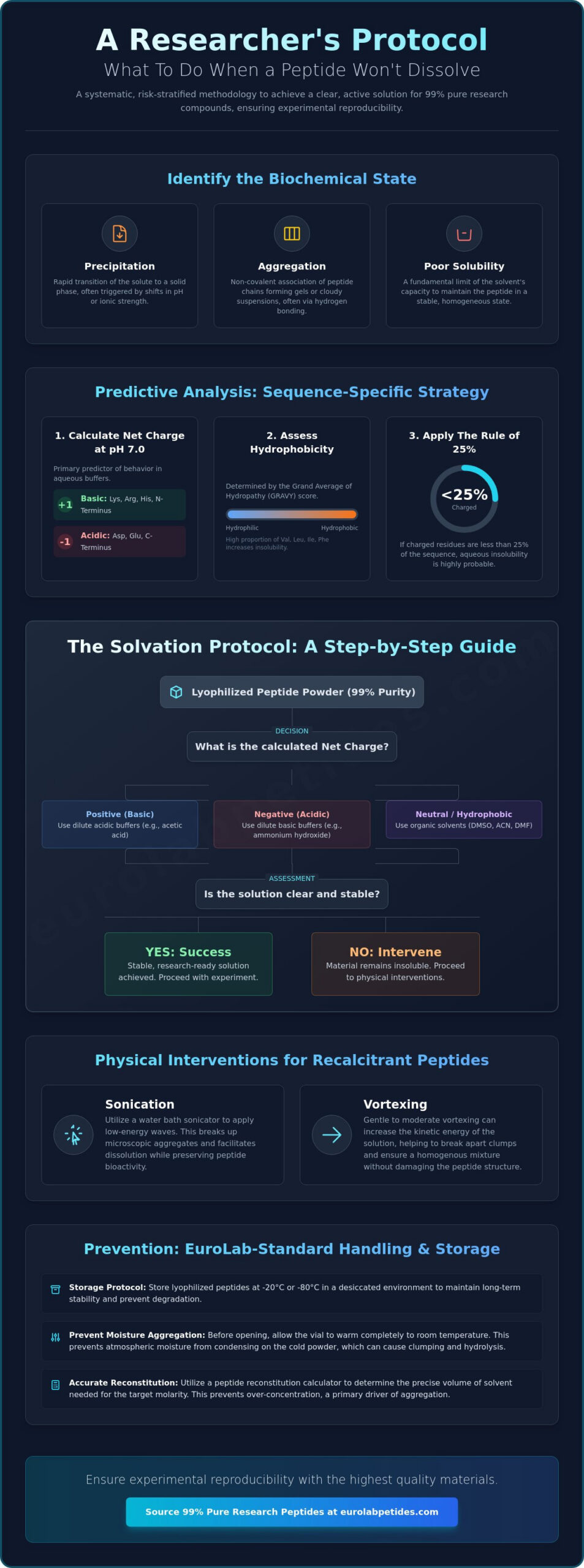
A Systematic Protocol for Dissolving Recalcitrant Peptides
The principle of Minimal Intervention dictates that the least aggressive solvent system must be utilized first to preserve the molecular integrity and bioactivity of the compound. When determining what to do if a peptide won’t dissolve, researchers should avoid immediate escalation to harsh organic solvents. Instead, the process begins with an initial test using a small aliquot (approximately 0.5 mg) rather than the entire vial. This stratified approach prevents the irreversible loss of high-purity material. Every step of the solvation process, including the specific volume and concentration of additives, must be recorded in laboratory logs to ensure experimental reproducibility and compliance with evolving analytical standards.
Protocol for Basic Peptides (Net Positive Charge)
Basic sequences, characterized by a net positive charge, should first be tested in sterile, deionized water. If the solution remains cloudy or exhibits visible particulates, the researcher should transition to 0.1% Acetic Acid. For highly stubborn basic sequences that resist solvation at low concentrations, an escalation to 10% Acetic Acid may be required. It’s essential to maintain a final pH significantly below the peptide’s isoelectric point (pI) to prevent late-stage precipitation during experimental assays. Understanding what to do if a peptide won’t dissolve in these instances requires a precise adjustment of the ionic environment to favor electrostatic repulsion.
Protocol for Acidic Peptides (Net Negative Charge)
Acidic peptides require a basic environment to achieve stable solvation. Initial attempts should utilize 0.1% Ammonium Bicarbonate. If this is insufficient, the protocol escalates to 1% Ammonium Hydroxide. While these basic additives are effective, researchers must remain vigilant regarding the risk of deamidation, which can occur in high pH environments and compromise the peptide’s primary structure. Neutralization of the solution may be necessary for specific in-vitro assays, but this must be performed carefully to avoid crossing the pI threshold.
Handling Hydrophobic and Neutral Sequences
Sequences with a high hydropathy index often require the use of organic co-solvents such as DMSO, DMF, or Acetonitrile. The “Dropwise Method” is the standardized laboratory technique for these compounds. The peptide is first dissolved in a minimal volume of the organic solvent before being diluted dropwise with the target aqueous buffer. This method ensures that the final organic solvent concentration remains below 1% for research safety and to prevent interference with biological assays. This systematic approach allows for the successful recovery of recalcitrant sequences while maintaining the rigorous quality standards required for tissue repair and recovery research.
Physical Interventions: Sonication and Temperature Control
Physical energy serves as a secondary intervention when chemical modifications, such as the pH adjustments discussed in previous sections, fail to achieve a clear solution. The gelling phenomenon, frequently encountered with hydrophobic sequences, indicates the formation of stable intermolecular beta-sheets. Standard mechanical agitation is often insufficient to disrupt these non-covalent associations. Knowing what to do if a peptide won’t dissolve requires a transition from chemical solvation to physical disruption. This process must be managed with high-stakes precision to avoid the degradation of delicate peptide bonds or the introduction of atmospheric contaminants.
Vortexing is often the first mechanical step, but it should be limited to short bursts. Excessive vortexing introduces shear stress and can lead to air-liquid interface denaturation, particularly in longer polypeptides. Gentle swirling is the preferred baseline, but for recalcitrant aggregates, ultrasonic energy is required to achieve the necessary molecular dispersion.
Sonication Best Practices
Sonication utilizes ultrasonic waves to create cavitation bubbles that disrupt microscopic aggregates. A water bath sonicator is the standard tool for this protocol. Probe sonicators, while powerful, are generally avoided because they introduce a high risk of cross-contamination and localized overheating at the probe tip. Researchers should utilize short pulses of 10 to 30 seconds, allowing the vial to rest between cycles. This prevents the solution temperature from rising significantly, which could compromise the 99% purity standard of the material. Visual confirmation of a clear solution should be performed under focused, high-intensity light to detect persistent micro-particulates that may not be visible under standard laboratory lighting.
Thermal Considerations in Solvation
Lyophilized vials must reach room temperature before the addition of any solvent. Introducing cold buffers to a peptide powder can increase solvent viscosity and hinder the initial wetting process, leading to the formation of “clumping” that is difficult to reverse. While some laboratory guides suggest heating as a primary solution, it’s a high-risk strategy. Gentle warming, defined as temperatures up to 37°C, should be considered a last resort. Temperatures exceeding this threshold risk the denaturation of sensitive sequences and the acceleration of side reactions like oxidation. For researchers utilizing the Advanced Metabolic Stack, maintaining this level of technical precision is essential for experimental validity. Cold-chain storage is vital for long-term stability, but room-temperature equilibration is the non-negotiable first step of any reconstitution protocol.
Maintaining Peptide Integrity: EuroLab Peptides Standards for Handling
The long-term stability and solvation potential of a compound are fundamentally linked to its environmental history. Proper storage of lyophilized peptides is a non-negotiable requirement to prevent moisture-induced aggregation. Lyophilized powders are hygroscopic; they actively attract atmospheric water vapor, which can initiate pre-solvation hydrolysis or the formation of irreversible aggregates. Determining what to do if a peptide won’t dissolve involves more than just solvent selection; it requires an assessment of the material’s storage history. Once a peptide is transitioned into a liquid state, its shelf-life decreases significantly. DMSO solutions are generally more stable than aqueous buffers, yet they remain susceptible to moisture absorption, which can lead to the gradual precipitation of the solute over time.
EuroLab Peptides maintains a multi-level quality control framework to ensure that every compound arrives in a state of maximum solvation potential. This includes the provision of high-purity peptides that meet a 99% threshold, verified by independent third-party HPLC and Mass Spectrometry. This rigorous validation ensures that the researcher is starting with a verifiable metric of quality, reducing the variables that lead to experimental failure.
Aliquoting for Longevity
Repeated freeze-thaw cycles are a primary driver of peptide degradation and insolubility. Each cycle introduces thermal stress and the risk of condensation, which promotes the formation of insoluble aggregates. To maintain consistent molarity and bioactivity, researchers should create single-use aliquots immediately after the initial solvation. These should be stored in low-protein binding vials to prevent the loss of material to the container walls. This practice is particularly critical for high-value compounds used in cognitive function research, where precise concentration is essential for data integrity.
The EuroLab Peptides Quality Guarantee
The Certificate of Analysis (CoA) provided with each batch by EuroLab Peptides serves as a technical roadmap for solvation. It contains critical data on the TFA (Trifluoroacetic acid) salt content, which directly influences the net charge and, consequently, the solubility profile. If a researcher is unsure what to do if a peptide won’t dissolve, the CoA provides the empirical evidence needed to adjust the protocol. EuroLab Peptides technical support is available to provide sequence-specific troubleshooting based on these analytical results. This level of transparency reflects a persona of radical honesty and professional accountability in the chemical synthesis space.
Final Reconstitution Checklist:
- Equilibrate the lyophilized vial to room temperature in a desiccator.
- Perform sequence analysis to determine the net charge at pH 7.0.
- Test solubility using a 0.5 mg aliquot before committing the entire vial.
- Utilize the “Dropwise Method” for sequences with >50% hydrophobic content.
- Aliquot the final solution into low-protein binding tubes for storage at -20°C or -80°C.
Standardizing Success in Molecular Solvation
Solubility is a verifiable metric of laboratory precision rather than a variable of chance. By integrating primary sequence analysis with the risk-stratified escalation protocols detailed in this guide, researchers can effectively mitigate the biochemical barriers to solvation. Mastering what to do if a peptide won’t dissolve is a critical competency for ensuring experimental reproducibility and preserving high-purity material during complex analytical procedures. These standardized methodologies provide a reliable framework for transitioning recalcitrant compounds into stable, bioactive solutions without compromising molecular integrity.
Experimental success begins with the analytical rigor of the starting compound. EuroLab Peptides provides research materials verified by independent third-party laboratories to meet 99% purity thresholds, supported by ISO-compliant manufacturing and specialized European logistics for maximum stability. Access EuroLab Peptides’ Full Range of Certified Research Peptides to secure the high-end tools required for sophisticated professional inquiry. Applying these technical standards ensures that your laboratory resources are optimized for consistent, empirical results.
Frequently Asked Questions
Is it normal for a peptide to look like a gel after adding water?
Gelling is a recognized phenomenon in peptide biochemistry, typically indicating the formation of stable intermolecular beta-sheet structures. This physical state occurs when the peptide concentration exceeds its solubility limit in a specific buffer or when hydrophobic residues aggregate. If this happens, researchers must evaluate what to do if a peptide won’t dissolve through standard hydration. Dilution or the addition of organic co-solvents is often required to disrupt these non-covalent associations and achieve a homogeneous solution.
Can I use DMSO for all types of peptides if they won’t dissolve?
DMSO is an effective aprotic solvent for hydrophobic or neutral sequences, but it’s not a universal solution for every peptide type. While it disrupts hydrogen bonding and aids solvation, its use must be limited to ensure the final concentration in research assays remains below 1%. High DMSO concentrations can cause cellular toxicity or interfere with specific analytical metrics. Always verify the compatibility of DMSO with your experimental model before committing the entire high-purity sample.
Will adjusting the pH of my peptide solution affect its purity?
Adjusting the pH does not alter the chemical purity of the primary sequence, though it changes the molecule’s ionization state. However, extreme pH shifts can trigger secondary chemical reactions that compromise the sample. High pH environments increase the risk of deamidation, particularly in sequences containing Asparagine or Glutamine. Researchers should aim for a pH at least one unit away from the isoelectric point to maintain stability without compromising the peptide’s structural integrity.
How long can I store a peptide once it has been dissolved in a solvent?
Dissolved peptides exhibit significantly lower stability than their lyophilized counterparts and should be used as quickly as possible. Aqueous solutions should be utilized immediately or aliquoted and stored at -20°C to minimize degradation. While DMSO provides a more stable environment than water, it’s hygroscopic and will absorb atmospheric moisture over time. This moisture absorption can lead to the gradual precipitation of the peptide, potentially shortening the compound’s functional shelf-life.
What happens if I accidentally use too much solvent during reconstitution?
Using excessive solvent results in a lower molarity than specified in the experimental protocol, which can skew research results. While this doesn’t damage the chemical structure of the peptide, it requires an immediate recalculation of the concentration to maintain data integrity. Accurate reconstitution is a verifiable metric of laboratory precision. If the solution becomes too dilute for the intended assay, the material may need to be re-lyophilized, though this process risks inducing secondary aggregation.
Does sonication damage the peptide structure?
Sonication is a validated physical intervention for breaking up microscopic aggregates when managed with technical precision. Using a water bath sonicator in short 10 to 20 second pulses prevents localized heating that could lead to peptide denaturation. Probe sonication is generally avoided due to the high risk of metal ion contamination and excessive energy transfer. Controlled ultrasonic energy is a safe tool for determining what to do if a peptide won’t dissolve after chemical adjustments.
Why do some peptides dissolve instantly while others take hours?
The rate of dissolution is a function of the hydropathy index and the physical surface area of the lyophilized material. Peptides with a high percentage of charged residues interact rapidly with aqueous solvents, leading to near-instant solvation. Hydrophobic sequences or those with complex secondary structures require more time for the solvent to penetrate the powder’s matrix. This variability is why initial testing with a small aliquot is a non-negotiable laboratory standard for researchers.
Can I filter my peptide solution if there are still visible particles?
Filtration through a 0.22 µm membrane is a standard procedure to remove persistent particulates and ensure a sterile solution. However, researchers must use low-protein binding filters, such as those made from PVDF, to minimize material loss. Visible particles often indicate that the peptide hasn’t reached its solvation limit. Before filtering, attempt physical interventions like sonication to ensure you aren’t simply removing the active research material from the final solution.
