

In the high-stakes environment of biochemical analysis, a peptide’s structural integrity is the single most critical variable between a scientific breakthrough and a failed replication. Most researchers recognize that even minor fluctuations in peptide purity or stability can compromise the validity of dual-agonist receptor binding data. Utilizing tirzepatide for in vitro metabolic studies requires a rigorous adherence to analytical standards to ensure that the synergistic effects of GIP and GLP-1 receptor agonism are captured with absolute precision. Inconsistent materials often lead to irreproducible results, which stalls progress in complex metabolic pathway research.
This technical profile provides a comprehensive scientific overview of the dual-agonist mechanisms and the specific methodological requirements for laboratory applications. You’ll gain the insights necessary to establish a robust protocol for metabolic modeling, including data on peptide stability in various culture media and the importance of sourcing 99%+ purity materials. We’ll examine the molecular specifications of the C225H348N48O68 structure, the storage requirements at -20°C for long-term integrity, and the concentration ranges from 10 nM to 100 nM typically required to approximate physiological interactions without inducing cytotoxicity.
Key Takeaways
- Analyze the dual-agonist mechanism of the “Twincretin” structure, focusing on its simultaneous activation of GLP-1 and GIP receptors in cellular models.
- Examine how the cAMP/PKA signaling pathway influences thermogenic gene expression and intracellular lipid modulation in specialized metabolic research.
- Identify the necessary cell line selections and dose-response parameters to ensure reproducible results when utilizing tirzepatide for in vitro metabolic studies.
- Validate peptide identity and structural integrity through HPLC and Mass Spectrometry to maintain analytical precision during long-term cryogenic storage.
- Establish a methodological framework that prioritizes 99%+ purity standards for advanced laboratory research and weight management metabolic modeling.
Tirzepatide as a Dual Incretin Agonist in Metabolic Research
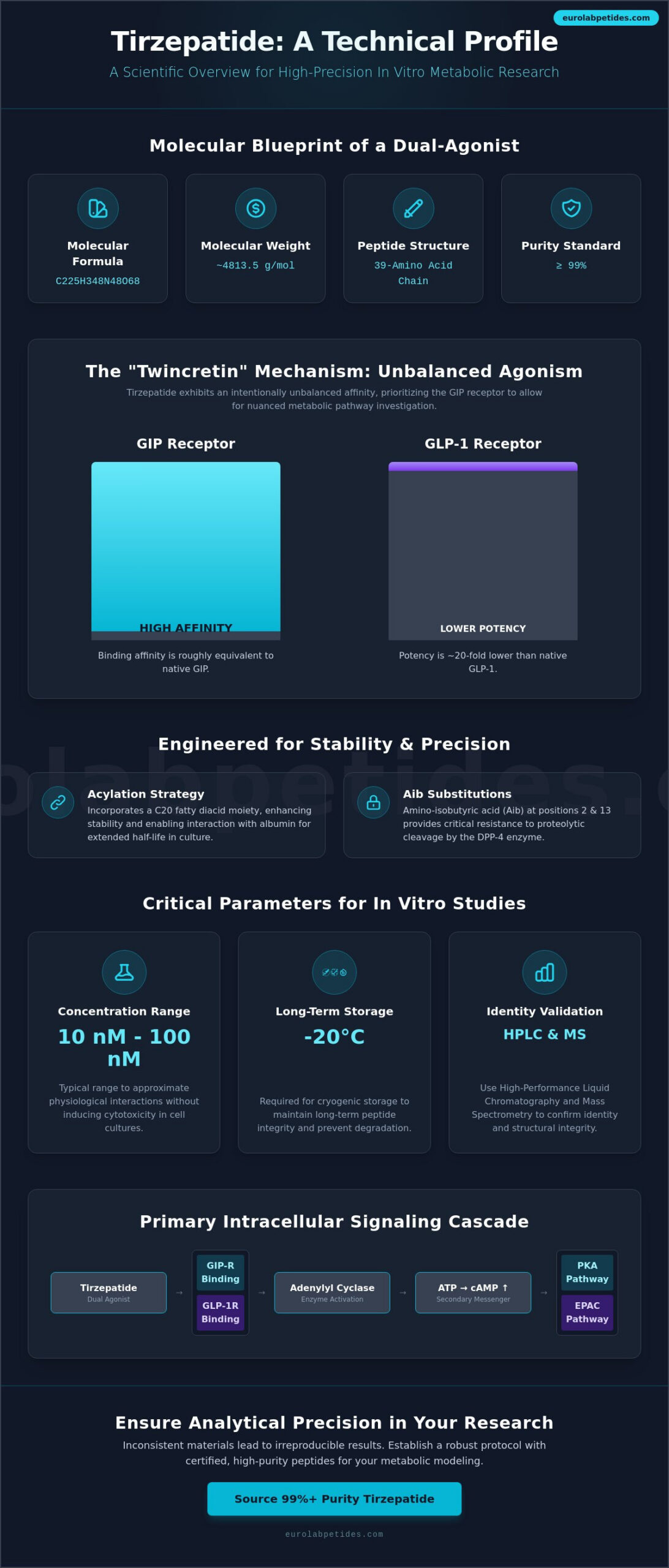
Precision in metabolic modeling begins with an exhaustive understanding of the molecular blueprint of the ligands employed. The application of tirzepatide for in vitro metabolic studies has expanded significantly due to its unique status as a dual-agonist, or “Twincretin.” Tirzepatide is a synthetic peptide that integrates the signaling properties of both glucose-dependent insulinotropic polypeptide (GIP) and glucagon-like peptide-1 (GLP-1). This dual-action mechanism is designed to leverage the synergistic potential of two distinct incretin pathways, which is a departure from traditional mono-agonist research models. The molecular formula C225H348N48O68 and its molecular weight of approximately 4813.5 g/mol reflect a complex architecture engineered for high-stakes laboratory development.
The acylation strategy is a defining feature of the molecule’s technical profile. It incorporates a C20 fatty diacid moiety attached via a linker at the lysine residue at position 20. In the context of tirzepatide for in vitro metabolic studies, this modification is essential for investigating how long-acting peptides interact with albumin and cell membranes during extended incubation. This structural detail ensures the peptide remains stable throughout rigorous assay cycles, providing a reliable metric for intracellular signaling analysis. Key structural benefits for laboratory research include:
- Enhanced resistance to enzymatic degradation in culture media.
- Improved solubility for precise concentration scaling.
- Optimized binding kinetics for both GIP and GLP-1 receptors.
- High-precision mapping of energy expenditure pathways.
The Molecular Architecture of Tirzepatide
The peptide utilizes a 31-amino acid core derived from the GIP sequence within its total 39-amino acid architecture. It includes aminoisobutyric acid (Aib) substitutions at positions 2 and 13, which are specifically engineered to provide resistance against proteolytic cleavage by the dipeptidyl peptidase-4 (DPP-4) enzyme. For laboratory investigators, these modifications translate to superior stability in various media. Maintaining 99%+ structural purity is non-negotiable for precise receptor titration, as degradation products can compromise the accuracy of binding affinity calculations in Weight Management Research.
GLP-1 vs. GIP Receptor Affinity Ratios
Tirzepatide exhibits an “unbalanced” agonism profile that prioritizes the GIP receptor. Its affinity for the GIPR is roughly equivalent to native GIP, while its potency at the GLP-1R is approximately 20-fold lower than native GLP-1. This intentional imbalance allows researchers to investigate glucagonostatic and insulinotropic effects without the over-saturation of GLP-1 pathways. It’s a critical distinction for studies focusing on isolated cellular systems where receptor density varies significantly between different tissue types, such as pancreatic or adipose models.
Mechanisms of Action: GLP-1 and GIP Receptor Synergy In Vitro
The primary utility of tirzepatide for in vitro metabolic studies lies in its capacity to trigger dual-receptor signaling pathways that are often studied in isolation. While traditional mono-agonists activate either the GLP-1 or GIP receptor, this peptide facilitates a simultaneous engagement that mirrors complex physiological incretin responses. Central to this interaction is the activation of the adenylyl cyclase enzyme, which catalyzes the conversion of adenosine triphosphate (ATP) into cyclic adenosine monophosphate (cAMP). This secondary messenger initiates a cascade involving protein kinase A (PKA) and exchange protein directly activated by cAMP (EPAC), particularly within pancreatic beta-cell and adipocyte models. A detailed analysis of Tirzepatide’s Mechanism of Action reveals that this dual-agonism yields a more robust signaling output than the additive effects of separate ligands.
Intracellular Signaling Cascades
Downstream signaling in incretin research is characterized by the modulation of mitochondrial biogenesis and cellular respiration. Upon receptor binding, the elevation of intracellular cAMP levels promotes the phosphorylation of various transcription factors. This process is critical for observing the cross-talk between GIP and GLP-1 pathways, where GIPR activation often complements the insulinotropic effects of GLP-1R signaling. In laboratory settings, these interactions are typically quantified using concentrations between 10 nM and 100 nM. This range allows for the observation of refined metabolic regulation without compromising cellular viability in isolated systems.
Adipocyte Metabolism and WAT Browning Studies
In differentiated 3T3-L1 adipocyte cell lines, the peptide’s metabolic influence is marked by the induction of a thermogenic state. This “browning” of white adipose tissue (WAT) models is identified through the significant upregulation of thermogenic markers, specifically peroxisome proliferator-activated receptor-gamma coactivator 1-alpha (PGC-1α) and uncoupling protein 1 (UCP1). Transcriptomic analysis often reveals a shift toward increased fatty acid oxidation and reduced lipid accumulation. Measuring the reduction of intracellular lipid droplets serves as a primary endpoint for researchers investigating Weight Management Research and lipid turnover kinetics. High-precision assays often benefit from the Advanced Metabolic Stack when establishing baseline comparative data across different cell types.
The insulinotropic effects observed in tirzepatide for in vitro metabolic studies are strictly glucose-dependent. In pancreatic MIN6 or INS-1 cell models, the peptide enhances insulin secretion only when ambient glucose concentrations exceed basal levels. It’s a controlled environment for studying the potentiation of glucose-stimulated insulin secretion (GSIS) and the preservation of beta-cell function. By maintaining structural integrity and 99%+ purity, researchers can ensure that these delicate signaling nuances are not obscured by peptide degradation or off-target impurities.
Methodological Frameworks for In Vitro Metabolic Studies
Establishing a standardized methodological framework is essential for achieving high-precision data in biochemical assays. When utilizing tirzepatide for in vitro metabolic studies, the choice of cell lines directly dictates the metabolic pathways under investigation. Pancreatic beta-cell models like MIN6 and INS-1 are primarily employed to evaluate glucose-stimulated insulin secretion (GSIS). Conversely, 3T3-L1 preadipocytes are differentiated into mature adipocytes to study lipid metabolism and thermogenesis. According to Preclinical and In Vitro Studies of Tirzepatide, these models provide the necessary cellular context to observe the synergistic effects of dual incretin agonism within a controlled laboratory environment.
Precise titration is required to map receptor binding kinetics accurately. Researchers typically establish dose-response curves within a concentration range of 10 nM to 100 nM to approximate physiological interactions. To validate that observed effects are indeed mediated through the cAMP/PKA pathway, adenylyl cyclase inhibitors such as SQ22536 are often introduced into the assay. If the metabolic response is attenuated in the presence of the inhibitor, the involvement of cAMP is confirmed. This level of experimental control is vital for differentiating between primary receptor-mediated actions and non-specific cellular responses, ensuring that the resulting data reflects true ligand-receptor interaction.
Cell Culture and Incubation Parameters
Optimal molar concentrations must be calculated based on the 4813.5 g/mol molecular weight of the peptide. For adipose models, incubation timelines usually span 24 to 48 hours to observe significant phenotypic shifts. Media composition is a critical variable; the presence of serum proteins can influence peptide bioactivity and stability. It’s recommended to utilize serum-reduced media during the treatment phase to minimize interference from endogenous growth factors. This practice maintains the integrity of tirzepatide for in vitro metabolic studies and prevents the masking of subtle signaling nuances.
Analytical Endpoints in Metabolic Research
Quantitative analysis of metabolic endpoints is conducted through multiple analytical channels. GSIS assays measure insulin concentrations in the supernatant via ELISA following specific glucose challenges. For adipocyte studies, lipid accumulation is quantified using Oil Red O staining, where the absorbance of the extracted dye serves as a proxy for intracellular lipid content. Additionally, qPCR and immunoblotting are employed to evaluate the mRNA and protein expression of lipid metabolism gene programs. Focus is placed on markers such as UCP1 and PGC-1α, which are fundamental for advancing Weight Management Research and understanding energy expenditure at the cellular level.
Stability and Purity Requirements for Analytical Research
High-stakes biochemical research demands an uncompromising approach to material verification. When employing tirzepatide for in vitro metabolic studies, the presence of even trace impurities can alter receptor binding affinity or induce off-target cellular responses. Verification is achieved through a combination of High-Performance Liquid Chromatography (HPLC) and Mass Spectrometry (MS). HPLC provides a quantitative measure of purity by isolating the target peptide from synthesis byproducts, while MS confirms the molecular weight of 4813.5 g/mol and the specific amino acid sequence. These metrics ensure that the “Twincretin” mechanism remains the sole driver of metabolic shifts in the assay.
Quality Control Metrics for Research-Grade Peptides
A purity benchmark of ≥99% is the standard for advanced Weight Management Research. Chromatograms must display a single, sharp peak with minimal baseline noise to confirm the absence of truncated sequences or residual reagents. Mass Spectrometry serves as an essential tool for verifying that the C20 fatty diacid moiety is correctly acylated to the lysine residue at position 20. Third-party laboratory testing provides an objective layer of validation, ensuring that the peptide’s chemical formula, C225H348N48O68, is accurately represented before any laboratory development begins. This rigorous screening process is vital for establishing a reliable baseline in high-precision receptor binding assays.
Handling and Storage for Maximum Stability
Analytical consistency depends heavily on the implementation of standardized protocols for storing lyophilized peptides. While short-term storage at 4°C is acceptable for one to two weeks, long-term stability requires -20°C for up to 12 months or -80°C for extended durations. Once the lyophilized powder is reconstituted, its structural integrity becomes significantly more volatile. Sterile water is the recommended solvent for initial reconstitution to maintain the peptide’s native conformation. It’s critical to avoid multiple freeze-thaw cycles, as the mechanical stress and temperature fluctuations can lead to peptide aggregation or cleavage of the delicate acylated side chain.
To mitigate degradation risks, researchers should implement a strict aliquotting procedure immediately following reconstitution. By dividing the stock solution into single-use volumes, the remaining material stays preserved at -20°C until needed. This approach ensures that every assay in a series uses a peptide with the same degradation profile, which is essential when utilizing tirzepatide for in vitro metabolic studies that span several days. Maintaining these stringent handling standards prevents the introduction of experimental noise that could compromise the data collected during Weight Management Research. Researchers seeking verified materials for their laboratory protocols can access high-purity peptides through the EuroLab Peptides quality-controlled catalog.
Sourcing Tirzepatide for In Vitro Laboratory Development
The acquisition of high-precision ligands is the foundational step in any rigorous experimental design. For investigators utilizing tirzepatide for in vitro metabolic studies, the distinction between research-grade materials and pharmaceutical-grade products is absolute. These peptides are synthesized and distributed exclusively for in vitro research and laboratory development purposes. They aren’t intended for human consumption or clinical application. By adhering to these strict parameters, the integrity of the specialized research community is maintained, ensuring that laboratory findings are based on objective biochemical interactions within isolated cellular systems.
The EuroLab Standard for Research Peptides
A multi-level quality control protocol is employed to verify the structural identity and purity of every batch. The commitment to a 99%+ purity benchmark is substantiated by independent third-party analysis, utilizing both HPLC and Mass Spectrometry to provide a verifiable metric of quality. Transparency regarding quality assurance benefits allows researchers to review the analytical data required for serious professional inquiry. When tirzepatide for in vitro metabolic studies is sourced through these rigorous channels, the risk of experimental interference from synthesis byproducts or truncated sequences is virtually eliminated. This level of precision is non-negotiable when mapping the complex signaling cascades of dual-agonist mechanisms.
Logistical Excellence and Regional Reliability
Stability during transit is a primary concern for acylated peptides. Efficient distribution networks across Europe are utilized to minimize the duration between laboratory synthesis and delivery, reducing the risk of transit-related degradation. Secure, temperature-stabilized packaging is designed to protect the peptide’s native conformation during shipping. This logistical reliability is a critical component for professionals engaged in weight management research, where consistent material quality is required for long-term study reproducibility. By providing localized logistics and ensuring regional regulatory compliance, a secure supply chain is established for the scientific community.
The focus remains on providing the high-stakes precision chemicals necessary for advanced metabolic screening. Every stage of the process, from chemical synthesis to final delivery, is governed by a meticulous attention to detail. This methodical approach respects the intelligence and time of the professional user, delivering a product that meets the exacting standards of modern biochemistry. The reliance on empirical data and formal validation ensures that every research project begins with a reliable, high-purity foundation.
Advancing Metabolic Modeling Through Analytical Precision
The integration of dual-agonist ligands into cellular assays offers a sophisticated pathway for exploring incretin synergy. Success in these research environments depends on the structural stability of the acylated peptide and the implementation of rigorous titration protocols. Utilizing tirzepatide for in vitro metabolic studies provides researchers with a high-fidelity tool for mapping intracellular signaling and thermogenic gene expression with absolute accuracy. It’s an essential standard for investigators who prioritize data integrity and require 99%+ purity for analytical precision.
Every batch undergoes third-party HPLC and MS validation to eliminate off-target variables. Secure European shipping protocols are utilized to maintain peptide integrity from the point of synthesis to the laboratory bench. Order Research-Grade Tirzepatide for In Vitro Studies to establish a reliable foundation for your next metabolic project. Your research objectives deserve the precision of elite biochemical tools to achieve reproducible breakthroughs.
Frequently Asked Questions
Is Tirzepatide suitable for human consumption in clinical settings?
Research-grade tirzepatide is strictly prohibited for human consumption or clinical applications. These materials are synthesized specifically for in vitro laboratory development and biochemical analysis. They aren’t manufactured under the sterile conditions required for pharmaceutical products. Using research-grade chemicals in a clinical context violates regulatory standards and compromises safety protocols.
What is the recommended purity level for Tirzepatide in metabolic studies?
A purity level of 99% or higher is the established standard for high-precision metabolic studies. This threshold ensures that the resulting data reflects the target ligand’s action rather than interference from synthesis byproducts or residual reagents. When utilizing tirzepatide for in vitro metabolic studies, verifying this metric through HPLC is essential for achieving reproducible results in Weight Management Research.
How should Tirzepatide be reconstituted for in vitro cell culture assays?
Lyophilized powder should be reconstituted using sterile water to maintain the peptide’s native conformation. While some protocols suggest bacteriostatic saline, the presence of preservatives can sometimes interfere with sensitive cell culture assays. Immediate aliquotting following reconstitution is required to prevent degradation from repeated temperature fluctuations. All stock solutions should be handled with minimal agitation to preserve the delicate acylated structure.
What are the common cell lines used for Tirzepatide metabolic research?
Laboratory investigators primarily utilize MIN6 and INS-1 cell lines for pancreatic beta-cell modeling and 3T3-L1 preadipocytes for adipose tissue research. These lines are selected for their high expression of GIP and GLP-1 receptors, which is necessary for observing dual-agonist signaling. Each cell line provides a distinct environment for analyzing glucose-stimulated insulin secretion or thermogenic gene upregulation in metabolic pathway studies.
How does Tirzepatide’s acylation affect its stability in laboratory media?
The C20 fatty diacid moiety significantly enhances the peptide’s resistance to enzymatic cleavage by DPP-4. This acylation allows for extended incubation periods in laboratory media without the rapid degradation seen in native incretins. It also facilitates albumin binding, which is a critical variable to account for when calculating effective molar concentrations in complex culture environments.
What is the difference between Tirzepatide and native GIP in receptor binding?
Tirzepatide acts as a dual agonist with high affinity for the GIP receptor, whereas native GIP is a mono-agonist. Unlike the native hormone, this synthetic peptide also targets the GLP-1 receptor, though its affinity there is roughly 20-fold lower than native GLP-1. This “unbalanced” signaling profile is specifically designed to investigate the synergistic effects of the “Twincretin” mechanism in cellular models.
Can Tirzepatide be stored in solution for extended periods?
Reconstituted peptides shouldn’t be stored in solution for more than 1-2 weeks at 4°C. For studies requiring longer timelines, the solution must be divided into single-use aliquots and stored at -20°C or -80°C to minimize hydrolytic degradation. Repeated freeze-thaw cycles must be avoided, as they compromise the structural integrity and bioactivity of the acylated peptide chain.
Why is third-party testing essential when sourcing research peptides?
Third-party validation provides an objective assessment of peptide identity and purity through HPLC and Mass Spectrometry. This verification is essential for ensuring that the chemical provided matches the molecular formula C225H348N48O68 and the weight of 4813.5 g/mol. When sourcing tirzepatide for in vitro metabolic studies, relying on external analysis confirms that the material meets the rigorous demands of high-stakes metabolic research.
