

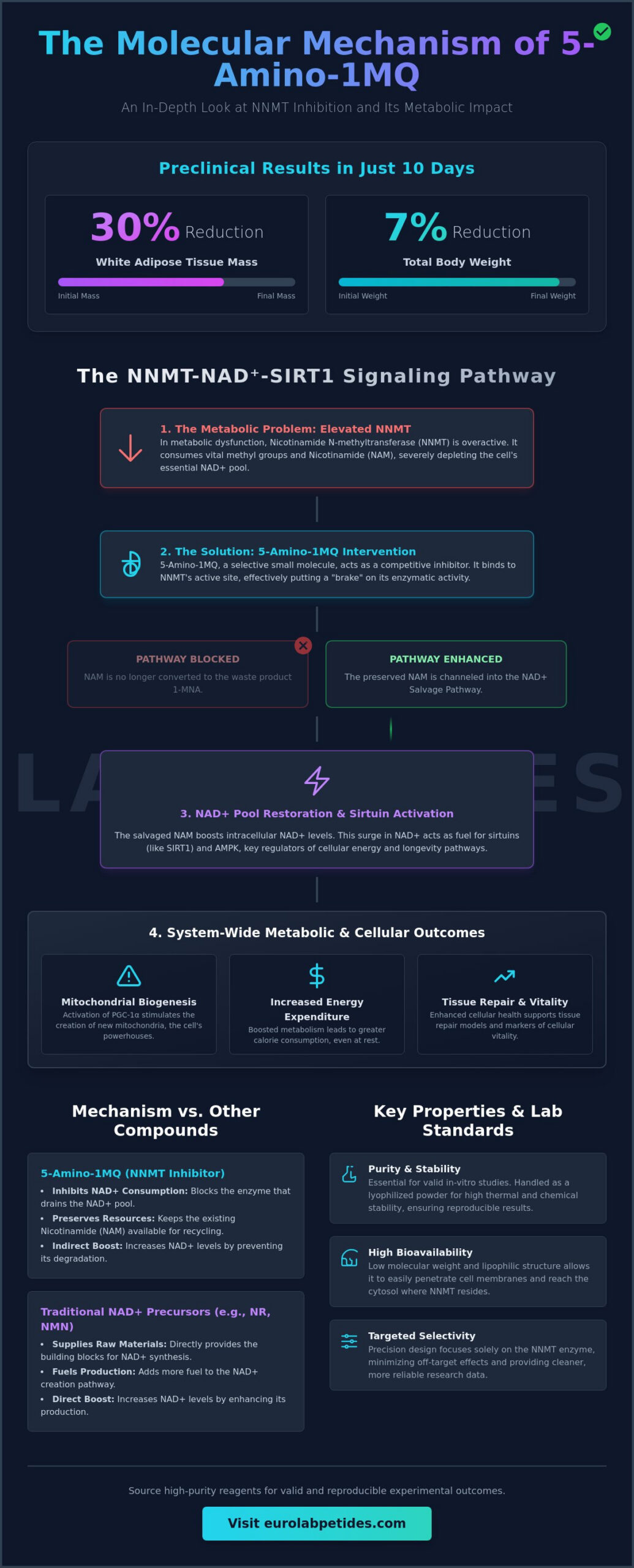
Preclinical data indicates that targeted inhibition of nicotinamide N-methyltransferase (NNMT) can reduce white adipose tissue mass by 30% and total body weight by over 7% within a ten-day observation period. This profound shift in cellular energy homeostasis underscores why 5-amino-1mq mechanism of action research has become a focal point for laboratories investigating metabolic dysfunction and NAD+ depletion. You’ve likely encountered the challenge of synthesizing fragmented data from paywalled journals or navigating the conflicting reports found in non-scientific literature. This technical review provides a consolidated, empirical analysis of the molecular binding and downstream metabolic markers essential for high-stakes precision in laboratory tracking. We’ll examine the modulation of the NNMT-NAD⁺-SIRT1 axis and the rigorous standards required to source high-purity reagents for valid experimental outcomes. This analysis moves from the specific enzymatic blockade to the broader implications for metabolic and tissue repair research models.
Key Takeaways
- Analyze the competitive inhibition of the NNMT enzyme to understand how 5-amino-1mq mechanism of action research clarifies the preservation of cellular NAD+ pools.
- Identify the specific molecular pathways through which the reduction of 1-methylnicotinamide (1-MNA) facilitates the activation of SIRT1 and AMPK signaling.
- Evaluate the stimulation of mitochondrial biogenesis via PGC-1α expression in specialized adipose and muscle tissue models.
- Differentiate the metabolic flux of 5-Amino-1MQ from other research compounds like SLU-PP-332 and traditional NAD+ precursors.
- Review standardized reconstitution protocols and purity requirements essential for maintaining reagent stability in valid in-vitro metabolic studies.
Introduction to 5-Amino-1MQ as a Small Molecule NNMT Inhibitor
5-Amino-1-methylquinolinium, identified in technical literature as 5-Amino-1MQ, is a specialized small molecule designed for the precise inhibition of cytosolic enzymes. It’s distinguished from generic metabolic agents by its high degree of selectivity and its classification as a membrane-permeable inhibitor. In the context of 5-amino-1mq mechanism of action research, this compound is utilized to investigate the specific regulatory pathways governing energy expenditure and cellular health. Its significance in longevity and metabolic research models is primarily due to its ability to cross cellular membranes and interact with target proteins without requiring complex delivery systems.
Chemical Structure and Properties
The molecular architecture of 5-Amino-1MQ is optimized for laboratory efficacy. It’s characterized by a low molecular weight that supports high solubility in standard reagents like DMSO or aqueous buffers. The methylquinolinium cation is the defining structural feature; it provides the necessary lipophilicity for the compound to penetrate cell membranes effectively. This high bioavailability ensures that the inhibitor reaches the cytosol in sufficient concentrations to exert measurable effects on enzymatic activity.
Standardized testing confirms that the structural integrity is maintained under proper storage conditions, ensuring reproducible results across different experimental batches. When handled as a lyophilized powder, the compound exhibits high thermal and chemical stability, which is a non-negotiable metric for researchers conducting long-term metabolic studies. Maintaining these rigorous quality benchmarks is essential for valid data acquisition in high-stakes biochemical environments.
Discovery and Early Research Context
The development of 5-Amino-1MQ was driven by the identification of Nicotinamide N-methyltransferase (NNMT) as a key metabolic regulator. Researchers observed that NNMT levels are frequently elevated in models of metabolic dysfunction, where the enzyme acts as a drain on cellular NAD+ pools. Early efforts to modulate this pathway relied on broad-spectrum inhibitors that often produced confounding data due to off-target effects. The shift toward targeted small molecules allowed for a more granular understanding of how 5-amino-1mq mechanism of action research could isolate the NNMT-NAD+ axis.
Currently, the compound is a staple in in-vitro and in-vivo laboratory development, particularly in studies focused on weight management research and tissue repair. Its ability to reverse metabolic “brakes” at the molecular level positions it as a sophisticated tool for modern biochemical inquiry. By focusing on the specific enzymatic blockade, laboratories can better track the downstream effects on mitochondrial biogenesis and cellular vitality markers.
The NNMT-NAD⁺-SIRT1 Signaling Pathway: Primary Mechanism of Action
The primary mechanism of 5-Amino-1MQ involves a strategic blockade of the nicotinamide N-methyltransferase (NNMT) enzyme. This cytosolic protein acts as a terminal sink for nicotinamide (NAM), converting it into 1-methylnicotinamide (1-MNA) through the transfer of a methyl group. By halting this conversion, 5-Amino-1MQ prevents the depletion of NAM, ensuring these molecules remain available for the NAD+ salvage pathway. This conservation of the intracellular NAD+ pool is the foundational driver for the compound’s metabolic effects. Understanding this sequential feedback loop is critical for 5-amino-1mq mechanism of action research, as it distinguishes the compound from simple NAD+ precursors.
Enzymatic Inhibition of NNMT
5-Amino-1MQ functions as a competitive inhibitor, specifically targeting the substrate-binding site of the NNMT enzyme. Research indicates that this molecule competes with NAM for the active site, effectively lowering the velocity of the enzymatic reaction. This intervention also alters the ratio of S-adenosyl-L-methionine (SAM) to S-adenosyl-L-homocysteine (SAH). Because NNMT is a major consumer of methyl groups, its inhibition preserves SAM levels, potentially influencing broader epigenetic landscapes in metabolic cells. Researchers often quantify this efficacy by measuring inhibitory constants (Ki), which reflect the high-affinity binding of the 1-methylquinolinium structure. These metrics provide a verifiable standard for potency in laboratory models.
NAD+ Salvage Pathway Enhancement
When NNMT activity is suppressed, the cellular environment shifts toward the NAD+ salvage pathway. NAM is recycled into nicotinamide mononucleotide (NMN) and subsequently into NAD+ by nicotinamide phosphoribosyltransferase (NAMPT). Recent research on NNMT inhibition demonstrates that this intracellular NAD+ increase is sufficient to activate Sirtuin 1 (SIRT1). As a NAD+-dependent deacetylase, SIRT1 serves as a critical metabolic sensor. Its activation triggers the deacetylation of key transcription factors, including PGC-1α, which coordinates mitochondrial biogenesis and fat oxidation. This cascade illustrates why the 5-amino-1mq mechanism of action research is vital for understanding the rescue of metabolic flux in compromised cellular models.
Laboratories focusing on Longevity & Vitality Research utilize these technical insights to track markers like 1-MNA reduction and SIRT1 activity. This sequential feedback loop from enzymatic blockade to gene expression modulation provides a verifiable metric for experimental success. By maintaining high NAM availability, the cell’s internal machinery is effectively reprogrammed to prioritize energy production over methyl group excretion. This shift represents a fundamental change in adipocyte and myocyte metabolic signaling.
Impact on Mitochondrial Biogenesis and Adipocyte Metabolic Flux
The activation of the SIRT1/AMPK signaling axis serves as the primary bridge between NNMT inhibition and systemic metabolic shifts. Following the conservation of NAD+ described in previous sections, SIRT1 facilitates the deacetylation of Peroxisome proliferator-activated receptor gamma coactivator 1-alpha (PGC-1α). This molecular event is a critical component of 5-amino-1mq mechanism of action research, as it initiates a cascade of gene expression that prioritizes energy expenditure over storage. The resulting metabolic flux is characterized by increased fatty acid oxidation (FAO) and elevated oxygen consumption rates (OCR), providing a measurable benchmark for mitochondrial efficiency in laboratory models.
Mitochondrial Biogenesis Markers
In laboratory models of muscle and adipose tissue, 5-Amino-1MQ induces the upregulation of nuclear respiratory factors, specifically NRF-1 and NRF-2. These factors coordinate the expression of mitochondrial proteins, leading to a verifiable increase in mitochondrial DNA (mtDNA) copy numbers. This expansion of the mitochondrial network enhances the cell’s capacity for ATP production through oxidative phosphorylation. Unlike stimulant-based compounds, the metabolic surge observed in 5-amino-1mq mechanism of action research is driven by structural biogenesis rather than temporary autonomic arousal. This distinction is vital for researchers developing protocols in Weight Management Research and Tissue Repair & Recovery Research.
Adipocyte Metabolism and Differentiation
The compound exhibits a high degree of efficacy in modulating adipocyte life cycles. In 3T3-L1 cell lines, 5-Amino-1MQ is observed to inhibit lipid accumulation during the differentiation phase, effectively preventing the formation of mature, lipid-heavy adipocytes. This process is often tracked through the expression of GLUT4, where increased translocation to the plasma membrane suggests improved glucose uptake and insulin sensitivity in the research model. Beyond glucose handling, the compound forces a shift toward the utilization of stored triglycerides.
In murine models of diet-induced obesity, 5-Amino-1MQ treatment results in a 30% decrease in white fat tissue mass and a significant reduction in individual adipocyte size. These findings demonstrate that the NNMT blockade doesn’t merely suppress appetite but fundamentally alters the metabolic programming of fat cells. Consistent results across these markers reinforce the compound’s utility as a high-precision tool for investigating metabolic rescue and energy homeostasis.
Comparative Analysis: 5-Amino-1MQ vs. Other Metabolic Research Compounds
Comparative analysis is essential to distinguish the unique 5-amino-1mq mechanism of action research from other metabolic modulators like SLU-PP-332. While SLU-PP-332 acts as an Estrogen-Related Receptor (ERR) agonist to simulate exercise-induced transcriptional changes, 5-Amino-1MQ operates through the enzymatic blockade of NNMT. This distinction is significant; one compound drives an active signaling pathway while the other removes a metabolic “brake” that limits NAD+ availability. In laboratory models, this results in a high degree of specificity for white adipose tissue (WAT) over brown adipose tissue (BAT). This occurs because NNMT expression is predominantly elevated in dysregulated WAT, where it acts as a primary regulator of energy homeostasis and lipid storage.
5-Amino-1MQ vs. NAD+ Precursors
Traditional metabolic research often utilizes precursors such as Nicotinamide Riboside (NR) or Nicotinamide Mononucleotide (NMN) to increase exogenous substrate availability. In contrast, 5-amino-1mq mechanism of action research focuses on endogenous conservation by preventing the methylation and subsequent excretion of nicotinamide. This approach maintains higher steady-state levels of NAD+ within the cellular environment. It leads to more sustained SIRT1 activation compared to the transient spikes often associated with precursor supplementation. For a broader perspective on molecular tools, researchers often consult the guide to peptides in longevity research to understand how different classes of small molecules and sequences interact within the metabolic framework.
Targeting NNMT vs. Mitochondrial Uncouplers
The metabolic efficiency of NNMT inhibition provides a stark contrast to the mechanism of mitochondrial uncouplers like DNP. Uncouplers dissipate the proton gradient to generate heat, a process that can lead to significant metabolic waste and high toxicity profiles in preclinical models. 5-Amino-1MQ promotes mitochondrial biogenesis and enhances the efficiency of ATP production, favoring a constructive metabolic shift. This profile makes it a viable candidate for inclusion in advanced metabolic research stacks. Synergistic potential is observed when combining NNMT inhibitors with ERR agonists, as they target complementary nodes of the SIRT1/AMPK axis. This combination allows for more granular tracking of metabolic markers without the confounding systemic stress associated with uncoupling agents.
Laboratories requiring high-purity reagents for Weight Management Research can access validated compounds through the Advanced Metabolic Stack protocols.
Laboratory Standards and Handling for 5-Amino-1MQ Research
High-stakes precision in metabolic research demands absolute chemical fidelity. For 5-amino-1mq mechanism of action research to yield valid, reproducible data, the compound must meet stringent purity benchmarks. This molecule is strictly classified under Research Use Only (RUO) guidelines. It’s not intended for human or animal consumption; any suggestion of “cycling” or “dosage” for human use is scientifically irresponsible and contradicts laboratory safety standards. In professional settings, maintaining a 99%+ purity level, verified via High-Performance Liquid Chromatography (HPLC), is a non-negotiable standard. Any deviation in chemical composition can introduce confounding variables that compromise the integrity of enzymatic assays.
Quality Assurance and Third-Party Testing
Analytical validation through HPLC and Mass Spectrometry (MS) is essential for identifying potential synthesis byproducts. Contaminants such as residual solvents or unreacted precursors can interfere with the NNMT binding site. This interference leads to false-negative results in metabolic flux studies. Adherence to the EuroLab quality protocol ensures that every batch undergoes multi-level validation before deployment in a research environment. Lyophilized powder should be stored at -20°C for long-term stability. This protects the methylquinolinium cation from oxidative degradation and moisture-induced instability, ensuring that the reagent remains viable for the duration of the study.
In Vitro Application Protocols
Reconstitution of 5-Amino-1MQ typically utilizes anhydrous DMSO or sterile aqueous buffers; the choice depends on the specific requirements of the cell culture medium and the intended assay sensitivity. Standard concentration ranges for in-vitro incubation often fall between 10 µM and 100 µM. Researchers must consider the time-course of SIRT1 activation. Significant changes in gene expression and mitochondrial biogenesis markers generally require a minimum exposure period of 24 to 48 hours. Tracking these shifts allows for a granular understanding of the 5-amino-1mq mechanism of action research within specific adipocyte or myocyte lineages.
Handling protocols must follow standardized chemical safety guidelines. This includes the use of appropriate personal protective equipment and documented disposal of chemical waste to maintain laboratory compliance. Accuracy in these preparatory stages is the baseline for high-purity metabolic inquiry. By eliminating external variables through rigorous handling, laboratories can isolate the specific effects of NNMT inhibition on cellular respiration and energy homeostasis.
Advancing Metabolic Inquiry Through Precision NNMT Inhibition
The empirical data surrounding the NNMT-NAD⁺-SIRT1 axis identifies 5-Amino-1MQ as a high-affinity tool for the rescue of cellular energy homeostasis. By strategically preventing the methylation of nicotinamide, this small molecule facilitates a sustained increase in intracellular NAD+ levels. This process subsequently drives mitochondrial biogenesis and enhances fatty acid oxidation in specialized research models. It’s clear that 5-amino-1mq mechanism of action research provides a sophisticated framework for investigating interventions within weight management and longevity research. It’s a method that shifts the focus from simple supplementation to endogenous conservation.
Valid experimental outcomes are contingent upon chemical integrity. We ensure that every batch is supported by independent third-party lab testing and 99%+ purity HPLC certification. Specialized European logistics are employed to ensure that these benchmarks are preserved throughout the delivery process. Researchers don’t have to settle for fragmented data when high-precision tools are available for immediate deployment.
View 5-Amino-1MQ HPLC-Verified Research Data
Precise enzymatic modulation remains the baseline for significant discovery in metabolic science.
Frequently Asked Questions
What is the primary enzymatic target of 5-Amino-1MQ?
The primary enzymatic target is Nicotinamide N-methyltransferase (NNMT), a cytosolic enzyme responsible for the methylation of nicotinamide. By inhibiting this specific protein, 5-Amino-1MQ prevents the conversion of nicotinamide into 1-methylnicotinamide. This blockade is the foundational element of 5-amino-1mq mechanism of action research, as it preserves the cellular NAD+ pool for use in other critical metabolic pathways. This enzymatic intervention is observed to remove a significant “brake” on cellular energy expenditure.
How does 5-Amino-1MQ differ from NAD+ supplements like NMN?
5-Amino-1MQ differs from NMN by functioning as an endogenous conservator rather than an exogenous precursor. While NMN provides a direct substrate for NAD+ synthesis, 5-Amino-1MQ inhibits the enzyme that depletes existing nicotinamide. This approach maintains steady-state NAD+ levels by closing a metabolic sink rather than simply increasing input. This distinction is vital for researchers investigating the efficiency of cellular recycling mechanisms and the long-term modulation of the NAD+ salvage pathway.
Can 5-Amino-1MQ be used in conjunction with BPC-157 in recovery research?
5-Amino-1MQ is frequently utilized alongside compounds like BPC-157 within specialized Recovery Research Stacks. In these laboratory models, the NNMT inhibitor addresses metabolic efficiency and energy homeostasis, while BPC-157 is observed for its impact on tissue repair and inflammation signaling. Combining these tools allows for a multi-faceted analysis of recovery markers in compromised muscle or connective tissue models. It’s a common strategy for investigating the synergy between metabolic flux and structural repair.
What are the observed effects of 5-Amino-1MQ on mitochondrial biogenesis?
Research indicates that NNMT inhibition leads to the activation of the SIRT1/AMPK signaling axis, which subsequently upregulates PGC-1α. This cascade stimulates the production of new mitochondria, increasing mitochondrial DNA copy numbers and oxygen consumption rates. These structural changes enhance the cell’s capacity for oxidative phosphorylation and fatty acid oxidation. This result is a key focus of 5-amino-1mq mechanism of action research in adipocyte and myocyte models, where energy demand is high.
Is 5-Amino-1MQ stable in aqueous solution for laboratory research?
5-Amino-1MQ exhibits limited long-term stability in aqueous solutions and is susceptible to degradation if not handled correctly. Laboratory protocols typically require reconstitution in anhydrous DMSO or specialized sterile buffers immediately before use. For long-term storage, the compound is best maintained in its lyophilized powder form at -20°C. This ensures the chemical integrity of the methylquinolinium cation remains intact for high-precision assays. Researchers should avoid repeated freeze-thaw cycles to maintain reagent potency.
How is the purity of 5-Amino-1MQ verified for research purposes?
The purity of 5-Amino-1MQ is verified through High-Performance Liquid Chromatography (HPLC) and Mass Spectrometry (MS). These analytical methods ensure the compound meets a minimum benchmark of 99% purity by identifying and quantifying any residual synthesis byproducts. Such rigorous testing is a non-negotiable standard for reagents used in professional metabolic research. External validation from independent third-party laboratories provides the necessary data for experimental reproducibility and absolute chemical security.
What is the role of the NNMT enzyme in metabolic dysfunction?
NNMT acts as a metabolic regulator that is often over-expressed in the adipose tissue of obese models. When active, it consumes nicotinamide and methyl groups, effectively acting as a brake on fat metabolism and energy expenditure. Elevated NNMT levels correlate with reduced NAD+ availability and impaired SIRT1 activity. Inhibiting this enzyme reverses these effects, facilitating a shift toward increased metabolic flux and reduced lipid accumulation in white adipose tissue models.
Is 5-Amino-1MQ intended for human consumption or clinical use?
5-Amino-1MQ is strictly intended for laboratory and in-vitro research purposes and is not approved for human consumption or clinical use. It is classified as an experimental small molecule rather than a pharmaceutical or medicine. All commercial applications and laboratory protocols must adhere to Research Use Only (RUO) guidelines. There are currently no registered clinical trials for this compound as of May 2026, and its safety profile in humans remains entirely undocumented.
