

The assumption that BPC-157 and TB-500 serve as interchangeable regenerative agents in-vitro ignores the fundamental divergence in their molecular signaling pathways. While both compounds are frequently grouped together in literature, successful experimental design depends on a precise understanding of bpc-157 vs tb-500 for cell migration assays and their non-redundant roles. It’s likely you face significant ambiguity when attempting to isolate specific cellular responses, as many studies fail to distinguish between physical motility and growth factor sensitization.
This technical overview clarifies the distinct mechanisms at play, specifically the actin-sequestering properties of TB-500 compared to the VEGF-modulating environment orchestrated by BPC-157. We provide a comparative analysis of their synergistic potential and the protocols required for standardized peptide-induced migration. Achieving reproducible results in this high-stakes environment requires more than just methodology; it demands reagents that meet the 98% purity threshold confirmed by HPLC and Mass Spectrometry. As the regulatory landscape for synthetic peptides evolves, including the EMA guidelines effective June 1, 2026, maintaining rigorous quality benchmarks is essential for professional inquiry. We’ll examine how to select the correct peptide for your specific molecular target while ensuring the integrity of your longitudinal data.
Key Takeaways
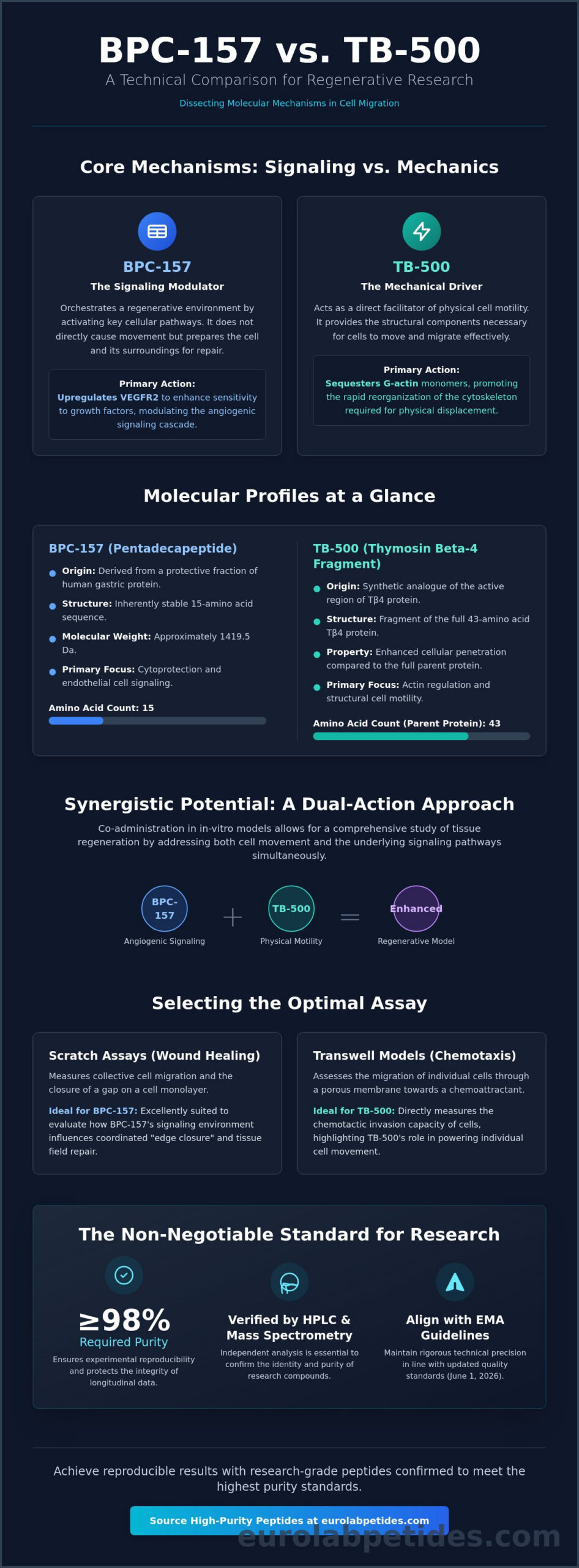
- Differentiate between the mechanical motility driven by G-actin sequestration in TB-500 and the signaling environment established by the upregulation of VEGFR2 in BPC-157.
- Select the optimal methodology for your study by evaluating bpc-157 vs tb-500 for cell migration assays, specifically comparing scratch assays for edge closure against Transwell models for chemotactic invasion.
- Analyze the synergistic potential of co-administration within in-vitro models to simultaneously address physical cell displacement and underlying angiogenic signaling pathways.
- Ensure experimental reproducibility by utilizing research-grade compounds with a verified purity of 98% or higher, as confirmed by independent HPLC and Mass Spectrometry analysis.
- Align laboratory protocols with the updated EMA quality standards for synthetic peptides to maintain the rigorous technical precision required for professional scientific inquiry.
Molecular Profiles: BPC-157 and TB-500 in Scientific Research
The chemical identity of research peptides is the primary determinant of experimental outcome. In the context of regenerative models, BPC-157 and TB-500 represent two distinct classes of molecular signaling agents. While they’re often discussed in similar contexts, their structural configurations dictate their specific roles in in-vitro regenerative and angiogenic models. Determining the correct variable in bpc-157 vs tb-500 for cell migration assays requires a detailed assessment of their amino acid sequences and solubility profiles. These compounds are typically synthesized as lyophilized powders to ensure long-term stability. For laboratory use, they’re reconstituted in sterile water or bacteriostatic saline, where they exhibit high solubility and predictable degradation rates under controlled thermal conditions.
BPC-157 (Pentadecapeptide) Specifications
BPC-157 is a 15-amino acid sequence characterized by the primary structure: Gly-Glu-Pro-Pro-Pro-Gly-Lys-Pro-Ala-Asp-Asp-Ala-Gly-Leu-Val. This specific pentadecapeptide is derived from a protected fraction of human gastric protein, which contributes to its inherent stability in various experimental media. Analytical consistency in cellular research depends on a molecular weight of approximately 1419.5 Da and a purity benchmark of ≥98%. Research focusing on cytoprotection and endothelial cell signaling often utilizes BPC-157 due to its ability to modulate nitric oxide (NO) synthesis and growth factor expression. Its robust chemical structure allows it to remain stable without the need for complex carrier proteins, making it a reliable tool for high-precision laboratory environments.
TB-500 (Thymosin Beta-4 Fragment) Specifications
TB-500 is a synthetic analogue of the active region of Thymosin Beta-4 (Tβ4), a naturally occurring protein involved in actin regulation. The sequence utilized in research is typically: Ac-Ser-Asp-Lys-Pro-Asp-Met-Ala-Glu-Ile-Glu-Lys-Phe-Asp-Lys-Ser-Lys-Leu-Lys-Lys-Thr-Glu-Thr-Gln-Glu-Lys-Asn-Pro-Leu-Pro-Ser-Lys-Glu-Thr-Ile-Glu-Gln-Glu-Lys-Gln-Ala-Gly-Glu-Ser. It’s vital to distinguish between the full-length 43-amino acid Tβ4 protein and the TB-500 fragment often used in specialized assays. The primary research focus for this compound is its actin-binding property; it sequesters G-actin to facilitate cell motility. Because TB-500 is a smaller, more focused fragment, it often demonstrates enhanced penetration in cellular models compared to the parent protein. This makes it a critical variable when measuring physical displacement in bpc-157 vs tb-500 for cell migration assays, as its mechanism is fundamentally tied to the structural reorganization of the cytoskeleton.
- BPC-157: 15 amino acids; focused on angiogenic signaling and cytoprotection.
- TB-500: 43 amino acids; focused on actin sequestration and physical motility.
- Purity Standards: Both compounds require ≥98% purity confirmed by HPLC for reproducible research data.
Mechanistic Comparison: Actin Sequestration vs. Angiogenic Signaling
The efficacy of bpc-157 vs tb-500 for cell migration assays is determined by the distinct intracellular cascades they trigger. TB-500 functions primarily as a mechanical driver of motility through actin regulation. Conversely, BPC-157 operates as a signaling modulator that sensitizes the cellular environment to angiogenic stimuli. These divergent pathways mean that while both facilitate movement, the biological intent of the cell differs. Researchers must distinguish between the physical capacity for movement and the signaling-driven directionality required for complex tissue repair models.
TB-500 and the LRRE Motif
The synthetic fragment TB-500 contains the essential Leu-Lys-Lys-Thr-Glu-Thr-Gln (LKKTETQ) sequence. This motif is responsible for its role as a multi-functional regenerative peptide. It binds to monomeric G-actin, preventing its spontaneous polymerization while maintaining a high concentration of subunits ready for rapid filament assembly. This sequestration is critical for the formation of lamellipodia, the thin, sheet-like protrusions required for cell crawling. In fibroblasts and endothelial cells, this results in enhanced chemokinesis, where the rate of random movement increases regardless of external gradients. This mechanical facilitation is a direct, energy-efficient process that prioritizes rapid coverage of a denuded area.
BPC-157 and Growth Factor Sensitization
BPC-157 promotes migration through the upregulation of Vascular Endothelial Growth Factor Receptor 2 (VEGFR2). This activation triggers the PI3K-Akt-eNOS pathway, leading to increased nitric oxide (NO) production. Unlike the direct mechanical action of TB-500, BPC-157 orchestrates the chemotactic response, directing cells toward a gradient of growth factors. It also influences the Early Growth Response-1 (EGR-1) gene, which is a key regulator of collagen synthesis and extracellular matrix (ECM) remodeling. This synergy with endogenous factors like bFGF and TGF-β ensures that the migratory response is supported by a stable structural environment. It’s an orchestrator of the local environment rather than a simple motor for motility.
- Physical Motility: Driven by TB-500 via G-actin sequestration.
- Directed Chemotaxis: Orchestrated by BPC-157 via VEGFR2 pathways.
- Cellular Response: TB-500 facilitates rapid, random motility (chemokinesis); BPC-157 facilitates targeted, gradient-based movement (chemotaxis).
Selecting the Optimal Peptide for Cell Migration Assays
The selection of an appropriate in-vitro model is essential for isolating the specific effects of bpc-157 vs tb-500 for cell migration assays. Researchers must align the chosen assay with the peptide’s primary mechanism of action. TB-500 is typically the primary variable in scratch assays, also known as wound healing assays, where the objective is to measure the rate of edge closure in a confluent monolayer. This 2D model emphasizes the actin-dependent motility previously discussed. Conversely, Boyden Chamber or Transwell assays are more effective for measuring the chemotactic invasion promoted by BPC-157. These models allow for the quantification of cells moving toward a specific chemical gradient, such as VEGF or bFGF, which better reflects BPC-157’s signaling-driven profile.
Cell type selection also dictates the experimental parameters. Myoblasts, tenocytes, and Human Umbilical Vein Endothelial Cells (HUVECs) are the standard for migration research. Determining the effective concentration (EC50) for peptide-induced migration is a critical step in protocol standardization. In a Comprehensive Review of BPC-157 and TB-500 Mechanisms, it is evident that concentration-dependent responses vary significantly across different cell lines. Establishing these benchmarks ensures that the observed migration is a direct result of peptide interaction rather than non-specific cellular stress.
Experimental Design for TB-500
Research involving mesenchymal stem cells (MSCs) often focuses on the actin-dependent motility facilitated by TB-500. Experimental designs should include high-resolution imaging to measure the rate of focal adhesion turnover. This metric provides a quantifiable value for how quickly a cell can detach and reattach its leading edge. Quantifying the density of lamellipodia and filopodia serves as a secondary indicator of cytoskeletal reorganization. These structural protrusions are the physical engines of migration; their frequency correlates directly with the presence of the LKKTETQ motif found in TB-500.
Experimental Design for BPC-157
Angiogenic sprouting is best assessed using 3D fibrin gel assays, where the structural environment more closely mimics in-vivo conditions. In these models, BPC-157 demonstrates a unique ability to maintain migratory capacity even under oxidative stress-induced inhibition. This cytoprotective quality makes it an ideal candidate for gastrointestinal cell line models, such as Caco-2 or IEC-6 cells. Studies should be designed to evaluate how BPC-157 modulates the PI3K-Akt-eNOS pathway to overcome environmental inhibitors of migration. This approach provides a comprehensive view of how the peptide maintains cellular homeostasis during the regenerative process.
Synergy and Co-Administration in In-Vitro Models
The theoretical basis for co-administration in cellular repair models relies on the simultaneous modulation of distinct biological variables. While previous sections established the individual roles of bpc-157 vs tb-500 for cell migration assays, contemporary research increasingly examines their synergistic potential. This approach addresses physical motility and extracellular signaling as non-competitive processes. TB-500 facilitates the mechanical requirements for displacement, while BPC-157 optimizes the signaling environment. This dual-action strategy is often categorized within a “Recovery Research Stack” in in-vitro protocols, aiming to achieve a more comprehensive regenerative response than either compound alone.
Designing a dual-variable experiment requires rigorous control to distinguish between independent and additive effects. Cross-talk between actin dynamics and VEGF-mediated pathways suggests that the presence of BPC-157 may enhance the efficiency of TB-500-induced motility by providing a more receptive signaling milieu. Research indicates that receptor phosphorylation and cytoskeletal rearrangement are not mutually exclusive; instead, they function as parallel streams within the migratory cascade. For researchers pursuing high-fidelity data, sourcing validated compounds from EuroLab ensures that the observed synergy is a result of molecular interaction rather than confounding impurities.
The Rationale for Combined Research Stacks
Complementary pathways form the core of synergistic research. TB-500 focuses on the polymerization of G-actin, whereas BPC-157 prioritizes the activation of the PI3K-Akt-eNOS pathway. Evidence from multi-lineage differentiation studies shows that these mechanisms can operate concurrently without site-specific competition. However, determining the inhibitory concentration (IC50) of the combination is a prerequisite to avoid cellular toxicity or pathway saturation. Researchers must establish a baseline where the additive benefits of the co-administration don’t compromise the metabolic stability of the cell line under investigation.
Handling and Reconstitution for Dual-Peptide Assays
Best practices for co-reconstitution prioritize the prevention of peptide degradation. Maintaining pH stability in cell culture media is critical when introducing concentrated solutions, as shifts in acidity can alter peptide conformation and bioactivity. It’s recommended to use the peptide reconstitution calculator to ensure precise molarity before adding compounds to the assay environment. Standardized protocols typically involve separate reconstitution in sterile water followed by sequential introduction to the media to minimize immediate interaction before cellular contact. This methodical approach preserves the integrity of the 98% purity standard essential for valid, reproducible results in bpc-157 vs tb-500 for cell migration assays.
Sourcing and Quality Standards for European Researchers
The integrity of longitudinal data in bpc-157 vs tb-500 for cell migration assays depends entirely on the chemical purity of the synthesized compounds. Impurities or structural variations can introduce experimental artifacts that invalidate results. For professional researchers, a purity benchmark of ≥98% is the non-negotiable standard. EuroLab employs a multi-level quality protocol where every batch undergoes both in-house analysis and independent laboratory validation. This dual-verification system ensures that the molecular identity matches the theoretical sequence and that residual reagents from the synthesis process are effectively removed.
High-Performance Liquid Chromatography (HPLC) and Mass Spectrometry (MS) serve as the primary analytical tools for this validation. HPLC provides a quantitative metric of purity by separating the target peptide from any related substances or contaminants. Mass Spectrometry confirms the exact molecular weight, ensuring that the 15-amino acid sequence of BPC-157 or the specific fragment of TB-500 has been correctly synthesized. These reports are provided as empirical proof of quality, allowing institutions to proceed with high-stakes assays with absolute security.
Verification of Peptide Purity
Interpreting a Certificate of Analysis (COA) is a critical skill for laboratory management. A valid COA must display the HPLC chromatogram and the MS spectrum alongside the batch number and date of analysis. Common contaminants in low-grade peptides include residual trifluoroacetic acid (TFA), moisture, or truncated sequences that can interfere with cellular signaling. Utilizing third-party tested peptides is the only reliable method to prevent these confounding variables from skewing the results of bpc-157 vs tb-500 for cell migration assays. This transparency is essential for maintaining the rigorous standards required by the specialized community.
Compliance and Laboratory Standards
Adherence to Research Use Only (RUO) guidelines is maintained throughout the manufacturing and distribution process. This classification ensures that the products are strictly intended for in-vitro or laboratory animal research and are not for human consumption. Logistical precision is further supported by localized European sourcing, which minimizes transit times and ensures cold-chain integrity. Peptides are shipped under temperature-controlled conditions to prevent thermal degradation during transit across the continent. To ensure the highest level of experimental reproducibility, researchers should source high-purity BPC-157 and TB-500 for your next assay from EuroLab Peptides.
- Purity Threshold: Minimum ≥98% as verified by HPLC.
- Identity Confirmation: Mass Spectrometry (MS) validation for every batch.
- Logistical Integrity: Cold-chain management and European-based distribution.
- Compliance: Strict adherence to RUO standards for laboratory research.
Advancing Precision in Cellular Migration Research
Maintaining the integrity of laboratory results requires reagents that adhere to the strictest quality metrics. EuroLab provides synthetic peptides with a verified purity of 98% or higher, validated through external HPLC and Mass Spectrometry analysis. These products are manufactured for specialized in-vitro research applications, supported by localized logistics that prioritize fast, secure shipping across Europe. Researchers may Order Research-Grade Peptides for Laboratory Analysis to secure the high-purity compounds necessary for reproducible scientific inquiry. Achieving high-stakes precision in cellular research begins with a commitment to verified chemical excellence.
Frequently Asked Questions
Is BPC-157 or TB-500 more effective for driving endothelial cell migration?
Efficacy is contingent upon whether the study prioritizes physical motility or signaling-driven chemotaxis. TB-500 demonstrates superior efficacy in models measuring raw displacement via G-actin sequestration. BPC-157 is more effective in assays targeting angiogenic signaling through the upregulation of VEGFR2. When evaluating bpc-157 vs tb-500 for cell migration assays, the choice must align with the specific cellular response under investigation to ensure the generation of meaningful data.
Can BPC-157 and TB-500 be reconstituted in the same vial for in-vitro research?
Co-reconstitution within a single vial is generally avoided in standardized research protocols to prevent potential peptide-peptide interactions. Best practices involve separate reconstitution in sterile water followed by sequential introduction to the cell culture media. This methodical approach ensures that the molarity of each compound is precisely controlled, maintaining the integrity of the experimental variables and preventing the formation of non-specific molecular aggregates before cellular contact.
What is the recommended purity level for peptides used in cell migration assays?
A purity benchmark of ≥98% is the non-negotiable standard for peptides used in these high-precision studies. Lower purity levels introduce residual reagents and truncated sequences that can act as confounding variables, leading to experimental artifacts. Utilizing research-grade compounds with verified HPLC and Mass Spectrometry reports is essential for ensuring that the observed biological responses in bpc-157 vs tb-500 for cell migration assays are reproducible and valid.
Does TB-500 influence actin sequestration in all cell types?
TB-500 primarily influences actin sequestration in cell types that rely on cytoskeletal reorganization for motility, such as fibroblasts, myoblasts, and endothelial cells. While the LKKTETQ motif is a universal driver of G-actin binding, the magnitude of the migratory response varies across different cell lines. Researchers must establish the baseline actin dynamics of their specific cell model before introducing TB-500 as a variable in motility-focused experiments.
How does BPC-157 affect VEGF receptor sensitivity in laboratory models?
BPC-157 enhances VEGF receptor sensitivity by upregulating the expression of VEGFR2 and activating downstream signaling cascades like the PI3K-Akt-eNOS pathway. This process facilitates a more robust response to endogenous growth factors, effectively sensitizing the cellular environment to angiogenic stimuli. In laboratory models, this modulation is often observed as an increase in directed chemotaxis, where cells move more efficiently toward an established gradient of vascular growth factors.
What are the common solvents used for BPC-157 and TB-500 in a lab setting?
Sterile water or 0.9% bacteriostatic saline are the standard solvents employed for the reconstitution of lyophilized BPC-157 and TB-500. The choice of solvent depends on the duration of the assay and the required pH stability of the final solution. For most in-vitro applications, sterile water is preferred to minimize the introduction of additional ions that could potentially interfere with the sensitive signaling pathways being measured during the assay.
Are these peptides stable at room temperature once reconstituted?
Reconstituted peptides are highly susceptible to thermal degradation and aren’t stable at room temperature for extended periods. Once the lyophilized powder is introduced to a solvent, the solution must be stored at 2-8°C to maintain molecular integrity. For longitudinal studies, aliquoting the reconstituted solution and storing it at -20°C or -80°C is recommended to prevent repeated freeze-thaw cycles that can compromise the bioactivity of the peptide chain.
