

The Drug Affinity Complex (DAC) modification represents a fundamental shift in peptide pharmacokinetics, yet its specific impact on the ipamorelin vs cjc-1295 dac mechanism is frequently misinterpreted in laboratory settings. While Ipamorelin functions as a selective ghrelin receptor agonist with a brief half-life, the addition of DAC to the CJC-1295 molecule creates a covalent bond with plasma albumin. This biochemical alteration extends the peptide’s half-life from minutes to several days. You’ve likely recognized the difficulty of maintaining precise growth hormone pulsatility while avoiding the risk of pituitary desensitization in chronic research models.
This clinical analysis provides a rigorous breakdown of these diverging biochemical pathways to ensure your research design remains accurate and reproducible. We’ll examine the specific molecular interactions that distinguish DAC variants from Mod GRF 1-29 and evaluate the pharmacokinetic data essential for longitudinal studies. This comparison also integrates the most recent June 2026 regulatory developments, including the upcoming July 23-24 Pharmacy Compounding Advisory Committee review, to contextualize the current status of these secretagogues in professional inquiry.
Key Takeaways
- Define the fundamental biochemical divergence between Ipamorelin as a selective ghrelin receptor agonist and CJC-1295 as a synthetic GHRH analog.
- Analyze the Drug Affinity Complex (DAC) and its covalent bonding to the Lys-525 residue of plasma albumin, which facilitates an extended pharmacokinetic profile.
- Examine how the ipamorelin vs cjc-1295 dac mechanism dictates the choice between mimicking natural pulsatile GH release or achieving continuous secretagogue elevation in laboratory models.
- Evaluate the necessity of HPLC and Mass Spectrometry validation to ensure research-grade purity and sequence accuracy for reproducible data.
Biochemical Classification of Ipamorelin and CJC-1295
Understanding the biochemical foundations of these compounds is critical for evaluating the ipamorelin vs cjc-1295 dac mechanism in controlled environments. While both agents elevate serum growth hormone (GH), they operate via distinct molecular pathways within the somatotropic axis. Ipamorelin is categorized as a selective growth hormone secretagogue (GHS), while CJC-1295 is a synthetic analog of growth hormone-releasing hormone (GHRH). This differentiation is central to the Biochemical Classification of Peptides, which distinguishes between compounds that mimic endogenous GHRH and those that activate the ghrelin receptor. The primary objective in research models is to determine how these diverging classifications influence the amplitude and frequency of GH release.
Ipamorelin: A Pentapeptide Profile
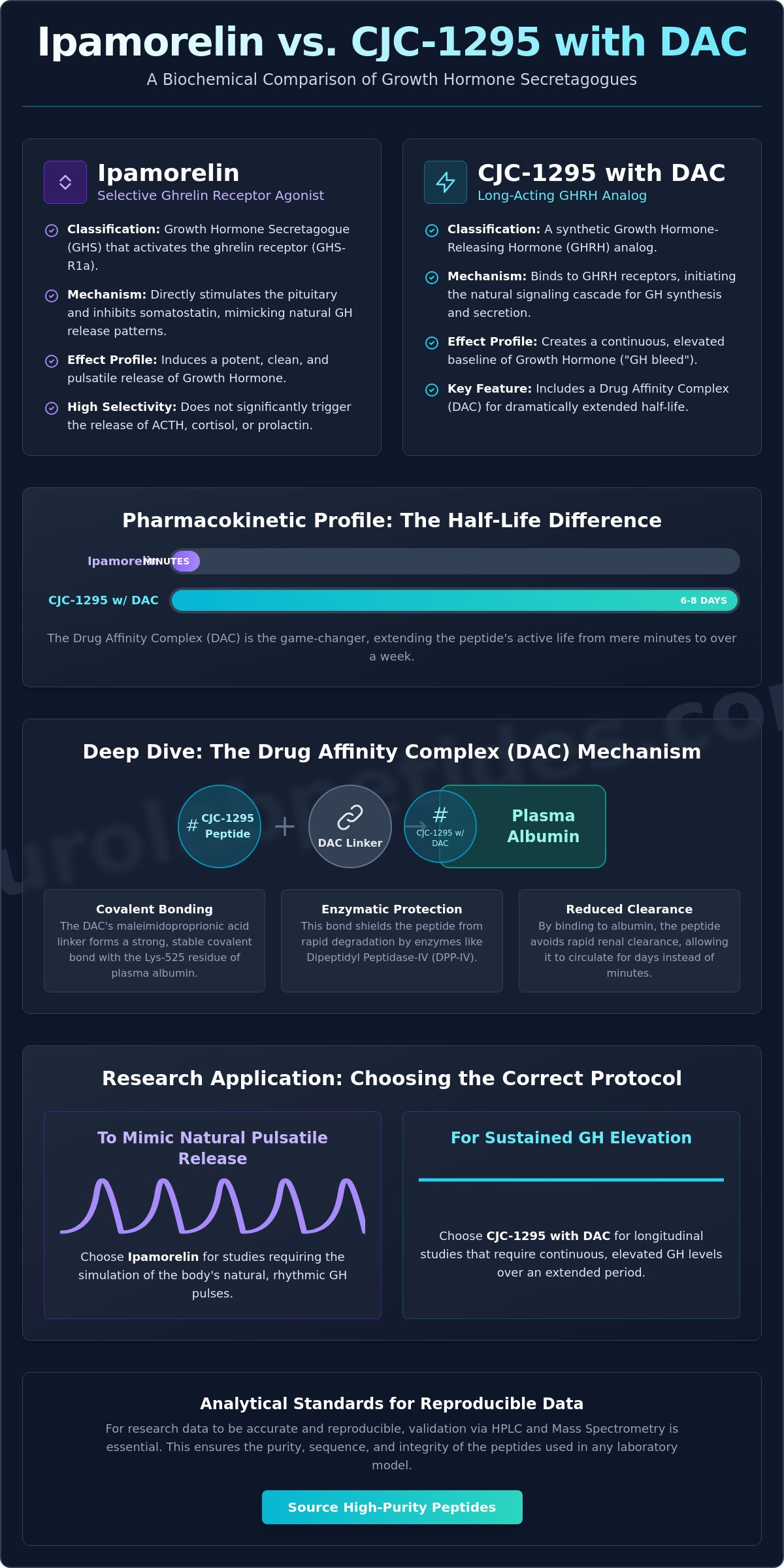
Ipamorelin is a pentapeptide with the specific structural sequence Aib-His-D-2-Nal-D-Phe-Lys-NH2. It’s recognized for its high degree of selectivity for the growth hormone secretagogue receptor (GHS-R1a). Unlike earlier generations of secretagogues, it doesn’t trigger the release of ACTH, cortisol, or prolactin, ensuring a focused research window that minimizes confounding variables. Its mechanism of action involves a dual approach; it directly stimulates the pituitary gland and simultaneously inhibits somatostatin, the hormone responsible for GH suppression. This results in a potent secretagogue effect without the orectic, or hunger-inducing, side effects often associated with ghrelin mimetics. By focusing purely on the GHS-R1a receptor, Ipamorelin maintains the natural pulsatile nature of hormone secretion.
CJC-1295: A Tetrasubstituted Peptide Analog
CJC-1295 is a tetrasubstituted peptide analog derived from the first 29 amino acids of endogenous GHRH, often referred to as GRF 1-29. To enhance metabolic stability, four specific amino acid substitutions are utilized: D-Alanine at position 2, Glutamine at position 8, Alanine at position 15, and Leucine at position 27. These modifications protect the peptide from rapid enzymatic degradation by dipeptidyl peptidase-4 (DPP-4). By binding to the GHRH receptor (GHRHR) in the anterior pituitary, CJC-1295 initiates the natural signaling cascade for GH synthesis and secretion. The ipamorelin vs cjc-1295 dac mechanism comparison highlights that while CJC-1295 provides the signal for GH production, it relies on a different receptor set than Ipamorelin, focusing on the GHRH pathway rather than the ghrelin pathway.
The modulation of the somatotropic axis in research models depends on the synergy between these two classes. GHRH analogs like CJC-1295 increase the quantity of GH-producing cells and the total pool of available GH. In contrast, GHS-R1a agonists like Ipamorelin trigger the immediate release of that stored hormone. This distinction between receptor-specific agonism and endogenous hormone mimicry allows researchers to manipulate GH levels with high precision. By selecting the appropriate analog based on its biochemical classification, investigators can better predict the physiological response within the laboratory model.
The CJC-1295 DAC Mechanism: Albumin Binding and Pharmacokinetics
The fundamental distinction in the ipamorelin vs cjc-1295 dac mechanism lies in the Drug Affinity Complex (DAC). This technology facilitates a covalent bond between the peptide and endogenous plasma albumin. Specifically, the maleimidoproprionic acid linker at the C-terminus of CJC-1295 reacts with the free thiol group on the Lys-525 residue of albumin. This interaction creates a stable conjugate that effectively shields the peptide from dipeptidyl peptidase-IV (DPP-IV) enzymatic degradation. Consequently, the molecule avoids rapid renal clearance, which is the primary limitation of non-modified GHRH analogs.
While standard analogs possess a half-life measured in minutes, the DAC modification extends this duration to a window exceeding 6 to 8 days in laboratory models. This shift occurs because the peptide assumes the long-circulating properties of albumin. Researchers seeking high-purity materials for such longitudinal studies often prioritize Ipamorelin Analytical Standards and verified CJC-1295 sequences to ensure data integrity across multiple observation points.
Covalent Bonding vs. Non-Covalent Association
Unlike non-covalent associations where peptides may detach prematurely, the DAC moiety ensures a permanent attachment until the albumin molecule is naturally catabolized. This creates a circulating reservoir. The volume of distribution is significantly reduced, as the peptide remains primarily within the intravascular compartment. This predictable concentration is vital for Longevity & Vitality Research where steady-state exposure is the primary objective.
Continuous Secretion vs. Pulsatile Release
The pharmacokinetic profile of CJC-1295 DAC leads to a phenomenon often termed “GH Bleed.” Because the GHRH receptor is constantly stimulated by the steady-state concentration of the peptide, growth hormone levels remain elevated without the characteristic troughs seen in natural physiology. This contrasts sharply with the pulsatile release facilitated by non-DAC variants or Ipamorelin. For research focusing on chronic GH exposure rather than acute rhythmic pulses, the ipamorelin vs cjc-1295 dac mechanism provides a necessary constant stimulus. This continuous secretion model is instrumental in studying the long-term metabolic effects of sustained somatotropic activation.
Ipamorelin Mechanism: Selective Ghrelin Receptor Agonism
Ipamorelin is recognized as a second-generation Growth Hormone Secretagogue (GHS) that exhibits a more refined pharmacological profile than its predecessors. Unlike earlier analogs such as GHRP-6, which often trigger significant releases of ACTH and prolactin, Ipamorelin maintains strict selectivity for the Growth Hormone Secretagogue Receptor (GHS-R1a). It’s specifically engineered to avoid the orexigenic pathways that induce hunger, making it a critical tool for Weight Management Research where metabolic precision is paramount. While GHRP-6 lacks the specificity to avoid non-target pituitary hormone elevation, Ipamorelin demonstrates a high degree of receptor selectivity that focuses exclusively on the somatotropic axis.
This peptide functions by mimicking the action of endogenous ghrelin, yet it doesn’t bind to the receptors responsible for gastric emptying or appetite stimulation. By targeting the GHS-R1a receptor, it provides a potent signal for GH release while maintaining the natural pulsatile rhythm of the endocrine system. Understanding this selectivity is essential when evaluating the ipamorelin vs cjc-1295 dac mechanism, as Ipamorelin provides the rhythmic amplitude that DAC-modified analogs lack.
GHS-R1a Signaling Pathways
The binding of Ipamorelin to the GHS-R1a receptor initiates the phospholipase C (PLC) signaling pathway. This activation leads to the production of inositol triphosphate (IP3), which subsequently triggers the mobilization of intracellular calcium stores from the endoplasmic reticulum. Increased cytosolic calcium concentrations serve as the primary catalyst for the exocytosis of GH-containing vesicles from pituitary somatotrophs. In comparative in-vitro assays, Ipamorelin displays a potency profile comparable to Hexarelin, but it does so without the rapid receptor desensitization risks often observed with high-dose Hexarelin exposure.
Somatostatin Antagonism
Beyond direct pituitary stimulation, Ipamorelin actively suppresses somatostatin, the endogenous hormone that functions as the physiological “brake” on GH release. This dual-action mechanism ensures the pituitary is both signaled to release GH and permitted to do so without inhibitory interference. This inhibitory suppression is a vital component of Tissue Repair & Recovery Research, as it maximizes the efficiency of each secretagogue pulse. When contrasted with the findings in CJC-1295 DAC Pharmacokinetics, it’s clear that Ipamorelin offers a tactical advantage for researchers who require discrete, high-amplitude surges rather than the continuous, non-rhythmic elevation characteristic of the DAC mechanism. This synergy with the body’s natural inhibitory bypass makes it a cornerstone of modern secretagogue modeling.
The ipamorelin vs cjc-1295 dac mechanism debate often centers on this pulsatile versus continuous release. By inhibiting somatostatin, Ipamorelin allows for a more robust response to endogenous GHRH, effectively amplifying the natural spikes in growth hormone levels. This makes it particularly useful for studies where maintaining the integrity of the natural hormonal rhythm is a primary research objective.
Comparative Analysis: DAC vs. No DAC in Synergistic Research
The synergy between GHRH analogs and Growth Hormone Secretagogues (GHS) is a cornerstone of somatotropic modeling. Researchers combine these classes because they target different physiological mechanisms; GHRH analogs increase the total pool of GH producing cells and synthesis, while GHS agents like Ipamorelin trigger the immediate release of those stores. In the context of the ipamorelin vs cjc-1295 dac mechanism, the primary variable is the temporal delivery of the GHRH signal. When Ipamorelin is paired with Mod GRF 1-29 (CJC-1295 without DAC), the resulting GH pulse mimics the natural physiological rhythm, as both peptides possess short half-lives and clear the system rapidly. This prevents the “GH bleed” associated with continuous stimulation.
Conversely, pairing Ipamorelin with CJC-1295 DAC creates a model of chronic GH elevation. The DAC moiety ensures the GHRH receptor is constantly occupied, providing a persistent baseline of GH secretion. While this maximizes total GH output, it introduces the risk of pituitary desensitization. Continuous stimulation of the GHRH receptor can lead to downregulation, potentially reducing the pituitary’s responsiveness to endogenous signals over long-term observation periods. Researchers must weigh the benefits of steady-state elevation against the potential for altered receptor sensitivity.
Pharmacokinetic Modeling in Laboratory Settings
The kinetic divergence between these models is stark. Ipamorelin provides a discrete activity window of approximately 2 hours, making it ideal for studies requiring precise, timed interventions. In contrast, the DAC variant exhibits a half-life of roughly 150 hours, maintaining elevated serum levels for nearly a week. This difference fundamentally alters the IGF-1 response curve. Pulsatile models result in rhythmic IGF-1 fluctuations, whereas the ipamorelin vs cjc-1295 dac mechanism in a DAC-inclusive stack produces a stable, high-plateau IGF-1 concentration. For accurate data, administration intervals for Ipamorelin in non-DAC models must be strictly timed to align with natural GH peaks.
Research Applications: Tissue Repair vs. Metabolic Studies
The choice between DAC and non-DAC variants often depends on the specific research objective. Tissue repair models frequently favor the pulsatile nature of non-DAC stacks, as this mimics the body’s natural recovery cycles. For investigators focusing on wound healing or ligamentous repair, integrating these secretagogues with other regenerative peptides can yield significant data. A detailed analysis of these interactions is available in our technical guide to BPC-157. Metabolic and weight management research, however, often utilizes the steady-state GH elevation provided by DAC to study fat oxidation and glucose metabolism under conditions of sustained somatotropic activity. To explore these synergistic effects in your own laboratory models, consider the validated profiles of our Recovery Research Stack.
Analytical Standards for Research-Grade Peptides
High-precision research requires more than just a theoretical understanding of the ipamorelin vs cjc-1295 dac mechanism; it demands empirical validation of the chemical entities themselves. High-Performance Liquid Chromatography (HPLC) is the gold standard for purity verification. It utilizes a stationary phase and a pressurized liquid solvent to separate each component within a sample. This process allows researchers to quantify the exact percentage of the target peptide relative to any residual trifluoroacetic acid (TFA) or synthesis byproducts. When data integrity is the priority, these metrics provide the necessary foundation for objective analysis.
While HPLC confirms purity, Mass Spectrometry (MS) is required to verify the molecular weight and amino acid sequence. MS ionizes the peptide molecules and measures their mass-to-charge ratio. This step is non-negotiable for distinguishing CJC-1295 DAC from its non-DAC counterpart, as the addition of the Drug Affinity Complex significantly alters the molecular mass. Relying on third-party laboratory testing eliminates supplier bias. It ensures that the data collected in your laboratory models isn’t compromised by substandard materials or sequence errors.
EuroLab Peptides Quality Protocol
Our synthesis process follows a multi-level quality control framework designed for high-stakes professional inquiry. Every batch undergoes internal testing before being subjected to independent validation by accredited external facilities. We ensure a purity benchmark of <99%, providing a level of precision that supports reproducible results in complex longitudinal studies. Transparency is maintained through the provision of a comprehensive Certificate of Analysis (COA) for every product. This documentation includes the raw HPLC chromatograms and MS spectra, allowing researchers to verify the integrity of their materials before initiating a protocol.
Storage and Stability in the Lab
The stability of lyophilized powders is contingent upon strict environmental controls. For long-term storage, lyophilized CJC-1295 DAC should be maintained at temperatures between -20°C and -80°C to prevent peptide degradation. Once reconstituted, the peptide becomes significantly more fragile. Researchers typically use bacteriostatic water or sterile saline for reconstitution, as these media maintain a stable pH and inhibit microbial growth. It’s critical to avoid vigorous agitation during this process; gentle swirling is the preferred method to prevent the shearing of delicate peptide bonds. For detailed handling specifications and molecular stability data, researchers should consult the Ipamorelin technical profile. Adherence to these analytical and storage standards ensures that the observed variances in the ipamorelin vs cjc-1295 dac mechanism are the result of biochemical pathways rather than chemical degradation or impurity interference.
Advancing Secretagogue Research with Precision Analytics
Identifying the optimal ipamorelin vs cjc-1295 dac mechanism for specific laboratory objectives requires a rigorous understanding of these diverging pharmacokinetic profiles. Ipamorelin facilitates a selective, pulsatile surge of growth hormone via GHS-R1a agonism without affecting non-target pituitary hormones like cortisol or prolactin. In contrast, the DAC modification on CJC-1295 establishes a continuous secretagogue state through covalent albumin binding at the Lys-525 residue. This fundamental distinction determines whether a research model reflects natural rhythmic pulses or sustained, steady-state metabolic elevation.
Scientific accuracy in these inquiries is contingent upon the chemical integrity of the compounds utilized. Every batch at EuroLab Peptides undergoes independent third-party laboratory testing to ensure verified HPLC/MS analysis with a purity benchmark exceeding 99%. Our specialized European logistics infrastructure is designed to support the rigorous demands of research institutions by providing reliable, documented delivery and maintaining the stability of lyophilized sequences during transit.
Browse High-Purity Research Peptides at EuroLab Peptides to secure the analytical standards required for your next project. We’re committed to supporting the precision and transparency essential for professional biochemical inquiry and look forward to facilitating your next breakthrough.
Frequently Asked Questions
What is the primary difference between CJC-1295 with DAC and without DAC?
The primary difference is the presence of the Drug Affinity Complex moiety, which facilitates covalent bonding to plasma albumin. This modification transforms the peptide from a short-acting GHRH analog, often referred to as Mod GRF 1-29, into a long-circulating secretagogue. Without DAC, the peptide is rapidly cleared by renal filtration and enzymatic degradation, typically within a 30-minute window.
Can Ipamorelin and CJC-1295 DAC be reconstituted in the same vial for research?
Reconstituting these peptides in the same vial is generally discouraged in high-precision research models. Variations in isoelectric points and potential peptide-peptide interactions may compromise the structural integrity of the sequences. Maintaining separate vials ensures that the concentration of each agent remains verifiable and that degradation rates are monitored independently during the study.
How does the DAC modification affect the half-life of the peptide?
The DAC modification extends the half-life of the peptide from approximately 30 minutes to a duration exceeding 6 to 8 days in laboratory models. This shift occurs because the covalent bond to albumin prevents dipeptidyl peptidase-IV (DPP-IV) from cleaving the peptide. In the context of the ipamorelin vs cjc-1295 dac mechanism, this extended residency time creates a steady-state physiological environment.
Is pituitary desensitization a concern with CJC-1295 DAC in long-term studies?
Pituitary desensitization is a recognized risk in long-term studies involving continuous GHRH receptor stimulation. The “GH bleed” phenomenon caused by DAC-modified analogs provides a non-rhythmic signal that can lead to receptor downregulation. Researchers often utilize pulsatile models with non-DAC variants to mitigate this risk and preserve the natural responsiveness of the somatotropic axis.
Why is Ipamorelin considered more selective than GHRP-2 or GHRP-6?
Ipamorelin exhibits superior selectivity because it exclusively targets the GHS-R1a receptor without cross-reacting with receptors that trigger ACTH or prolactin release. Earlier analogs like GHRP-2 and GHRP-6 often produce unwanted elevations in cortisol and hunger-inducing orexigenic pathways. This specificity makes Ipamorelin a more precise tool for isolating growth hormone effects in controlled laboratory settings.
What are the storage requirements for lyophilized research peptides?
Lyophilized research peptides require storage at temperatures between -20°C and -80°C for long-term stability. Protection from light and moisture is essential to prevent chemical degradation of the lyophilized cake. Once reconstituted with bacteriostatic water, the solution should be kept refrigerated at 2°C to 8°C and utilized within a limited window to ensure sequence integrity.
How do GHRH analogs and GH secretagogues work together in a synergistic model?
GHRH analogs and GH secretagogues work synergistically by targeting different stages of the GH release cycle. CJC-1295 increases the synthesis of GH and the total pool of available secretory vesicles, while Ipamorelin triggers the immediate exocytosis of these stores and suppresses somatostatin. This dual-action approach results in a significantly amplified GH pulse compared to using either agent in isolation.
What analytical methods are used to verify the purity of CJC-1295 DAC?
Verification of CJC-1295 DAC purity relies on High-Performance Liquid Chromatography (HPLC) and Mass Spectrometry (MS). HPLC quantifies the purity percentage by separating the target peptide from synthesis impurities, while MS confirms the exact molecular mass and amino acid sequence. These analytical methods are essential for validating the ipamorelin vs cjc-1295 dac mechanism in any rigorous scientific protocol.
