

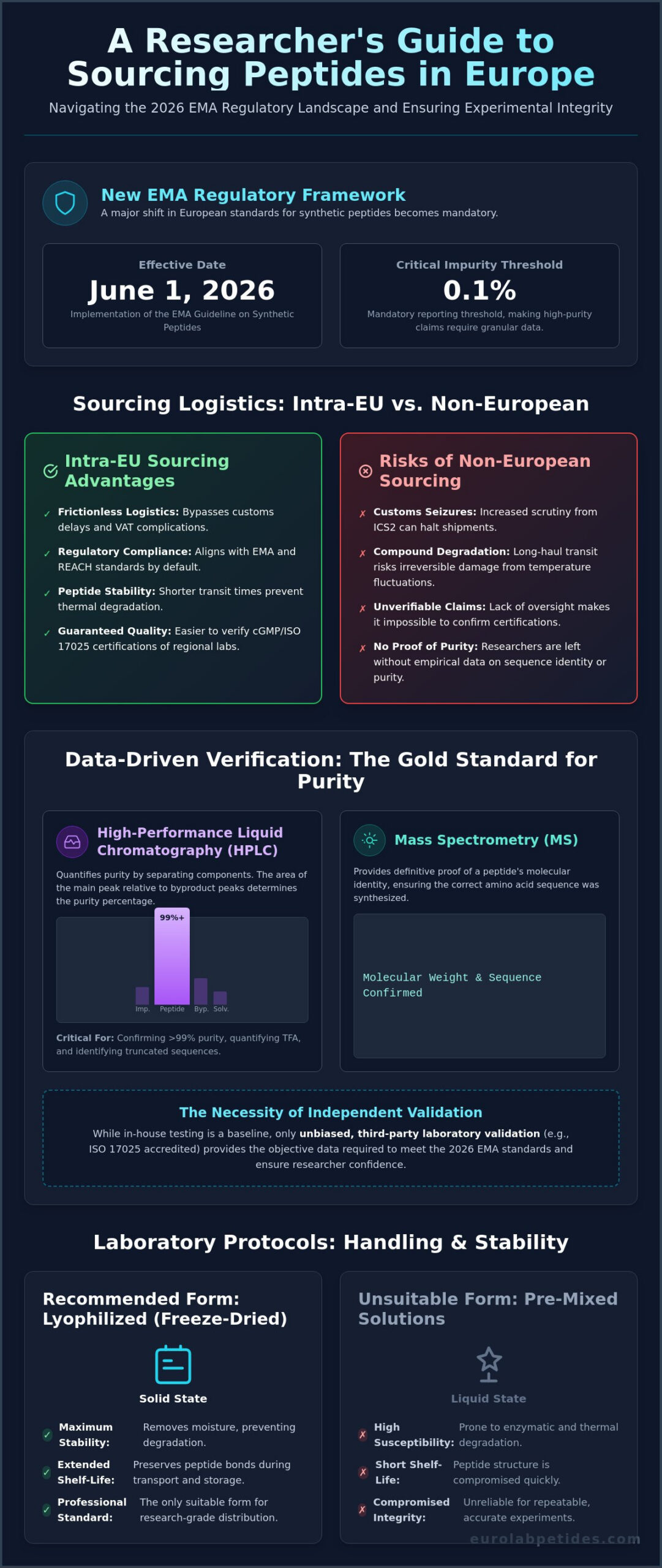
The implementation of the EMA Guideline on the Development and Manufacture of Synthetic Peptides on June 1, 2026, has codified a 0.1% reporting threshold for impurities, rendering traditional high-purity claims obsolete without granular analytical backing. It’s a reality that researchers often encounter significant logistical friction, ranging from batch-to-batch inconsistency to prohibitive customs delays when attempting to buy research peptides Europe from non-regional sources. In a landscape of increasing regulatory scrutiny, particularly regarding GLP-1 class compounds, the margin for error in chemical synthesis has effectively vanished.
This guide provides a technical framework for evaluating laboratory-grade sourcing standards, ensuring your procurement process aligns with current European regulatory compliance and REACH standards. The following sections examine the critical role of cGMP certification and the necessity of ISO 17025 accredited third-party validation. This analytical overview concludes with an assessment of specialized research stacks and the logistical protocols required to prevent peptide degradation during transit within the European Economic Area.
Key Takeaways
- Navigate the updated 2026 EMA regulatory landscape and the critical 0.1% reporting threshold for synthetic peptide impurities.
- Utilize HPLC and Mass Spectrometry data as non-negotiable metrics for verifying peptide purity and molecular sequence accuracy.
- Streamline procurement by leveraging intra-EU distribution to buy research peptides Europe without customs friction or VAT complications.
- Apply standardized laboratory protocols for the reconstitution and handling of lyophilized compounds to ensure experimental integrity.
- Explore specialized research stacks, including longevity and tissue repair frameworks, supported by a rigorous multi-level quality control protocol.
The Landscape of Sourcing Research Peptides in Europe
The procurement of high-purity biochemicals requires a foundational understanding of molecular stability and regulatory frameworks. To define the subject, What are peptides? They’re short chains of amino acids linked by peptide bonds, synthesized for specific laboratory applications. In the context of 2026, those looking to buy research peptides Europe must distinguish between industrial-grade chemicals and research-grade peptides designed for in-vitro and laboratory development. The latter requires rigorous analytical validation to ensure that the primary sequence remains uncompromised during synthesis.
The European regulatory environment underwent a significant shift on June 1, 2026, with the implementation of the EMA Guideline on the Development and Manufacture of Synthetic Peptides. This directive established a 0.1% reporting threshold for impurities, demanding a level of transparency that many global suppliers cannot meet. Regional sourcing isn’t just a logistical preference; it’s a prerequisite for maintaining peptide chain integrity and ensuring compliance with REACH standards. When researchers buy research peptides Europe, they’re engaging with a supply chain governed by these strict analytical benchmarks.
Stability is a primary concern in chemical synthesis. Research-grade peptides are predominantly distributed as lyophilized solids rather than liquid solutions. Lyophilization, or freeze-drying, removes moisture from the compound, significantly extending its shelf life and preserving the structural integrity of the peptide bonds during transport. Solution-based peptides are highly susceptible to enzymatic degradation and thermal instability, making them unsuitable for professional laboratory distribution.
Understanding Research-Only Designations
Synthetic peptides sold within the European Union are classified as ‘research use only’ chemicals. This designation places them outside the scope of Directive 2001/83/EC, provided they’re used exclusively for in-vitro study or laboratory analysis. EuroLab Peptides adheres to these legal frameworks by maintaining strict ‘not for human consumption’ compliance. This ethical commitment ensures that the focus remains on biochemical inquiry and the advancement of scientific data rather than unregulated application.
Risks of Non-European Sourcing
Procuring materials from outside the EU introduces substantial logistical and qualitative risks. The Import Control System 2 (ICS2) has increased customs scrutiny, often leading to the seizure of GLP-1 class compounds and other research materials at the border. Long-haul international transit exposes sensitive peptides to extreme temperature fluctuations, which can trigger irreversible degradation of the peptide chain. Verifying the cGMP or ISO 17025 certifications of non-EU laboratories is often impossible. This lack of oversight leaves the researcher with no empirical proof of purity or sequence identity.
Analytical Standards for Verifying Peptide Purity
Data-driven verification has superseded trust-based procurement in the chemical synthesis sector. For those who buy research peptides Europe, the ability to interpret analytical data is the only safeguard against substandard materials. High-Performance Liquid Chromatography (HPLC) and Mass Spectrometry (MS) are the primary instruments used to establish a verifiable metric of quality. These methodologies provide the empirical evidence required to confirm both the purity level and the molecular identity of a synthesized compound.
HPLC Methodology in Peptide Analysis
HPLC methodology relies on the separation of chemical species within a pressurized liquid solvent. Each component is identified by its specific retention time; the purity percentage is derived from the relative area of the main peak compared to secondary peaks representing synthesis byproducts. For metabolic research, the 98% and 99% purity thresholds are critical; even marginal deviations can introduce confounding variables into in-vitro models. HPLC methodology is utilized to quantify residual Trifluoroacetic acid (TFA) concentrations, ensuring they fall below the established safety thresholds for laboratory inquiry. Identifying impurities through peak analysis and retention times allows researchers to exclude batches containing truncated sequences or deleted amino acids.
The Necessity of Independent Laboratory Validation
Unbiased purity metrics are only achievable through external verification. While in-house testing is a necessary first step, independent third-party labs provide the objective data required for 2026 standards. EuroLab Peptides submits every production batch to independent facilities to confirm that internal results align with external benchmarks. This process adheres to Good Laboratory Practice (GLP) principles, ensuring data integrity and reproducibility. Verifying the credentials of the testing facility, such as ISO 17025 accreditation, is a mandatory step in the procurement process. Reviewing the technical specifications at EuroLab Peptides provides a benchmark for these analytical standards.
Mass Spectrometry serves as the secondary layer of validation by providing sequence confirmation and molecular weight verification. While HPLC determines the quantity of the target peptide relative to impurities, MS confirms that the synthesized chain actually matches the theoretical molecular weight of the target sequence. A comprehensive Certificate of Analysis (COA) must include both HPLC chromatograms and MS reports. It’s not enough to see a summary table; the researcher must inspect the raw data to ensure no overlapping peaks or baseline noise suggest hidden contaminants. This level of transparency is essential for anyone looking to buy research peptides Europe for high-stakes metabolic studies.
Logistical Advantages of European-Based Peptide Distribution
The logistical framework of the European Single Market provides a distinct advantage for laboratory procurement. By utilizing intra-EU shipping, researchers avoid the logistical friction associated with the Import Control System 2 (ICS2) and the unpredictable delays of customs clearance. When organizations buy research peptides Europe, the transaction is treated as an intra-community acquisition, effectively eliminating the VAT complications and border seizures that frequently compromise international shipments. This regional proximity ensures that the chain of custody remains transparent and accountable from the point of synthesis to final delivery.
Securing the physical integrity of research materials requires specialized packaging protocols. Standardized laboratory-grade distribution utilizes light-shielded, shock-absorbent containers to protect the lyophilized matrix from photodegradation and mechanical stress. Every shipment is assigned a unique tracking identifier, allowing for real-time monitoring of the transit environment. This level of accountability is essential for maintaining the high-stakes precision required in biochemical inquiry. The use of discreet, neutral packaging further ensures the secure arrival of sensitive laboratory reagents without unnecessary external scrutiny.
Intra-Schengen Logistics and Speed
The concentration of high-efficiency logistics hubs within the Schengen Area enables rapid transit times, typically ranging from 24 to 72 hours for major research centers. This speed is a critical factor in ensuring consistent supply chains for long-term longitudinal studies, such as those focused on Longevity & Vitality Research or Tissue Repair & Recovery Research. Reducing the transit duration minimizes the cumulative exposure to environmental variables. Additionally, localized distribution significantly lowers the carbon footprint associated with laboratory procurement compared to transcontinental air freight, aligning with modern institutional sustainability goals.
Maintaining Cold Chain and Stability
While lyophilized peptides are engineered for resilience at ambient temperatures during short-haul transit, certain complex sequences or solution-based reagents require strict cold chain management. For most freeze-dried solids, the vacuum-sealed environment of the vial provides sufficient protection against atmospheric moisture and thermal degradation for the duration of European shipping. Strategic storage protocols at European distribution centers involve temperature-controlled warehousing at -20°C or -80°C to preserve long-term enzymatic stability. It’s the responsibility of the distributor to determine when active cooling, such as insulated gel packs, is technically necessary based on the specific molecular sequence being transported. When you buy research peptides Europe from regional suppliers, the risk of degradation due to prolonged heat exposure is effectively mitigated.
Laboratory Protocols for Handling and Reconstitution
Precision in the laboratory environment is as critical as the purity of the biochemical itself. Once researchers buy research peptides Europe, the focus shifts to maintaining molecular integrity during the transition from a lyophilized solid to a liquid reagent. This phase requires adherence to standardized protocols to ensure that the primary sequence remains stable and the concentration is accurately quantified for in-vitro application. Any deviation in handling can introduce confounding variables that compromise the reproducibility of the data.
Selecting the appropriate solvent is the first analytical variable. Bacteriostatic water, containing 0.9% benzyl alcohol, is typically utilized to inhibit bacterial growth in multi-use vials. However, certain research models may require sterile saline (0.9% NaCl) to maintain specific osmotic conditions or pH levels. The choice of diluent must align strictly with the requirements of the metabolic or tissue repair study being conducted. It’s essential to quantify the solvent volume to achieve the exact molarity required for the experimental design.
The Reconstitution Process
The introduction of the solvent must be performed with high-stakes precision to prevent peptide shearing. The liquid should be directed down the internal side of the glass vial, allowing it to slowly saturate the lyophilized cake. Forceful agitation or direct impact can disrupt the delicate peptide bonds of the molecule. Utilizing a peptide reconstitution calculator is mandatory for ensuring that the final concentration matches the intended laboratory parameters. After the solvent is added, the vial should be gently swirled rather than shaken. A visual inspection for complete solubility and clarity is the final step; any turbidity or particulate matter indicates a failure in the reconstitution protocol or potential degradation.
Storage and Stability Benchmarks
Thermal management is the primary determinant of a peptide’s shelf life. Lyophilized materials should be stored at temperatures between -20°C and -80°C for long-term preservation, where they can remain stable for several years. When professionals buy research peptides Europe, they must account for the specific storage requirements of each compound to prevent experimental drift. Once reconstituted, the stability window narrows significantly. Solution-based peptides should be maintained at 4°C and used within a specific timeframe, often not exceeding 14 to 30 days depending on the specific sequence.
Researchers must avoid repeated freeze-thaw cycles, which introduce mechanical stress to the molecules. Aliquoting the solution into smaller, single-use volumes before initial freezing is a standard laboratory practice to mitigate this risk. Additionally, protection from direct light exposure is necessary to prevent photodegradation of the amino acid chain. For high-precision inquiry, procurement from a reliable source like EuroLab Peptides ensures that the starting material meets the rigorous standards required for these handling protocols.
EuroLab Peptides: Specialized Research Stacks and Quality Protocol
EuroLab Peptides operates at the intersection of biochemical precision and logistical reliability. Researchers who buy research peptides Europe require more than isolated compounds; they require validated frameworks for complex inquiry. Our multi-level quality control protocol integrates internal HPLC analysis with independent ISO 17025 validation for every batch. This rigorous approach ensures that every vial meets the 2026 reporting thresholds established by the EMA, providing a verifiable metric of excellence for the professional user.
The pentadecapeptide BPC-157 is a foundational tool in recovery and inflammation models. It’s frequently investigated for its role in angiogenic modulation and tissue repair within in-vitro environments. Similarly, the growth hormone secretagogue Ipamorelin is utilized in scientific settings for its selective ghrelin receptor agonism. This selectivity allows for the study of somatotropin release without the confounding variables of cortisol or prolactin elevation. By providing these compounds with comprehensive analytical backing, EuroLab facilitates high-stakes precision in laboratory settings.
Targeted Research Applications
The 2026 research landscape demands specialized tools for metabolic regulation and weight management studies. Compounds like SLU-PP-332 are currently being evaluated for their impact on mitochondrial function and metabolic rate. In the field of longevity research, components such as Epitalon and GHK-Cu are examined for their influence on telomere maintenance and cellular regeneration. Cognitive function research models often incorporate Semax and DSIP to investigate neuroprotective pathways and sleep-wake cycle regulation. Beyond the laboratory, those interested in the application of these principles to cognitive wellness can explore The Brain Song (Killer NEW Memory Offer) to see how sleep and memory rituals are evolving. These targeted applications are supported by EuroLab’s specialized stacks, including the Longevity Research Stack and the Advanced Metabolic Stack.
The EuroLab Commitment to Purity
Our 2026 mandate requires 100% transparency in analytical reporting. Every batch is accompanied by raw HPLC and Mass Spectrometry data, ensuring that purity isn’t just claimed but verified through empirical evidence. Our European base provides a shorthand for reliability, allowing researchers to buy research peptides Europe with total confidence in the regional regulatory compliance and localized logistics. This commitment to moral consistency and technical rigor positions EuroLab as a meticulous partner in the chemical synthesis space. Researchers are invited to review our full catalog of research-grade peptides to align their procurement with these laboratory-grade standards.
Standardizing Analytical Excellence in European Peptide Procurement
The 2026 regulatory landscape has redefined the benchmarks for biochemical sourcing. Success in complex research models relies on the intersection of 99%+ purity thresholds and the logistical integrity of intra-EU distribution. By prioritizing compounds with verifiable third-party analytical validation, researchers eliminate the confounding variables introduced by synthesis byproducts or degradation during transit. Adherence to standardized reconstitution and storage protocols is the final step in ensuring that laboratory data remains precise and reproducible.
Procurement decisions should be guided by empirical evidence rather than marketing claims. When you buy research peptides Europe from regional specialists, you’re investing in a supply chain that respects both the technical demands of biochemistry and the legal requirements of REACH compliance. EuroLab Peptides maintains this standard by providing strictly laboratory-grade materials for in-vitro research, supported by comprehensive HPLC and Mass Spectrometry reporting for every batch.
Researchers based in the UK who require the same level of analytical rigor and high-purity standards can learn more about Astra Labs and their specialized catalog of research-grade compounds.
Secure High-Purity Research Peptides from EuroLab Peptides to ensure your research is supported by clinical-grade precision and secure regional logistics. Reliable data begins with a reliable partner.
Frequently Asked Questions
Is it legal to buy research peptides in Europe?
Synthetic peptides are legally available for laboratory use under the “research use only” classification, which excludes them from the definition of medicinal products under Directive 2001/83/EC. Researchers who buy research peptides Europe must ensure the materials are utilized exclusively for in-vitro study and laboratory development. It’s essential to verify specific national regulations, as countries like Germany or certain Nordic nations may require additional documentation for chemical procurement.
How do I verify the purity of the peptides I purchase?
Purity is verified through the rigorous analysis of High-Performance Liquid Chromatography (HPLC) chromatograms and Mass Spectrometry (MS) data. A legitimate Certificate of Analysis (COA) must demonstrate that the primary peak area meets the 98% or 99% threshold while adhering to the 2026 EMA reporting threshold of 0.1% for impurities. Verification is only complete when internal manufacturer data is validated by an independent, ISO 17025 accredited third-party laboratory.
What is the difference between pharma-grade and research-grade peptides?
Pharmaceutical-grade peptides are manufactured for clinical administration and human consumption under strict cGMP standards, whereas research-grade peptides are synthesized for in-vitro laboratory inquiry. While purity levels may be comparable, research-grade chemicals are explicitly not for human consumption or medical use. EuroLab Peptides provides elite tools for serious professional inquiry within the specialized research community, maintaining high-stakes precision in every synthesis.
How should peptides be shipped to ensure they don’t degrade?
Peptides should be shipped in a lyophilized (freeze-dried) state within vacuum-sealed vials to ensure maximum molecular stability. This solid matrix is highly resilient during the 24 to 72 hour transit windows typical of intra-EU logistics. Secure, light-shielded packaging is utilized to prevent photodegradation, while the speed of regional shipping minimizes the cumulative exposure to thermal fluctuations that can compromise the amino acid chain.
What is the shelf life of a lyophilized peptide?
Lyophilized peptides maintain structural integrity for several years when stored in a controlled environment at -20°C or -80°C. At standard refrigeration of 4°C, the compounds typically remain stable for 12 to 24 months. When you buy research peptides Europe, the materials arrive in a state optimized for long-term storage, though the stability window narrows significantly to approximately 14 to 30 days once the compound is reconstituted into a liquid solution.
Can research peptides be used for clinical trials?
Research-grade peptides are strictly prohibited from use in clinical trials or any form of human application. These substances are categorized as laboratory reagents intended for in-vitro study and biochemical analysis. Any use beyond the laboratory setting violates the “research use only” designation and falls outside the intended scope of chemical distribution. EuroLab Peptides does not sell products for human consumption or medical use.
How does EuroLab Peptides ensure batch-to-batch consistency?
Consistency is enforced through a multi-level quality control protocol that begins with cGMP-compliant manufacturing processes. Every production batch is subjected to internal HPLC and Mass Spectrometry analysis to confirm sequence identity and purity. This is followed by mandatory external validation from independent laboratories, ensuring that the numerical quality benchmarks and analytical results remain uniform across different synthesis cycles for all research stacks.
What solvents are recommended for peptide reconstitution?
Bacteriostatic water, containing 0.9% benzyl alcohol, is the standard solvent used to inhibit microbial growth during the course of a study. In specific research models where benzyl alcohol may interfere with experimental variables, sterile saline (0.9% NaCl) is an appropriate alternative. The choice of solvent must be dictated by the specific solubility profile of the peptide and the requirements of the in-vitro model being utilized.
