

A single thermal excursion can compromise the 99% purity threshold of a triple-agonist sequence, rendering complex metabolic research data fundamentally invalid. Professional researchers recognize that the structural integrity of high-value materials is the baseline for any credible laboratory outcome. This protocol establishes the definitive retatrutide storage guidelines required to prevent hydrolysis and maintain bioactivity over extended durations. You’ll gain a clear, evidence-based SOP for managing both lyophilized powders at -20°C and reconstituted solutions within the critical 2°C to 8°C range.
We’ll detail the precise environmental parameters necessary to maximize the utility of your research materials and ensure that experimental results remain untainted by peptide degradation. This includes managing the 24-month stability window for lyophilized stocks and the 28 to 60 day viability of reconstituted solutions. By adhering to these validated technical standards, laboratories can eliminate the uncertainty of sample degradation and focus on the rigorous demands of specialized metabolic inquiry. This analysis prioritizes empirical data and objective methodology to ensure your high-purity materials perform as specified in your research design.
Key Takeaways
- Understand the biochemical vulnerability of the 39-amino acid sequence and the role of the fatty acid diacid moiety in maintaining structural integrity.
- Implement standardized retatrutide storage guidelines for lyophilized powders at -20°C to ensure a stable 24-month shelf life for long-term archiving.
- Establish a precise 2°C to 8°C refrigeration protocol for reconstituted solutions to preserve bioactivity for up to 60 days when using bacteriostatic water.
- Adopt laboratory SOPs for aliquoting and equilibration to minimize environmental exposure and prevent condensation during sample handling.
- Utilize third-party HPLC and MS validation metrics to verify 99% baseline purity before initiating long-term preservation protocols.
Molecular Stability and the Biochemical Profile of Retatrutide
Retatrutide is a synthetic peptide comprising a 39-amino acid sequence. It’s engineered as a unimolecular triple agonist, simultaneously targeting the glucagon-like peptide-1 (GLP-1), glucose-dependent insulinotropic polypeptide (GIP), and glucagon receptors. This complex architecture includes a C20 fatty acid diacid moiety attached to the lysine residue at position 17. This specific modification is essential for albumin binding; it ensures the peptide maintains a prolonged duration of action in laboratory models. However, this complexity also increases the molecule’s vulnerability to environmental degradation. Adhering to professional retatrutide storage guidelines isn’t just a recommendation; it’s a requirement for maintaining the 99% purity levels necessary for high-stakes research.
The relationship between structural integrity and research data reproducibility is absolute. In professional laboratory environments, even minor alterations to the peptide’s primary structure lead to experimental failure. When amide bonds within the sequence are compromised, the resulting fragments lose their specific receptor affinity. This leads to inconsistent data and wasted resources. Researchers must maintain the peptide’s exact biochemical state to ensure that in-vitro models yield valid results. High-purity peptides synthesized by EuroLab Peptides require these rigorous storage standards to ensure that third-party HPLC and MS analysis remains a true reflection of the sample’s quality throughout the study’s duration.
The Triple Agonist Structure: GLP-1, GIP, and Glucagon
Retatrutide’s amino acid sequence features specific modifications that distinguish it from dual agonists. The integration of glucagon receptor activity adds a layer of biochemical sensitivity. Structural degradation often begins at the glucagon-targeting sites, which are prone to conformational shifts if the cold chain is broken. If these components degrade, the triple-agonist synergy is lost, and the peptide no longer functions as a representative model for advanced metabolic inquiry.
Primary Mechanisms of Peptide Degradation
Deamidation and oxidation are the most frequent pathways for chemical degradation. Deamidation occurs at asparagine residues, while oxidation affects sulfur-containing amino acids. These reactions are temperature-dependent and accelerate when samples are exposed to heat. Peptide hydrolysis is the primary threat to Retatrutide stability in aqueous solutions. Following strict retatrutide storage guidelines mitigates these risks. Maintaining stable temperatures prevents the breakage of peptide bonds, ensuring the sample remains chemically identical to its post-synthesis state.
Lyophilized Retatrutide Storage: Long-Term Preservation Protocols
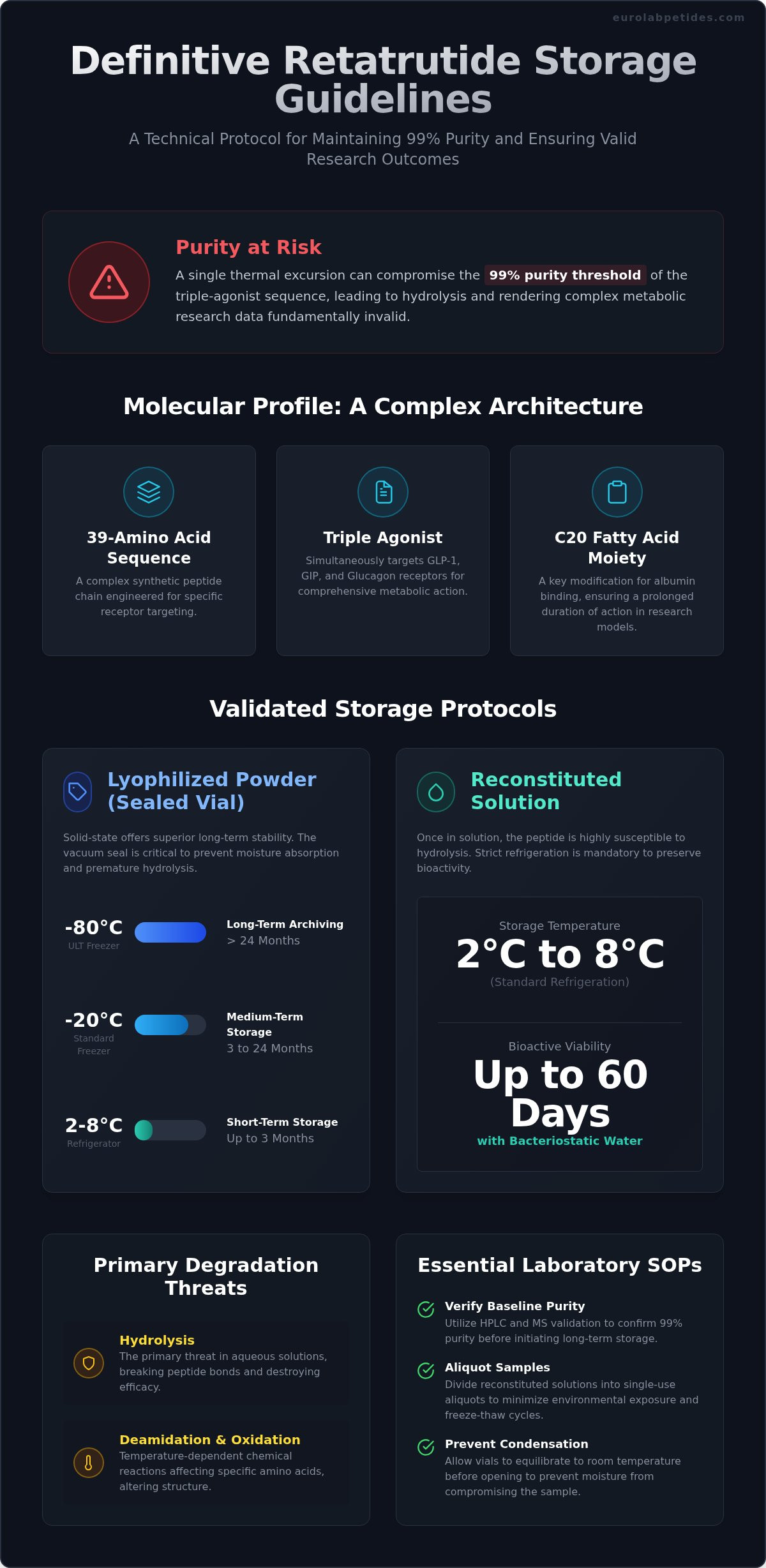
The transition from synthesis to long-term archiving requires a rigorous cold chain protocol to preserve the 99% purity baseline. Upon laboratory receipt, lyophilized Retatrutide must be transferred immediately to a stable thermal environment. Unlike many GLP-1 Receptor Agonists provided in liquid formulations, the solid-state lyophilized powder offers superior stability if the vacuum seal remains intact. These retatrutide storage guidelines dictate that for durations exceeding 24 months, temperatures must be maintained at -20°C or, for indefinite archiving, -80°C.
Maintaining the vacuum seal is the primary defense against atmospheric moisture. If the vial’s integrity is compromised, the hygroscopic nature of the peptide cake facilitates moisture absorption, leading to premature hydrolysis even at sub-zero temperatures. High-purity research materials from EuroLab Peptides are packaged under vacuum to mitigate this risk, but secondary containment remains a critical laboratory standard. Failure to manage these environmental variables often results in experimental variance that can’t be corrected post-reconstitution.
Temperature Thresholds for Solid-State Peptides
Stability windows for lyophilized Retatrutide are strictly temperature-dependent. Laboratory protocols should distinguish between the following storage durations:
- Short-term (up to 3 months): 2°C to 8°C (refrigeration).
- Medium-term (3 to 24 months): -20°C (standard laboratory freezer).
- Long-term (over 24 months): -80°C (ultra-low temperature archiving).
A critical risk factor in laboratory settings is the use of frost-free freezers. These units utilize thermal cycling to prevent ice buildup, which exposes the peptide to repeated temperature fluctuations. Such cycles can induce microscopic structural changes and reduce the effective shelf life. Dedicated, non-cycling laboratory-grade freezers are the only acceptable standard for preserving high-value research stocks.
Environmental Stressors: Light and Moisture
UV light exposure serves as a catalyst for peptide bond cleavage, particularly in sequences with complex side chains like Retatrutide. Opaque storage containers or foil wrapping must be utilized to shield vials from ambient laboratory light. Additionally, the role of desiccants is vital for maintaining the solid state. When vials are removed from the freezer, moisture condensation on the exterior can migrate into the cap assembly. Utilizing secondary containment with silica gel packets ensures the environment remains dry. Adhering to these strict retatrutide storage guidelines ensures the analytical purity of the sample is maintained from receipt to reconstitution.
Handling Reconstituted Retatrutide: Stability in Solution
Reconstitution initiates a significant shift in the peptide’s biochemical profile. The introduction of an aqueous environment increases the risk of hydrolysis, making the molecule more vulnerable than in its lyophilized state. Maintaining retatrutide storage guidelines in the solution state is significantly more demanding. Once the vacuum seal is broken and a solvent is introduced, the 39-amino acid sequence is immediately susceptible to environmental stressors that can compromise its 99% purity baseline.
A fundamental rule in peptide handling is that reconstituted solutions must never be re-frozen. The formation of ice crystals during the freezing process exerts mechanical stress on the peptide’s structure, causing irreversible damage to the sequence. Before any research application, a visual inspection is mandatory. If the solution exhibits cloudiness, visible particulates, or phase separation, it indicates advanced degradation. Such samples don’t meet the rigorous standards required for metabolic research and must be discarded to prevent experimental failure.
Reconstitution Media and Preservative Efficacy
The choice of solvent determines the longevity of the research material. Bacteriostatic water, which contains 0.9% benzyl alcohol, is the preferred medium for multi-use vials because it inhibits microbial growth. In contrast, sterile water or Phosphate Buffered Saline (PBS) lacks these preservatives, making them suitable only for immediate, single-use applications. Solvent pH is another critical variable; deviations from the neutral range accelerate deamidation, particularly at the asparagine residues. Strict aseptic technique is required during reconstitution to prevent microbial-induced degradation of the peptide chain.
Stability Timelines for Aqueous Solutions
Solution-state Retatrutide requires constant refrigeration between 2°C and 8°C. Laboratory protocols typically follow a conservative 28-day window for maintaining peak bioactivity, though an extended protocol of up to 60 days is viable under optimal, stable conditions. Mechanical agitation and temperature excursions outside the specified 2-8°C range significantly shorten this window. To ensure experimental consistency, vials should be labeled with the exact ‘Date of Reconstitution’ and a ‘Calculated Expiry’ based on these retatrutide storage guidelines. This methodical approach ensures that the high-purity materials provided for Weight Management Research perform reliably throughout the duration of the study.
Standard Operating Procedures for Laboratory Handling
Professional laboratory handling extends beyond thermal regulation. Even with strict adherence to retatrutide storage guidelines, improper handling during the transition from storage to application can introduce degradants. Establishing a standardized SOP ensures that the 99% purity achieved during synthesis is maintained through every phase of the experimental process. Researchers must prioritize sterile technique and minimize physical stress on the peptide sequence to prevent structural artifacts.
Step-by-Step Vial Equilibration
Moving a vial from -20°C storage to the laboratory bench requires a methodical equilibration period. Vials should remain in their secondary containment or a desiccator for approximately 30 to 60 minutes until they reach ambient room temperature. This delay is necessary to prevent the formation of condensation on the lyophilized powder. Opening a cold vial immediately introduces atmospheric moisture that can degrade the peptide. This moisture facilitates hydrolysis, even if the powder is subsequently returned to the freezer.
Aliquoting for Multi-Phase Studies
Repeated freeze-thaw cycles are detrimental to peptide stability. To mitigate this, researchers should adopt an aliquoting strategy immediately following the initial reconstitution. By dividing the solution into single-use portions, the main stock remains undisturbed at 2°C to 8°C. Reducing the headspace in each aliquot vial also minimizes the volume of air available for oxidation. For high-stakes research involving Advanced Metabolic Stacks, batch consistency is only as reliable as the labeling and traceability protocols implemented at the bench level.
Physical handling must be characterized by precision rather than force. Vigorous vortexing or rapid aspiration can lead to peptide shearing or the formation of aggregates. Instead, gentle inversion or swirling is the recommended method for ensuring a homogeneous solution. When possible, all handling should occur within a laminar flow hood to maintain an aseptic environment and prevent microbial contamination that could otherwise compromise the peptide’s primary sequence. These meticulous steps ensure that the analytical integrity of the material is preserved for the duration of the study.
Quality Assurance: The EuroLab Peptides Standard
The efficacy of any preservation protocol is fundamentally limited by the initial quality of the synthetic material. Even the most rigorous retatrutide storage guidelines can’t restore bioactivity to a degraded or low-purity sample. EuroLab Peptides implements a multi-level quality control process designed to ensure that every vial exceeds a 99% purity threshold before it enters the cold chain. This baseline purity is a non-negotiable standard for professional inquiry, as sourcing high-quality research peptides remains the primary variable in experimental success. Quality is treated as a verifiable metric, where radical honesty in data reporting builds absolute trust with the specialized research community.
Verification Through Third-Party Testing
Analytical validation is conducted via independent third-party laboratories to provide objective evidence of chemical identity and purity. High-Performance Liquid Chromatography (HPLC) reports provide a chromatographic profile that identifies the primary peak of the target peptide while quantifying any related substances or impurities. Simultaneously, Mass Spectrometry (MS) is utilized to confirm the molecular weight of the 39-amino acid sequence. This ensures the synthesized molecule matches the theoretical sequence of Retatrutide exactly. These EuroLab Peptides Certificates of Analysis (COAs) are provided with every batch, allowing researchers to integrate precise purity metrics into their formal laboratory documentation and ensure batch-to-batch consistency.
Ensuring Research Integrity
Reliability in the global chemical synthesis space is often compromised by opaque supply chains. By sourcing from reputable European peptide suppliers, laboratories benefit from regional manufacturing standards and localized logistics that prioritize cold chain integrity. This logistical precision ensures that materials arrive in their optimal state, ready for immediate archiving or reconstitution according to established retatrutide storage guidelines. Preserving the 99%+ purity standard requires a shared responsibility between the synthesis excellence of EuroLab Peptides and the researcher’s adherence to the technical protocols detailed in this guide.
The commitment to specialized research demands elite tools characterized by rigor and moral consistency. The adherence of EuroLab Peptides to regional regulatory compliance serves as a shorthand for reliability, ensuring that high-value materials perform as specified in complex in-vitro models. View the EuroLab Peptides Retatrutide technical profile to access the full analytical specifications and quality certifications required for your laboratory’s next phase of metabolic research.
Advancing Metabolic Research Through Structural Precision
Professional inquiry into metabolic pathways relies on the absolute stability of the research material. As established, the transition from lyophilized powder to aqueous solution requires meticulous environmental control to prevent amide bond breakage. These retatrutide storage guidelines provide the technical framework necessary to maintain the 99% purity baseline from delivery to assay. By implementing the aliquoting and equilibration protocols discussed, laboratories protect the integrity of the triple-agonist sequence against moisture-induced hydrolysis and thermal cycling.
Reliable data is the product of both chemical synthesis excellence and rigorous laboratory stewardship. EuroLab Peptides provides the analytical validation and specialized logistics required to initiate high-stakes studies with confidence. Every batch is supported by third-party verification, ensuring that the structural specifications match the theoretical sequence. Secure High-Purity Retatrutide for Your Next Research Phase to ensure your experimental outcomes remain untainted by peptide degradation. Precision in storage is the final metric of professional laboratory standards.
Frequently Asked Questions
Can Retatrutide be stored at room temperature for shipping?
Lyophilized powder can tolerate room temperature for up to 21 days during transit, provided it remains in its vacuum-sealed vial. However, professional retatrutide storage guidelines prioritize the cold chain to ensure the material arrives at its 99% purity benchmark. Once received, the material should be transferred to -20°C immediately. Reconstituted solutions don’t have this tolerance and must be maintained at 2°C to 8°C during any internal laboratory transfers.
How long does lyophilized Retatrutide last in a standard freezer?
Lyophilized Retatrutide maintains its structural integrity for 24 months or more when stored at -20°C. This temperature threshold is the standard for medium-term laboratory archiving. For archiving durations exceeding two years, ultra-low temperature freezers at -80°C provide the most secure environment. It’s essential to use non-frost-free units to avoid the thermal cycling that can compromise the vacuum seal and lead to moisture ingress.
Is it safe to freeze Retatrutide after it has been reconstituted?
Freezing reconstituted Retatrutide is strictly prohibited in professional laboratory protocols. The transition from liquid to solid state creates ice crystals that exert mechanical force on the 39-amino acid sequence, leading to peptide shearing. This damage is irreversible and fundamentally alters the molecule’s receptor affinity. Once a sample is reconstituted, it must be stored exclusively in a refrigerated environment between 2°C and 8°C to maintain its bioactivity.
What is the best solvent for reconstituting Retatrutide for maximum stability?
Bacteriostatic water containing 0.9% benzyl alcohol is the superior solvent for maximizing the stability of multi-use research vials. The preservative inhibits microbial growth, which is critical for maintaining purity over the 28 to 60 day refrigerated window. While Phosphate Buffered Saline (PBS) is an alternative for specific in-vitro assays, it lacks antimicrobial protection and requires immediate use to prevent microbial-induced degradation of the peptide chain.
How can I tell if my Retatrutide sample has degraded?
Visual inspection is the primary method for identifying advanced peptide degradation at the bench level. A stable, high-purity sample will result in a perfectly clear, colorless solution upon reconstitution. The presence of cloudiness, visible particulates, or any form of phase separation indicates that the peptide has aggregated or hydrolyzed. Samples exhibiting these characteristics are unsuitable for metabolic research and will yield unreliable experimental results.
Why is light protection specifically mentioned in Retatrutide storage guidelines?
UV radiation serves as a potent catalyst for the breakage of amide bonds and the oxidation of sensitive amino acid residues. Light protection is a core component of retatrutide storage guidelines because even brief exposure to high-intensity laboratory lighting can initiate deamidation. Vials should be stored in their original opaque packaging or wrapped in foil to ensure the 99% purity baseline is preserved throughout the study’s duration.
Does the concentration of the solution affect its stability over time?
Peptide concentration directly influences the rate of molecular aggregation and potential precipitation. Highly concentrated solutions increase the proximity of individual peptide molecules, which can facilitate the formation of dimers or larger aggregates over time. Adhering to standard reconstitution volumes ensures that the peptide remains in a stable, soluble state. This prevents the loss of bioactivity that occurs when molecules fall out of solution or form inactive complexes.
What should I do if my Retatrutide was accidentally left out of the refrigerator overnight?
If a reconstituted vial is left at room temperature overnight, its stability is compromised. While unopened pens may tolerate temperatures up to 30°C for 21 days, laboratory-reconstituted solutions are significantly more sensitive to thermal excursions. The sample should be visually inspected for particulates or cloudiness. If the research requires absolute 99% purity, the vial should be discarded; once stored at room temperature, the sample shouldn’t be returned to long-term refrigeration.
