

A 98% purity claim on a research label often functions as a marketing placeholder rather than a verified analytical metric. In the rigorous landscape of 2026, where the EMA has implemented new synthetic peptide guidelines and the FDA has tightened oversight, relying on supplier trust is no longer a viable scientific strategy. Purity is a verifiable metric, not a subjective claim. Precise peptide purity calculation requires a methodical synthesis of High-Performance Liquid Chromatography (HPLC) and Mass Spectrometry (MS) data to isolate the target sequence from truncated sequences or residual solvents.
You’ve likely encountered the ambiguity inherent in inconsistent Certificates of Analysis or the confusion between raw purity and actual net peptide content. This guide eliminates that uncertainty by providing the mathematical frameworks and analytical protocols used to verify chemical integrity for high-stakes research. You’ll learn the specific formulas for purity determination, the nuances of HPLC peak integration, and how to identify the subtle red flags in third-party reports that suggest a lack of empirical rigor. We’ll move from the foundational chemistry to the final verification, ensuring your data remains beyond reproach.
Key Takeaways
- Understand why 98%+ purity is the non-negotiable baseline for valid in-vitro research and how it directly impacts data reproducibility.
- Learn the dual-verification process using High-Performance Liquid Chromatography (HPLC) for purity determination and Mass Spectrometry (MS) for definitive identity confirmation.
- Master the precise peptide purity calculation formula used to integrate chromatographic peaks and account for baseline noise in analytical reports.
- Identify the critical distinction between chromatographic purity and Net Peptide Content (NPC) to ensure accurate molar concentration in experimental design.
- Gain the technical proficiency required to interpret third-party Certificates of Analysis (COA) and verify the empirical integrity of research batches.
Defining Peptide Purity in a Research Context
Peptide purity is defined as the relative percentage of the target amino acid sequence compared to the sum of all UV-absorbing components detected in the sample. In the context of analytical chemistry, this metric excludes non-absorbing substances such as water and residual salts, focusing strictly on the chemical integrity of the peptide chain. A precise peptide purity calculation serves as the primary benchmark for assessing the success of the solid-phase peptide synthesis (SPPS) and the subsequent purification stages. Without this verification, researchers cannot distinguish between the biological effects of the target molecule and the confounding influence of synthesis byproducts.
The standard baseline for reliable in-vitro research is 98% purity or higher. This rigorous threshold is necessary because impurities can trigger unintended cellular signaling or exert cytotoxic effects that mask true experimental outcomes. To maintain this level of integrity post-synthesis, lyophilization is employed to remove volatile solvents and create a stable, dehydrated powder. This process minimizes the risk of hydrolytic degradation during storage, ensuring the calculated purity remains consistent from the laboratory to the point of reconstitution.
Types of Impurities in Peptide Synthesis
Impurities generally fall into several technical categories based on their origin during the synthesis cycle. Deletion sequences occur when an amino acid fails to couple, resulting in a chain missing a specific residue. Truncated peptides represent chains where the synthesis was prematurely terminated, often due to steric hindrance. Incomplete deprotection of side-chain protecting groups can leave bulky chemical moieties attached to the peptide, significantly altering its binding affinity and solubility. Additionally, oxidation products, particularly in peptides containing methionine or cysteine, can introduce structural heterogeneity. Residual solvents and counter-ions, such as Trifluoroacetic acid (TFA) or acetate, are also present and must be accounted for in the final mass balance.
The Threshold for Research-Grade Standards
While some suppliers offer 95% purity as a “research-grade” standard, this level is often insufficient for sensitive biological assays. A 5% impurity margin allows for a high concentration of truncated sequences that may compete for the same receptor sites as the target peptide, leading to skewed dose-response curves. There’s a direct correlation between purity levels and data reproducibility; higher purity reduces the noise in quantitative biological data. For complex sequences like those discussed in our BPC-157 technical guide, maintaining a 98% threshold is critical for ensuring that the observed regenerative signaling is attributable solely to the pentadecapeptide. Verification of these standards is typically conducted via High-Performance Liquid Chromatography (HPLC), which provides the chromatographic profile necessary for an accurate peptide purity calculation.
Analytical Methodologies for Purity Verification
High-Performance Liquid Chromatography (HPLC) is utilized as the definitive instrument for determining chemical homogeneity in peptide synthesis. This technique separates the target peptide from synthesis byproducts based on hydrophobic interactions within a stationary phase. Detection is achieved by monitoring UV absorbance, typically at wavelengths of 214nm or 220nm. These specific wavelengths are selected because they correspond to the maximum absorption of peptide bonds. A peptide purity calculation derived from HPLC data provides the quantitative assessment required for high-stakes research. Relying solely on internal manufacturer data introduces potential bias; therefore, EuroLab Peptides mandates independent third-party validation as a non-negotiable standard for every batch produced.
Interpreting the HPLC Chromatogram
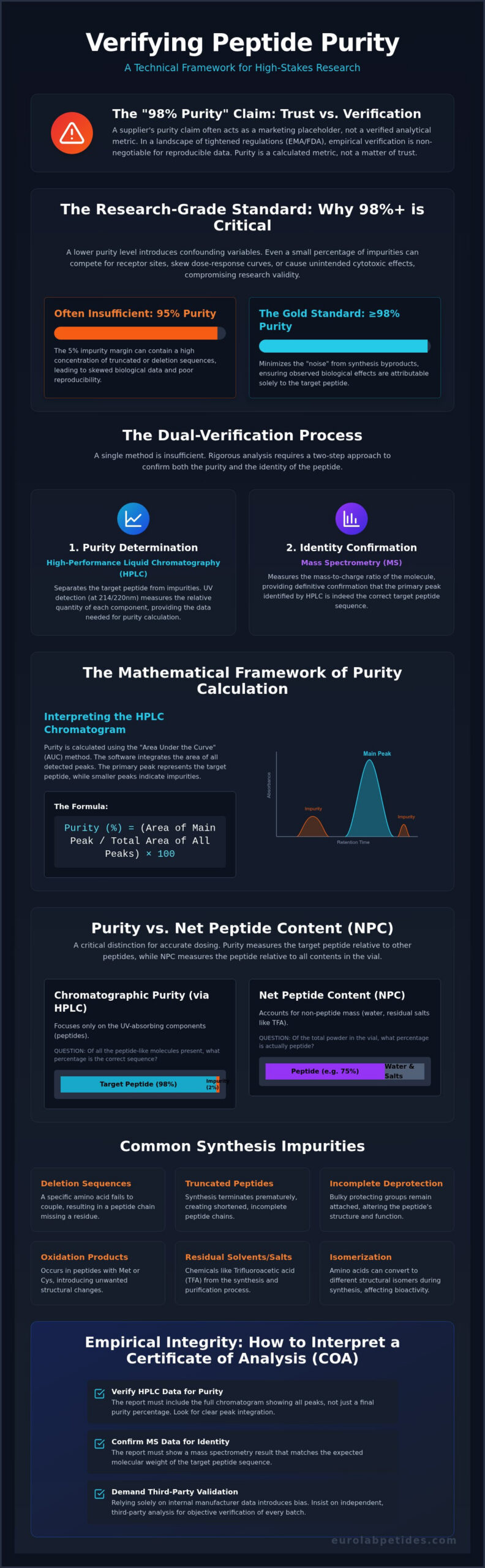
The quantitative analysis of a chromatogram relies on the “Area Under the Curve” (AUC) methodology. In this process, the integrator software calculates the area for every detected peak within a specified run time. The primary peak represents the target peptide sequence, while secondary peaks indicate the presence of impurities such as deletion sequences or truncated fragments. To perform the peptide purity calculation, the area of the main peak is divided by the total integrated area of all peaks detected. This ratio, expressed as a percentage, defines the chromatographic purity of the sample. Precise integration requires the exclusion of baseline noise and solvent fronts to ensure the resulting metric accurately reflects the chemical state of the research material.
Identity Confirmation via Mass Spectrometry
While HPLC measures purity, Mass Spectrometry (MS) is required to verify molecular identity. MS determines the mass-to-charge (m/z) ratio of the ionized peptide, allowing researchers to compare the observed mass against the theoretical molecular weight. This step is critical for detecting residual protecting groups or identifying incorrect amino acid sequences that might otherwise elute at the same time as the target in an HPLC run. A successful MS analysis confirms that the primary peak identified in the chromatogram is indeed the intended molecule. By reviewing the verified analytical reports provided with each batch, researchers can confirm both the identity and the high-stakes precision of their starting materials. This dual-verification approach ensures that experimental variables are limited to the biological system under study rather than inconsistencies in the chemical reagents.
The Mathematical Framework of Peptide Purity Calculation
The determination of chemical homogeneity relies on a standardized quantitative model derived from chromatographic data. The purity calculation formula is defined as the ratio of the target peak area to the sum of all integrated peak areas. This peptide purity calculation represents the percentage of the intended sequence relative to other UV-absorbing synthesis byproducts. It’s critical to recognize that this specific metric is a relative measurement of peptide-like contaminants. Consequently, it does not account for non-UV-absorbing substances such as residual water, acetate, or trifluoroacetate (TFA) salts. These components are typically quantified through separate analytical techniques like Karl Fischer titration or ion chromatography, as they don’t impact the UV profile at standard detection wavelengths.
Step-by-Step Calculation Example
To execute a precise peptide purity calculation, a methodical integration process must be followed. First, the chromatogram is analyzed to identify the Area Under the Curve (AUC) for every peak that exceeds the established signal-to-noise threshold. The following steps outline the mathematical progression:
- Step 1: Integration. The integrator software determines the AUC for the target peptide peak and all secondary impurity peaks detected during the run.
- Step 2: Summation. The areas of all detected peaks are added together to determine the total integrated area of the sample.
- Step 3: Division and Conversion. The target peak area is divided by the total area, and the result is multiplied by 100 to yield the final purity percentage.
For example, if a target peak displays an area of 9,850 units and the total area of all integrated peaks is 10,000 units, the purity is verified at 98.5%. This calculation provides the empirical evidence required to validate the quality of a research batch before experimental use.
Factors Affecting Calculation Accuracy
The reliability of the mathematical output is contingent upon the optimization of the analytical environment. Column selection and the specific solvent gradient significantly influence the resolution between the target peptide and closely related deletion sequences. If the resolution is insufficient, impurity peaks may overlap with the main peak, leading to an artificially inflated purity value. Detection wavelength sensitivity remains a critical variable; while 214nm is the standard for detecting peptide bonds, variations in the baseline can introduce integration errors. Additionally, the sample concentration and injection volume must be calibrated to ensure the detector remains within its linear range. Overloading the column results in peak broadening, which complicates the integration of baseline-resolved impurities and compromises the integrity of the peptide purity calculation.
Differentiating Purity from Net Peptide Content (NPC)
Net Peptide Content (NPC) represents the actual weight percentage of the target peptide sequence within a lyophilized sample. While the peptide purity calculation identifies the relative abundance of the intended sequence compared to peptide-related impurities, it doesn’t account for non-peptide components. A sample may demonstrate 99% chromatographic purity but contain only 80% net peptide content. The remaining mass typically consists of residual moisture and counter-ions, such as Trifluoroacetic acid (TFA), which are essential for stabilizing the peptide during the synthesis and purification stages. Distinguishing between these two metrics is vital for maintaining stoichiometric accuracy in experimental environments.
Researchers must recognize that lyophilized powders are not 100% peptide by weight. Residual water is often present due to the hygroscopic nature of the material, and salts are a byproduct of the cleavage and HPLC purification processes. If a researcher assumes that a 5mg vial contains exactly 5mg of pure peptide without considering the NPC, the resulting molar concentration will be significantly lower than intended. This discrepancy introduces a systematic error that can invalidate quantitative data and hinder the reproducibility of high-stakes research.
Purity vs. Net Peptide Content: Comparison
Purity serves as a metric for the “cleanliness” of the sequence, ensuring that the synthesis hasn’t produced significant quantities of truncated or modified sequences. Conversely, NPC measures the absolute “quantity” of the peptide molecule present in the vial. For quantitative research, both values must be integrated into the final dosing strategy. Purity ensures you’re testing the correct molecule, while NPC ensures you’re testing the correct amount. For detailed preparation protocols, researchers should utilize our Peptide Reconstitution Guide to align their volumetric adjustments with these empirical variables.
Calculating the Actual Peptide Mass
Determining the actual peptide mass requires a multi-variable equation: Total Weight x Net Peptide Content (%) x Purity (%). This calculation accounts for the “salt factor” inherent in lyophilized powders. Most synthetic peptides are provided as TFA salts unless a specific salt exchange has been performed. Because TFA can constitute a significant portion of the total weight, ignoring this variable compromises the integrity of the peptide purity calculation in practical application. Transparency in NPC reporting is a non-negotiable standard at EuroLab Peptides, providing the empirical foundation for rigorous research. You can access our verified research materials to ensure your laboratory utilizes peptides with fully transparent analytical specifications that meet 2026 regulatory expectations.
Ensuring Analytical Integrity with EuroLab Peptides
EuroLab Peptides maintains a multi-level quality control framework that prioritizes empirical validation over subjective quality claims. In an industry often obscured by “research-grade” ambiguity, the brand utilizes standardized analytical methodologies to ensure every batch meets a minimum purity threshold of 98%. This commitment to transparency is evidenced through the provision of comprehensive Certificates of Analysis (COA) for all research materials. By integrating the peptide purity calculation directly into the final quality assurance report, EuroLab Peptides provides the precise data required for high-stakes in-vitro inquiry. Accessing these reports allows researchers to verify the specific chromatographic profile of their material before initiating any experimental protocols.
Our Multi-Level Verification Protocol
The verification process begins with an exhaustive in-house screening protocol. Every synthesis cycle undergoes High-Performance Liquid Chromatography (HPLC) and Mass Spectrometry (MS) analysis to confirm both chemical homogeneity and molecular identity. Once the internal benchmarks are satisfied, the material is submitted to independent third-party laboratories for final validation. These external audits mitigate manufacturer bias and provide an objective verification of the peptide purity calculation. Adherence to regional European logistics and storage standards ensures that the chemical integrity of the lyophilized powder is preserved during the transition from the manufacturing facility to the laboratory. This rigorous oversight eliminates the variables typically associated with secondary market suppliers who lack localized quality control infrastructure.
Sourcing Reliable Peptides in Europe
Localized sourcing within the European region remains a critical factor in maintaining peptide stability. Because peptides are susceptible to thermal degradation and hydrolytic cleavage, minimizing transit times and utilizing temperature-controlled logistics is essential for preserving the molecular structure. EuroLab Peptides’ regional manufacturing infrastructure ensures compliance with 2026 European regulatory standards, including the latest EMA guidelines for synthetic peptides. This proximity allows for rigorous oversight of the entire lifecycle, from initial synthesis to final delivery. Researchers benefit from a chain of custody that is both transparent and localized, reducing the likelihood of atmospheric exposure or contamination during transport.
For professionals seeking to mitigate the risks associated with global supply chain inconsistencies, understanding how to buy research peptides safely in Europe is a fundamental prerequisite for data integrity. By relying on verifiable data rather than anecdotal evidence, researchers can ensure their experimental results are based on a foundation of absolute chemical precision. To secure validated materials for your next project, you may explore our third-party tested research catalog and review the empirical results associated with our current inventory. Every product is backed by a verifiable COA, ensuring that your research is supported by a meticulous and reliable partner.
Advancing Research Through Empirical Validation
Validating chemical integrity requires a departure from trust-based procurement in favor of objective analytical data. This guide has detailed how a precise peptide purity calculation serves as the foundation for experimental reproducibility by isolating the target sequence from synthesis byproducts. By distinguishing between chromatographic purity and Net Peptide Content, researchers can ensure molar accuracy and mitigate the risks of systematic error in quantitative biological assays. EuroLab Peptides facilitates this level of precision through a multi-level quality control process, providing detailed HPLC and Mass Spectrometry reports for every batch. Independent third-party testing remains our non-negotiable standard, ensuring that your starting materials meet the rigorous demands of the specialized scientific community.
As you move forward with your in-vitro protocols, let empirical evidence guide your selection of research tools. We’re committed to providing the transparency and accountability required for high-stakes inquiry. View our third-party tested research peptides to ensure your data remains beyond reproach. Your commitment to precision is matched by our dedication to verifiable quality.
Frequently Asked Questions
What is the standard purity for research peptides?
The industry-accepted baseline for quantitative biological research is 98% or higher. While 95% purity is frequently marketed as “research grade,” this level often contains excessive concentrations of truncated sequences that can confound experimental outcomes. High-stakes in-vitro studies require the 98% threshold to ensure maximum data reproducibility. This standard ensures that observed biological responses are attributable solely to the target molecule rather than synthesis byproducts.
How does HPLC determine peptide purity?
HPLC determines purity by separating the target peptide from impurities based on hydrophobic interactions. As the sample passes through a stationary phase, a UV detector at 214nm measures the absorbance of peptide bonds. The resulting chromatogram allows for a peptide purity calculation by comparing the area of the target peak to the total area of all integrated peaks. This separation is critical for identifying closely related deletion sequences.
Is 100% peptide purity possible?
Absolute 100% purity is analytically unattainable due to the inherent chemical limitations of solid-phase peptide synthesis and the sensitivity thresholds of detection equipment. Even the most refined samples contain trace amounts of closely related deletion sequences or oxidation products. Professional laboratories typically report purity as “greater than 99%” to reflect the highest standard of chemical homogeneity currently achievable. Claiming 100% purity is generally considered a red flag in analytical reporting.
What is the difference between peptide purity and net peptide content?
Purity defines the ratio of the target sequence to other peptide-related impurities detected via HPLC. In contrast, net peptide content (NPC) identifies the actual weight percentage of the peptide molecule within the total lyophilized mass. A sample might display 99% purity but only contain 80% NPC; the remaining 20% typically consists of counter-ions like TFA and residual moisture. Both metrics are required for precise molar concentration and stoichiometric accuracy.
Why do purity reports include TFA levels?
Trifluoroacetic acid (TFA) levels are included because TFA functions as the primary counter-ion during synthesis and HPLC purification. These salts can constitute a significant portion of the total lyophilized weight, sometimes exceeding 15%. Reporting TFA levels is essential for researchers to adjust their molar calculations correctly. Additionally, high residual TFA can exert cytotoxic effects in specific cell culture assays, making its quantification a critical component of quality assurance.
How do I read a peptide Certificate of Analysis (COA)?
A Certificate of Analysis (COA) should be reviewed by examining the HPLC chromatogram and the Mass Spectrometry (MS) data. The HPLC plot must exhibit a single, dominant peak with minimal baseline noise. The MS report should confirm that the observed mass-to-charge ratio aligns with the theoretical molecular weight. Verify that the peptide purity calculation accounts for all integrated peaks in the run rather than relying on a selective integration of the main peak.
What happens if I use a low-purity peptide in my research?
Utilizing low-purity peptides introduces uncontrolled variables that compromise the integrity of biological data. Truncated sequences or deletion sequences often possess similar binding affinities to the target receptor, acting as competitive inhibitors. This interference leads to skewed dose-response curves and poor data reproducibility. Impurities can also trigger inflammatory responses or cytotoxicity in in-vitro systems, masking the actual therapeutic potential or physiological effect of the intended peptide sequence.
Can I calculate peptide purity at home or in a basic lab?
No, determining peptide purity requires sophisticated analytical instrumentation, including an HPLC system with a UV detector and a Mass Spectrometer. These instruments must be operated under standardized conditions by trained personnel to ensure accurate results. Basic laboratory setups lack the resolution necessary to identify closely related sequence impurities. Researchers should rely on third-party laboratory validation and comprehensive COAs to verify the chemical specifications of their research materials before use.
