

The assumption that Growth Hormone Releasing Hormones and Growth Hormone Releasing Peptides are functionally interchangeable in metabolic modeling represents a fundamental misunderstanding of secretagogue signaling. While both classes facilitate the release of growth hormone, their divergent mechanisms of action at the GHRH receptor and the Growth Hormone Secretagogue Receptor produce distinct physiological outputs. Understanding the nuances of GHRH vs GHRP peptides in research is essential for investigators who require precise control over somatotroph response. Ambiguity regarding receptor cross-talk and inconsistent purity standards often compromises the integrity of longitudinal assays.
You likely recognize that achieving reproducible data requires more than just high-purity reagents; it demands a deep comprehension of ligand-receptor kinetics. This article provides a rigorous technical comparison of these secretagogues, detailing their molecular differences and the supra-additive potential of combined administration. We’ll analyze degradation kinetics, evaluate the impact of the June 2026 EMA quality benchmarks on research-grade materials, and outline standardized handling protocols for lyophilized secretagogues to ensure experimental stability.
Key Takeaways
- Differentiate between the cAMP-dependent PKA and PLC-mediated signaling pathways to understand the mechanisms driving supra-additive growth hormone release.
- Evaluate the optimal selection criteria for GHRH vs GHRP peptides in research by comparing half-life kinetics and receptor specificity across various synthetic analogues.
- Implement standardized laboratory handling and reconstitution protocols to mitigate the risk of peptide degradation caused by pH sensitivity or mechanical agitation.
- Master the interpretation of lot-matched HPLC and Mass Spectrometry data to ensure that research materials meet the essential ≥99% purity threshold for valid metabolic assays.
Defining the Secretagogue Landscape: GHRH vs GHRP Peptides
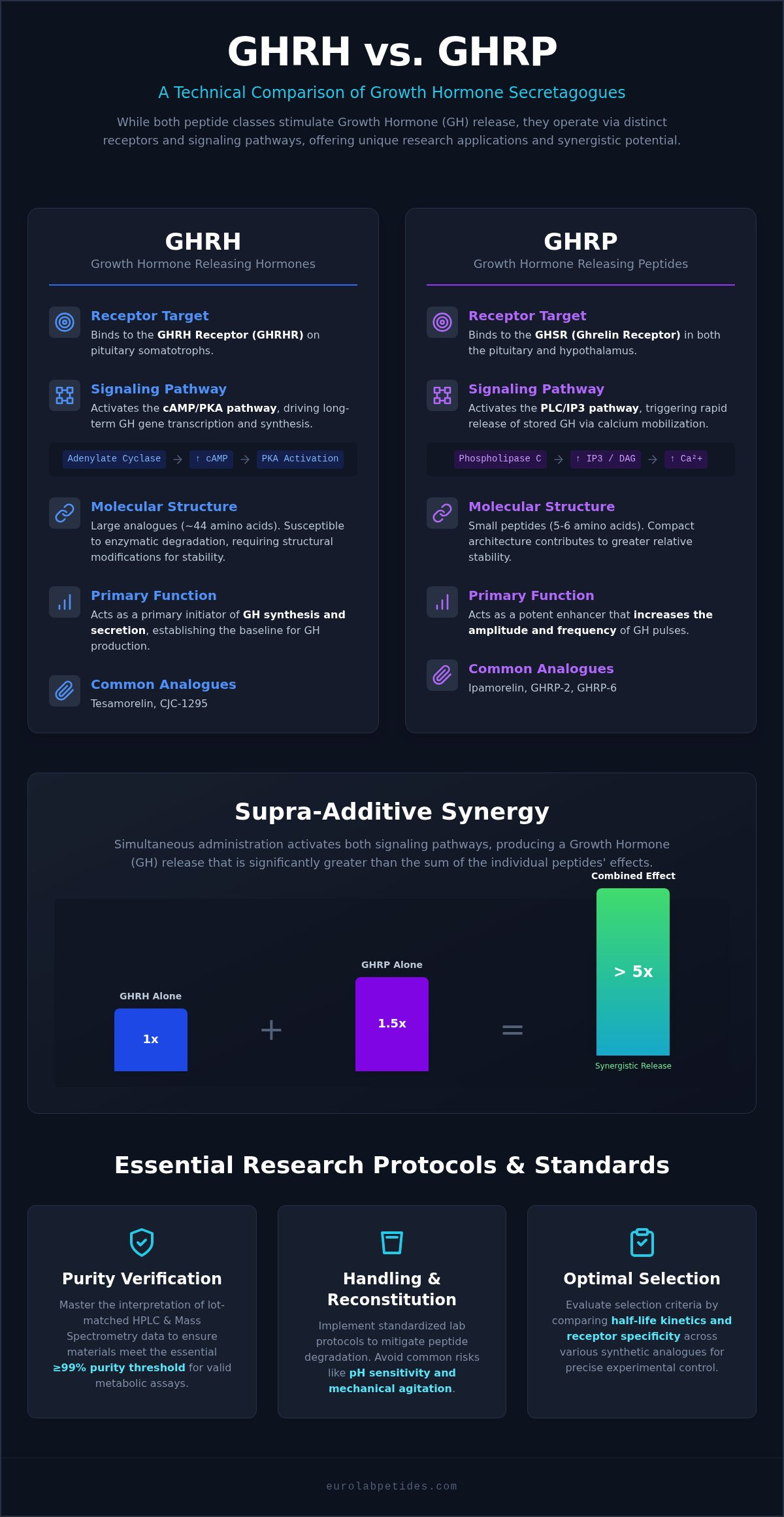
The classification of Growth hormone secretagogues (GHSs) encompasses two primary families of synthetic molecules designed to stimulate the somatotropic axis. While both classes facilitate the release of growth hormone (GH), the fundamental distinction between GHRH vs GHRP peptides in research lies in their receptor targets and molecular architecture. GHRH analogues are synthetic mimetics of the endogenous 44-amino acid Growth Hormone Releasing Hormone, specifically targeting the GHRH receptor (GHRHR) located on pituitary somatotrophs. Conversely, GHRPs are synthetic agonists that target the growth hormone secretagogue receptor (GHSR), more commonly identified as the ghrelin receptor.
GHRH Analogue Architecture
GHRH analogues are engineered to replicate the biological activity of the native hormone while improving upon its rapid enzymatic degradation. The native GHRH(1-44) sequence is highly susceptible to cleavage by dipeptidyl peptidase-4 (DPP-4). To counter this, synthetic versions like Tesamorelin incorporate a trans-3-hexenoyl group at the N-terminal position. This modification provides significant resistance against enzymatic proteolysis, thereby extending the peptide’s metabolic half-life in laboratory assays. Detailed comparative data on these structural modifications is available in the Tesamorelin peptide profile. Another prominent example is CJC-1295, which utilizes tetra-substitution to stabilize the peptide sequence, often paired with a Drug Affinity Complex (DAC) to enhance plasma residency through covalent bonding with albumin.
GHRP Molecular Mechanism
GHRPs represent a structurally distinct class of secretagogues, typically characterized by small peptide chains consisting of only 5 to 6 amino acids. This compact architecture contributes to their relative stability compared to larger GHRH analogues. These peptides bind to the GHSR located within both the pituitary gland and the hypothalamus. This binding initiates a signaling cascade that involves the mobilization of intracellular calcium, a pathway entirely separate from the cAMP-dependent mechanism utilized by GHRH. Ipamorelin and GHRP-2 are standard tools in metabolic studies. Ipamorelin is frequently selected for its high specificity, as it does not stimulate the secretion of prolactin or cortisol in most research models. For a technical breakdown of its binding affinity, see the Ipamorelin technical profile.
The operational difference between these classes is critical for designing experimental protocols. GHRH acts as a primary initiator of GH synthesis and secretion, while GHRPs act as potent enhancers that increase the amplitude of the GH pulse. When utilized in tandem, these secretagogues often exhibit a synergistic effect, producing a GH response that exceeds the sum of their individual impacts. This interaction is a central focus for investigators studying peak somatotroph capacity and the regulation of the GH-IGF-1 axis.
Molecular Signaling Pathways and Receptor Specificity
The biochemical distinction between GHRH and GHRP agonists is defined by their recruitment of divergent intracellular messengers. GHRH analogues engage the G-protein coupled receptor GHRHR, which initiates the adenylate cyclase cascade. This interaction elevates intracellular cyclic adenosine monophosphate (cAMP) levels, subsequently activating protein kinase A (PKA). This specific GHRH receptor signaling pathway serves as the primary driver for growth hormone gene transcription and long-term somatotroph health. It establishes the cellular framework necessary for sustained hormone production.
GHRPs utilize a separate intracellular route through the GHSR (ghrelin receptor). Binding to this receptor activates phospholipase C (PLC), leading to the generation of inositol trisphosphate (IP3) and diacylglycerol (DAG). IP3 triggers the rapid mobilization of calcium ions from the endoplasmic reticulum. The resulting spike in cytosolic calcium facilitates the immediate exocytosis of pre-formed GH vesicles. When evaluating GHRH vs GHRP peptides in research, investigators must account for these parallel but distinct mechanisms to accurately model somatotropic flux.
A critical phenomenon in secretagogue research is the “double-stimulus” effect. Simultaneous activation of the PKA and PLC pathways frequently produces a supra-additive secretagogue response, where the total GH output exceeds the mathematical sum of individual ligand effects. GHRPs further amplify this by antagonizing the inhibitory influence of somatostatin at both the hypothalamic and pituitary levels. This action effectively removes the physiological “brake” on the somatotroph while GHRH provides the excitatory signal. Utilizing high-purity secretagogues in these combined models is essential for observing these synergistic kinetics without interference from peptide degradation products.
Somatotroph Cell Proliferation and GH Synthesis
GHRH is indispensable for the genomic maintenance of the somatotropic axis. It promotes the proliferation of somatotroph cells and ensures a consistent supply of GH through increased mRNA transcription. In contrast, GHRPs are primarily effective for modeling acute, pulsatile secretion rather than long-term synthesis. Researchers often use GHRH to establish a baseline of GH synthesis before applying GHRPs to trigger massive vesicular release. This allows for the precise modeling of pulsatile versus sustained GH elevation in laboratory assays.
Receptor Cross-Talk and Desensitization
Prolonged exposure to high ligand concentrations can lead to receptor internalization and subsequent desensitization. GHRP-6 and GHRP-2 exhibit moderate binding specificity and may interact with receptors that modulate prolactin and cortisol secretion. Ipamorelin provides a more refined tool for investigators requiring high GHSR specificity without ancillary hormonal interference. Signaling saturation must be carefully monitored in in-vitro models. High peptide concentrations can lead to ligand-induced down-regulation, which may skew data regarding receptor sensitivity and maximum secretory capacity.
Comparative Research Analysis: Selection Criteria for Lab Studies
Selecting the appropriate ligand for somatotropic modeling requires a precise alignment between the peptide’s kinetic profile and the intended assay duration. The fundamental choice between GHRH vs GHRP peptides in research is often dictated by whether the investigator requires a transient, high-amplitude pulse or a sustained elevation of growth hormone levels. While the signaling pathways discussed previously define the biological response, the structural stability of the molecule determines its utility within specific experimental windows. Investigators must evaluate metabolic clearance rates and receptor specificity to avoid data contamination from secondary hormonal surges.
Half-Life and Degradation Kinetics
The primary challenge in maintaining consistent peptide concentrations in cell culture media is enzymatic susceptibility. Native GHRH is rapidly inactivated by dipeptidyl peptidase-4 (DPP-4) cleavage at the N-terminal Ala2 position. Synthetic analogues address this through specific structural modifications. For instance, CJC-1295 DAC utilizes a Drug Affinity Complex to covalently bond with albumin, extending its half-life to several days in certain models. In contrast, GHRPs are small, robust molecules typically consisting of 5 to 6 amino acids. Although they resist some proteolytic enzymes better than large-chain peptides, their half-lives are significantly shorter, often ranging from 30 to 120 minutes. Researchers modeling pulsatile secretion patterns typically favor these short-acting agonists to replicate endogenous rhythms.
Selecting the Right Secretagogue for Metabolic Research
The specificity of the secretagogue is paramount when modeling metabolic disorders or tissue-specific signaling. GHRP-2 and GHRP-6 are known to stimulate ancillary pathways, often resulting in the elevation of prolactin and cortisol. This cross-reactivity can obscure results in studies focused strictly on the GH-IGF-1 axis. Ipamorelin is the preferred alternative for high-precision assays, as it maintains exceptional selectivity for the GHSR without impacting other pituitary hormones.
For investigations centered on lipid metabolism and visceral adiposity, Tesamorelin remains the gold standard. Its unique trans-3-hexenoyl modification not only provides proteolytic resistance but also appears to enhance its efficacy in adipose tissue signaling models. When designing protocols for lipid oxidation or weight-related assays, consulting a comprehensive Weight management research guide can assist in calibrating dosage and exposure times. The following criteria should guide the selection process:
- Assay Duration: Use CJC-1295 DAC for long-term synthesis studies; use Ipamorelin for acute secretion modeling.
- Specificity Requirements: Select Ipamorelin to avoid prolactin/cortisol interference; utilize GHRP-2 if broader secretagogue activity is desired.
- Tissue Focus: Prioritize Tesamorelin for visceral adipose tissue and lipid oxidation research.
- Media Stability: Account for the rapid degradation of non-modified GHRH by utilizing D-amino acid substituted analogues.
Ultimately, the integrity of the research depends on the verifiable purity of the secretagogues. Utilizing materials with ≥99% purity ensures that the observed metabolic effects are a result of the primary ligand rather than truncated peptide fragments or residual reagents.
Laboratory Handling: Reconstitution, Stability, and Storage
Maintaining the structural integrity of secretagogues during laboratory preparation is a prerequisite for generating valid metabolic data. The physical stability of GHRH vs GHRP peptides in research varies significantly based on their molecular complexity and amino acid sequence. While the small-chain structure of GHRPs makes them relatively robust, GHRH analogues are highly sensitive to environmental stressors, including pH fluctuations and mechanical agitation. Improper handling leads to peptide aggregation or denaturation, which directly compromises the ligand’s binding affinity for the GHRHR or GHSR receptors.
Reconstitution Methodology
Calculating molar concentrations for precise in-vitro dosing is the first step in any standardized protocol. For GHRPs like Ipamorelin or GHRP-2, sterile saline or bacteriostatic water is typically sufficient for complete dissolution. However, the larger 44-amino acid chain of GHRH analogues often requires more specific environments. If solubility issues occur, a dilute buffer like 0.1% acetic acid is used to lower the pH and prevent the formation of insoluble aggregates. Gentle swirling is the only acceptable method for mixing; mechanical agitation via vigorous shaking can disrupt the delicate tertiary structure of GHRH, rendering the sample biologically inactive. Researchers should allow the vial to sit undisturbed for several minutes to ensure full solvation before use.
Long-Term Storage and Stability Metrics
Lyophilized powders must be stored in a moisture-free environment at -20°C or -80°C to minimize the risk of hydrolysis. Once a peptide is reconstituted, its shelf-life decreases dramatically as it becomes more susceptible to temperature-dependent degradation. While reconstituted secretagogues can remain stable at 4°C for short-term assays (7 to 14 days), long-term preservation requires aliquoting and storage at -80°C. Repeated freeze-thaw cycles must be avoided, as the resulting mechanical stress causes peptide fragmentation. The degradation kinetics of GHRH vs GHRP peptides in research also dictate the frequency of media changes in cell culture models.
Signs of chemical degradation, such as deamidation or oxidation, aren’t always visible to the naked eye. Investigators should rely on lot-matched HPLC and LC-MS verification to confirm the identity and ≥99% purity of their samples. For detailed guidance on preserving reagent integrity, refer to the technical brief on Storing lyophilized peptides. To ensure experimental consistency, investigators should source high-purity secretagogues that are verified by independent third-party laboratory testing.
Sourcing High-Purity GHRH and GHRP for European Research
The validity of metabolic signaling assays is contingent upon the chemical precision of the reagents utilized. In the comparative analysis of GHRH vs GHRP peptides in research, a purity threshold of ≥99% is established as the non-negotiable metric for professional inquiry. Impurities, such as residual solvents or truncated peptide sequences, can induce off-target effects or inhibit receptor binding, leading to inconsistent data. Verification through independent third-party analysis is the only method to ensure that the secretagogues meet these rigorous standards.
Quality Assurance and Analytical Validation
Interpreting analytical data requires a focus on both identity and purity. HPLC chromatograms must demonstrate a singular, sharp peak, indicating the absence of peptide fragments. Simultaneously, Mass Spectrometry (LC-MS) is employed to confirm that the molecular weight matches the theoretical sequence precisely. Lot-matched analytical data isn’t just a preference; it’s a requirement for reproducible research. Investigators must be able to detect even trace amounts of synthesis byproducts that could interfere with somatotroph response. For a detailed framework on evaluating suppliers, researchers should refer to the How to buy research peptides 2026 guide.
EuroLab Peptides: A Partner in Scientific Inquiry
EuroLab Peptides provides a reliable infrastructure for European laboratories by eliminating the risks associated with international customs and long-haul transit. Temperature-sensitive compounds, particularly GHRH analogues, are susceptible to degradation if they aren’t handled within a controlled logistical chain. By maintaining a European-based distribution network, transit times are minimized, and peptide stability is preserved. Every batch of GHRH and GHRP is accompanied by lot-matched HPLC and Mass-Spec verification, ensuring that the materials provided are elite tools for serious professional inquiry. This commitment to transparency and empirical validation establishes a baseline of absolute security for the research community.
The selection between GHRH and GHRP analogues must be supported by reagents that perform predictably under laboratory conditions. Whether modeling visceral adiposity with Tesamorelin or acute secretion with Ipamorelin, the use of high-purity secretagogues is essential for advancing the understanding of the GH-IGF-1 axis. EuroLab Peptides remains the authoritative source for high-stability materials, strictly for in-vitro research and laboratory development only.
Advancing Somatotropic Research through Analytical Precision
The selection between Growth Hormone Releasing Hormones and Peptides remains a pivotal decision in the design of in-vitro metabolic assays. As established, the divergence between cAMP-dependent and PLC-mediated pathways dictates the amplitude and duration of the growth hormone pulse. Achieving reproducible results in GHRH vs GHRP peptides in research requires more than just an understanding of receptor kinetics; it’s essential to utilize reagents that meet the most stringent analytical benchmarks.
EuroLab Peptides supports the specialized community by providing research-grade secretagogues with strictly ≥99% purity. Every batch is validated through lot-matched HPLC and LC-MS verification, ensuring that experimental integrity isn’t compromised by truncated sequences or residual reagents. Our reliable European laboratory supply chain facilitates minimal transit times to preserve peptide stability. By prioritizing empirical data over anecdotal evidence, investigators can confidently model the somatotropic axis with absolute precision. Secure High-Purity Secretagogues for Your Research and ensure your laboratory standards remain at the forefront of biochemical inquiry.
Frequently Asked Questions
What is the primary difference between GHRH and GHRP in a lab setting?
The primary distinction between GHRH and GHRP in a laboratory setting involves their respective target receptors and intracellular signaling cascades. GHRH analogues specifically bind to the pituitary GHRH receptor (GHRHR), initiating a cAMP-dependent protein kinase A pathway. Conversely, GHRPs are agonists of the growth hormone secretagogue receptor (GHSR), which triggers phospholipase C activation and intracellular calcium mobilization. These divergent mechanisms allow researchers to model different aspects of the somatotropic axis.
Why are GHRH and GHRP often used together in research models?
Investigators utilize GHRH and GHRP simultaneously to achieve a synergistic, supra-additive growth hormone release. This “double-stimulus” effect occurs because GHRH stimulates the synthesis and secretion of GH, while GHRPs enhance the amplitude of the pulse and antagonize the inhibitory effects of somatostatin. When evaluating GHRH vs GHRP peptides in research, this combined administration is often the gold standard for modeling peak somatotroph capacity in metabolic studies.
Is Ipamorelin considered a GHRH or a GHRP?
Ipamorelin is classified as a GHRP (Growth Hormone Releasing Peptide). It’s a pentapeptide that functions as a selective agonist of the growth hormone secretagogue receptor (GHSR). Unlike earlier generation secretagogues, Ipamorelin is specifically recognized in research for its high selectivity. It stimulates the release of growth hormone without inducing a significant increase in the secretion of ancillary hormones such as prolactin or cortisol, making it a precise tool for in-vitro modeling.
What is the most stable GHRH analogue for long-duration studies?
CJC-1295 with Drug Affinity Complex (DAC) is considered the most stable GHRH analogue for extended laboratory studies. The DAC modification allows the peptide to form a covalent bond with albumin, significantly extending its half-life from minutes to several days. For studies requiring enzymatic resistance without long-term albumin binding, Tesamorelin is frequently used. Its trans-3-hexenoyl group provides substantial protection against proteolytic cleavage, ensuring sustained signaling in adipose tissue and metabolic research models.
How does DPP-4 affect the half-life of GHRH peptides?
Dipeptidyl peptidase-4 (DPP-4) is the primary enzyme responsible for the rapid degradation of native GHRH. It specifically cleaves the peptide at the N-terminal Ala2 position, rendering the molecule biologically inactive within minutes. Researchers must account for this enzymatic susceptibility by utilizing synthetic analogues with structural modifications, such as D-amino acid substitutions or N-terminal protective groups, to maintain effective ligand concentrations throughout the duration of an in-vitro assay.
Can GHRPs affect other hormones like cortisol or prolactin in models?
Certain GHRPs, specifically GHRP-2 and GHRP-6, exhibit cross-reactivity that can elevate cortisol and prolactin levels in research models. This lack of specificity occurs due to secondary interactions within the hypothalamus and pituitary gland. For investigators requiring a pure GH axis model, Ipamorelin is often the preferred reagent. It maintains high binding affinity for the GHSR while demonstrating minimal impact on ancillary hormone pathways, thereby ensuring the integrity of metabolic signaling data.
What purity level is required for reliable GHRH/GHRP research?
A purity level of ≥99% is the established standard for reliable GHRH vs GHRP peptides in research. High-purity reagents are essential to prevent data interference from residual solvents, truncated peptide sequences, or synthesis byproducts. EuroLab Peptides ensures this standard through lot-matched HPLC and Mass Spectrometry verification. Utilizing materials with lower purity thresholds can lead to unpredictable receptor binding kinetics and inconsistent results in longitudinal metabolic or tissue repair studies.
Do GHRH analogues and GHRPs interact with the same receptor?
No, GHRH analogues and GHRPs target entirely different receptor classes. GHRH ligands interact with the G-protein coupled GHRH receptor (GHRHR), which primarily modulates growth hormone synthesis and basal secretion. GHRPs target the growth hormone secretagogue receptor (GHSR), also known as the ghrelin receptor. Because these receptors utilize distinct intracellular messengers, cAMP for GHRHR and calcium for GHSR, they provide complementary rather than redundant signaling inputs within the somatotropic axis.
