
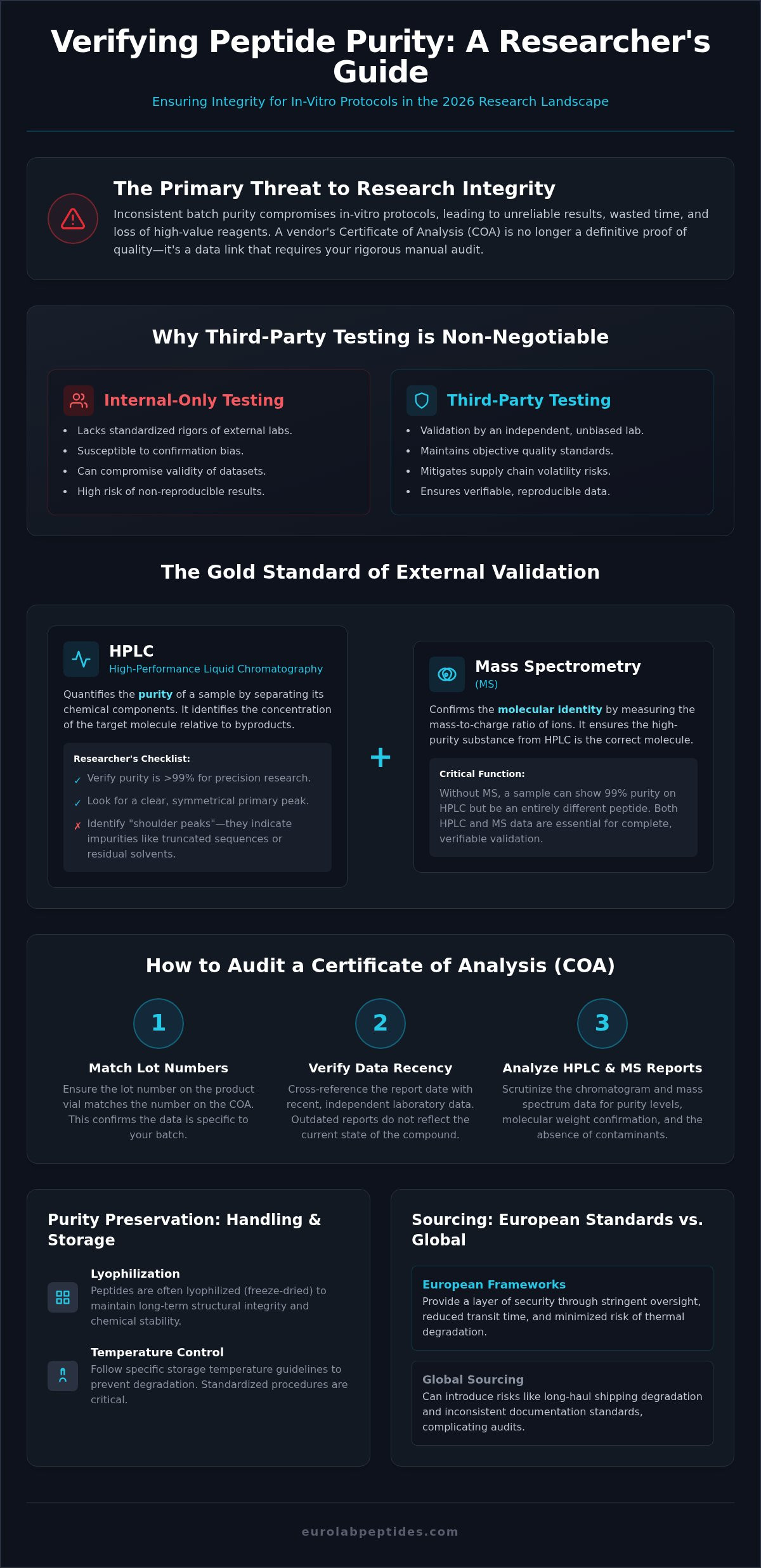
In the 2026 research landscape, a static Certificate of Analysis is no longer a definitive proof of quality; it’s a data link that requires a rigorous manual audit to be considered valid. Most researchers recognize that inconsistent batch purity is the primary threat to the integrity of in-vitro protocols, making the procurement of third-party tested peptides a non-negotiable standard for reproducible science. When a supply chain lacks transparency, results become unreliable, wasting both time and high-value reagents.
You likely agree that the burden of verification has shifted from the vendor to the researcher. This guide provides the technical framework to verify peptide purity through independent laboratory data to ensure the integrity of your in-vitro research. We’ll examine the technical metrics of HPLC and Mass Spectrometry, establish a protocol for auditing batch-specific reports, and address how to maintain chemical stability through standardized laboratory storage.
Key Takeaways
- Analyze the impact of 2026 regulatory shifts and why independent validation is the only objective standard for in-vitro research.
- Identify the technical specifications of HPLC and Mass Spectrometry required to verify molecular identity and purity benchmarks.
- Establish a rigorous protocol for auditing Certificates of Analysis by cross-referencing specific lot numbers with recent laboratory data.
- Implement standardized storage and handling procedures, including temperature control and lyophilization, to preserve the structural integrity of chemical assets.
- Secure the integrity of your laboratory protocols by sourcing third-party tested peptides through a multi-level quality control and verification framework.
The 2026 Peptide Market: Why Third-Party Testing is Non-Negotiable
Third-party testing is defined as the analytical validation of a chemical substance by an independent laboratory that possesses no financial interest in the sale of the product. This separation of interests is essential for maintaining objective quality standards. In the 2026 research environment, relying on third-party tested peptides has become the primary mechanism for mitigating the risks associated with global supply chain volatility. Internal-only testing protocols often lack the standardized rigors of external facilities and are susceptible to confirmation bias. Such bias can compromise the validity of in-vitro datasets, leading to the publication of non-reproducible results.
The 2026 shift in the market follows the failure of several legacy vendors who relied on historical reputation rather than batch-specific verification. As regulatory oversight increases, the integrity of research data depends on the ability to audit every lot independently. External validation via High-performance liquid chromatography (HPLC) and mass spectrometry provides a verifiable metric of purity. This ensures that experimental outcomes aren’t skewed by unintended chemical interactions or degraded material. Without these external audits, the risk of utilizing misidentified or contaminated compounds increases exponentially.
The Consequences of Unverified Research Compounds
Impurities within a peptide sample can trigger aberrant cellular signaling or interfere with metabolic pathways, leading to experimental outliers that are difficult to isolate. These contaminants often act as confounding variables, rendering the primary research data unusable. The financial burden of failed laboratory trials is significant when considering the man-hours and high-value reagents lost to degraded compounds. Within the professional community, a 99% purity threshold is categorized as a baseline requirement for precision research, not a premium feature. Anything less than this standard introduces unacceptable levels of uncertainty into the experimental model.
European Standards vs. Global Sourcing
Sourcing chemical assets within European logistics frameworks provides a layer of security often absent in international transactions. Regional synthesis and localized distribution reduce the duration of transit, minimizing the risk of thermal degradation that occurs during long-haul shipping. third-party tested peptides sourced from European facilities are subject to stringent oversight that ensures batch-to-batch consistency. These facilities must adhere to rigorous documentation standards that simplify the auditing process for researchers. EU chemical compliance in 2026 functions as a standardized benchmark for laboratory safety and molecular transparency across the continent.
HPLC and Mass Spectrometry: The Gold Standard of External Validation
The analytical validation of third-party tested peptides is achieved through the dual application of High-Performance Liquid Chromatography (HPLC) and Mass Spectrometry (MS). HPLC is utilized to quantify the purity of a sample by separating its constituent chemical components. This process identifies the concentration of the target molecule relative to any synthesis byproducts. However, HPLC alone is insufficient for complete verification. While it confirms the presence of a pure substance, it cannot verify the specific amino acid sequence. Mass Spectrometry is therefore required to confirm molecular identity by measuring the mass-to-charge ratio of the ions.
High-stakes in-vitro research demands the integration of both data sets. A sample may exhibit high purity on a chromatogram while containing an entirely different molecular sequence than intended. The identification of baseline noise and secondary substances is critical for maintaining experimental integrity. Relying on a single metric introduces variables that can compromise the reproducibility of laboratory results. The use of third-party tested peptides ensures that every chemical asset is matched to a verifiable identity before it’s introduced into a protocol.
Decoding the HPLC Chromatogram
The HPLC chromatogram provides a graphical representation of chemical separation. The area under the primary peak is calculated to determine the percentage purity of the peptide batch. It’s essential for researchers to identify “shoulder peaks,” which appear as small deviations on the sides of the main peak. These signals indicate the presence of truncated sequences or residual solvents from the synthesis process. A clear, symmetrical primary peak is the standard for research-grade materials. This visual data ensures that the chemical asset hasn’t undergone significant degradation during storage or transit.
Mass Spectrometry and Molecular Weight Verification
Molecular identity is confirmed by comparing the observed mass to the theoretical molecular weight, measured in Daltons (Da). Mass Spectrometry detects even minor structural errors, such as incorrect amino acid substitutions or incomplete peptide chains. These deviations can fundamentally alter the interaction of the peptide with cellular targets. Sequence accuracy is verified when the measured mass aligns precisely with the calculated weight of the target peptide. For researchers prioritizing data stability, EuroLab Peptides provides comprehensive HPLC and MS reports for every production lot.
How to Audit a Certificate of Analysis (COA) for Research Integrity
The audit of a Certificate of Analysis (COA) is a critical procedural step for any researcher utilizing third-party tested peptides. A COA must be evaluated as a verifiable data link between the manufacturing lot and the final analytical result. The integrity of in-vitro research depends on the accuracy of this document. If a supplier provides a report that can’t be independently verified, the chemical asset should be considered unvalidated. Researchers must implement a standardized audit framework to identify discrepancies before integrating compounds into a laboratory protocol.
Verification of the testing date is the first priority. Data that is over 12 months old may not reflect the current state of a batch, particularly if storage conditions have been suboptimal. Every vial must be cross-referenced by its lot number to ensure the laboratory report corresponds to that specific synthesis. Discrepancies between the vial label and the COA are a significant indicator of supply chain failure. The credentials of the analytical facility should also be scrutinized. Reputable laboratories maintain transparent reporting systems where researchers can confirm the authenticity of a report using a unique reference number.
Red flags often appear in the visual presentation of the data. Generic headers, missing timestamps, and inconsistent font styles within a single document suggest manual editing or template recycling. Professional reports maintain a standardized format that reflects the laboratory’s internal quality management system. If a document lacks these markers of formal certification, the purity metrics it contains can’t be trusted for high-stakes research.
The Batch-Specific Verification Process
A common red flag in the peptide industry is the use of a “representative” COA. This occurs when a supplier uses a single high-purity report to cover multiple production lots. This practice is unacceptable for professional applications as it obscures batch-to-batch variability. For a comprehensive list of verification criteria, researchers should consult the 2026 guide to purity and sourcing. Modern analytical facilities now utilize QR codes and unique digital IDs that allow for immediate data verification on the laboratory’s secure portal. This direct link eliminates the possibility of intermediary tampering and ensures the data is current.
Spotting Data Manipulation in Reports
Technical manipulation of HPLC chromatograms is often identified through a detailed analysis of the x and y axes. Cropping or stretching of the visual data is a technique used to minimize the appearance of “shoulder peaks” or baseline noise that would otherwise lower the calculated purity percentage. The sample name on the report must match the chemical nomenclature of the peptide exactly. Any variation suggests that the report may have been recycled from a different product line. Verification of a laboratory’s signature and seal is achieved by cross-referencing the digital certificate with the lab’s public registry or verifying the document’s cryptographic checksum.
Maintaining Purity: Handling and Storage of Verified Peptides
The chemical integrity of third-party tested peptides is preserved only through strict adherence to post-analytical storage protocols. While HPLC/MS data confirms initial batch quality, environmental factors such as temperature fluctuations and moisture exposure can induce rapid degradation. Lyophilization, or freeze-drying, is the standard method for preserving peptide structure. This process removes water through sublimation, which significantly reduces the rate of hydrolytic cleavage. Without this stabilization, the primary sequence remains vulnerable to chemical breakdown even in climate-controlled environments.
Light sensitivity is another critical variable. Exposure to ultraviolet or intense visible light can trigger the oxidation of specific amino acid residues, such as methionine or tryptophan. Utilizing amber or opaque containers is a non-negotiable standard for protecting these chemical assets. Additionally, minimizing freeze-thaw cycles is essential. Frequent temperature shifts lead to moisture condensation within the vial, introducing water that facilitates degradation and compromises the purity metrics established during testing.
Best Practices for Laboratory Storage
Optimal long-term stability is achieved by storing lyophilized compounds at -20°C or -80°C. While -20°C is sufficient for short-term use, -80°C is required for multi-year preservation of sensitive sequences. The use of a desiccant within the storage container prevents moisture accumulation, which is the primary driver of hydrolytic degradation. For a detailed technical breakdown, refer to the guide on storing lyophilized peptides. These measures ensure that analytical purity remains consistent with original laboratory reports for third-party tested peptides.
Handling and Reconstitution Protocols
Reconstitution must be performed using appropriate solvents based on the intended in-vitro model. Bacteriostatic water is frequently utilized for its antimicrobial properties, whereas sterile saline may be required for specific physiological buffers. Gentle reconstitution techniques are mandatory; the solvent should be allowed to flow slowly down the side of the vial. Vigorous agitation or vortexing must be avoided to prevent molecular shearing, which permanently alters the peptide’s secondary structure. Once in solution, the shelf-life of a peptide is drastically reduced, typically requiring use within 7 to 14 days when refrigerated at 4°C. To maintain high-stakes research precision, researchers should source verified chemical assets that include specific handling instructions for every lot.
EuroLab Peptides: Our Multi-Level Quality Control Protocol
EuroLab Peptides operates a multi-level quality control protocol designed to eliminate the variables commonly associated with international chemical procurement. The process begins with rigorous raw material verification and internal synthesis validation. This first step ensures that precursor amino acids meet high-purity standards before synthesis commences. Once the chemical assets are synthesized, the second phase is initiated: external validation. Every single production lot is subjected to independent analysis, ensuring that third-party tested peptides delivered to the researcher match the exact specifications recorded in the laboratory reports.
The third phase involves secure, European-based storage and temperature-controlled logistics. By maintaining operations within Europe, the risks of thermal degradation during long-haul international shipping are mitigated. Transparency remains the cornerstone of this protocol. Every researcher is provided with access to lot-matched COAs, allowing for an immediate audit of the purity and identity metrics discussed in previous sections. This data-first approach replaces the industry’s reliance on anecdotal reputation with empirical evidence and verifiable certificates.
A Commitment to European Research Excellence
Regional presence within the European Union ensures faster delivery cycles and higher molecular stability. It’s a logistical advantage that directly impacts the integrity of in-vitro research. The EuroLab guarantee is built on radical honesty in analytical reporting; results are never “representative” but are always specific to the batch in hand. This commitment to precision is documented in our multi-level quality protocol case study, which outlines the standardized benchmarks required for modern chemical synthesis and laboratory safety.
Ordering Research-Grade Peptides with Confidence
The EuroLab catalog is structured to support specialized inquiry across several domains, including longevity and vitality research, weight management research, and tissue repair and recovery research. Each compound is prepared as a high-purity lyophilized solid to ensure maximum shelf-life. It’s essential that all researchers adhere to strict in-vitro guidelines, as these products are intended solely for laboratory development and are not for human consumption. By selecting third-party tested peptides, you’re establishing a foundation of data integrity for your experimental protocols. View our third-party tested research catalog to access verified chemical assets for your next phase of professional inquiry.
Securing the Future of In-Vitro Research Integrity
The 2026 research landscape demands a transition from reputation-based sourcing to empirical validation. As demonstrated, the integration of HPLC and Mass Spectrometry data remains the only objective standard for verifying molecular identity and purity benchmarks. Researchers must prioritize auditing every Certificate of Analysis to ensure that lot numbers and timestamps align with the specific chemical assets in their inventory. This rigorous approach effectively mitigates the risks of experimental outliers and ensures the long-term reproducibility of laboratory findings.
Maintaining these standards requires a commitment to third-party tested peptides that are supported by batch-specific HPLC/MS reports. By utilizing European-based logistics and strictly research-grade synthesis, you eliminate the volatility often associated with international supply chains. These protocols don’t just protect your data; they establish a foundation for sophisticated, high-stakes inquiry. Secure the integrity of your laboratory environment by sourcing from partners who prioritize radical transparency and technical accuracy. Browse Third-Party Tested Research Peptides to secure the verified chemical assets required for your next protocol. Success in the laboratory begins with the absolute certainty of chemical purity.
Frequently Asked Questions
What is the difference between in-house and third-party peptide testing?
Third-party testing involves validation by an independent laboratory with no financial interest in the product’s sale, whereas in-house testing is performed by the manufacturer. Independent analysis provides an objective layer of accountability that in-house protocols cannot replicate. This separation is vital for verifying the integrity of third-party tested peptides. It ensures that the purity metrics reported are not influenced by internal production biases or non-standardized methodology.
How do I read an HPLC chromatogram for peptide purity?
Purity is determined by calculating the area under the primary peak on the chromatogram relative to any secondary peaks. A symmetrical, singular peak indicates a high-purity compound. Conversely, “shoulder peaks” or baseline noise signal the presence of synthesis byproducts or degradation. Researchers should analyze the integration table provided in the report to confirm that the primary substance accounts for 98% or higher of the total detected area.
Can I trust a COA that is more than six months old?
A Certificate of Analysis exceeding six months is generally considered outdated for high-stakes research. Peptides are sensitive chemical assets that can undergo degradation over time even when stored correctly. To ensure the chemical integrity of third-party tested peptides, every acquisition should be matched to a report from the current production lot. Utilizing older data introduces an unacceptable margin of error regarding the actual concentration and purity of the compound.
Why is 99% purity important for in-vitro research?
High purity is essential to eliminate confounding variables that could skew in-vitro experimental results. Impurities such as truncated sequences or residual solvents can trigger aberrant cellular responses or interfere with metabolic signaling pathways. When purity falls below the 99% benchmark, the risk of non-reproducible data increases. This level of precision is required to ensure that observed biological effects are strictly attributable to the target peptide sequence.
Does third-party testing guarantee the peptide is safe for human use?
No, third-party testing verifies chemical purity and identity but does not establish safety for human consumption. EuroLab Peptides products are strictly for in-vitro research and laboratory development only. Analytical validation ensures the molecule matches the intended sequence and meets purity requirements for scientific inquiry. These compounds are not pharmaceuticals and are never intended for clinical use or human administration regardless of the verified purity percentage.
How can I verify if a Certificate of Analysis is authentic?
Verification is achieved by cross-referencing the report’s unique identification number directly with the issuing laboratory. Reputable facilities provide digital portals or contact methods for researchers to confirm that the data hasn’t been altered. Red flags include generic headers, inconsistent font styles, or the absence of a specific batch lot number. Authentic reports will always feature a clear timestamp and the formal digital signature of the certifying chemist.
What are the most common impurities found in low-quality peptides?
Low-quality synthesis often results in truncated sequences where specific amino acids are missing from the chain. Other common contaminants include residual trifluoroacetic acid (TFA), organic solvents, and atmospheric moisture. These impurities are often visible as baseline noise on an HPLC chromatogram. Their presence can fundamentally alter the peptide’s interaction with cellular receptors, rendering the research data invalid and wasting laboratory resources on failed protocols.
Why does EuroLab Peptides focus on European-based synthesis?
European-based synthesis ensures adherence to stringent regional regulatory standards and chemical compliance frameworks. Localized production and logistics reduce the duration of transit, minimizing the risk of thermal degradation associated with long-haul international shipping. EuroLab Peptides prioritizes this regional model to provide researchers with higher molecular stability and faster delivery cycles. This localized approach supports the demands of the European scientific community by providing reliable, verifiable chemical assets.
