

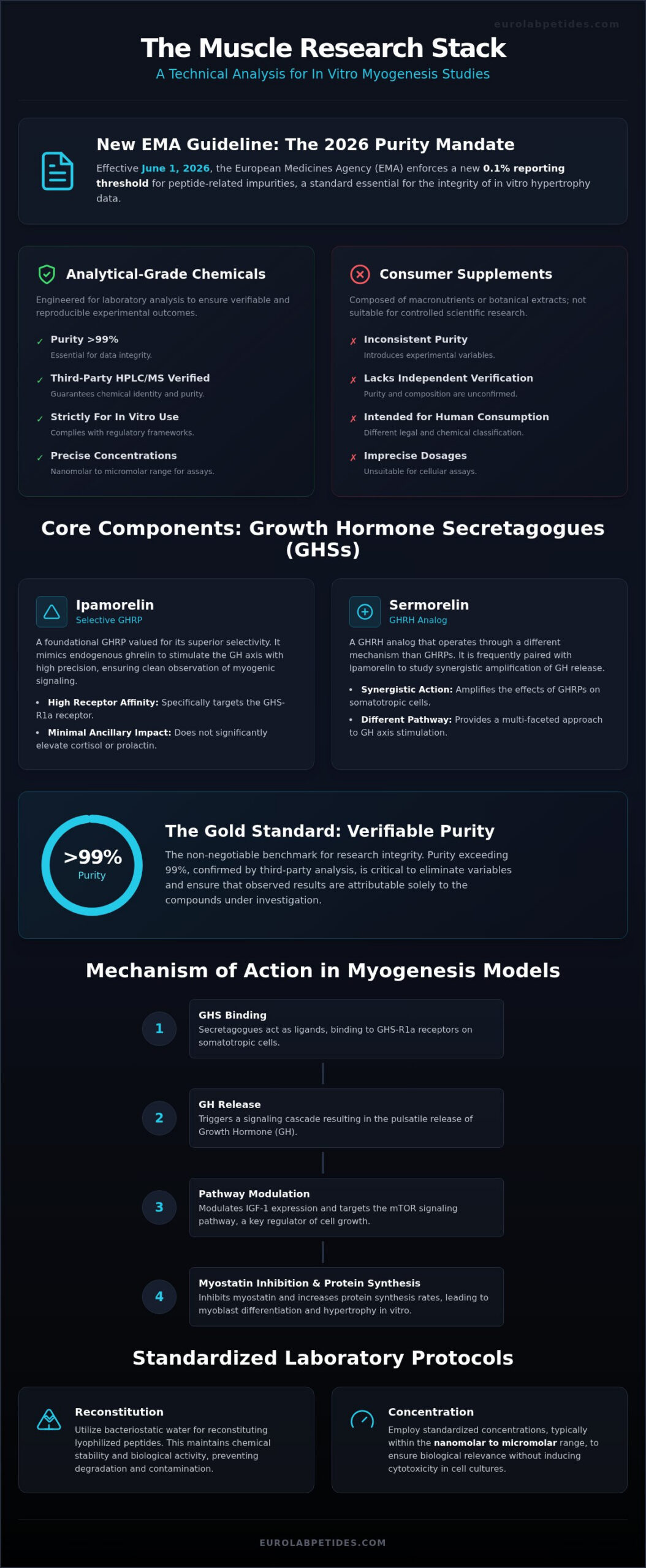
The European Medicines Agency (EMA) implemented new guidelines on June 1, 2026, establishing a 0.1% reporting threshold for peptide-related impurities; a standard that many current market offerings fail to achieve. You likely recognize that inconsistent chemical purity is the primary variable compromising the integrity of in vitro hypertrophy data. When utilizing a Muscle Research Stack for laboratory synthesis or repair studies, the absence of third-party HPLC and MS validation introduces unacceptable risks to experimental reproducibility.
This article delivers an objective, technical analysis of peptide synergies used to investigate muscle tissue synthesis within strictly controlled, in vitro environments. The following analysis details the biochemical pathways triggered by GH secretagogue combinations and the methodology for identifying research-grade chemicals that meet 2026 EMA qualification thresholds. We’ll examine the specific mechanisms of myogenesis and the rigorous testing protocols required to ensure that laboratory research remains compliant, verifiable, and scientifically sound. This profile prioritizes empirical data over anecdotal claims to support high-stakes professional inquiry.
Key Takeaways
- Distinguish between analytical-grade research chemicals and consumer dietary supplements to ensure the integrity of myogenic pathway modeling.
- Analyze the biochemical mechanisms of Ghrelin mimetics and their specific role in stimulating somatotropic cells within controlled laboratory environments.
- Evaluate the synergistic efficacy of the Muscle Research Stack in targeting the mTOR pathway and modulating IGF-1 expression during in vitro studies.
- Master standardized reconstitution protocols using bacteriostatic water to maintain the chemical stability and biological activity of lyophilized peptide sequences.
- Identify the critical importance of >99% purity benchmarks and third-party HPLC verification for maintaining rigorous analytical standards in European research.
Defining the Muscle Research Stack in Molecular Biology
A Muscle Research Stack is defined as a precise combination of synthetic peptide sequences engineered to investigate specific myogenic signaling pathways in vitro. Unlike consumer-grade dietary supplements, which consist of macronutrients or botanical extracts, these stacks are composed of high-purity chemical agents intended for laboratory analysis. The primary function of a Muscle Research Stack is the modulation of the growth hormone (GH) axis, particularly through the use of Growth Hormone Secretagogues (GHSs). These compounds act as ligands for the ghrelin receptor, facilitating studies on somatotropic cell response and subsequent IGF-1 expression. In cellular assays, standardized concentration requirements typically fall within the nanomolar to micromolar range. This precision ensures biological relevance without inducing cytotoxicity in delicate cell cultures.
Research Objectives in Myogenesis and Hypertrophy
The primary objective when utilizing these chemical tools is the quantification of protein synthesis rates within skeletal muscle cell lines. Researchers employ these stacks to observe the inhibition of myostatin, a key regulatory protein that limits muscle growth, through targeted chemical intervention. These studies provide critical data on cellular proliferation and the differentiation of myoblasts into mature myotubes. By measuring changes in the mTOR signaling pathway and the phosphorylation of downstream targets like p70S6K, laboratories can establish a baseline for how specific peptide synergies influence myogenic regulatory factors. This data is vital for understanding the molecular triggers of hypertrophy in a controlled environment.
The Legal and Ethical Framework of Research Peptides
Regulatory compliance is a non-negotiable metric for chemical suppliers within the European Union. Products are strictly designated for laboratory-use-only, and any deviation into clinical or human-use terminology is prohibited by law. EuroLab Peptides adheres to the June 1, 2026, EMA guidelines, which standardize impurity thresholds and characterization of peptide quality. It’s essential for researchers to source materials that provide verifiable batch purity, typically exceeding 99% as confirmed by HPLC analysis. This rigorous adherence to ethical frameworks ensures that experimental outcomes aren’t compromised by uncharacterized contaminants or regulatory inconsistencies. The distinction between research-grade chemicals and pharmaceuticals is maintained to protect the integrity of the scientific process.
Biochemical Components: Growth Hormone Secretagogues
Growth hormone secretagogues (GHSs) represent a specialized class of ligands that mimic the action of endogenous ghrelin. In a laboratory setting, these compounds function as a Ghrelin Receptor Agonist, binding to the GHS-R1a receptor located on somatotropic cells. This binding triggers a signaling cascade that results in the pulsatile release of growth hormone. Unlike non-selective agonists, the components of a high-quality Muscle Research Stack are chosen for their ability to isolate this specific pathway without activating secondary endocrine axes. This precision is vital for researchers aiming to isolate the variables of muscle tissue synthesis from broader metabolic interference.
Ipamorelin is frequently utilized as the foundational GHRP in these models due to its superior selectivity. While older secretagogues like Sermorelin can stimulate significant GH release, they often lack the specificity required for high-stakes in vitro research. Sermorelin, a GHRH analog, operates through a different mechanism and is frequently paired with Ipamorelin to observe synergistic amplification. The choice of secretagogue directly impacts the experimental data’s purity, as receptor crosstalk can skew results in cellular proliferation assays. Maintaining a narrow focus on receptor affinity ensures that observed hypertrophy is a result of GH axis modulation rather than unintended hormonal signaling.
Ipamorelin as a Selective GH Secretagogue
Ipamorelin’s primary advantage in biochemical modeling is its minimal impact on ancillary hormones. Studies indicate that it doesn’t significantly elevate cortisol or prolactin levels, even at higher concentrations. This lack of leakage into other hormonal pathways allows for a cleaner observation of myogenic signaling. For researchers requiring a more granular analysis, our technical profile on Ipamorelin provides exhaustive data on its molecular structure and receptor affinity. This selectivity makes it an ideal control agent for investigating growth hormone’s direct effects on protein synthesis without the confounding variables associated with broader-spectrum secretagogues.
Secondary Peptides in Muscle Research Synergies
The efficacy of a GHS is often amplified by the inclusion of a GHRH analog, such as CJC-1295. This peptide acts as a mimetic of endogenous growth hormone-releasing hormone, which enhances the amplitude of the GH pulse. CJC-1295 variants, particularly those without the Drug Affinity Complex (DAC), are preferred in many protocols for their specific half-life characteristics and stability in aqueous solutions. Combining a GHRH with a GHRP creates a potent synergy, mimicking the natural physiological interplay between these two pathways. This dual-action approach is a hallmark of the Muscle Research Stack, providing a comprehensive tool for investigating complex tissue repair mechanisms. For laboratories requiring high-purity materials for these protocols, the Muscle Research Stack provides a verified foundation for consistent experimental results. The resulting data provides a clearer picture of how synchronized signaling influences myotube maturation and protein accretion.
Synergistic Mechanisms in Tissue Hypertrophy Models
The investigation of myogenesis in vitro requires a sophisticated understanding of the Mechanistic Target of Rapamycin (mTOR) pathway. This pathway serves as the primary integrator for biochemical signals within the Muscle Research Stack, coordinating protein translation initiation and cellular growth. When secretagogues like Ipamorelin and CJC-1295 are introduced into a cellular assay, researchers observe a distinct modulation of Insulin-like Growth Factor 1 (IGF-1) expression. This modulation isn’t merely additive. It often demonstrates potentiation, where the combined signaling intensity exceeds the sum of individual compound effects. Such synergies are critical for modeling rapid tissue repair and hypertrophy in skeletal muscle cell lines, providing a more complex representation of physiological growth than single-compound studies can offer.
Pathway Analysis: mTOR and IGF-1 Signaling
Protein synthesis in skeletal myocytes is governed by the phosphorylation of key regulatory proteins, specifically 4E-BP1 and p70S6K. The application of a Muscle Research Stack facilitates the study of these translation initiation factors under GH-stimulated conditions. Additionally, the elevation of IGF-1 levels in the extracellular matrix of cellular models is associated with the activation of satellite cells. These precursor cells are essential for the expansion of myonuclear domains during hypertrophy. Researchers quantify these changes by measuring nitrogen retention and the incorporation of labeled amino acids into nascent protein chains within the cell culture. This data allows for a granular assessment of how peptide combinations influence the rate of protein accretion.
Experimental Design for Synergistic Studies
Rigorous experimental design requires the establishment of multiple control groups to isolate the variables of synergy. A standard protocol includes a negative control, single-compound groups for each peptide, and the combined stack group. Determining the optimal molar ratio is a critical step in this process; ratios are often calibrated based on the receptor affinity data discussed in previous sections. Data collection typically involves high-resolution microscopy to assess myocyte diameter and density. By utilizing automated imaging software, laboratories generate quantitative data on the morphological shifts induced by the peptide intervention. This methodology ensures that the results are statistically significant and reproducible across different batches of HPLC-tested materials.
Laboratory Protocols: Reconstitution and Handling
Maintaining the structural integrity of a Muscle Research Stack is a fundamental requirement for experimental reproducibility. Lyophilized peptides are provided in a freeze-dried state to ensure maximum stability during transit and storage. However, the transition from a solid state to an aqueous solution introduces significant risks of chemical degradation. Researchers must utilize high-purity solvents, specifically bacteriostatic water or sterile saline, to achieve a stable reconstituted environment. Bacteriostatic water is typically preferred for multi-assay protocols because the 0.9% benzyl alcohol content inhibits microbial proliferation. For researchers establishing new laboratory standards, understanding how to buy research peptides with verified lyophilization quality is the first step in ensuring experimental precision.
Temperature sensitivity is an absolute constraint in peptide handling. The secondary and tertiary structures of these molecules are held together by relatively weak bonds that are easily disrupted by thermal energy. Reconstitution should occur at room temperature, but the resulting solution must be immediately returned to a controlled cold chain. Denaturation also occurs through mechanical stress. Shaking a vial can lead to the formation of air-liquid interfaces that shear the delicate peptide chains, rendering the stack biologically inactive. This failure in protocol often leads to false-negative results in hypertrophy studies, where the lack of cellular response is erroneously attributed to the compound rather than handling errors.
Reconstitution Best Practices for Researchers
Precision in concentration calculation is mandatory for quantitative analysis. Researchers should determine the required peptide mass per milliliter of solvent based on the specific molarities needed for their in vitro models. When introducing the solvent, the liquid should be aimed at the glass wall of the vial rather than directly at the lyophilized powder to minimize impact. The “swirl, don’t shake” rule must be strictly followed; gentle rotation of the vial is sufficient to achieve a clear, homogenous solution. Once reconstituted, the Muscle Research Stack should be stored at temperatures between 2°C and 8°C. Solutions maintained at these temperatures generally remain stable for 14 to 21 days, though this varies by specific peptide sequence.
Long-term Stability of Lyophilized Research Stacks
Lyophilized peptides are highly sensitive to light and moisture, both of which accelerate degradation through oxidation and hydrolysis. Research vials are vacuum-sealed to prevent atmospheric interaction, and they should be stored in a dark, desiccated environment. For multi-year longitudinal studies, deep-freezing is the standardized protocol. Vials can be maintained at -20°C for up to 24 months, while storage at -80°C is required for indefinite preservation. To prevent the degradation caused by repeated freeze-thaw cycles, researchers are advised to aliquot large batches into single-use volumes. For institutions requiring consistent batch availability for long-term projects, you can source HPLC-tested research stacks to ensure that every aliquot meets the necessary purity metrics.
Sourcing the Muscle Research Stack from EuroLab Peptides
EuroLab Peptides provides a standardized Muscle Research Stack specifically engineered to facilitate the investigation of myogenic signaling and protein synthesis. This pre-formulated synergy eliminates the variability associated with manual compound mixing in the laboratory. Every batch is synthesized under rigorous quality controls, ensuring a purity benchmark that typically exceeds 99%. This level of precision is essential for avoiding the confounding variables introduced by uncharacterized impurities or degraded peptide sequences. By centralizing manufacturing within Europe, the brand maintains a robust cold chain, which is a critical requirement for preserving the biochemical integrity of lyophilized research agents during distribution.
Analytical transparency is the foundation of professional chemical sourcing. EuroLab Peptides provides comprehensive access to High-Performance Liquid Chromatography (HPLC) and Mass Spectrometry (MS) data for every product batch. A Certificate of Analysis (COA) accompanies the Muscle Research Stack, allowing researchers to verify the molecular mass and purity profile before beginning an assay. Independent, third-party laboratory validation is treated as a non-negotiable standard. This multi-level verification protocol ensures that the peptide sequences are correctly identified and free from residual reagents or trifluoroacetic acid (TFA) concentrations that could impact cellular viability in vitro. Interpreting these metrics correctly allows laboratories to maintain the high-stakes precision required for peer-reviewed research.
Quality Assurance and Third-Party Verification
Batch consistency is paramount for longitudinal hypertrophy studies. The multi-level quality control protocol employed by EuroLab Peptides includes in-house analytical testing followed by external validation. This dual-verification system ensures that every vial contains the exact milligram weight and purity percentage specified on the label. Researchers can access these reports to confirm that the chemical identity of the peptides matches the intended molecular structure. This level of accountability is a prerequisite for maintaining the integrity of experimental data in highly regulated laboratory environments. It provides a verifiable metric of quality that anecdotal evidence cannot replicate.
Ordering and Logistics for European Laboratories
The procurement process is designed to meet the administrative and logistical demands of verified research institutions. Logistics are managed through a European-based network, ensuring that transit times are minimized and regional regulatory compliance is strictly maintained. Shipping protocols prioritize the maintenance of peptide stability, utilizing specialized packaging to protect vials from light exposure and thermal fluctuations. This localized approach provides a significant advantage over global suppliers whose long-haul logistics often compromise the structural integrity of the compounds. Laboratories can expect a methodical progression from order placement to delivery, supported by transparent tracking and formal documentation.
Final Disclaimer: All products, including the Muscle Research Stack, are intended strictly for in-vitro laboratory research and development purposes. These chemicals are not for human consumption, and EuroLab Peptides does not provide medical advice or pharmaceuticals. Compliance with local regulations regarding the use of research-grade chemicals is the sole responsibility of the purchasing institution.
Advancing Quantitative Analysis in Myogenic Research
The integration of high-purity chemical agents into myogenesis models requires an uncompromising approach to analytical standards. The synergistic modulation of the GH/IGF-1 axis via the Muscle Research Stack provides a sophisticated framework for observing protein translation and satellite cell activation in vitro. Success in these studies depends not only on the biochemical profile of the secretagogues but also on the strict adherence to standardized reconstitution and cold-chain logistics. It’s this level of precision that ensures long-term reproducibility in the laboratory.
EuroLab Peptides supports these rigorous demands through European-based manufacturing and a commitment to verifiable excellence. Every batch is subjected to third-party HPLC and Mass Spectrometry analysis to confirm a purity benchmark of >99%. By removing the variables of chemical instability and uncharacterized impurities, researchers can maintain a narrow focus on their experimental outcomes. Rapid delivery through localized logistics further ensures that the structural integrity of the compounds is maintained from synthesis to the assay.
View the Technical Specifications of our Muscle Research Stack to ensure your laboratory utilizes only the most precise tools for cellular hypertrophy investigation. Your commitment to empirical accuracy deserves a partner that prioritizes data over hyperbole.
Frequently Asked Questions
What is included in a typical Muscle Research Stack?
A standard formulation for hypertrophy studies consists of precisely formulated Growth Hormone Secretagogues (GHSs) such as Ipamorelin and Growth Hormone Releasing Hormone (GHRH) analogs like CJC-1295. These peptides are selected for their synergistic effects on the GH/IGF-1 axis in cellular models. The combination is designed to facilitate the study of protein synthesis in a controlled environment. Every component is provided in a lyophilized state to ensure chemical stability.
Are these peptides intended for human bodybuilders?
No, these products are strictly prohibited for human use or consumption. EuroLab Peptides supplies these formulations exclusively for laboratory research and development purposes within in vitro environments. They are not pharmaceuticals, medicines, or athletic performance enhancers. Any application involving human subjects or clinical trials is outside the intended scope of these chemical agents. Researchers must adhere to institutional ethics and local regulations regarding the handling of research-grade chemicals.
How should I store my Muscle Research Stack upon arrival?
Lyophilized vials should be stored in a dark, desiccated environment at temperatures between 2°C and 8°C for short-term use. For long-term preservation exceeding six months, deep-freezing at -20°C or -80°C is required to prevent structural degradation. Protection from light exposure and moisture is critical for maintaining the integrity of the peptide sequences. Once reconstituted, solutions must be refrigerated and utilized within 14 to 21 days to ensure experimental accuracy.
What is the purity level of EuroLab Peptides research stacks?
Every Muscle Research Stack provided by EuroLab Peptides adheres to a purity benchmark of >99% as verified by analytical testing. This high level of precision is achieved through a multi-level quality control process that includes both in-house synthesis monitoring and independent third-party validation. These standards ensure that experimental data isn’t compromised by uncharacterized impurities. Verification metrics are documented via High-Performance Liquid Chromatography (HPLC) and Mass Spectrometry (MS) for every batch.
Can I buy these peptides for personal use in Europe?
Purchase is restricted to verified research institutions and professional laboratories for in vitro applications. These chemicals are not available for personal use, human consumption, or clinical administration. EuroLab Peptides operates as a specialized supplier within the European Union, ensuring that all logistics and procurement processes comply with regional regulatory standards for laboratory reagents. Buyers must confirm their status as legitimate research entities before the acquisition of any peptide sequences.
How do I reconstitute a multi-peptide research stack?
Reconstitution requires the introduction of a bacteriostatic solvent, such as 0.9% benzyl alcohol water, into the lyophilized vial. The solvent should be aimed at the glass wall to minimize mechanical stress on the peptide chains. A gentle swirling motion is used to achieve a homogenous solution; shaking must be avoided as it can cause denaturation. Precision in solvent volume is necessary to reach the exact molar concentrations required for specific in vitro hypertrophy assays.
What is the difference between a research stack and a supplement stack?
A research stack is composed of high-purity synthetic peptides designed for molecular biology studies, whereas a supplement stack contains dietary ingredients like protein and amino acids. Research-grade chemicals are manufactured to analytical standards for in vitro use only. Supplement stacks are regulated as food products for human consumption. The Muscle Research Stack is a technical tool for investigating myogenic pathways, not a nutritional product for physical performance or health.
Does the Muscle Research Stack come with a Certificate of Analysis?
Yes, every order includes a batch-specific Certificate of Analysis (COA) documenting the purity and identity of the compounds. This document provides the results of HPLC and MS analysis, which are essential for verifying the molecular mass and chemical consistency of the peptides. Access to this data allows researchers to maintain the high-stakes precision required for peer-reviewed scientific inquiry. Transparency in analytical metrics is a non-negotiable standard for ensuring experimental reproducibility.
