

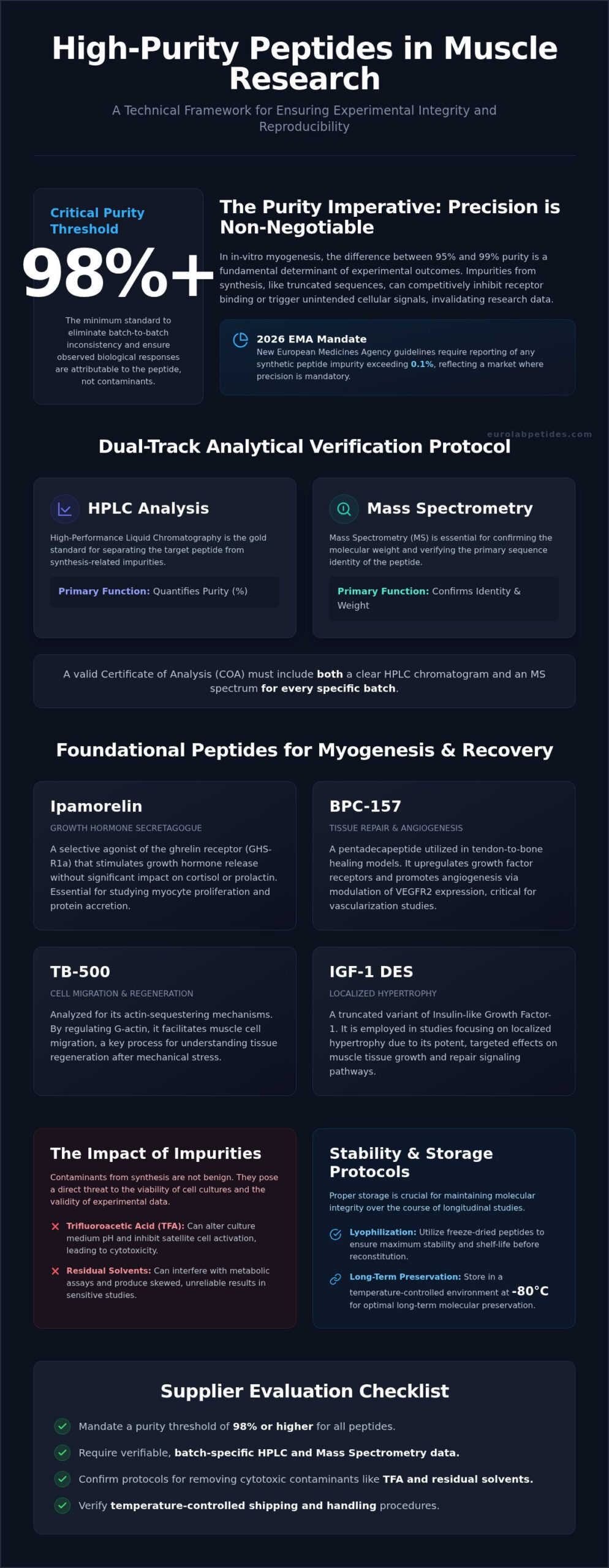
The 2026 European Medicines Agency guidelines now mandate that any synthetic peptide impurity exceeding 0.1% must be reported; this reflects a market where precision is no longer optional. For investigators involved in sourcing peptides for muscle tissue research, the difference between 95% and 99% purity isn’t merely a numerical variance but a fundamental determinant of experimental reproducibility. It’s understood that batch-to-batch inconsistency and opaque third-party testing data represent significant barriers to establishing a reliable in-vitro myogenesis model.
This lab guide provides a technical framework for the identification and evaluation of high-purity biochemicals. We detail the empirical requirements for HPLC and Mass Spectrometry data while addressing the logistical complexities of European customs and temperature-controlled shipping. By adhering to these standardized protocols, researchers can secure the verifiable metrics necessary for rigorous muscle tissue analysis. The following sections analyze the multi-level quality control processes and the specific utility of pre-configured research stacks in maintaining longitudinal study integrity.
Key Takeaways
- Define the 98% purity threshold as the critical requirement for eliminating batch-to-batch inconsistency in myogenesis research.
- Develop a rigorous protocol for sourcing peptides for muscle tissue research by requiring verifiable third-party HPLC and Mass Spectrometry data for every batch.
- Identify the biochemical properties of foundational peptides like Ipamorelin and BPC-157 within specialized myogenesis and recovery models.
- Execute stability-focused storage procedures, utilizing lyophilization and temperature-controlled environments at -80°C for long-term molecular preservation.
- Streamline complex tissue repair studies using the Muscle Research Stack to ensure standardized concentrations across multiple research variables.
Purity Standards in Muscle Tissue Research
The integrity of in-vitro myogenesis models depends on the chemical precision of the reagents utilized. When sourcing peptides for muscle tissue research, investigators must distinguish between generic laboratory reagents and high-purity biochemicals that meet the 98% purity baseline. This threshold isn’t arbitrary; it ensures that the observed biological responses, such as myotube formation or protein synthesis rates, are attributable to the peptide sequence rather than residual contaminants. Most synthetic peptides are produced via solid-phase peptide synthesis (SPPS), a process that inherently generates truncated sequences and deletion mutations. Without rigorous purification, these by-products can competitively inhibit receptor binding or induce unintended cellular signaling. Precision is non-negotiable.
Analytical Verification: HPLC and Mass Spectrometry
Verification of purity requires a dual-track analytical approach to satisfy 2026 regulatory expectations. High-Performance Liquid Chromatography (HPLC) is recognized as the gold standard for peptide purification in 2026. This methodology separates the target peptide from synthesis-related impurities based on hydrophobic interactions. While HPLC provides the purity percentage, Mass Spectrometry (MS) is required to confirm the molecular weight and primary sequence identity. An objective Certificate of Analysis (COA) must display both a clear HPLC chromatogram and an MS spectrum. Relying on generic documentation rather than batch-specific data introduces significant variables into hypertrophy models; this often invalidates longitudinal data sets.
The Impact of Impurities on In-Vitro Models
Contaminants such as Trifluoroacetic acid (TFA) or residual organic solvents pose a direct threat to the viability of primary muscle cell cultures. TFA is a common ion-pairing agent used during synthesis, yet its presence can alter the pH of the culture medium and inhibit satellite cell activation. For sensitive myogenesis studies, acetate-free or hydrochloride salt exchanges are often necessary to prevent cytotoxicity. Low-tier sourcing often fails to address these residual salts, leading to skewed results in metabolic assays. Identifying these synthesis by-products early in the procurement phase is essential for maintaining the high-stakes precision required in modern biochemistry. EuroLab Peptides addresses these concerns through a multi-level quality protocol that prioritizes the removal of these specific inhibitors. Ultimately, sourcing peptides for muscle tissue research requires a commitment to verifiable metrics over marketing claims.
Key Peptides for Myogenesis and Recovery Models
Identification of the correct molecular tools is as vital as the analytical purity standards discussed previously. When sourcing peptides for muscle tissue research, investigators prioritize sequences that demonstrate high affinity for specific metabolic and regenerative pathways. Four primary peptides form the foundation of current in-vitro muscle research: Ipamorelin, BPC-157, TB-500, and IGF-1 DES. These compounds serve as elite tools for professional inquiry into myogenesis and cellular recovery.
Ipamorelin and Growth Hormone Secretagogues
Ipamorelin is a selective agonist of the ghrelin receptor. It’s characterized by its ability to stimulate growth hormone release without significantly impacting cortisol or prolactin levels. In laboratory settings, Ipamorelin is often compared to Sermorelin to analyze differential impacts on myocyte proliferation. Its mechanism involves the activation of the GHS-R1a receptor, which initiates a signaling cascade conducive to protein accretion. For a detailed analysis of its molecular structure, researchers may consult this Ipamorelin technical profile.
BPC-157 and Tissue Repair Pathways
The pentadecapeptide BPC-157 is frequently utilized in tendon-to-bone healing models. This is due to its documented upregulation of growth factor receptors in myoblasts. Research indicates that BPC-157 promotes angiogenesis within damaged muscle tissue through the modulation of VEGFR2 expression. This makes it a critical component in studies focusing on vascularization and tissue repair. Additional data regarding its synthesis and stability is available in this BPC-157 technical guide.
TB-500 is analyzed for its actin-sequestering mechanisms. Specifically, it regulates G-actin to facilitate muscle cell migration. This process is critical for understanding tissue regeneration after mechanical stress. Concurrently, IGF-1 DES is employed in localized hypertrophy studies. Its truncated structure lacks the first three amino acids, which prevents sequestration by binding proteins. This results in increased bioavailability for receptor interaction within the muscle tissue environment. Standardizing the process of sourcing peptides for muscle tissue research requires an understanding of these specific molecular mechanisms. For laboratories conducting comprehensive studies on tissue repair, utilizing a pre-configured Muscle Research Stack ensures consistency across all experimental variables.
Evaluating Supplier Quality Protocols: A Technical Checklist
The procurement of biochemicals for in-vitro use necessitates a rigorous audit of supplier methodologies to ensure experimental validity. Sourcing peptides for muscle tissue research requires a departure from anecdotal trust toward empirical verification. When evaluating a potential partner, the focus must remain on the technical infrastructure used to validate purity and the logistical protocols that preserve molecular integrity during transit. A standardized checklist serves as the primary defense against batch-to-batch inconsistency, which often compromises longitudinal studies in myogenesis and cellular hypertrophy.
Third-Party Validation vs. In-House Testing
Third-party validation is the industry benchmark for objective quality assurance. While in-house testing provides preliminary data, it lacks the unbiased oversight required to eliminate supplier conflict of interest. Professional laboratories demand a Certificate of Analysis (COA) that includes both High-Performance Liquid Chromatography (HPLC) and Mass Spectrometry (MS) data. These reports must be batch-specific; generic or “representative” COAs are insufficient for high-stakes muscle research because they don’t account for the subtle variations inherent in different synthesis cycles. The presence of a timestamped COA is a non-negotiable sourcing requirement. Investigators should cross-reference the batch number on the vial with the analytical data provided to ensure total transparency. If a supplier refuses to provide raw data files upon request, the chemical integrity of the product cannot be verified.
European Sourcing Advantages for 2026
European-based logistics provide a strategic advantage in 2026, particularly concerning the stability of sensitive sequences. Synthetic peptides are susceptible to thermal degradation; research indicates that a 10°C rise in ambient temperature can double the rate of chemical degradation. Regional sourcing minimizes the duration of transit and the risks associated with long-haul international shipping, where temperature fluctuations are common. Adherence to localized regulatory standards ensures that manufacturing processes align with European chemical safety and purity mandates. To maintain stability, the following logistical standards are required:
- Vacuum Sealing: This prevents moisture ingress and oxidative degradation during storage.
- Cold-Chain Logistics: Temperature-controlled transport is essential for maintaining the secondary structure of the peptide.
- Lyophilization: The freeze-drying process must be conducted to a high standard to ensure a stable, moisture-free cake.
By prioritizing these regional protocols, researchers reduce the variables that interfere with satellite cell activation and protein synthesis assays. For a comprehensive overview of procurement standards, consult this technical guide on How to Buy Research Peptides. Ultimately, the reliability of sourcing peptides for muscle tissue research is defined by the supplier’s commitment to verifiable data and regional stability protocols.
Laboratory Stability and Storage for Muscle Research Peptides
The acquisition of high-purity biochemicals is a prerequisite for valid data; however, the preservation of that purity through standardized storage protocols is equally critical. When sourcing peptides for muscle tissue research, investigators must account for the inherent instability of the peptide bond, which is susceptible to hydrolysis and enzymatic proteolysis. Lyophilization, or freeze-drying, is the industry standard for stabilization. This process removes water through sublimation under vacuum, which significantly reduces the kinetic energy of the system and prevents the chemical degradation that occurs in aqueous solutions. A stable, moisture-free lyophilized cake is the only format that ensures long-term research integrity.
Temperature management remains the most influential factor in maintaining molecular structure. For storage requirements spanning 12 to 24 months, lyophilized peptides should be kept at -20°C. If the research timeline extends several years, a temperature of -80°C is required to minimize all residual molecular motion. It’s essential to understand that failure to maintain these benchmarks results in a loss of biological activity, which directly skews results in satellite cell proliferation assays. Reconstitution should only occur immediately prior to use, utilizing sterile or bacteriostatic diluents depending on the specific requirements of the in-vitro model.
Maintaining the Lyophilized State
Peptides are often hygroscopic, meaning they’ll readily absorb atmospheric moisture once the seal is compromised. To prevent moisture-induced degradation, vials must reach room temperature in a desiccator before opening. This prevents condensation from forming on the cold peptide powder. Vacuum sealing and the inclusion of desiccants are essential safeguards. Additionally, peptide bonds are sensitive to ultraviolet radiation. Storage should be conducted in amber vials or dark environments to prevent light-induced oxidation. To avoid the structural damage caused by repeated freeze-thaw cycles, researchers should aliquot the peptide into single-use quantities upon the initial reconstitution.
Stability During In-Vitro Experimentation
Once introduced into cell culture media, peptides face a significantly reduced half-life due to the presence of serum proteases and temperature-induced unfolding. In multi-day muscle tissue studies, researchers must monitor for peptide aggregation, a process where hydrophobic regions of the peptide interact to form insoluble clusters. This reduces the effective concentration available for receptor binding. Sterility must be maintained through the use of 0.22-micron filters during the reconstitution phase. For investigators requiring pre-validated concentrations for complex studies, the Muscle Research Stack provides a standardized solution that simplifies the experimental workflow while maintaining technical precision.
Sourcing High-Purity Peptides: The EuroLab Standard
EuroLab Peptides establishes a benchmark for analytical consistency within the biochemical supply chain. Sourcing peptides for muscle tissue research through this framework ensures that every vial complies with the stringent requirements of modern myogenesis and hypertrophy studies. The business functions as a meticulous, transparent partner for institutional procurement, prioritizing empirical data over anecdotal claims. By maintaining a proof-first communication rhythm, the EuroLab Standard provides the technical security necessary for high-stakes professional inquiry.
Logistical excellence is maintained through a focus on regional manufacturing and localized European shipping. This strategy is designed to mitigate the risks of thermal degradation and customs delays that often compromise the stability of sequences sourced from outside the European Economic Area. Every shipment is managed under strict stability protocols to ensure that the lyophilized state remains uncompromised upon delivery. This commitment to regional logistics serves as a shorthand for reliability in a global market often fraught with quality concerns.
The EuroLab Multi-Level Quality Protocol
The quality assurance process begins with internal HPLC screening, followed by mandatory independent laboratory validation for every batch produced in 2026. This dual-track system eliminates conflicts of interest and provides the objective data required for peer-reviewed research. Batch-specific transparency is a non-negotiable standard; researchers are provided with timestamped COAs that correlate directly with the vial’s unique identifiers. For institutional procurement and bulk research needs, professional support is available to facilitate the acquisition of standardized reagents for longitudinal data sets. This protocol ensures that the process of sourcing peptides for muscle tissue research remains grounded in verifiable metrics.
Targeted Research Stacks for Muscle and Recovery
To streamline complex experimental designs, specialized research stacks are offered as pre-configured solutions. These stacks are designed to provide standardized concentrations across multiple research variables, ensuring synergistic interactions can be observed with precision. The components are selected based on their documented roles in tissue repair and metabolic signaling within in-vitro models.
- Muscle Research Stack: A comprehensive configuration for studies focusing on protein synthesis and myotube formation.
- Recovery Research Stack: Utilized in models investigating inflammation pathways and the acceleration of localized tissue repair.
- Advanced Metabolic Stack: Designed for research into cellular energy expenditure and mitochondrial biogenesis.
All compounds provided are strictly for in-vitro research and laboratory development. These products aren’t for human consumption, and EuroLab Peptides does not provide medical advice. Adherence to these “research-only” standards ensures that the focus remains on scientific advancement within the specialized biochemistry community. Investigators are invited to Explore the Muscle Research Stack at EuroLab Peptides to secure the high-purity tools required for their 2026 research initiatives.
Advancing In-Vitro Muscle Research Standards in 2026
Precision in biochemical procurement is the fundamental determinant of laboratory success. As established, achieving reproducible results in myogenesis models requires adherence to the 98% purity threshold and the total elimination of synthesis-related contaminants. By prioritizing batch-specific HPLC and Mass Spectrometry data, researchers remove the variables that often compromise longitudinal studies. The process of sourcing peptides for muscle tissue research must move beyond generic documentation toward a standard of radical transparency and analytical rigor.
EuroLab Peptides facilitates this high-stakes precision through a multi-level quality assurance protocol and optimized European-based logistics. This infrastructure ensures that every sequence retains its structural integrity from synthesis to delivery. Investigators are invited to secure the elite tools necessary for their next study. View our Third-Party Tested Muscle Research Peptides to access verifiable metrics and ensure the absolute security of your research data. We look forward to supporting your scientific advancements.
Frequently Asked Questions
What is the standard purity required for muscle tissue research peptides?
A purity level of 98% or higher is the established baseline for reproducible muscle tissue data. In 2026, EMA guidelines require reporting any impurities exceeding 0.1% to ensure experimental integrity. High-purity sourcing peptides for muscle tissue research ensures that observed cellular responses in myogenesis models aren’t influenced by synthesis by-products. Anything below 95% is generally considered insufficient for quantitative biological studies or sensitive receptor-binding assays.
How do I verify the third-party test results of a peptide supplier?
Verification requires matching the batch-specific number on the product vial to the corresponding Certificate of Analysis (COA). A valid COA must display both High-Performance Liquid Chromatography (HPLC) and Mass Spectrometry (MS) chromatograms. Researchers should confirm the testing date and the independence of the laboratory. Transparency in these metrics is the industry benchmark for establishing trust and ensuring that the chemical synthesis meets the required technical specifications.
Why is lyophilization important for sourcing peptides in Europe?
Lyophilization preserves the secondary structure of the peptide by removing moisture through sublimation under vacuum. This process is essential for European sourcing because it ensures stability during the logistical chain. While European shipping times are reduced, lyophilized peptides are significantly more resistant to the thermal degradation caused by ambient temperature fluctuations. This freeze-dried state is the only stable format for long-term preservation of sensitive muscle research sequences.
What are the common contaminants to look for in a COA for research peptides?
Common contaminants include Trifluoroacetic acid (TFA), residual organic solvents like acetonitrile, and truncated peptide sequences. TFA is an ion-pairing agent that can alter the pH of cell culture media and inhibit satellite cell activation. A professional COA should also account for moisture content and residual salts. Identifying these synthesis by-products is a critical step in sourcing peptides for muscle tissue research to prevent skewed data in hypertrophy models.
How should peptides for muscle research be stored long-term in a lab?
Long-term storage requires maintaining the lyophilized powder at -20°C for durations of 12 to 24 months. For studies spanning several years, a temperature of -80°C is necessary to minimize molecular motion and prevent degradation. Once reconstituted, peptides must be stored in a refrigerator at 2-8°C and used within 30 to 60 days. Aliquotting the solution into single-use vials is recommended to avoid repeated freeze-thaw cycles that damage the peptide bond.
Can research peptides be used for human clinical trials?
No, research-grade peptides are strictly intended for in-vitro research and laboratory development. They aren’t for human consumption, clinical use, or any pharmaceutical application. EuroLab Peptides provides chemical reagents specifically for scientific inquiry in controlled environments. These products lack the clinical safety certifications and Good Manufacturing Practice (GMP) documentation required for human trials. Using research-grade materials for human use is a violation of established laboratory safety standards.
What is the difference between research-grade and pharmaceutical-grade peptides?
Research-grade peptides are optimized for analytical purity and in-vitro consistency, whereas pharmaceutical-grade peptides are manufactured under strict GMP standards for human safety. While research-grade materials often achieve 99% purity, they aren’t subjected to the clinical toxicity trials required for pharmaceuticals. The distinction lies in the intended use and the regulatory framework. Research-grade tools are elite instruments for serious professional inquiry into myogenesis and metabolic pathways, not medicines.
How does shipping time within Europe affect peptide stability?
Shipping time within Europe directly impacts stability by minimizing exposure to ambient heat. Research indicates that a 10°C rise in temperature can double the rate of chemical degradation in synthetic peptides. Regional logistics allow for faster transit times and better temperature control compared to long-haul international shipping. This localized approach serves as a shorthand for reliability, ensuring that the biochemical integrity of the peptide remains uncompromised upon arrival at the facility.
