

Does the targeted activation of telomerase via synthetic tetrapeptides offer a verifiable pathway to modulating cellular senescence in controlled models? While the potential of epitalon peptide longevity research is well documented in academic literature, the transition from theoretical framework to reproducible laboratory results is often obstructed by fluctuating chemical purity and inconsistent experimental protocols. It’s clear that the lack of standardized technical data regarding reconstitution and telomere elongation metrics remains a significant hurdle for the specialized community.
This technical review addresses these challenges by providing a comprehensive analysis of Epitalon’s biochemical mechanisms and its specific telomerase-regulating properties. You’ll gain a precise understanding of the molecular structure alongside established protocols for in-vitro study. We examine the critical role of chromatography-verified reagents in ensuring data integrity; this is followed by a detailed look at current laboratory standing and the rigorous standards required for high-stakes longevity research. This sequence ensures that your inquiry is supported by empirical evidence rather than anecdotal reports.
Key Takeaways
- Understand the precise molecular composition of the tetra-peptide L-Alanyl-L-glutamyl-L-aspartyl-glycine and its transition to high-purity synthetic production.
- Analyze how epitalon peptide longevity research utilizes telomerase activation to modulate cellular replication potential in somatic cell models.
- Review empirical lifespan extension data and tumor incidence metrics from significant rodent studies to establish established research benchmarks.
- Identify standardized protocols for peptide reconstitution and storage to ensure biochemical integrity during laboratory experimentation.
- Recognize the importance of HPLC and Mass Spectrometry as essential tools for verifying purity and sequence accuracy in research-grade chemicals.
Understanding Epitalon: The Biochemistry of the Tetra-Peptide Ala-Glu-Asp-Gly
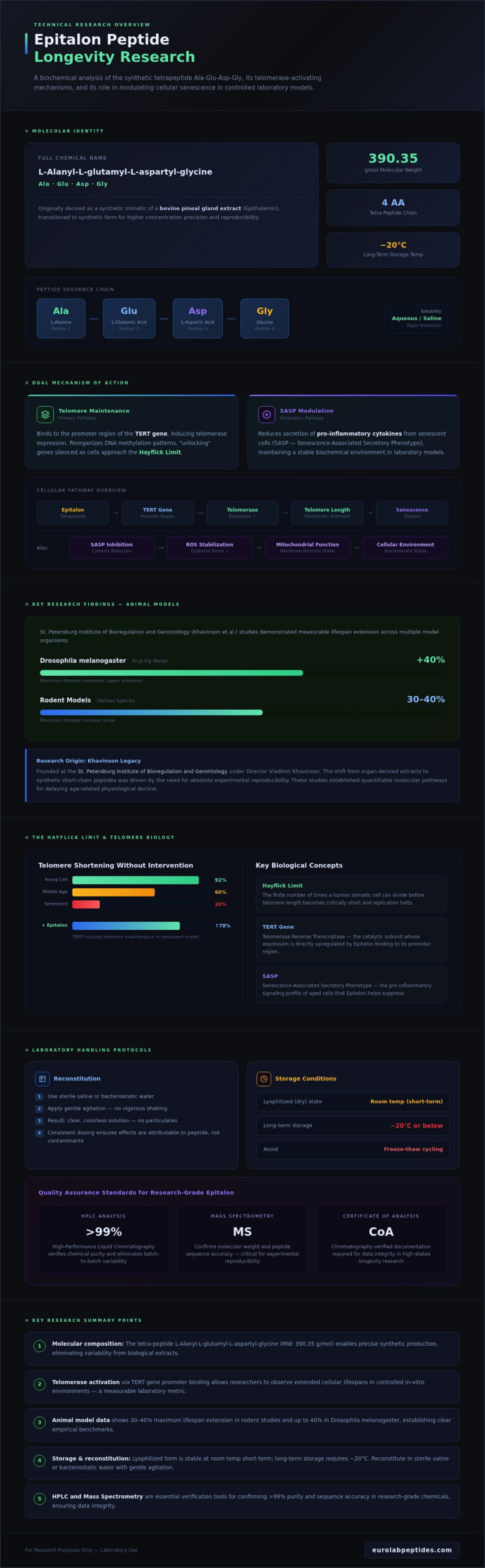
Epitalon is a synthetic mimetic of the pineal gland peptide with high telomerase affinity. Its primary molecular composition consists of the tetra-peptide L-Alanyl-L-glutamyl-L-aspartyl-glycine. Historically, this short-chain peptide was developed to replicate the biological activity of Epithalamin, a complex extract derived from bovine pineal glands. The transition to a synthetic form was necessitated by the requirement for higher precision in concentration and the elimination of variability inherent in biological extracts. In laboratory environments, Epitalon exhibits a molecular weight of approximately 390.35 g/mol. It’s highly soluble in aqueous solutions, including sterile saline and bacteriostatic water, which are standardized for in-vitro research protocols. High-purity synthesis ensures that the biochemical integrity of the Ala-Glu-Asp-Gly sequence is maintained for rigorous epitalon peptide longevity research.
The peptide’s stability is a critical parameter for laboratory preparation. In its lyophilized state, Epitalon remains stable at room temperature for limited durations, though long-term storage is typically conducted at temperatures of -20°C or lower to prevent sequence degradation. Its hydrophilic properties facilitate rapid dissolution; usually, only gentle agitation is required to achieve a clear, colorless solution. This physicochemical profile allows for consistent dosing in experimental models, ensuring that the observed biological effects are attributable to the peptide itself rather than contaminants or degradation products.
The Khavinson Research Legacy
The development of Epitalon is rooted in the extensive work of the St. Petersburg Institute of Bioregulation and Gerontology. Under the direction of Vladimir Khavinson, researchers identified that specific peptide bioregulators could modulate protein synthesis and cellular aging. The institute’s shift from organ-derived extracts to synthetic short-chain peptides was driven by the need for absolute experimental reproducibility. Initial studies demonstrated significant results, including a 30% to 40% increase in the maximum lifespan of Drosophila melanogaster and various rodent models. These findings established a foundation for investigating the peptide’s role in delaying age-related physiological decline through quantifiable molecular pathways.
Molecular Mechanism of Action
Epitalon functions primarily through its interaction with the promoter region of the telomerase reverse transcriptase (TERT) gene. By binding to specific DNA sequences, it induces the expression of telomerase, the enzyme responsible for maintaining telomere length. This epigenetic modulation involves the reorganization of DNA methylation patterns, effectively “unlocking” genes that typically become silenced as cells approach the Hayflick Limit. Additionally, research indicates that Epitalon influences the Senescence-Associated Secretory Phenotype (SASP). By reducing the secretion of pro-inflammatory cytokines from senescent cells, the peptide helps maintain a stable biochemical environment in laboratory models. This dual action on telomere maintenance and inflammatory signaling makes it a primary focus in modern epitalon peptide longevity research.
Telomerase Activation and Senescence in In-Vitro Models
The replication capacity of human somatic cells is governed by the progressive shortening of telomeric DNA, a phenomenon known as the Hayflick Limit. Epitalon influences this biological constraint by inducing the expression of the catalytic subunit of telomerase. This process is central to epitalon peptide longevity research, as it allows researchers to observe extended cellular lifespans in controlled in-vitro environments. Unlike bulkier telomerase activators that may exhibit lower specificity, Epitalon’s tetrapeptide structure permits efficient interaction with the TERT gene promoter. The data generated from epitalon peptide longevity research suggests that telomere elongation is not merely a theoretical possibility but a measurable laboratory metric.
Beyond genetic modulation, Epitalon impacts oxidative stress markers and mitochondrial function within senescent models. In aged cellular environments, reactive oxygen species (ROS) production typically increases as mitochondrial membrane potential declines. Experimental data indicates that Epitalon helps stabilize these metabolic parameters, leading to a reduction in oxidative damage to lipids and proteins. This stabilization is critical for maintaining the biochemical integrity of the cell during prolonged culture periods.
Impact on Human Fibroblasts
In human lung fibroblast cultures, exposure to Epitalon correlates with a verifiable increase in telomerase activity. Quantitative analysis suggests that telomere lengthening occurs in a concentration-dependent manner, with optimal expression levels reached at specific micromolar thresholds. Researchers also observe distinct morphological changes in aged cells post-exposure. Fibroblasts that previously exhibited the enlarged, flattened characteristics of senescence often transition back to a more youthful, spindle-shaped morphology. This shift serves as a visible indicator of functional rejuvenation at the cellular level.
Telomere Biology and Genomic Stability
Maintaining genomic integrity is a primary objective in laboratory longevity studies. Epitalon provides a protective effect against chromosomal aberrations that typically accumulate as cells age. When evaluating a longevity research stack, the inclusion of this tetrapeptide often yields synergistic results regarding DNA repair mechanisms and the mitigation of telomere attrition. Measuring these rates in controlled settings requires reagents of the highest analytical grade to ensure that experimental variables remain isolated. For professionals seeking to validate these outcomes, sourcing high-purity research chemicals is a non-negotiable standard for maintaining data accuracy.
Reviewing Longevity Research Findings in Animal Models
Animal-based studies provide empirical data on the systemic effects of Epitalon within complex biological systems. In cohorts of C3H/He mice and rats, researchers have documented significant shifts in longevity metrics. These findings complement the cellular mechanisms discussed previously, illustrating how telomerase activation translates to organismal stability. Current epitalon peptide longevity research frequently cites these rodent models as the benchmark for evaluating peptide-induced lifespan extension. Beyond simple survival rates, these studies examine the preservation of physiological functions that typically degrade with chronological age.
The regulation of circadian rhythms represents a significant aspect of Epitalon’s systemic influence. Research indicates that the peptide stimulates the pineal gland, leading to the normalization of melatonin production in aged animal subjects. This restoration of endocrine balance is often associated with improved sleep-wake cycles and enhanced antioxidant capacity. Improvements in immune system markers are frequently observed; specifically, the preservation of thymic function and the maintenance of T-cell populations in senescent models suggest a slowing of immunosenescence. These systemic observations are critical for researchers developing comprehensive epitalon peptide longevity research protocols.
Lifespan and Vitality Metrics
Quantitative analysis of rodent cohorts reveals that Epitalon administration is associated with increases in both mean and maximum lifespan. In several long-term studies, mean lifespan extensions of 18% to 25% were recorded compared to control groups. These quantitative gains are accompanied by observable vitality markers. Aged animal subjects often maintain higher physical activity levels and superior coat quality, which are indicative of preserved metabolic health. Neurological and cognitive markers in aging mouse models show a reduction in age-related behavioral decline, suggesting that the peptide’s influence extends to neuroprotective pathways.
Oncological Safety in Research
A primary concern in telomerase-related research is the potential for unregulated cellular proliferation. Data from long-term rodent studies consistently demonstrate that Epitalon doesn’t increase spontaneous tumor incidence. In many experimental groups, a reduction in the total number of tumors was observed. This suggests that the peptide’s role in telomerase regulation contributes to genomic stability and healthy cell cycles rather than oncogenic transformation. Maintaining high-purity standards through chromatography is essential when replicating these studies to ensure that impurities don’t skew oncological data. Long-term observation protocols remain the standard for verifying these safety profiles in laboratory development.
Laboratory Handling: Reconstitution, Storage, and Stability
Analytical precision in epitalon peptide longevity research depends entirely on the maintenance of biochemical integrity during laboratory handling. Epitalon is typically synthesized and provided as a lyophilized powder, which is the most stable state for preventing proteolytic degradation. Long-term storage of the dry cake requires temperatures of -20°C or -80°C to preserve the primary tetrapeptide structure. It’s a standard laboratory requirement to refrigerate all vials immediately upon receipt, even if the peptide remains stable at room temperature for short durations during transit. Failure to adhere to these thermal constraints can result in sequence fragmentation, which compromises the reliability of in-vitro assays.
Selecting an appropriate solvent is the first critical step in successful reconstitution. Bacteriostatic water, which contains 0.9% benzyl alcohol, is often preferred for multi-use vials due to its antimicrobial properties. Conversely, sterile saline (0.9% NaCl) is utilized when the presence of benzyl alcohol might interfere with sensitive cellular models. The following 4-step protocol is established for reconstituting Epitalon for in-vitro applications:
- Equilibrate the vial to room temperature (approximately 20-25°C) before opening to prevent atmospheric condensation.
- Sanitize the rubber septum using a 70% isopropyl alcohol swab.
- Introduce the solvent slowly by aiming the needle at the side of the vial, allowing the liquid to flow down the glass to avoid impacting the lyophilized cake directly.
- Gently swirl the vial in a circular motion until the powder is fully dissolved; don’t subject the solution to mechanical agitation or vigorous shaking.
Solubility and Concentration Calculations
Precise molarity is essential when conducting dose-response assays in epitalon peptide longevity research. Determining the exact volume of solvent required to reach a target concentration can be streamlined by using a peptide reconstitution calculator. Once reconstituted, Epitalon exhibits limited stability. Solutions should be stored at 2-8°C and utilized within 7 to 14 days. If a longer duration is required, the solution must be frozen, although this introduces the risk of structural stress during phase changes.
Preventing Degradation
Peptide chains aren’t immune to degradation from light exposure and mechanical stress. Standard best practices involve storing lyophilized peptides in opaque containers or dark environments. To minimize the damaging effects of multiple freeze-thaw cycles, researchers should divide the reconstituted solution into single-use aliquots. This strategy ensures that each experimental sample maintains the highest possible biochemical purity. For researchers requiring consistent, high-purity reagents, you can source research-grade Epitalon from validated European facilities.
Sourcing Epitalon: Quality Assurance and Purity Standards
Procuring reliable reagents for epitalon peptide longevity research necessitates a commitment to rigorous analytical validation. High-Performance Liquid Chromatography (HPLC) is the recognized standard for determining chemical purity, as it facilitates the separation and quantification of each constituent within a sample. This process identifies potential synthesis byproducts that could otherwise introduce confounding variables into in-vitro assays. To confirm the identity of the peptide, Mass Spectrometry (MS) is utilized to verify the molecular mass and amino acid sequence against the theoretical profile of L-Alanyl-L-glutamyl-L-aspartyl-glycine. Suppliers that fail to provide a verifiable Certificate of Analysis (COA) or offer vague sourcing details represent a significant risk to research integrity. EuroLab Peptides implements a multi-level quality protocol that includes both in-house analysis and independent third-party validation to ensure that every batch meets these precise requirements.
The Importance of Third-Party Testing
Independent laboratory verification is a non-negotiable standard for professional inquiry. A purity level exceeding 98% indicates that less than 2% of the sample consists of residual solvents or truncated peptide sequences. When reviewing a COA, researchers must verify that the batch number corresponds to the delivered product and that the HPLC chromatogram displays a single, sharp peak. This level of transparency prevents the introduction of unintended biological signals into sensitive models. Radical accountability in reporting is what distinguishes elite tools from standard commercial offerings.
Buying Research Peptides in Europe
Procuring laboratory chemicals within the European Union involves navigating specific regional standards for synthesis and safety. Logistical efficiency is paramount; maintaining the cold chain during transport is essential for preserving the stability of lyophilized compounds discussed in previous sections. EuroLab Peptides prioritizes localized logistics and specialized packaging to ensure that reagents arrive with their biochemical properties intact. This methodical approach to delivery respects the user’s timeline and the high stakes of their professional inquiry. For researchers requiring high-purity chemicals, you should buy research peptides Europe from EuroLab Peptides to ensure your epitalon peptide longevity research is supported by verifiable data.
Standardizing Parameters for Future Longevity Research
It’s clear that the technical utility of Epitalon is defined by its capacity to modulate the TERT gene promoter and influence cellular senescence. Effective epitalon peptide longevity research requires a transition from generalized observation to high-precision laboratory standards. By implementing rigorous reconstitution protocols and maintaining cold-chain integrity, researchers ensure the biochemical stability of the tetrapeptide Ala-Glu-Asp-Gly. The data indicates that when researchers utilize reagents verified by HPLC and Mass Spectrometry, the resulting metrics for telomere elongation and lifespan extension remain reproducible across diverse models.
EuroLab Peptides provides the specialized scientific-grade chemical synthesis necessary for these high-stakes inquiries. Every batch undergoes independent third-party laboratory testing to confirm a purity benchmark of >98%. Our European-based logistics and support ensure that these sensitive compounds are delivered without structural compromise. Maintaining these standards is essential for the advancement of modern gerontology and provides the foundation for reliable in-vitro analysis.
Explore Epitalon for Laboratory Research at EuroLab Peptides to ensure your experimental outcomes are supported by verifiable analytical data.
Frequently Asked Questions
What is the primary mechanism of Epitalon in longevity research?
Epitalon’s primary mechanism in epitalon peptide longevity research involves the induction of telomerase activity. It binds to the promoter region of the telomerase reverse transcriptase (TERT) gene. This interaction facilitates the elongation of telomeres in somatic cells, which effectively bypasses the Hayflick Limit in controlled models. The resulting genomic stability allows researchers to analyze cellular replication potential without the interference of premature senescence or apoptosis.
How does Epitalon differ from Epithalamin?
Epitalon is a precise synthetic tetrapeptide consisting of the sequence L-Alanyl-L-glutamyl-L-aspartyl-glycine. Conversely, Epithalamin is a complex biological extract derived from bovine pineal glands. While both target telomerase pathways, the synthetic nature of Epitalon ensures a standardized concentration and eliminates the batch-to-batch variability found in organic extracts. This chemical specificity is essential for maintaining the integrity of modern laboratory protocols and ensuring reproducible data in longevity studies.
What are the recommended storage conditions for lyophilized Epitalon?
Lyophilized Epitalon should be stored at temperatures of -20°C or -80°C for long-term preservation of its biochemical structure. While the dry powder remains stable at 2-8°C for several weeks, sub-zero storage is required to prevent proteolytic degradation over extended periods. Researchers must keep vials in a dark environment to avoid light-induced fragmenting. Once reconstituted, the solution’s stability decreases significantly, necessitating refrigeration and use within a 7 to 14-day window.
Is Epitalon intended for human consumption?
Epitalon is strictly for in-vitro research and laboratory development purposes only. It’s not intended for human consumption, clinical use, or as a pharmaceutical product. EuroLab Peptides doesn’t provide medical advice or endorse the administration of research chemicals to humans or animals outside of controlled experimental settings. All products are sold as high-purity reagents intended for the specialized community of analytical scientists and professional researchers focused on biochemical inquiry.
What concentration is typically used in in-vitro telomerase assays?
Concentration levels for in-vitro telomerase assays typically range from 0.01 µM to 1.0 µM depending on the specific somatic cell line under investigation. Researchers often utilize a dose-response model to identify the threshold at which telomerase expression peaks. Precise molarity is achieved by using analytical-grade solvents and a reconstitution calculator to ensure dosing accuracy. These standardized concentrations are critical for generating quantifiable data regarding the rate of telomere attrition and cellular rejuvenation.
How is the purity of Epitalon peptide verified?
The purity of epitalon peptide longevity research materials is verified through High-Performance Liquid Chromatography (HPLC) and Mass Spectrometry (MS). HPLC quantifies the presence of the target peptide against potential impurities, while MS confirms the exact molecular mass and amino acid sequence. EuroLab Peptides requires every batch to exceed a 98% purity benchmark. These results are documented on a Certificate of Analysis, which provides external validation of the chemical’s structural integrity.
Can Epitalon be used alongside other research peptides like BPC-157?
Epitalon is frequently included in a Longevity Research Stack alongside other peptides to observe synergistic effects on cellular repair and genomic stability. While BPC-157 is often studied for tissue repair, researchers combine it with Epitalon to analyze the intersection of telomerase activation and regenerative pathways. These multi-peptide protocols must be carefully designed to isolate specific variables. Sourcing all components from a single, high-purity European facility ensures that the experimental results remain consistent.
What solvents are best for Epitalon reconstitution in a lab setting?
The most effective solvents for Epitalon reconstitution are bacteriostatic water and sterile saline (0.9% NaCl). Bacteriostatic water is utilized for its antimicrobial properties, which extend the shelf life of the solution during short-term refrigerated storage. Sterile saline is often preferred for cellular assays where benzyl alcohol might cause cytotoxicity or interfere with metabolic markers. Researchers should select the solvent based on the specific requirements of their in-vitro model and the duration of the study.
