

The most familiar solvent can be the wrong choice for a peptide assay. When to use different reconstitution solvents depends on the peptide, its formulation, the research objective, and the downstream method. A vial that looks dissolved does not necessarily contain a preparation suitable for the planned measurement.
Solubility varies between peptides, and solvent components can affect assay conditions or complicate interpretation. A universal recipe can hide important variables in a controlled in-vitro study. Instead, evaluate the material and the assay together, then document why the selected solvent fits the intended workflow.
This article compares aqueous options, buffers, and organic cosolvents, with practical checks for solubility and assay compatibility. It also covers controls and recordkeeping, including how to distinguish visible sample characteristics from evidence that a preparation meets an assay’s requirements. Use the framework alongside current product documentation and validated, study-specific procedures, not as a one-size-fits-all preparation protocol.
Key Takeaways
- Choose a reconstitution solvent by considering the peptide, experimental design, and downstream analytical method together.
- Compare purified water, aqueous buffers, and organic cosolvents according to their research purpose and compatibility with the assay.
- Visible dissolution alone does not establish that a preparation is suitable for an assay. Consider method-specific constraints and solvent controls.
- Use a consistent checklist to review peptide information, protocol requirements, controls, and the records needed for reproducible in-vitro research.
- Keep solvent selection distinct from product-quality review, and use relevant analytical documentation when planning a research workflow.
When Does Solvent Choice Matter in Peptide Reconstitution?
Reconstitution means dissolving a lyophilized research material in a liquid for a defined in-vitro workflow. The solvent is part of the experimental system, not simply a way to make a dry sample look dissolved. A candidate that supports initial solubility may still be unsuitable if its pH, ionic composition, or other components affect the assay or measurement.
Solvent suitability is specific to a peptide and an experiment. It does not mean that a solvent is compatible with every peptide or research application. There is no single solvent for all peptides and assays. To decide when to use different reconstitution solvents, consider the material, the method, and the controls needed to identify solvent-related effects.
How peptide characteristics influence initial solubility
A peptide’s sequence composition and net charge influence how it interacts with its surrounding solvent. Charged and polar residues affect interactions with aqueous environments, while hydrophobic residues may reduce compatibility with water. The Peptide structure provides useful foundational context, but sequence features should be considered together rather than treated as a simple solvent-selection rule.
Hydrophobicity is one factor, not a stand-alone predictor of successful dissolution. Peptides with similar overall hydrophobicity can behave differently because their residue placement and charge distribution vary. Formulation matters too. The lyophilized material’s composition and available product documentation may help explain its behavior. Review information for the specific material instead of assuming that a familiar peptide will behave the same way across preparations.
Why the downstream experiment belongs in the decision
The solvent must also suit the assay’s sensitivity, detection chemistry, and sample matrix. A preparation may appear compatible with the peptide while introducing components that affect the measurement. For example, solvent absorbance can matter in optical detection, and pH or ionic composition can influence methods that are sensitive to sample conditions. Compatibility is method-specific and cannot be judged by appearance alone.
Before selecting a solvent, identify what the assay detects and which sample conditions it can tolerate. Consider whether solvent-derived signals, changes to the matrix, or interactions with detection chemistry could affect the readout. Include appropriate solvent controls in the experimental design so that solvent effects can be distinguished from peptide-associated signals.
Material identity and batch-specific analytical documentation are also relevant to interpreting results, but they do not establish that a solvent suits a particular assay. EuroLab Peptides supplies research-grade peptides for in-vitro research and laboratory development, with in-house and independent third-party laboratory testing. For wider context on evaluating research materials and documentation, consult the peptide handling and sourcing guide.
How Water, Buffers, and Organic Cosolvents Differ
Water, aqueous buffers, and organic cosolvents serve different research purposes. None is a universal default. Select among them by checking documented compatibility with the peptide and assay, rather than relying on a general ranking. The comparison below highlights questions to evaluate, not instructions to substitute one solvent for another.
| Solvent class | Research-use purpose | Potential compatibility concerns | Protocol checks |
|---|---|---|---|
| Purified water | Candidate aqueous medium when peptide properties and experimental design support it. | May not provide the pH or ionic conditions needed for sample stability or the assay. | Review peptide-specific solubility information and whether the downstream method permits an unbuffered sample. |
| Aqueous buffer | Provides a defined chemical environment when pH or ionic conditions are relevant. | Buffer components, pH, or ionic strength may alter sample behavior or interfere with detection. | Confirm compatibility of each component with the peptide and analytical method. |
| Organic cosolvent | May be considered in research contexts where aqueous solubility is limited. | Residual cosolvent can affect assay performance, detection chemistry, or the sample matrix. | Verify use and allowable carryover against the applicable protocol or literature. |
When aqueous solvents or buffers may fit an assay
Aqueous systems are candidates when the peptide and experimental conditions support them. Purified water and a buffer are not interchangeable: a buffer’s composition and pH can influence peptide behavior, while its ions or other components may affect measurement. Compare the assay conditions with the peptide’s documented handling information before choosing between them.
Separate the requirements for initial dissolution from those for the assay. The medium that supports dissolution may differ from the buffer required by the method. Any transition between them must follow the established workflow, since changing pH or ionic strength can affect the sample and introduce a variable. Treat peptide-specific compatibility information as a starting point, then assess it against the product documentation, established protocol, or relevant literature.
When organic cosolvents require additional scrutiny
An organic cosolvent may be considered when aqueous solubility is limited, but its presence creates a separate compatibility question. Carryover into an assay may affect detection chemistry or the sample matrix, even if the peptide appears well dispersed. Consider the method’s sensitivity to solvent components and whether the study includes controls that distinguish solvent effects from peptide-associated results.
Do not infer a preferred cosolvent or suitable amount from general guidance. Those choices require protocol-specific evidence for the peptide, assay, and analytical readout. Check any peptide-specific claim against the relevant protocol or literature, then document the rationale and solvent controls used.
EuroLab Peptides supplies research-grade peptides designated for in-vitro research and laboratory development. Explore research-grade peptides for in-vitro research as part of a workflow that also evaluates solvent compatibility and analytical documentation.
How to Compare Solvents for Solubility and Assay Compatibility
Compare candidate solvents against both the peptide’s behavior and the assay’s requirements. The goal is not simply to find a liquid in which the material appears to dissolve. A decision matrix makes the important variables explicit and gives you a clear basis for comparing options within the study design.
- Peptide properties: Review sequence-related characteristics and available product documentation. Use them to identify candidates, not as a guarantee that a particular solvent will work under your conditions.
- Target concentration needs: Consider the concentration required by the planned experiment and whether the preparation can meet that need while remaining compatible with the assay. Check peptide-specific expectations against an applicable protocol or literature.
- Assay requirements: Identify the detection chemistry, sample matrix, and sensitivity to pH, ionic conditions, or solvent components. These constraints can rule out an otherwise plausible preparation.
- Solvent controls: Plan a solvent-only control that reflects the study’s sample conditions. Use it to assess whether the solvent contributes signal or otherwise affects the measurement.
Solubility alone does not establish compatibility with the complete assay system. A solvent that appears suitable in one method may not be suitable in another. Assess each option against the requirements of the actual measurement.
Assessing solubility without assuming a universal outcome
Sequence information can inform expectations, but it cannot guarantee a particular solubility outcome. Product documentation and relevant literature are useful starting points for selecting a candidate solvent. They do not replace assessment under the study’s conditions. Record sample characteristics using the laboratory’s approved method, and keep those observations distinct from conclusions about analytical suitability.
Checking whether the solvent changes the measurement
A solvent-only control can reveal background signal or matrix effects attributable to the solvent rather than the peptide. Align control conditions with the study design and relevant measurement conditions so that comparisons remain interpretable. Analytical documentation can inform material identity and quality review, but it does not establish solvent and assay compatibility. EuroLab Peptides describes in-house and independent third-party testing. Its research peptide quality-control overview provides context for that documentation.
Treat visible dissolution and analytical suitability as separate checkpoints. A clear-looking preparation may still produce a solvent-related signal or fail to meet the method’s requirements. Assess it using the laboratory’s established criteria, assay controls, and protocol-specific evidence. Record the observations and rationale with the study records.
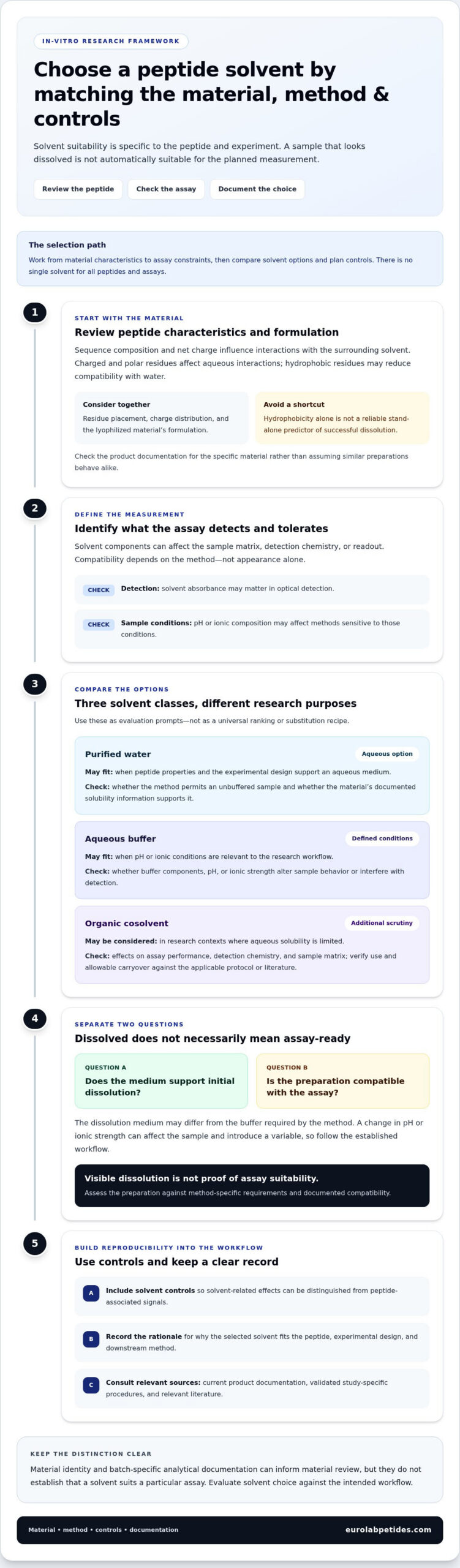
A Researcher’s Checklist for Selecting a Reconstitution Solvent
A consistent pre-study review makes solvent decisions traceable and helps prevent overlooked assay constraints. Use this checklist to organize the decision, not as a preparation recipe. Validated institutional procedures and study-specific protocols take precedence over general guidance about solvent selection.
A five-point pre-study solvent review
- Define the research objective. Identify what the experiment is designed to measure and which analytical method will produce the readout. The method determines which compatibility criteria matter.
- Review peptide-specific information. Examine available product documentation for material identity and handling considerations. Note details that may inform solvent selection, but do not treat documentation alone as proof of assay compatibility.
- Consult relevant primary literature. Look for evidence tied to the peptide and research context. Use findings as a starting point, since differences in assay design or sample matrix can limit how directly a published method applies.
- Define compatibility criteria. Identify assay constraints related to detection chemistry, sample conditions, and solvent components. Decide in advance what evidence will show that a candidate preparation meets the planned method’s requirements.
- Plan controls before the experiment. Determine how solvent-only controls will match the study conditions and how you will interpret their results. Planning controls in advance makes potential solvent-related signals or matrix effects easier to identify.
Keep calculation tasks separate from solvent selection. A calculator can support concentration or reconstitution calculations once the relevant inputs are defined, but it cannot establish peptide solubility or assay compatibility. The peptide reconstitution calculator guide covers that distinct calculation task. It is not a substitute for a validated protocol.
What to document for reproducibility
Record enough information for another researcher to understand what was selected and how the decision was evaluated. The laboratory record should capture the solvent identity, grade, source, and relevant lot details, alongside the protocol reference and preparation date. Document observed sample characteristics using the laboratory’s approved method, and distinguish observations from conclusions about analytical suitability.
- Record why the solvent was selected and which protocol or literature informed the choice.
- Capture solvent-control conditions and results in the context of the study design.
- Document deviations from the applicable protocol, including the reason and relevant observations.
- Retain relevant product and analytical documentation with the study records, using current, product-specific information.
A complete record connects the material, solvent decision, controls, and measurement in one interpretable account. EuroLab Peptides supplies research-grade peptides for in-vitro research and laboratory development. Explore research-grade peptides for laboratory research as you plan a documented, protocol-led workflow.
How EuroLab Peptides Fits into a Research-Only Workflow
Solvent selection is one part of a controlled research workflow. Reproducibility also depends on clearly characterized research materials, adherence to the study protocol, and records of the decisions that shape the sample and its measurement. EuroLab Peptides supplies research-grade peptides for in-vitro research and laboratory development. Its quality-control process includes in-house and independent third-party laboratory testing.
That testing informs material assessment, but it does not prescribe a solvent for a particular peptide and assay combination. Solvent choices depend on the experimental design and analytical method. Supplier documentation can inform your review of research materials, while solvent compatibility and assay performance must be evaluated within the validated study workflow.
Using quality documentation as one part of study planning
Review product-specific analytical documentation when assessing a research material’s identity and quality. Retain relevant documentation with the study record and verify that it applies to the material being used. This supports traceability, but it cannot establish that a solvent is suitable for a particular assay or replace experimental controls.
Supplier evaluation is another part of research planning. The research peptide sourcing guide provides broader context on quality documentation and sourcing, which are distinct from method validation. Material records inform what was studied. Protocol-specific validation addresses how it behaves in the analytical system.
Keep the workflow within its research-use scope
This discussion concerns in-vitro research and laboratory development only. Select solvents according to validated institutional procedures, applicable study protocols, and the requirements of the intended analytical method. General educational material is not a substitute for those controls, and supplier quality testing does not establish suitability for every research application.
EuroLab Peptides’ products are designated strictly for in-vitro research and laboratory development. They are not intended for human consumption or clinical use. This boundary applies to the materials and the guidance in this article. No human-use, clinical, dosing, injection, or treatment guidance is provided.
For laboratory research planning, explore EuroLab Peptides research materials and evaluate relevant product documentation alongside your study-specific protocol.
Make Your Next Study More Deliberate
Make the solvent decision traceable before your next experiment. Define what evidence will demonstrate compatibility with the intended method, and record the basis for your choice alongside the study’s controls. This gives you a clearer basis for interpreting results and refining future workflows. The right solvent depends on the research design, not on a universal rule.
EuroLab Peptides’ quality-control process includes in-house and independent third-party laboratory testing. Its research-grade peptides are designated strictly for in-vitro research and laboratory development, not for human consumption or clinical use. Use current product documentation as one part of your research planning, alongside validated protocols and assay-specific evidence for experimental decisions.
Explore EuroLab Peptides research materials for your laboratory research planning. Keep the next step grounded in your study protocol and document the decisions that support interpretable in-vitro work.
Frequently Asked Questions
Is water always suitable for reconstituting a research peptide?
No. Suitability varies with the peptide, its formulation, the study protocol, and the analytical method. Water may be a candidate, but a peptide supplied as a lyophilized material is not necessarily compatible with water under every experimental condition. When deciding when to use different reconstitution solvents, follow validated, study-specific guidance and account for relevant controls. A method sensitive to sample pH, for example, requires attention to that condition even if the preparation looks acceptable.
Can a reconstitution solvent affect assay results?
Yes, depending on the assay. Solvent components may contribute background signal, change sample-matrix properties, or interact with detection chemistry. A solvent-only control can help identify an effect that might otherwise be attributed to the peptide. Align control conditions with the study design and relevant measurement conditions. An effect in one assay does not mean the same solvent will interfere with every method, so interpret results within the validated protocol.
What is the difference between a solvent and a buffer?
A solvent is the liquid medium used to dissolve or disperse a material. A buffer is a solution formulated to resist changes in pH under defined conditions. An aqueous solution can contain buffer components, but “water” and “buffer” are not interchangeable terms. A buffer’s ions may matter to a measurement even when its pH is appropriate. Assess its composition as part of the experiment, not only its ability to maintain pH.
How can researchers assess solvent compatibility with LC-MS?
Assess compatibility against the specific LC-MS method, sample preparation, and analytical conditions. A solvent that supports sample preparation is not automatically suitable for the instrument workflow or measurement. Consult the validated method and relevant instrument guidance, paying attention to stated sample constraints and potential sources of interference. Do not apply a solvent recommendation from a different analytical setup without supporting evidence. This is a method-review question, not one that can be settled by appearance alone.
Should solvent selection be based only on whether a peptide appears dissolved?
No. Visual appearance can describe a sample, but it does not establish concentration, stability, homogeneity, or analytical suitability. A clear-looking preparation may still fail to meet a method’s requirements. Interpret observations using the laboratory’s validated criteria, and consider control results alongside them. Do not assume a preparation is suitable simply because no visible material remains. The relevant evidence is whether it meets the experiment’s defined analytical requirements.
Does reconstitution solvent selection determine how a peptide should be stored?
No. Solvent choice and storage conditions are related considerations, but one does not establish the other. Storage depends on the specific material, formulation, and validated handling information. The selected solvent alone cannot establish stability or a suitable storage period. Refer to current product-specific documentation and approved laboratory procedures for storage decisions. Keep this review separate from solvent selection so that assumptions about preparation conditions are not mistaken for evidence of storage suitability.
