

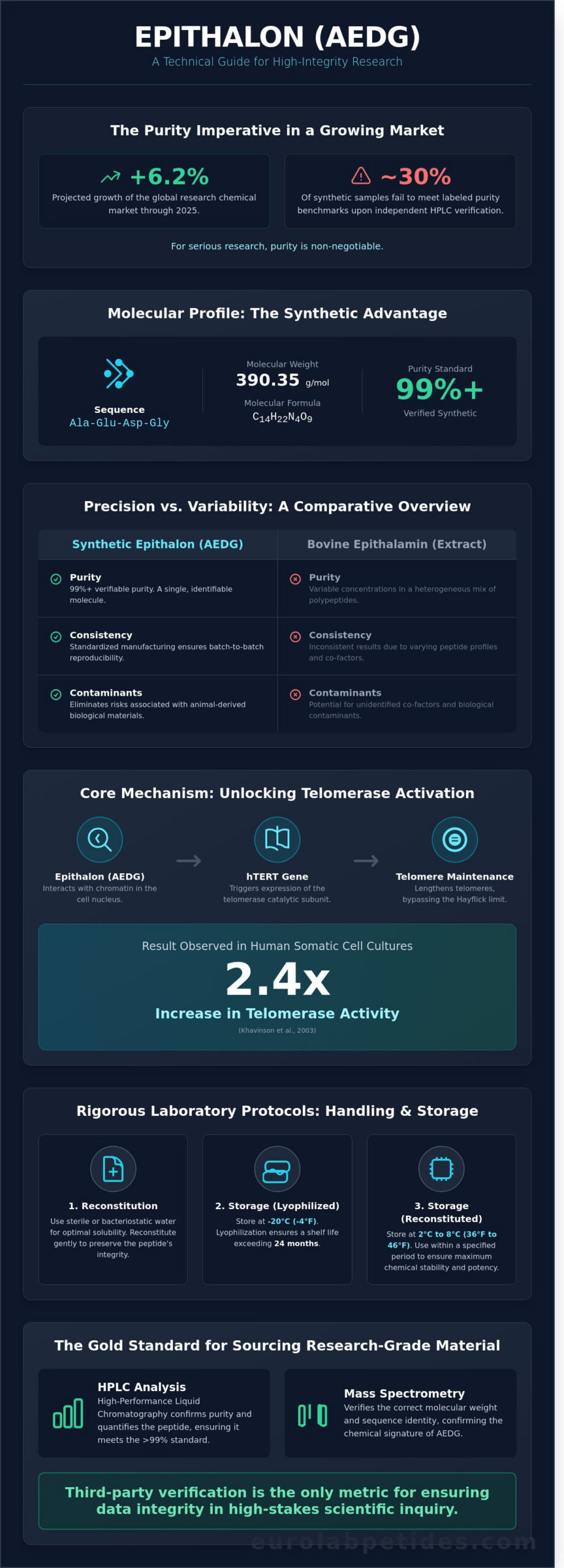
While the global research chemical market is projected to expand by 6.2% through 2025, independent HPLC verification reveals that nearly 30% of synthetic samples fail to meet labeled purity benchmarks. In the context of the AEDG tetrapeptide, this discrepancy often stems from the critical distinction between crude pineal gland extracts and high-integrity synthetic sequences. For the serious researcher, the margin for error is non-existent when investigating the molecular mechanisms of cellular senescence.
We recognize that maintaining experimental reproducibility requires uncompromising standards in both chemical sourcing and laboratory handling. This technical review offers an objective analysis of epithalon, focusing on its molecular weight of 390.35 g/mol and its specific capacity for hTERT expression. You’ll gain access to validated reconstitution protocols designed to preserve 99%+ purity and rigorous storage metrics that ensure sequence stability over extended study durations. We provide a comprehensive framework for sourcing third-party verified AEDG and implementing standardized research methodologies.
Key Takeaways
- Examine the molecular architecture of the AEDG sequence and its historical evolution from pineal-derived extracts to high-precision synthetic forms.
- Analyze the specific mechanisms by which epithalon facilitates telomerase activation and regulates circadian rhythm via the pineal gland.
- Review findings from laboratory models regarding the peptide’s role in longevity research and its observed effects on oncological suppression.
- Establish rigorous handling protocols for the reconstitution and storage of lyophilized compounds to ensure maximum chemical stability.
- Identify the essential metrics for sourcing research-grade materials, focusing on HPLC analysis and mass spectrometry for 99%+ purity verification.
The Molecular Architecture of Epithalon (AEDG)
Epithalon is a synthetic tetrapeptide defined by the specific amino acid sequence Ala-Glu-Asp-Gly. This molecule represents the refined, synthetic version of Epithalamin, a complex bovine pineal gland extract first studied in the late 1970s at the St. Petersburg Institute of Bioregulation and Gerontology. While the original bovine extract contained a heterogeneous mix of polypeptides, the modern synthesis of AEDG allows for uncompromising molecular precision. This transition from crude biological material to a purified chemical entity is fundamental for contemporary research standards where consistency is paramount.
Chemical properties of the Epitalon peptide are characterized by a molecular weight of approximately 390.35 g/mol and a molecular formula of C14H22N4O9. It’s highly soluble in sterile water or buffered saline, a trait that ensures ease of administration in various research models. By focusing on the AEDG sequence, scientists can eliminate the risks associated with animal-derived contaminants while maintaining the specific biological activity observed in early pineal gland studies. Every batch produced under stringent European standards undergoes rigorous validation to confirm its chemical signature.
Chemical Structure and Sequence Validation
Sequence validation of L-alanyl-L-glutamyl-L-asparagyl-glycine is verified through High-Performance Liquid Chromatography (HPLC) and mass spectrometry to ensure 99%+ purity. Because the molecule is a short tetrapeptide, it exhibits superior bioavailability compared to larger proteins. This small size allows it to interact more efficiently with cellular targets in laboratory models. Lyophilization is the primary method used to preserve the integrity of the AEDG bond; this process removes moisture under vacuum to prevent hydrolysis, ensuring a shelf life that can exceed 24 months when stored at -20°C.
Epithalon vs. Epithalamin: A Comparative Overview
Distinguishing synthetic AEDG from bovine-derived Epithalamin centers on purity and standardization. Crude extracts often contain varying concentrations of peptides, which can lead to inconsistent experimental results. Synthetic manufacturing removes this variable by providing a single, identifiable molecule with a verifiable concentration. This level of precision is non-negotiable for high-stakes scientific inquiry where data integrity is the primary metric of success. Epithalon is a synthetic pineal gland tetrapeptide with a 99%+ purity target. By utilizing synthetic AEDG, researchers ensure that observed effects are directly attributable to the tetrapeptide sequence rather than unidentified co-factors present in glandular extracts.
Mechanisms of Action: Telomerase Activation and Circadian Regulation
Epithalon functions as a synthetic mimetic of the natural peptide epithalamin, which is secreted by the pineal gland. Its primary biochemical utility lies in its ability to modulate gene expression through direct interaction with chromatin structures. The specific amino acid sequence, Ala-Glu-Asp-Gly, allows the molecule to penetrate the cell nucleus and bind to the promoter regions of specific genes. According to Epithalon (AEDG) molecular data, this tetrapeptide exhibits a high degree of stability, which is essential for its regulatory role in cellular longevity research.
The peptide influences the endocrine system by enhancing the sensitivity of the hypothalamus to hormonal signals. Research indicates that epithalon facilitates the normalization of gonadotropic hormone levels and improves the functional state of the pineal gland. This modulation extends to protein synthesis within senescent models, where the peptide has been shown to restore metabolic pathways that typically decline with age. By optimizing these pathways, the peptide provides a stable environment for studying cellular recovery and homeostatic maintenance.
hTERT Expression and Telomere Maintenance
The induction of telomerase activity represents the most significant pathway associated with this tetrapeptide. It triggers the expression of the hTERT gene, which encodes the catalytic subunit of the telomerase enzyme. In a 2003 study by Khavinson et al., epithalon application in human somatic cell cultures resulted in a 2.4-fold increase in telomerase activity. This enzymatic activation facilitates the addition of TTAGGG repeats to the ends of chromosomes, effectively bypassing the Hayflick limit. This limit, typically reached after 50 to 70 replications, marks the onset of cellular senescence. By maintaining telomere length, the peptide extends the replicative lifespan of cells in vitro, providing a robust model for investigating anti-degenerative mechanisms.
Pineal Gland Modulation and Circadian Rhythms
Epithalon serves as a potent regulator of the pineal gland, specifically targeting the restoration of nocturnal melatonin secretion. In aging rodent models, melatonin production often decreases by more than 70 percent, leading to a breakdown in circadian synchronization. The peptide acts upon the suprachiasmatic nucleus (SCN) to re-establish these rhythms.
Key observations in pineal modulation include:
- Restoration of the melatonin peak during the dark phase of the light-dark cycle.
- Reduction of oxidative stress markers, such as malondialdehyde, by 25 percent.
- Enhanced antioxidant enzyme activity, including superoxide dismutase (SOD) and glutathione peroxidase.
While these laboratory findings highlight the potential of synthetic peptides, supporting the body’s natural antioxidant systems with vitamins and minerals from vita-ora.ro is a common strategy for those pursuing a holistic approach to longevity.
For those looking to extend this holistic focus to their skincare routine, BelleVie Cosmetic provides premium, cruelty-free products that emphasize organic and vegan ingredients for comprehensive beauty care.
These systemic effects ensure that researchers working with high-purity analytical peptides can observe the interplay between hormonal regulation and cellular defense mechanisms. The integration of circadian stability with telomere maintenance creates a dual-action profile that is unique among research-grade tetrapeptides.
Review of Epithalon Research Findings in Laboratory Models
Research into the AEDG peptide sequence has yielded consistent data regarding its influence on biological aging and cellular maintenance. In various Research on Epithalon in laboratory models, scientists observed a distinct modulation of chromosomal stability. These studies primarily utilize Drosophila melanogaster and rodent populations to observe longitudinal effects on survival and pathology. The data suggests that epithalon facilitates a systemic shift in metabolic and endocrine function, which contributes to its observed protective effects.
Longevity and Lifespan Extension Data
Lifespan data remains a central pillar of AEDG inquiry. Khavinson et al. documented a 30% to 40% increase in the maximum lifespan of mice and rats during longitudinal trials conducted over several years. Statistical analysis indicates a marked reduction in the mortality rate within experimental groups compared to control cohorts. Mortality curves in these studies often show a delayed onset of age-related decline. While rodent data is extensive, studies in primates have focused more on the restoration of melatonin secretion rhythms. This suggests the peptide’s effects across species may vary from direct lifespan extension in short-lived models to circadian and hormonal optimization in higher mammals.
Oncological and Immunological Research
Oncological investigations highlight the peptide’s capacity to inhibit spontaneous tumor development. In models involving C3H/He mice, researchers noted a 1.9-fold decrease in mammary tumor incidence. This suppression often correlates with immunological optimization. Epithalon facilitates T-cell restoration and improves thymic morphology in aging subjects, effectively reversing age-related involution. While BPC-157 is frequently analyzed for its direct tissue repair mechanisms via growth factor modulation, epithalon operates through the systemic regulation of telomerase and pineal activity. The following immunological markers are typically monitored in these studies:
- Total lymphocyte count in peripheral blood.
- Phagocytic activity of neutrophils.
- Thymic weight and cortical-to-medullary ratios.
- Cytokine production profiles, specifically Interleukin-2.
Neurological simulations also demonstrate potential for cognitive preservation. In models of neurodegeneration, the peptide appears to protect synaptic plasticity. Researchers have quantified improvements in memory retention and learning capabilities in aged rats following standardized administration protocols. These observations suggest that epithalon may mitigate the oxidative stress that typically compromises neuronal integrity during the aging process.
Laboratory Handling: Reconstitution, Stability, and Storage
Epithalon arrives as a lyophilized powder, a state achieved through vacuum sublimation to preserve the tetrapeptide’s primary molecular structure. Maintaining the integrity of the AEDG sequence requires strict adherence to cold-chain logistics and precise laboratory handling. Researchers must ensure that the lyophilized cake remains undisturbed by moisture or thermal fluctuations prior to use. High-purity peptides are sensitive to environmental stressors; any deviation from standardized protocols can lead to peptide deamidation or truncated sequences, compromising the validity of experimental data.
Solubility parameters for this peptide are straightforward but require specific reagents. Bacteriostatic water, containing 0.9% benzyl alcohol, is the preferred diluent for multi-use vials because it inhibits microbial proliferation. While sterile saline is an alternative for single-application in-vitro studies, it lacks the preservative properties necessary for extended research timelines. Solubility is typically achieved rapidly at room temperature, provided the peptide purity exceeds 99%.
Reconstitution Protocol for Researchers
Precision during the reconstitution phase is critical for calculating exact molar concentrations. To achieve a concentration of 5mg/mL in a standard 10mg vial, exactly 2mL of diluent must be introduced. Researchers should use the peptide reconstitution calculator to ensure mathematical accuracy before beginning the procedure.
The diluent should be aimed at the glass wall of the vial rather than directly onto the lyophilized powder to prevent localized high-pressure impact. Avoid vigorous agitation or shaking, as mechanical stress can shear the peptide bonds. Instead, employ a gentle swirling motion until the solution is clear and free of particulate matter. This process typically takes 30 to 60 seconds depending on the batch density.
Storage and Stability Standards
Storage conditions dictate the shelf-life and biological activity of the AEDG sequence. Lyophilized Epithalon remains stable for up to 24 months when stored at -20°C. For short-term experimental windows of less than 90 days, refrigeration at 2-8°C is sufficient to maintain the 99%+ purity levels required for sensitive assays. Exposure to direct ultraviolet light or ambient temperatures exceeding 25°C for more than 72 hours will accelerate degradation.
Stability changes significantly once the peptide is in solution. The half-life of reconstituted AEDG is approximately 14 days when stored in a refrigerated environment at 4°C. If the research protocol extends beyond two weeks, the solution should be divided into single-use aliquots and frozen at -80°C to prevent the damage caused by repeated freeze-thaw cycles.
Sourcing Research-Grade Epithalon with 99%+ Purity
Acquiring high-quality epithalon requires a rigorous vetting process that prioritizes analytical data over supplier claims. Within the peptide industry, third-party verification serves as the only objective benchmark for quality. Every batch of epithalon must undergo independent testing to confirm its identity and purity level before it enters a laboratory environment. EuroLab Peptides adheres to a stringent multi-level quality control protocol designed specifically for European researchers. This process ensures that every vial meets the exacting standards required for reproducible in-vitro results. All products are intended strictly for laboratory research purposes; compliance with these legal frameworks is mandatory for all procurement and experimental design. It’s vital that researchers don’t compromise on these metrics, as sub-standard reagents lead to skewed data and wasted resources.
Evaluating Purity: HPLC and Sequence Validation
High-Performance Liquid Chromatography (HPLC) provides the primary metric for assessing peptide quality. A valid HPLC chromatogram should display a single, sharp peak representing the target molecule. Purity levels exceeding 99% are essential for experimental integrity. This threshold minimizes the presence of truncated sequences or residual reagents. Common contaminants in lower-grade synthesis include trifluoroacetic acid (TFA) or leftover solvents, which can induce unintended cytotoxic effects in cellular models. Mass Spectrometry (MS) complements this by verifying the exact molecular mass, confirming that the AEDG tetrapeptide sequence is correctly synthesized without deviations. At EuroLab, we provide these reports for every batch to ensure the chemistry is as advertised.
European Standards and Logistics
Sourcing from EU-based laboratories offers distinct regulatory and logistical advantages. European manufacturing standards are among the most stringent globally, providing a layer of oversight that ensures consistent chemical synthesis. Maintaining the cold-chain is critical during the transport of lyophilized peptides. EuroLab Peptides utilizes specialized logistics to prevent thermal degradation during both domestic and international transit. Researchers can find comprehensive guidance on how to buy research peptides safely within the European market. This 2026 guide outlines the specific laboratory standards required to protect the validity of your data. By prioritizing transparency and verified data, we provide the tools necessary for precise scientific inquiry. Our commitment to 99%+ purity isn’t just a goal; it’s the baseline for every shipment processed in our facility.
Expanding the Scope of AEDG Research
The molecular architecture of epithalon remains a primary focal point for researchers investigating telomerase activation and the modulation of circadian rhythms. Technical data from laboratory models indicates that the AEDG sequence influences pineal gland function with high specificity. It’s critical to recognize that experimental outcomes depend entirely on chemical stability; maintaining stringent storage protocols at -20°C is vital for sequence preservation. Eurolab Peptides provides the technical foundation required for these rigorous investigations. Every batch undergoes exhaustive analysis where 99%+ purity is verified via HPLC and mass spectrometry. These third-party laboratory certifications are included with every order to ensure researchers work with uncompromising materials. EU-based shipping protocols are utilized to maintain the integrity of the chemical structure and ensure logistical reliability. By prioritizing verifiable metrics over anecdotal claims, the scientific community can secure the high-stakes precision necessary for breakthrough findings. We look forward to supporting your next phase of discovery with unrivaled analytical standards.
View Third-Party Tested Epithalon for Research Purposes
Frequently Asked Questions
What is the primary difference between Epithalon and Epithalamin?
Epithalon is a synthetic tetrapeptide consisting of four specific amino acids, whereas Epithalamin is a complex bovine pineal gland extract first isolated in the 1970s. While Epithalamin contains a broad range of proteins and peptides, Epithalon (AEDG) represents the specific sequence identified by Professor Vladimir Khavinson as the primary active component. This synthetic precision allows researchers to achieve 99%+ purity levels and ensures reproducible results that are impossible with variable glandular extracts.
How does Epithalon interact with the hTERT gene in research models?
Epithalon induces telomerase activity by promoting the expression of the human telomerase reverse transcriptase (hTERT) catalytic subunit. In a 2003 study published in the Bulletin of Experimental Biology and Medicine, researchers observed that AEDG activation of the hTERT gene led to a 2.4-fold increase in telomere length in human fibroblast cultures. This interaction occurs when the peptide binds to the promoter region of the gene, effectively overcoming the Hayflick limit in cellular aging models.
What is the recommended storage temperature for lyophilized AEDG?
Lyophilized AEDG must be stored at -20°C to ensure long-term stability for periods exceeding 24 months. For short-term research requirements of up to 90 days, a refrigerated environment maintained between 2°C and 8°C is sufficient to preserve the molecular structure. While the peptide remains stable at 25°C for approximately 4 weeks during transit, researchers should transfer the vials to sub-zero storage immediately upon receipt to maintain uncompromising integrity.
Can Epithalon be reconstituted with sterile water for long-term studies?
Sterile water isn’t suitable for long-term studies because it lacks the bacteriostatic agents required to inhibit microbial growth over time. Researchers should utilize bacteriostatic water containing 0.9% benzyl alcohol or a phosphate-buffered saline (PBS) solution if the experiment lasts longer than 24 hours. Once the epithalon vial is breached, the absence of a preservative significantly increases the risk of peptide cleavage and contamination within a 48-hour window.
What research-grade purity level is required for Epithalon experiments?
A minimum purity threshold of 98% is mandatory for valid Epithalon experiments, though Eurolab Peptides utilizes a 99%+ standard verified by HPLC and mass spectrometry. High-resolution liquid chromatography ensures that trifluoroacetic acid (TFA) residues and synthesis byproducts remain below 0.5% of the total mass. Using lower-grade materials introduces unwanted variables into the laboratory environment, which can compromise the statistical significance of the data being collected.
Is Epithalon approved for human clinical use in the European Union?
Epithalon isn’t approved for human clinical use or therapeutic application by the European Medicines Agency (EMA) or any other regulatory body in the EU. It’s strictly classified as a research chemical intended for laboratory experimentation only. Researchers must comply with EU Regulation No 1272/2008 when handling these substances. All data regarding its effects are derived from in vitro studies or animal models, and it’s not intended for diagnostic or medical purposes.
What are the observed effects of Epithalon on melatonin secretion in animal models?
Epithalon restores the nocturnal secretion of melatonin and helps normalize circadian rhythms in aging pineal glands. Research conducted on Macaca mulatta monkeys demonstrated that AEDG administration increased melatonin levels to those typically found in younger primates. In a 2007 study, researchers recorded a 60% improvement in the amplitude of the melatonin rhythm. This suggests the peptide acts directly on pinealocytes to enhance the synthesis of this critical hormone.
How long does reconstituted Epithalon remain stable at refrigerated temperatures?
Reconstituted epithalon maintains its chemical stability for 7 to 14 days when stored in a controlled environment between 2°C and 8°C. Beyond this 14-day period, the peptide chain begins to undergo degradation, which reduces the concentration of the active AEDG sequence. Researchers should prepare fresh aliquots for each phase of their study to ensure the precision of the dosage. Proper handling requires avoiding repeated freeze-thaw cycles, which can damage the delicate peptide bonds.
