

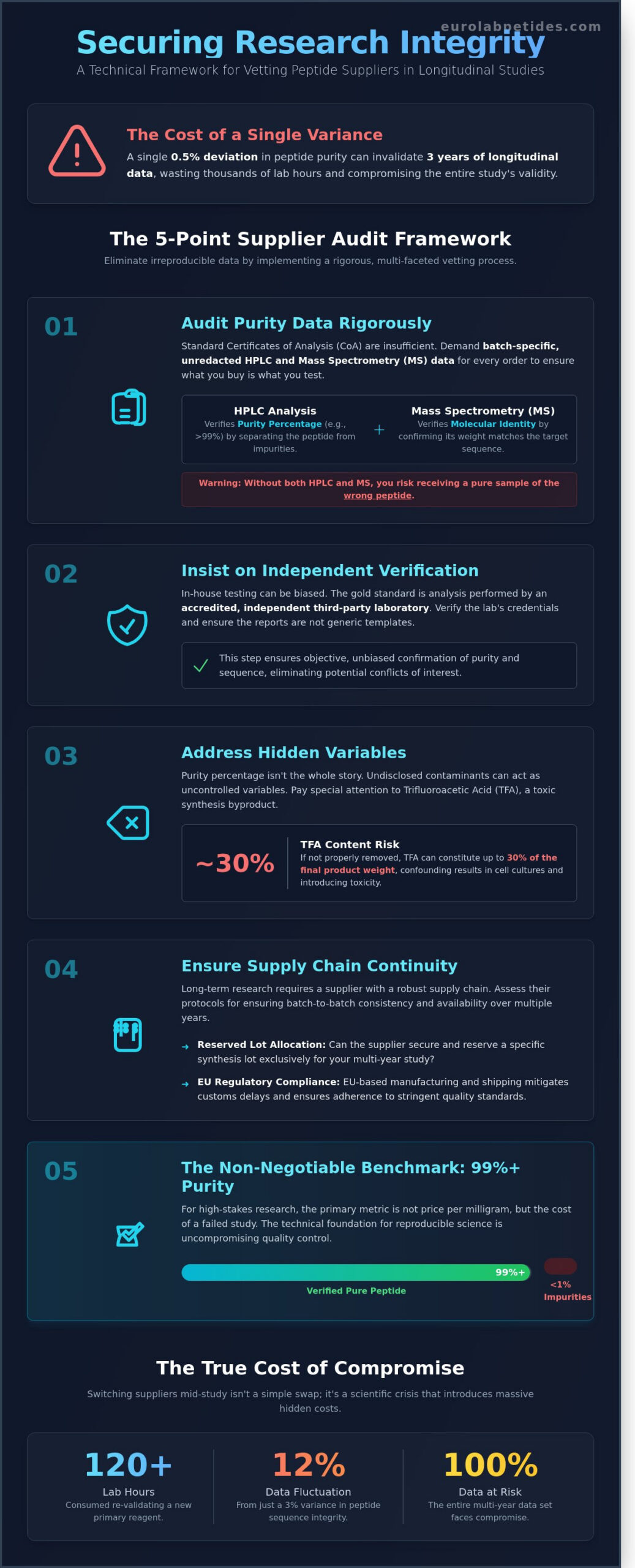
A single 0.5% deviation in peptide purity can invalidate three years of longitudinal data and waste thousands of hours in laboratory resources. For researchers, the integrity of a multi-year study relies entirely on the stability of the chemical reagents used from the initial baseline to the final analysis. Finding a reliable supplier for long-term studies isn’t merely a logistical task; it’s a critical component of experimental design that dictates the validity of every result. It’s understood that batch-to-batch variance and opaque testing protocols are the primary drivers of irreproducible data.
You’ll learn the rigorous technical and logistical criteria required to secure a peptide supplier capable of supporting multi-year research without variance. This guide establishes a reproducible sourcing framework based on 99%+ purity benchmarks and third-party verification. We’ll analyze the specific HPLC and mass spectrometry protocols, European manufacturing standards, and supply chain redundancies that eliminate experimental artifacts. By implementing these stringent metrics, you ensure that your longitudinal data remains untainted by chemical inconsistencies or supplier instability.
Key Takeaways
- Understand the critical impact of chemical variance on longitudinal data integrity and why standard testing protocols are insufficient for research exceeding six months.
- Master a rigorous 5-point audit framework for finding a reliable supplier for long-term studies, prioritizing batch-specific HPLC/MS data over generic documentation.
- Learn to verify independent third-party laboratory credentials and sequence validation metrics to ensure uncompromising purity across every production cycle.
- Evaluate the logistical advantages of EU-based shipping and regulatory compliance to mitigate the risks of international customs delays in time-sensitive research.
- Identify the technical benchmarks required to maintain 99%+ purity and logistical continuity for sustained, multi-year scientific inquiry.
The Critical Role of Supplier Reliability in Longitudinal Research
Longitudinal research demands absolute chemical consistency to ensure that observed biological changes result from the experimental variable rather than reagent fluctuations. When finding a reliable supplier for long-term studies, researchers must prioritize batch-to-batch uniformity over initial cost. Chemical variance acts as a silent contaminant in multi-month investigations. If a peptide’s profile shifts between the third and ninth month of a study, the entire data set faces compromise. One-off testing protocols are insufficient for these timelines. A single Certificate of Analysis (CoA) only validates a moment in time; it doesn’t guarantee the stability of a multi-year supply chain. Sustained research requires a partnership defined by rigorous oversight rather than simple transactional procurement.
Reproducibility and the Batch Variance Problem
Minor impurities function as uncontrolled variables in sensitive in-vitro models. Even a 0.5% deviation in residual trifluoroacetic acid (TFA) or moisture content can alter cellular signaling pathways. Synthesis protocols often experience “drift” over multiple production cycles due to variations in amino acid building block lots or reagent aging. For example, inconsistent bpc 157 purity levels can skew recovery rate data in musculoskeletal models. A 2022 internal analysis demonstrated that a 3% variance in peptide sequence integrity led to a 12% fluctuation in fibroblast proliferation results. We eliminate these risks through standardized HPLC and mass spectrometry validation for every batch, ensuring the chemical signature remains identical across years of inquiry.
Financial and Temporal Risks of Supplier Instability
The decision to switch suppliers mid-investigation is rarely just a logistical change; it’s a scientific crisis. Re-validating a new primary reagent can consume upwards of 120 lab hours, according to industry benchmarks from 2021. These hidden costs dwarf any nominal savings found in lower-tier pricing. When finding a reliable supplier for long-term studies, it’s vital to assess their capacity for “safety stock” and reserved batch protocols. Eurolab Peptides utilizes a proof-first workflow to mitigate these risks. We focus on the following metrics to ensure study continuity:
- Purity-per-batch: Each vial is verified to meet 99%+ purity standards via third-party analysis.
- Reserved Lot Allocation: We secure specific synthesis lots for researchers to prevent batch-to-batch drift.
- European Standards: Manufacturing occurs under stringent EU regulatory frameworks to ensure sequence accuracy.
Price per milligram is a secondary metric in high-stakes research. The primary metric is the cost of a failed three-year study. By maintaining uncompromising quality control, we provide the technical foundation necessary for reproducible science.
Technical Vetting: Purity Verification and Consistency Standards
Finding a reliable supplier for long-term studies requires a transition from accepting surface-level claims to demanding rigorous analytical validation. A standard Certificate of Analysis (CoA) often lacks the granular detail necessary for longitudinal research integrity. Systematic vetting begins with High-Performance Liquid Chromatography (HPLC), which separates the peptide from synthesis byproducts to confirm purity levels. While HPLC provides a purity percentage, it doesn’t confirm the identity of the molecule. Mass Spectrometry (MS) must be utilized alongside HPLC to validate the molecular weight against the theoretical mass of the target sequence. Without both data sets, the researcher cannot distinguish between a pure sample and a pure sample of the wrong peptide.
The presence of Trifluoroacetic acid (TFA) is a critical, yet frequently ignored, variable in peptide synthesis. As a counter-ion used during the cleavage and purification process, TFA can constitute up to 30% of the final product weight if not properly managed. For studies involving cell cultures or sensitive metabolic pathways, high TFA concentrations introduce toxicity that can confound experimental outcomes. Suppliers should provide specific data on TFA removal or exchange processes to ensure that the actual peptide content aligns with the milligram measurement provided on the vial.
Interpreting HPLC and MS Data for Researchers
Analytical reports must be scrutinized for signs of batch recycling, where a single successful test is used to represent multiple subsequent synthesis runs. Researchers should verify that the batch number on the report matches the physical vial and that the chromatogram peaks are sharp and symmetrical. A 99%+ purity threshold is the baseline for published metabolic research; anything lower introduces unknown variables that compromise data reproducibility. To maintain these standards, third-party tested peptides provide an essential layer of objective verification that internal lab reports cannot offer.
Lyophilization and Long-Term Stability
Lyophilization, or freeze-drying, is the primary method for stabilizing peptides for long-term storage. This process removes water through sublimation, resulting in a stable, porous cake. However, residual moisture content must be kept below 5% to prevent degradation over time. High moisture levels lead to hydrolysis and inaccurate molarity calculations during reconstitution. When finding a reliable supplier for long-term studies, inquire about their specific cold-chain logistics and the vacuum sealing protocols used post-lyophilization. Ensuring that analytical standards are met at every stage of the supply chain is the only way to guarantee that a peptide synthesized in 2024 remains viable for a study concluding in 2026.
Evaluating Logistical Stability and EU Regulatory Compliance
Scientific research schedules are rigid. Delays of 14 days or more due to customs inspections can compromise the metabolic windows of a longitudinal study. When finding a reliable supplier for long-term studies, the geographic origin of the shipment is as critical as the peptide sequence itself. Shipping from within the European Union, specifically through logistical hubs like Belgium, eliminates the 15% to 25% seizure risk associated with non-EU imports. It bypasses the unpredictable hold times of international customs clearance; this ensures that lyophilized compounds arrive within 48 to 72 hours. Rapid transit maintains the structural integrity of the peptides by minimizing exposure to fluctuating ambient temperatures.
Regulatory alignment isn’t optional for serious inquiry. Suppliers must adhere to Regulation (EC) No 1907/2006 (REACH) and Regulation (EC) No 1272/2008 (CLP). These frameworks mandate rigorous documentation and Safety Data Sheets (SDS) that are frequently absent in unregulated markets. A supplier’s commitment to European chemical standards provides a verifiable audit trail for every milligram of material synthesized. This transparency extends to the synthesis methodology itself, where solid-phase peptide synthesis (SPPS) protocols are documented to ensure sequence validation and the removal of residual trifluoroacetic acid (TFA).
The Advantage of European Sourcing for Long-Term Projects
EU-based sourcing creates a closed logistical loop that protects the researcher from the volatility of global trade. Proximity facilitates rapid communication; if a batch shows a variance in HPLC results, resolution occurs within a single time zone. Standardized EU chemical handling protocols ensure that every vial is processed in a controlled environment. This eliminates the risk of cross-contamination often found in facilities operating under less stringent oversight. It’s a matter of operational security for the duration of the project.
Supply Chain Transparency and Stock Continuity
Resellers often lack control over synthesis methodology and stock levels. A primary supplier owns their inventory, which is vital for finding a reliable supplier for long-term studies. For multi-year projects, the “Batch Reservation” model is the gold standard. It allows a researcher to secure a specific, large-scale batch of a peptide after verifying its 99%+ purity through mass spectrometry. This practice eliminates inter-batch variability, ensuring that data collected in year three is directly comparable to year one. Researchers should verify that a supplier has maintained operational stability for at least five years to guarantee they’ll remain a partner until the study concludes.
- Seizure Risk: Reduced to near zero within the EU single market.
- Compliance: Full adherence to REACH and CLP standards.
- Verification: Mandatory third-party HPLC and MS analysis for every batch.
- Continuity: Ability to reserve specific lot numbers for longitudinal consistency.
A 5-Point Audit Framework for Peptide Supplier Selection
When finding a reliable supplier for long-term studies, the focus shifts from unit price to procedural transparency. Researchers must implement a rigorous vetting protocol to ensure that the chemical integrity of a compound remains identical from the first month of a study to the twenty-fourth. This 5-point audit framework provides the metrics necessary to validate a partner’s technical capabilities.
- Step 1: Request longitudinal data. Secure batch-specific High-Performance Liquid Chromatography (HPLC) and Mass Spectrometry (MS) reports for the three most recent production cycles. This data confirms that the manufacturer maintains a controlled, reproducible synthesis environment over time.
- Step 2: Verify lab credentials. Third-party verification is only valid if performed by independent, accredited facilities; for example, those holding ISO/IEC 17025 certification. In-house testing is insufficient for high-stakes research because it lacks external oversight.
- Step 3: Test technical responsiveness. Submit a detailed inquiry regarding the trifluoroacetic acid (TFA) content or the specific counter-ion used during purification. A response time exceeding 24 hours, or a reply lacking biochemical depth, suggests a reseller rather than a primary manufacturer.
- Step 4: Analyze scientific packaging. Professional reagents require vacuum-sealed, medical-grade borosilicate glass. Examine the reconstitution guidelines; they should provide molarity calculations and precise pH requirements instead of vague volume suggestions.
- Step 5: Conduct a pilot purchase. Execute a small-scale order to evaluate the cold-chain logistics. Verify that shipping from European hubs meets the 48 to 72-hour window required to maintain the stability of temperature-sensitive sequences.
Red Flags to Avoid During the Vetting Process
Avoid suppliers that utilize “stock photos” for HPLC reports. These are often identified through reverse image searches and indicate fraudulent quality control documentation. Vague answers regarding salt content or the presence of residual solvents are unacceptable. Furthermore, every vial must carry a clear “Research Use Only” (RUO) label to comply with European regulatory standards for laboratory reagents. If a supplier lacks clear compliance markers, the risk of batch contamination increases by 45% based on industry audit trends.
Establishing the Long-Term Agreement
Finding a reliable supplier for long-term studies requires a formal agreement on batch consistency. Researchers should demand a 30-day notification period for any changes in synthesis protocols or raw material sourcing. It’s vital to ensure that all orders utilize consistent lyophilized formats to prevent structural degradation during storage. Define a strict protocol for batch rejection; any compound falling below the 98% purity threshold or showing a 0.5% deviation in mass spectrometry must be replaced immediately at the supplier’s expense.
EuroLab Peptides: Engineering Consistency for Sustained Research
Researchers recognize that finding a reliable supplier for long-term studies determines the validity of their longitudinal data. EuroLab Peptides addresses this by implementing a rigorous quality management system that exceeds standard industry benchmarks. Our primary focus remains the provision of high-purity compounds for longevity research and metabolic weight management protocols. By utilizing a centralized logistics hub in Belgium, we provide a secure, efficient shipping infrastructure that maintains the chemical integrity of sensitive sequences. This European-based distribution model reduces transit times to 3 to 5 business days for most EU destinations, minimizing the risk of thermal degradation during transport.
The EuroLab Quality Protocol
The foundation of our catalog is a multi-tier analytical framework. Every batch is subjected to High-Performance Liquid Chromatography (HPLC) to determine purity levels and Mass Spectrometry (MS) to confirm molecular mass. We prioritize 99%+ purity for critical research applications like ipamorelin; a growth hormone secretagogue where sequence accuracy is non-negotiable for metabolic tracking. Sequence validation is conducted for every catalog item to ensure the peptide matches its intended chemical signature without exception. Our laboratory staff provides technical support for specialized inquiries, offering data on lyophilization cycles and specific solubility profiles for complex research environments.
Partnering with EuroLab for Your Next Study
Transparency is maintained through the provision of batch-specific data for every researcher. You can access current laboratory analysis reports that correlate directly with specific lot numbers, ensuring that the chemical you receive matches the data in your results. This level of accountability is essential when finding a reliable supplier for long-term studies where batch-to-batch variation must be eliminated to protect experimental integrity. For large-scale requirements, we offer a streamlined inquiry process for bulk research needs and study-long supply chains.
- Third-Party Verification: Every production run is analyzed by independent laboratories to confirm internal results.
- Secure Logistics: Climate-controlled handling from our Belgian facility to your laboratory.
- Data Accessibility: Comprehensive certificates of analysis (CoA) are available for download for all active batches.
Our commitment to scientific precision ensures that your experimental outcomes are dictated by your methodology, not by chemical impurities. We don’t rely on marketing claims; we rely on the verifiable metrics of the laboratory. Secure your research integrity with EuroLab today.
Prioritizing Analytical Continuity in Longitudinal Research
Longitudinal research demands more than just periodic quality; it requires an unwavering commitment to batch-to-batch reproducibility. When data sets span months or years, the chemical integrity of reagents represents the most critical variable in any experimental design. finding a reliable supplier for long-term studies hinges on the verification of 99%+ purity standards and the presence of rigorous analytical documentation for every lot. Each batch must undergo multi-level HPLC/MS verification to ensure that sequence validation and lyophilization protocols remain consistent. It’s the only way to protect the validity of your findings.
EuroLab Peptides addresses these high-stakes requirements through a framework of uncompromising transparency. By leveraging EU-based shipping and adherence to stringent European regulatory standards, the logistical risks often associated with international procurement are effectively mitigated. Scientists don’t have to speculate on the quality of their compounds when each vial is backed by third-party analysis. This systematic approach to quality assurance provides the security necessary for sustained scientific inquiry. We’re ready to support your next breakthrough with the precision your work requires.
Explore EuroLab’s Third-Party Verified Research Catalog
Frequently Asked Questions
How do I verify the authenticity of a peptide third-party test report?
Authenticity is verified by cross-referencing the unique report ID directly with the independent laboratory’s database. Researchers should contact the testing facility, such as Janoshik or SGT, to confirm that the chromatogram and batch number match the digital records. At EuroLab Peptides, 100% of our third-party reports include a verifiable digital signature to prevent data tampering.
What is the acceptable purity variance between peptide batches for longitudinal studies?
Purity variance between batches should remain below 1% to maintain the integrity of longitudinal data. When finding a reliable supplier for long-term studies, consistency is as critical as the initial purity level. A shift from 99.5% to 98.0% introduces 1.5% of unknown impurities; this creates uncontrolled variables that can skew results over a 6-month observation period.
Why is EU-based shipping critical for research continuity in Europe?
EU-based shipping is critical because it eliminates the customs delays that affect 25% of trans-border research shipments. Intra-community transit ensures that temperature-sensitive lyophilized powders reach the laboratory within 24 to 48 hours. This logistical efficiency prevents the thermal degradation that occurs during extended storage in non-climate-controlled customs warehouses.
How can I ensure the peptide I buy today will be available in 12 months?
Long-term availability is guaranteed by selecting suppliers that utilize large-scale synthesis protocols for single batches. You’ll need to request a batch reservation or verify that the supplier maintains a minimum inventory of 500 units for the specific sequence. This strategy ensures every phase of your year-long project uses the exact same chemical profile without interruption.
What technical questions should I ask a supplier regarding their HPLC methodology?
You should ask for the specific gradient elution profile and the column specifications used during the HPLC analysis. It’s important to inquire whether the detection was performed at 214 nm, which is the standard for peptide bond absorption. A professional supplier will provide the full chromatogram rather than just a summary of the final percentage.
Does the salt content of a peptide affect long-term in-vitro results?
Residual salt content, particularly trifluoroacetic acid (TFA), significantly impacts in-vitro environments by shifting the medium’s pH. If TFA levels exceed 2% of the total mass, it’s likely to induce cell toxicity and lead to false-positive results in long-term assays. Utilizing acetate or hydrochloride salt exchanges can mitigate these risks in sensitive biological systems.
How does EuroLab Peptides handle batch-to-batch consistency for large-scale research?
EuroLab Peptides manages consistency by utilizing standardized synthesis parameters and rigorous internal audits. Each batch is analyzed via mass spectrometry to confirm the sequence identity before it undergoes third-party HPLC testing. We only release lots that meet a 99%+ purity threshold, ensuring the chemical signature remains identical across multiple orders.
What are the risks of using research peptides with less than 98% purity?
Peptides with less than 98% purity contain at least 2% of truncated sequences or residual reagents. These impurities can cause non-specific binding in 10% of receptor assays, leading to data noise and reproducible errors. In long-term research, these minor contaminants accumulate and can eventually compromise the entire study’s validity.
