

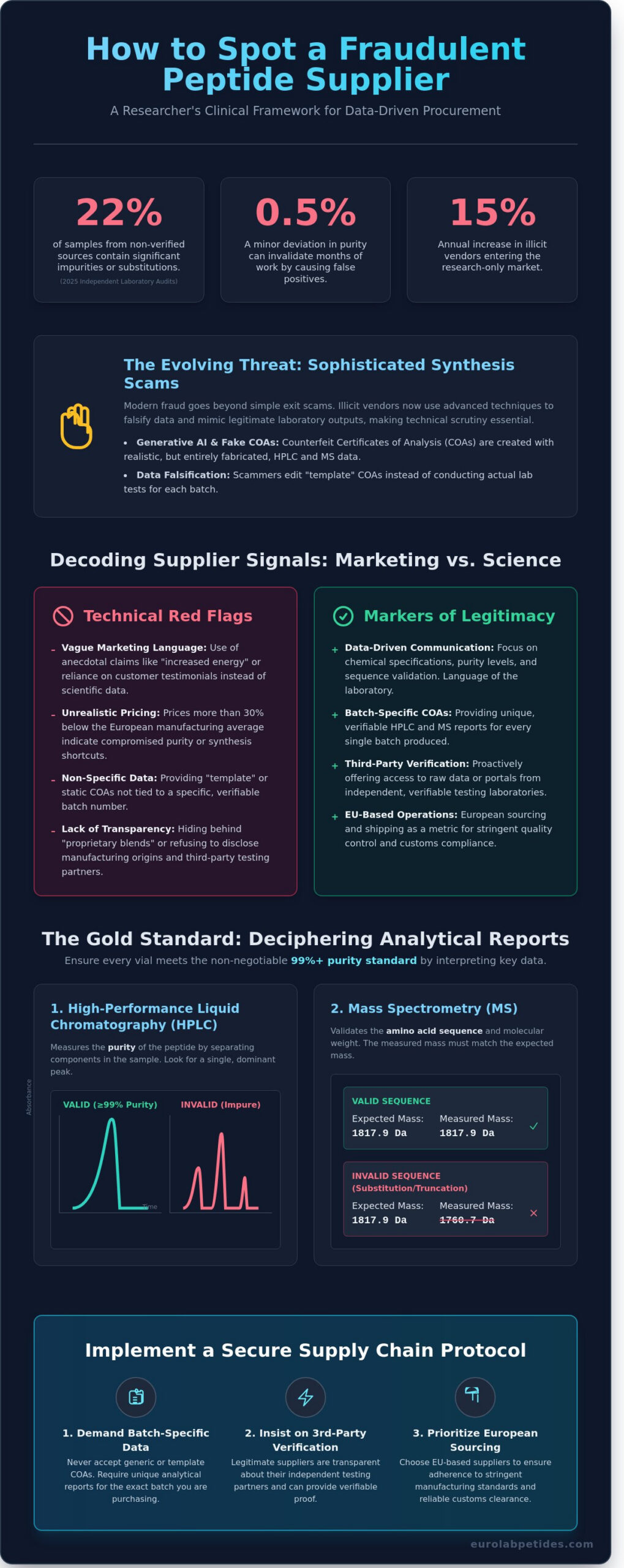
In 2025, independent laboratory audits revealed that 22% of peptide samples from non-verified sources contained significant amino acid substitutions or residual solvents. Learning how to spot a fraudulent peptide supplier is now a critical skill for any researcher who values the integrity of their experimental outcomes. You know that inconsistent reagents don’t just waste budget; they compromise the reproducibility of your entire data set. Even a minor 0.5% deviation in purity can lead to false positives in cellular assays, rendering months of work invalid.
This guide establishes a clinical framework for identifying the markers of fraudulent distribution. You’ll learn to analyze High-Performance Liquid Chromatography (HPLC) and Mass Spectrometry (MS) data to ensure every vial meets a 99%+ purity standard. We provide a repeatable verification protocol that leverages third-party testing and secure European-based sourcing to protect your laboratory from batch inconsistency. Each batch is analyzed against stringent standards before it enters your workflow. By the end of this analysis, you’ll possess the technical criteria needed to transition from speculative purchasing to data-driven procurement.
Key Takeaways
- Identify the evolution of sophisticated synthesis scams, moving beyond simple exit strategies to the complex falsification of analytical data.
- Master how to spot a fraudulent peptide supplier by decoding the critical differences between clinical laboratory language and unreliable anecdotal marketing.
- Acquire the technical expertise to interpret HPLC purity peaks and Mass Spectrometry sequence validation to ensure the integrity of your research materials.
- Evaluate operational reliability through stringent European standards, prioritizing EU-based shipping as a non-negotiable metric for customs compliance.
- Implement a secure supply chain protocol that demands third-party verification and batch-specific data to guarantee uncompromising 99%+ peptide purity.
The Proliferation of Fraudulent Peptide Suppliers in the 2026 Research Market
The landscape of peptide procurement in 2026 is increasingly complex. Fraudulent actors have evolved beyond the rudimentary “exit scams” observed in previous decades. Modern synthesis scams now rely on sophisticated data falsification to mimic legitimate laboratory outputs. Understanding how to spot a fraudulent peptide supplier requires a shift from evaluating website aesthetics to auditing technical data. By 2026, industry reports indicate a 15% annual increase in illicit vendors entering the research-only space, largely driven by the global demand for high-purity metabolic and neurological research compounds.
The research-only market remains a primary target for these actors because it operates with different regulatory oversight than human-grade pharmaceuticals. A fraudulent supplier is defined by a lack of chemical integrity; this includes mislabeling sequences or providing under-dosed vials that fail to meet the stated 99%+ purity threshold. The impact on in-vitro research is catastrophic. Impure compounds introduce uncontrolled variables that invalidate longitudinal studies and waste institutional funding. The fundamental complexity of chemical peptide synthesis means that shortcuts directly compromise the end product. High-purity synthesis requires precise amino acid sequencing and rigorous purification stages that can’t be bypassed without leaving detectable residues or truncated sequences.
The Rise of Synthetic Data and Faked COAs
In 2026, generative AI tools are routinely used to produce counterfeit Certificates of Analysis (COAs). These documents often feature realistic High-Performance Liquid Chromatography (HPLC) and Mass Spectrometry (MS) results that never occurred in a physical lab. A “template” COA is a static image easily edited with software. Legitimate results are tied to specific batch numbers and are verifiable through third-party laboratory databases. Researchers must now perform a rigorous digital audit of these assets to ensure the data correlates with the physical shipment. If a supplier can’t provide raw data files or a direct link to a third-party testing facility’s portal, the integrity of the compound is compromised.
Why ‘Cheap’ is the First Red Flag
The economics of peptide manufacturing in Europe are governed by fixed costs. High-purity synthesis, multi-stage lyophilization, and independent third-party verification require significant capital. Analyzing the market reveals that “budget” high-purity peptides are an economic impossibility. Fraudulent suppliers use low pricing to capture high-volume research orders, often substituting cheaper, similar-mass compounds or omitting the final purification steps. When the price deviates more than 30% from the European manufacturing average for a specific sequence, it’s a clear indicator of compromised quality. Knowing how to spot a fraudulent peptide supplier starts with recognizing that precision has a non-negotiable price floor in the 2026 market.
Identifying Technical Red Flags in Product Listings and Marketing
The distinction between a legitimate laboratory and a fraudulent vendor often manifests in the lexicon used across their digital storefront. Understanding how to spot a fraudulent peptide supplier requires a transition from consumer-facing intuition to analytical scrutiny. Legitimate suppliers communicate through the language of the laboratory; they prioritize chemical specifications over emotional appeals. When a website prioritizes flashy photography or lifestyle imagery over High-Performance Liquid Chromatography (HPLC) reports, the integrity of the material is likely compromised. Scientific procurement is a data-driven process where the only relevant metrics are purity, sequence validation, and stability.
Anecdotal claims and customer testimonials serve no purpose in a controlled research environment. A vendor showcasing subjective reviews about “increased energy” or “rapid recovery” is targeting a consumer market, not the scientific community. In 2026, the industry standard for validation remains the Certificate of Analysis (CoA) for every unique batch. If a supplier hides behind “proprietary blends” or refuses to disclose manufacturing origins, they’re likely a middleman for low-tier, unverified synthesis facilities. Transparency in corporate identity is a non-negotiable requirement for any researcher managing high-stakes experiments.
Hyperbolic vs. Clinical Claims
Fraudulent vendors frequently use “miracle” descriptors or list benefits that imply human consumption. This is a significant legal and technical red flag. Regulatory bodies frequently issue FDA warning letters to entities that misbrand these compounds as therapeutic agents rather than laboratory reagents. In contrast, for individuals who are legitimately seeking therapeutic support, My NuEra Rx or established entities like farmacidirettiitalia.com provide a valid clinical pathway for compounded medications and professional pharmaceutical services, distinguishing themselves from the deceptive marketing common in the research chemical sector. Terms like “pharma grade” are often used as a misnomer in the research space to justify inflated prices without providing the necessary documentation. A reputable supplier focuses on precise terminology:
- 99%+ purity: This isn’t a goal but a baseline requirement for analytical reliability.
- Sequence validation: Confirmation that the amino acid chain matches the theoretical structure exactly.
- TFA removal: Specific mention of salt content reduction, which is critical for cell culture integrity.
Evaluating the ‘About Us’ and Contact Transparency
Ghost suppliers often operate with no verifiable European address, using “virtual offices” to mask their true location. A lack of technical depth in the “About Us” section suggests a sales-driven operation rather than a scientific one. You should look for a responsive technical support team capable of discussing lyophilization parameters or solubility profiles, rather than a sales-only chat bot. Furthermore, a total absence of clear research peptides handling instructions, such as storage temperature requirements or reconstitution ratios, indicates the vendor doesn’t understand the chemistry they’re selling. If you require materials that meet stringent European standards, it’s vital to verify the laboratory credentials before initiating a purchase. Precise research requires a partner who understands that a 1% deviation in purity can compromise an entire data set.
The Gold Standard: Deciphering HPLC and Mass Spectrometry Reports
Every analytical report serves as the definitive proof of a peptide’s chemical integrity. For a researcher, the Certificate of Analysis (CoA) is the only document that substantiates a supplier’s claims. Marketing language is irrelevant when compared to the raw data provided by High-Performance Liquid Chromatography (HPLC) and Mass Spectrometry (MS). To understand how to spot a fraudulent peptide supplier, you must look past the 99%+ purity claim and scrutinize the underlying chromatograms. If a supplier refuses to provide batch-specific reports or offers generic, outdated documents, the material’s identity is unverified.
The necessity of independent, third-party laboratory verification cannot be overstated. Internal testing is prone to bias and lacks the accountability required for high-stakes research. This lack of transparency is often a precursor to regulatory intervention. For instance, an FDA Warning on Unapproved Peptides issued on February 26, 2025, underscored the risks associated with suppliers that circumvent standard safety and labeling protocols. Researchers must verify every report’s authenticity directly with the testing facility by matching the unique report ID on the lab’s official database.
Reading the Chromatogram
HPLC is the primary tool for determining chemical purity. The process separates the target peptide from synthesis byproducts and residual solvents. When reviewing a report, identify the primary peak; its size relative to all other peaks determines the purity percentage via the Area Under the Curve (AUC) calculation. A 99%+ purity rating means the primary peak accounts for 99% of the total detected material. Any secondary peaks, often referred to as “noise,” indicate contaminants or truncated sequences. A flat, stable baseline is the hallmark of professional purification. If the baseline is erratic or shows multiple jagged spikes, the peptide hasn’t been properly refined.
Verifying Molecular Weight via Mass Spec
While HPLC confirms purity, Mass Spectrometry (MS) confirms identity. This test measures the mass-to-charge ratio of the molecules to determine their exact molecular weight. Researchers must compare the theoretical molecular weight of the peptide sequence to the observed mass reported by the lab. A variance as small as 0.1% can signal a different peptide sequence or the presence of heavy metal salts. Every analytical report must include:
- A clear date stamp matching the purchase period
- A batch number that corresponds to the vial label
- A specific reference to the theoretical vs. observed mass
Data integrity is the only way how to spot a fraudulent peptide supplier in an environment where digital documents are easily manipulated. If the observed mass doesn’t align with the known sequence of the peptide, the product is scientifically invalid for research applications.
Evaluating Operational Integrity and European Supply Chain Standards
Operational integrity in 2026 is defined by logistical transparency. A supplier’s physical presence within the European Union is the primary indicator of regulatory accountability. When evaluating how to spot a fraudulent peptide supplier, researchers must scrutinize the origin of the shipment. EU-based shipping ensures compliance with stringent chemical handling laws and provides a clear chain of custody. It’s a non-negotiable standard because it subjects the supplier to European consumer protection and chemical safety regulations, which are among the most rigorous globally.
Legitimate entities avoid “anonymous only” payment methods like untraceable cryptocurrency wallets or person-to-person wire transfers. These methods lack the financial recourse required for professional laboratory procurement. Instead, look for established merchant gateways that accept credit cards or SEPA transfers; these require the business to pass rigorous “Know Your Customer” (KYC) protocols. If a vendor refuses to provide a standard commercial invoice, it’s a definitive signal of high-risk operational practices.
Customs and Regulatory Compliance in the EU
Sourcing from jurisdictions with lax oversight increases the risk of receiving contaminated or mislabeled sequences. Legitimate European suppliers provide transparent VAT invoicing and comprehensive laboratory documentation with every order. Claims of “discreet packaging” are a significant red flag. In a professional context, peptides are research chemicals, not contraband. Legitimate shipping utilizes standard commercial invoices and correct HS codes, typically 2937 for hormones and derivatives. Masking the contents suggests a desire to bypass customs inspections, which often correlates with a lack of underlying product certification.
Storage and Handling Protocols
Peptide stability depends entirely on the science of lyophilization. This freeze-drying process removes water while preserving the molecular structure of the peptide. When researchers learn how to buy research peptides, they must also understand how to identify compromised material. A high-quality lyophilized cake should appear as a solid, uniform “plug” or a crisp, white powder. Any variation in this physical state indicates a failure in the supply chain.
Indicators of poor storage or degraded integrity include:
- Collapsed or “melted” cakes, suggesting moisture ingress or temperature excursions during transit.
- Discoloration or yellowing of the powder, which can indicate oxidation or the presence of impurities.
- The absence of cold-chain logistics for temperature-sensitive analogs that require consistent refrigeration.
Fraudulent suppliers often ignore these protocols to reduce overhead. Reliable partners maintain strict temperature controls from the moment of synthesis to final dispatch, ensuring that the 99%+ purity verified in the lab remains intact upon arrival. If a supplier cannot explain their cold-chain management or storage protocols, the chemical integrity of their catalog is compromised.
Verify the integrity of your research by sourcing from a laboratory that prioritizes European standards. View our certified peptide catalog.
Establishing a Secure Supply Chain with EuroLab Peptides
Research integrity depends on the absolute reliability of chemical inputs. Learning how to spot a fraudulent peptide supplier is a critical skill, yet the ultimate goal is the establishment of a verified, secure supply chain. EuroLab Peptides utilizes a multi-level quality control protocol that bridges the gap between synthesis and final application. Every sequence is subjected to a rigorous internal validation process before undergoing an independent third-party audit. This ensures that the 99%+ purity threshold isn’t just a claim, but a verifiable chemical reality.
European manufacturing standards provide an unrivaled safety margin for researchers. By operating within the EU regulatory framework, EuroLab ensures that every batch meets stringent identity and stability requirements. Integrating EuroLab into a long-term research project provides the consistency needed for longitudinal studies. The variables of batch-to-batch drift are eliminated through standardized lyophilization and sequence validation protocols. This level of precision is necessary to maintain the integrity of complex experimental models.
Transparency as a Non-Negotiable Standard
Objective chemical analysis is the only acceptable proof of quality. Every order includes access to batch-specific High-Performance Liquid Chromatography (HPLC) and Mass Spectrometry (MS) reports. Anecdotal marketing is refused in favor of raw data. This transparency allows researchers to confirm peptide identity and purity before the first aliquot is used. Understanding how to spot a fraudulent peptide supplier involves looking beyond the website interface and into this technical documentation. If technical inquiries arise, our team provides detailed insights into sequence-specific characteristics or complex solubility requirements.
The Logistics of Reliability
The stability of a peptide is often determined by its handling post-synthesis. EuroLab maintains EU-based warehousing to facilitate expedited shipping, which minimizes the time compounds spend in transit. Secure, professional payment processing is standard, accommodating the specific administrative needs of corporate and academic institutions. Reliable logistics ensure that the chemical integrity of the product is preserved from the laboratory to the researcher’s bench.
A trusted partner is essential when the stakes of scientific inquiry are high. By prioritizing data over hyperbole, EuroLab Peptides supports the pursuit of scientific truth with uncompromising precision. Reliability isn’t a secondary concern; it’s the foundation of every successful experiment. Choosing a partner with a transparent, European-based supply chain is the final step in securing your research future.
Securing the Integrity of 2026 Research Protocols
The landscape of 2026 biochemical research demands a rigorous approach to procurement. Understanding how to spot a fraudulent peptide supplier is no longer optional; it’s a prerequisite for valid data. Researchers must prioritize vendors who provide batch-specific third-party HPLC and Mass Spectrometry reports as a non-negotiable standard. These analytical documents verify that purity levels meet the 99%+ threshold required for high-precision assays. Technical red flags often precede catastrophic experimental failure. Don’t ignore them.
Operational transparency remains the definitive benchmark for reliability in the modern market. Eurolab Peptides adheres to stringent European manufacturing standards, ensuring that every sequence is validated through meticulous chemical synthesis and lyophilization. By maintaining EU-based shipping and logistics, the risk of degradation or regulatory impoundment is minimized. Data doesn’t lie. Establishing a secure supply chain is the final step in ensuring your laboratory’s success.
Secure Your Research with Verifiable 99%+ Purity Peptides
Your commitment to scientific excellence deserves a supply chain that mirrors your own precision.
Frequently Asked Questions
How can I tell if a Certificate of Analysis (COA) is faked?
You can identify a fraudulent COA by examining the report for inconsistent fonts, missing batch numbers, or mismatched dates. Authentic certificates must include High-Performance Liquid Chromatography (HPLC) and Mass Spectrometry (MS) data. It’s a significant red flag if the scan date is 6 months older than your purchase date. Verification requires cross-referencing the unique report ID directly with the testing facility’s digital database.
What is the minimum purity level I should accept for research peptides?
A minimum purity of 99% is the established industry standard for credible scientific research. Anything below 98% indicates poor synthesis or inadequate purification during the HPLC phase. Knowing how to spot a fraudulent peptide supplier involves identifying those who market 95% purity as acceptable. These substandard batches often contain 5% unknown synthesis byproducts that compromise experimental integrity and data reproducibility.
Why do some suppliers offer peptides at significantly lower prices than others?
Lower prices typically reflect the omission of third-party analytical testing and the use of industrial-grade reagents instead of ACS-grade chemicals. High-integrity synthesis requires expensive, multi-stage purification cycles. Suppliers cutting costs often skip the final 24-hour lyophilization steps. This results in a product with 15% higher residual moisture and lower peptide content by mass, which undermines the accuracy of your research dosages.
Is it safe to buy peptides from suppliers located outside of Europe?
Safety depends on the supplier’s adherence to ISO 9001 standards rather than geography, though European suppliers provide superior regulatory oversight. Non-EU shipments face a 30% higher risk of customs seizure or extreme temperature fluctuations during transit. EU-based shipping ensures compliance with stringent chemical handling protocols. These standards maintain a 99%+ purity profile from the laboratory to your facility without logistical degradation.
What should I do if a supplier refuses to provide third-party lab results?
Terminate the transaction immediately if a supplier fails to provide batch-specific HPLC and MS data upon request. Refusal is a primary indicator of how to spot a fraudulent peptide supplier. Transparency is a non-negotiable metric in biochemistry. 100% of reputable vendors maintain an open-access repository of their analytical results to ensure researcher security and provide a verifiable audit trail for every vial.
Can I verify a lab report by contacting the testing company directly?
You can and should verify reports by contacting the third-party laboratory with the specific COA reference number provided. Most analytical labs, such as MZ Biolabs, provide digital verification portals for this purpose. If a lab can’t find a record of the 99%+ purity claim within their 24-month archive, the document is likely a digital forgery. Professional researchers don’t rely on trust; they rely on data verification.
What are the common contaminants found in low-quality research peptides?
Common contaminants include residual Trifluoroacetic acid (TFA), acetonitrile, and truncated sequences. Analysis of substandard batches often reveals 3% to 7% acetic acid content or heavy metal traces like lead and arsenic. These impurities arise from rushed synthesis protocols and the use of low-cost solvents. High-purity peptides undergo secondary purification stages to ensure these harmful chemical residues are removed before the lyophilization process begins.
How does improper shipping affect the purity of a lyophilized peptide?
Improper shipping leads to thermal degradation, which reduces the effective peptide content even if the initial purity was 99%+. Exposure to temperatures exceeding 30 degrees Celsius for more than 72 hours can initiate the breakdown of sensitive amino acid chains. Maintaining a stable, cool environment during transit is essential. It prevents deamidation or oxidation of the lyophilized powder, ensuring the molecule’s structural integrity remains intact for your study.
