

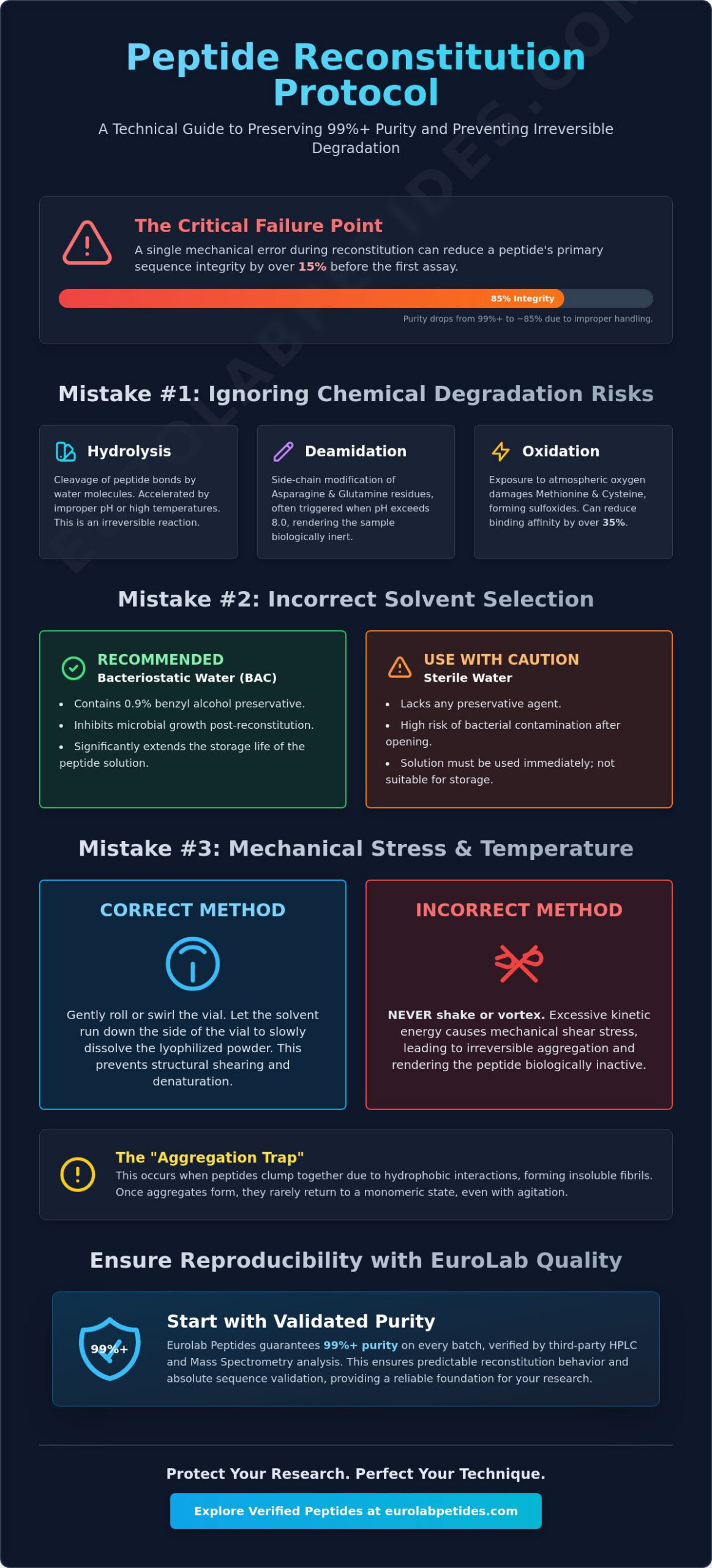
A single mechanical error during the transition from a lyophilized solid to a liquid solution can reduce a peptide’s primary sequence integrity by over 15% before the first assay is even conducted. You recognize that achieving 99%+ purity in the laboratory is a requirement, not an option, for generating reproducible data. Even the most stringent European manufacturing standards cannot protect a sequence if the final stage of preparation is handled incorrectly. It’s frustrating when inconsistent results or degraded samples lead to a wasted research budget and stalled timelines.
This technical guide identifies the common mistakes reconstituting lyophilized peptides that trigger irreversible chemical degradation and compromised research data. By following a standardized protocol, you’ll maintain the high-stakes precision your work demands. We’ll analyze the critical parameters of pH adjustment, the risks of mechanical shear stress, and the specific solvents required to achieve full solubility without sacrificing molecular integrity for long-term storage.
Key Takeaways
- Mitigate the risk of hydrolysis and deamidation by understanding the heightened vulnerability of the peptide bond during the transition from lyophilized powder to aqueous phase.
- Select the optimal reconstitution solvent by comparing the stability profiles of Bacteriostatic and Sterile water to ensure compatibility with your specific research models.
- Prevent physical denaturation by adhering to rigorous “no-shake” protocols and managing temperature transitions to avoid structural shearing of delicate sequences.
- Identify and eliminate the most common mistakes reconstituting lyophilized peptides that compromise chemical integrity and lead to non-reproducible research data.
- Leverage EuroLab’s 99%+ purity standards and third-party HPLC verification to ensure predictable reconstitution behavior and absolute sequence validation.
Why Reconstitution is the Critical Failure Point in Peptide Research
Reconstitution is the technical process of returning a lyophilized (freeze-dried) state powder to a liquid medium. While it may seem like a rudimentary step, it’s actually the most volatile phase in the handling of synthetic compounds. The peptide bond is uniquely vulnerable during the transition from a solid to an aqueous phase. Minor errors at this juncture don’t just cause delays; they can invalidate weeks of in-vitro laboratory data by altering the chemical identity of the sample. Avoiding common mistakes reconstituting lyophilized peptides is essential for maintaining the 99%+ purity standards established during the manufacturing process.
The high-stakes precision required during this stage reflects the delicate nature of the amide bonds. If a diluent is introduced with excessive force or at an incorrect temperature, the resulting kinetic energy can disrupt the molecular structure. Eurolab Peptides ensures that every batch is analyzed via HPLC and mass spectrometry to verify integrity before shipping. However, once the vial is unsealed and the solvent is added, the responsibility for maintaining that integrity shifts entirely to the researcher’s technique. A single procedural lapse can lead to aggregation or hydrolysis, rendering the research material useless for precise quantification.
The Science of Lyophilisation and Stability
Lyophilization involves the removal of water through sublimation under a vacuum, a process that prevents hydrolysis and inhibits microbial enzymatic degradation. Research peptides are shipped as “cakes” or fine powders because this dehydrated state is the only way to ensure long-term stability and 99%+ purity during international transport. While the lyophilized form is resilient at ambient temperatures for short durations, the reconstituted solution is significantly more fragile. Once the peptide is in solution, the rate of chemical degradation increases by a factor of 10 or more depending on the specific sequence and storage temperature.
The Risk of Irreversible Denaturation
Researchers often confuse simple precipitation with permanent chemical alteration. While precipitation can sometimes be corrected by adjusting the pH or using a different buffer, denaturation is terminal. Denaturation in the context of short-chain research peptides is the irreversible loss of the molecule’s specific structural conformation that renders it biologically inactive. Visual clarity doesn’t always guarantee molecular integrity. A solution can appear perfectly clear while the peptides have already undergone significant aggregation or sequence cleavage. This hidden degradation is one of the most frequent common mistakes reconstituting lyophilized peptides, leading to inconsistent data and failed replications in sensitive biochemical assays.
Chemical Degradation: How Improper Reconstitution Compromises Integrity
Chemical degradation during the transition from a lyophilized solid to a liquid state represents a primary failure point in peptide research. One of the common mistakes reconstituting lyophilized peptides is the use of non-buffered solvents, which facilitates rapid hydrolysis. This process involves the cleavage of peptide bonds by water molecules, a reaction that’s often accelerated by improper storage temperatures or fluctuating pH levels. Deamidation risks are equally critical; residues such as Asparagine and Glutamine are susceptible to side-chain modifications when the environment exceeds a pH of 8.0. These structural shifts can render a 99%+ purity sample biologically inert within minutes.
Oxidation primarily targets sensitive amino acids like Methionine and Cysteine. When these residues are exposed to atmospheric oxygen during the mixing phase, they form sulfoxides or unwanted disulfide linkages. Data indicates that uncontrolled oxidation can reduce the binding affinity of a peptide by more than 35% in specific assays. The “Aggregation Trap” is another physical hurdle researchers must navigate. This phenomenon occurs when peptides clump together due to hydrophobic interactions, forming insoluble fibrils. Once these aggregates form, they rarely return to a monomeric state, even with vigorous vortexing, which itself poses risks of mechanical shear.
The Impact of pH on Solubility
Solubility is governed by the Isoelectric Point (pI) of the peptide sequence, which is the specific pH where the molecule has no net charge. If the reconstitution solvent is too close to the pI, the peptide will precipitate immediately. It’s essential to analyze the sequence before adding liquid. Don’t assume a universal solvent works for every batch. For hydrophobic sequences, researchers often utilize 0.1% acetic acid to lower the pH or dilute ammonia to raise it. This ensures the solvent remains at least two units away from the pI. Maintaining this chemical distance is vital for preserving the uncompromising integrity of the research material.
Contamination and Sterility Protocols
The use of standard laboratory water instead of certified sterile, grade-validated solvents introduces microscopic contaminants that act as catalysts for degradation. Trace metals or microbial enzymes can trigger proteolytic cleavage, destroying the peptide sequence before the first assay is performed. Stringent protocols require that purity is verified through sterile handling. Each batch is analyzed for stability, but that work is undone if the environment isn’t controlled. Best practices include:
- Sanitize the vial stopper with 70% isopropyl alcohol for a minimum of 15 seconds.
- Use only LC-MS grade or bacteriostatic water to prevent bacterial growth.
- Ensure all syringes and needles are single-use and medical-grade.
Following these clinical standards prevents the introduction of exogenous proteases that compromise sequence validation. It’s the only way to ensure the data reflects the peptide’s true potential rather than the effects of environmental contamination.
Solvent Selection Errors: BAC Water vs. Sterile Water
Selecting an inappropriate reconstitution medium is a primary driver of experimental failure. One of the most common mistakes reconstituting lyophilized peptides involves the failure to match the solvent’s chemical properties with the peptide’s primary sequence. While sterile water for injection is free of additives, it lacks the antimicrobial defense required for multi-use vials. This necessitates an immediate transition to Bacteriostatic (BAC) water or a buffered solution for most laboratory workflows. Phosphate Buffered Saline (PBS) is frequently employed when maintaining a physiological pH of 7.4 is critical for stability, though it can cause precipitation in sequences with low solubility.
Bacteriostatic Water: Pros and Cons
Bacteriostatic water contains 0.9% benzyl alcohol, which serves as a potent preservative. This additive allows the reconstituted solution to remain viable for up to 28 days when stored at 4°C. It’s the standard choice for researchers performing longitudinal studies where multiple draws from a single vial are necessary. However, the presence of benzyl alcohol isn’t always benign. In high-precision enzymatic assays or sensitive cell culture models, the preservative can interfere with molecular interactions or cause cytotoxic effects. When working with high-integrity research peptides, verify if the sequence is sensitive to alcohol-induced denaturation before proceeding with BAC water.
Handling Hydrophobic Peptides
Hydrophobic sequences present unique challenges that often lead to common mistakes reconstituting lyophilized peptides. If a peptide contains more than 50% hydrophobic amino acids, it’ll likely resist dissolution in pure aqueous solvents. Adding a large volume of water too quickly often results in irreversible clumping, sequestering the peptide within an insoluble mass. To prevent this, researchers should follow a “drop-wise” protocol:
- Basic Peptides: Use 10% acetic acid for initial wetting.
- Acidic Peptides: Use 10% ammonium bicarbonate to facilitate dissolution.
- Highly Non-Polar Sequences: Apply a minimal volume of DMSO (Dimethyl Sulfoxide) or DMF to the powder before adding the aqueous buffer.
Once the peptide is fully wetted and the solution appears clear, the bulk solvent is added slowly. This meticulous approach ensures the sample maintains its 99%+ purity profile without structural compromise. Rushing this stage is a technical error that frequently compromises the entire analytical batch, leading to wasted material and inconsistent data.
Mechanical Stress and Temperature: Avoiding Physical Denaturation
The physical preservation of a peptide sequence is as critical as its chemical purity. One of the most frequent common mistakes reconstituting lyophilized peptides involves the application of excessive kinetic energy. While it’s tempting to accelerate the dissolution process through vigorous movement, peptides are delicate chains of amino acids held together by bonds that can be disrupted by physical force. Maintaining the structural integrity of a 99%+ purity sample requires a controlled, methodical approach to both temperature and movement.
The Dangers of Shaking
Vigorous agitation is prohibited in laboratory protocols because it induces air-bubble formation and increases surface tension at the liquid-air interface. This exposure to oxygen significantly accelerates oxidative degradation of the peptide. Mechanical shearing of peptide bonds occurs when high-velocity agitation forces molecules against the vial walls, compromising the sequence integrity. Researchers can identify mechanical damage through specific visual indicators. Persistent foam that does not dissipate within 300 seconds or the presence of “floaters”—small, undissolved particulates suspended in the solution—suggests that the peptide has denatured or aggregated rather than dissolved. Instead of shaking, use the “Swirl Technique.” Gently rotate the vial between your thumb and forefinger to create a low-velocity vortex that encourages dissolution without stressing the molecular bonds.
Temperature Equilibrium Protocols
Temperature shock is a primary catalyst for reconstitution failure. Vials stored at -20°C or -80°C must undergo a mandatory 15-30 minute acclimation period to reach room temperature before the seal is breached. Opening a cold vial introduces atmospheric moisture, which causes immediate condensation on the lyophilized cake. This moisture can initiate premature degradation or lead to the formation of insoluble aggregates.
The temperature of the solvent is equally vital. Using cold bacteriostatic water or sterile saline often results in incomplete solubility, which leads to inaccurate dosing in subsequent applications. For precise results, ensure both the vial and the diluent are at equilibrium. Researchers should utilize a peptide reconstitution calculator to determine the exact volume of solvent required once the materials have reached the appropriate thermal state.
Managing internal vacuum pressure is the final step in preventing physical denaturation. High-quality lyophilized vials are typically vacuum-sealed to ensure long-term stability. If a researcher injects solvent too rapidly, the vacuum pulls the liquid in with excessive force, creating a “splash effect” that coats the stopper and the upper walls of the vial. This results in significant loss of material. To prevent this, allow the solvent to trickle slowly down the interior glass wall of the vial, letting the vacuum pull the plunger naturally rather than applying manual pressure.
To ensure your research utilizes only the highest caliber materials, buy pharmaceutical-grade peptides from Eurolab Peptides, where every batch undergoes rigorous third-party verification.
Ensuring Experimental Reproducibility with EuroLab Quality
Experimental reproducibility depends entirely on the chemical integrity of the starting material. When purity levels fall below the 99% threshold, residual solvents or synthesis byproducts can disrupt the hydrogen bonding required for uniform dissolution. EuroLab ensures that every batch undergoes rigorous third-party HPLC and Mass Spectrometry analysis. This verification confirms that the sequence is accurate and the purity is verified before the product enters the laboratory environment. Predictable reconstitution behavior is a direct result of this 99%+ purity standard, as it eliminates the unpredictable chemical interactions caused by contaminants.
The Importance of Third-Party Verification
Impurities in low-grade peptides don’t just reduce the effective concentration; they act as “seeds” for aggregation during the transition from a lyophilized state to a liquid phase. These microscopic particles trigger the formation of insoluble fibrils, which is one of the most
common mistakes reconstituting lyophilized peptides
. Researchers who buy research peptides with verified Certificates of Analysis (CoA) protect their data from these confounding variables. EuroLab’s commitment to European manufacturing standards involves stringent quality control protocols where each batch is analyzed for both purity and sequence identity, ensuring that the peptide you receive matches the theoretical model exactly.
Storage Best Practices for Reconstituted Solutions
The stability of a peptide in solution is significantly lower than its lyophilized form. While 4°C is acceptable for short-term studies lasting less than 72 hours, -20°C is the required standard for extended storage. However, repeated freeze-thaw cycles must be avoided as they cause mechanical stress on the peptide bonds. Using light-shielded vials is mandatory for photosensitive compounds like BPC-157, as UV exposure can catalyze the degradation of the molecular structure. A professional protocol requires documenting the exact date of reconstitution and the specific solvent lot numbers to maintain a clear audit trail for any experimental deviations.
Aliquoting is the professional method for maintaining long-term stability. By dividing the initial solution into single-use volumes, you ensure that the bulk of the sample remains undisturbed at -20°C or -80°C until the moment of use. This practice minimizes the risk of bacterial contamination and thermal degradation. To achieve a flawless reconstitution workflow in 2026, follow this final technical checklist:
- Verify the CoA: Confirm the batch-specific purity exceeds 99% via HPLC.
- Pressure Equalization: Use a venting needle to prevent the vacuum from drawing in diluent too aggressively.
- Aliquoting: Divide the solution into sterile, polypropylene vials immediately after dissolution.
- Light Protection: Use amber vials or aluminum wrap for all storage phases.
- Documentation: Record the solvent type, volume, and date on each aliquot.
By adhering to these stringent laboratory standards, researchers can mitigate the
common mistakes reconstituting lyophilized peptides
and ensure that their results are both precise and reproducible. EuroLab provides the high-fidelity tools necessary for these rigorous scientific inquiries.
Standardizing Reconstitution Protocols for Reproducible Data
Scientific accuracy depends on eliminating variables that compromise molecular stability. Avoiding common mistakes reconstituting lyophilized peptides requires a rigorous adherence to solvent compatibility and thermal management. Every researcher understands that chemical degradation or mechanical denaturation at the point of reconstitution renders even the most precise sequences useless. Successful outcomes are predicated on the use of reference-grade material and validated protocols. It’s essential to recognize that even minor deviations in pH or agitation can invalidate months of data.
EuroLab Peptides provides the foundation for this technical precision. Every batch undergoes mandatory third-party HPLC and Mass Spectrometry verification to confirm 99%+ purity before it leaves the facility. All manufacturing strictly adheres to European laboratory standards, ensuring that researchers receive compounds of unrivaled integrity. Logistical reliability is guaranteed through EU-based shipping, which minimizes transit times and maintains the necessary environmental controls. Don’t settle for unverified materials when your research demands absolute certainty. When the margin for error is zero, the quality of the starting material is the only metric that matters. This level of transparency allows for total confidence in experimental reproducibility.
Secure Your Research Integrity with 99%+ Purity Peptides from EuroLab
Frequently Asked Questions
Why did my peptide turn cloudy after I added bacteriostatic water?
Cloudiness typically indicates that the peptide has reached its isoelectric point or is reacting to the 0.9% benzyl alcohol content in the bacteriostatic water. This phenomenon occurs when the solvent’s pH shifts the peptide toward a neutral charge, causing immediate precipitation. To resolve this, a drop of 0.1% acetic acid is often required to adjust the pH level by 1 or 2 points until the solution reaches 100% clarity.
Can I use a vortex mixer to speed up the reconstitution of stubborn peptides?
You shouldn’t use a vortex mixer because the high-frequency mechanical shear stress can permanently denature the delicate peptide chains. One of the common mistakes reconstituting lyophilized peptides is attempting to accelerate dissolution through vigorous agitation. Instead, gently swirl the vial or allow it to sit undisturbed for 10 to 15 minutes until the solution achieves 100% clarity. This patient approach preserves the 99% purity levels required for precise results.
How long is a reconstituted peptide stable at room temperature?
Most reconstituted peptides begin to degrade within 2 to 4 hours if left at a room temperature of 22°C. While some sequences maintain 95% integrity for up to 24 hours, the risk of bacterial growth and hydrolysis increases exponentially without refrigeration. Laboratory protocols dictate that samples should be returned to a 2°C to 8°C environment immediately after the required aliquot is withdrawn to ensure continued stability.
What happens if I accidentally shake the vial after adding the solvent?
Shaking the vial introduces air bubbles and surface tension that can lead to the aggregation of the peptide molecules. This physical stress often results in the formation of irreversible protein clusters, which reduces the effective concentration of the active sequence. If accidental agitation occurs, allow the vial to rest in a refrigerator for 30 minutes to permit the foam to dissipate before proceeding with any analytical procedures.
Is it possible to re-freeze a peptide after it has been reconstituted?
Re-freezing a reconstituted peptide isn’t recommended as the formation of ice crystals during the secondary freezing process can shear the peptide bonds. Each freeze-thaw cycle typically reduces the peptide’s biological activity by 10% to 20% due to structural degradation. For long-term storage of aqueous solutions, researchers should aliquot the sample into single-use volumes before the initial freeze to avoid repeated temperature fluctuations and maintain sequence integrity.
Why is there a vacuum in the peptide vial, and should I vent it?
The vacuum in the vial is a result of the lyophilization process and serves as an indicator of a hermetic seal. You should vent the vial using a sterile needle to equalize the pressure before introducing the solvent; this prevents the liquid from spraying forcefully onto the lyophilized cake. Avoiding this step is one of the common mistakes reconstituting lyophilized peptides, as rapid pressure changes can damage the peptide’s delicate secondary structure.
Can I mix two different peptides in the same vial during reconstitution?
Mixing two different peptides in the same vial is contraindicated because it introduces unpredictable chemical cross-reactivity and alters the specific pH requirements of each sequence. One peptide might require a slightly acidic environment for stability, while the other might precipitate under those same conditions. To ensure 99% analytical accuracy, each peptide must be reconstituted and stored in its own dedicated sterile vial to prevent contamination.
What is the best way to store a reconstituted Ipamorelin sample?
The optimal method for storing a reconstituted Ipamorelin sample is at a constant temperature between 2°C and 8°C in a light-shielded environment. When stored under these specific refrigerated conditions, the sequence maintains its structural integrity for approximately 14 to 21 days. Researchers must ensure the vial remains upright to minimize contact between the solution and the rubber stopper, which can occasionally leach impurities over extended periods of storage.
