

A 5% variance in peptide purity isn’t just a statistical margin; it’s a catalyst for experimental failure that can invalidate months of laboratory work. While the pressure to optimize research budgets is constant, the analytical risks of buying cheap research peptides often result in a total loss of funding due to inconsistent data or contaminated reagents. Substandard synthesis protocols frequently introduce truncated sequences and residual solvents that skew biological assays and can even damage sensitive chromatography equipment.
You understand that in a high-stakes laboratory environment, precision is the only metric that matters. This article explores how uncompromising manufacturing standards and stringent third-party HPLC/MS verification protect your research from the variables introduced by low-cost alternatives. We’ll examine the technical requirements for achieving 99%+ purity and why verifiable sequence validation is non-negotiable for reproducible science. By prioritizing clinical-grade synthesis over discounted reagents, you ensure that your experimental results are a reflection of your hypothesis rather than your impurities.
Key Takeaways
- Identify the critical distinction between nominal purity claims and actual chemical content to prevent contamination from residual solvents and salts.
- Analyze the risks of buying cheap research peptides where pricing below reagent costs indicates a compromise in essential purification and synthesis protocols.
- Recognize the necessity of independent, third-party verification to mitigate the impact of forged or biased manufacturer-provided Certificates of Analysis.
- Examine how non-European sourcing and inadequate temperature control during transit can lead to the structural degradation of sensitive peptide sequences.
- Learn how a multi-level quality protocol and 99%+ purity standards ensure the analytical integrity and reproducibility of your laboratory results.
The Hidden Costs of Low-Price Research Peptides
The term “cheap” in biochemical procurement refers to any product priced below the operational cost of high-grade reagents and validated analytical procedures. When a supplier offers prices 40% below the market average for 99%+ purity, it typically indicates a compromise in the synthesis chain. The risks of buying cheap research peptides extend beyond simple financial loss; they compromise the fundamental validity of the scientific inquiry. High-purity synthesis requires uncompromising adherence to protocol, which budget-oriented vendors often ignore to maintain low price points. Data doesn’t lie. While the initial invoice might be lower, the secondary costs associated with failed assays and uninterpretable data points quickly eclipse any perceived savings.
The Economics of Peptide Synthesis
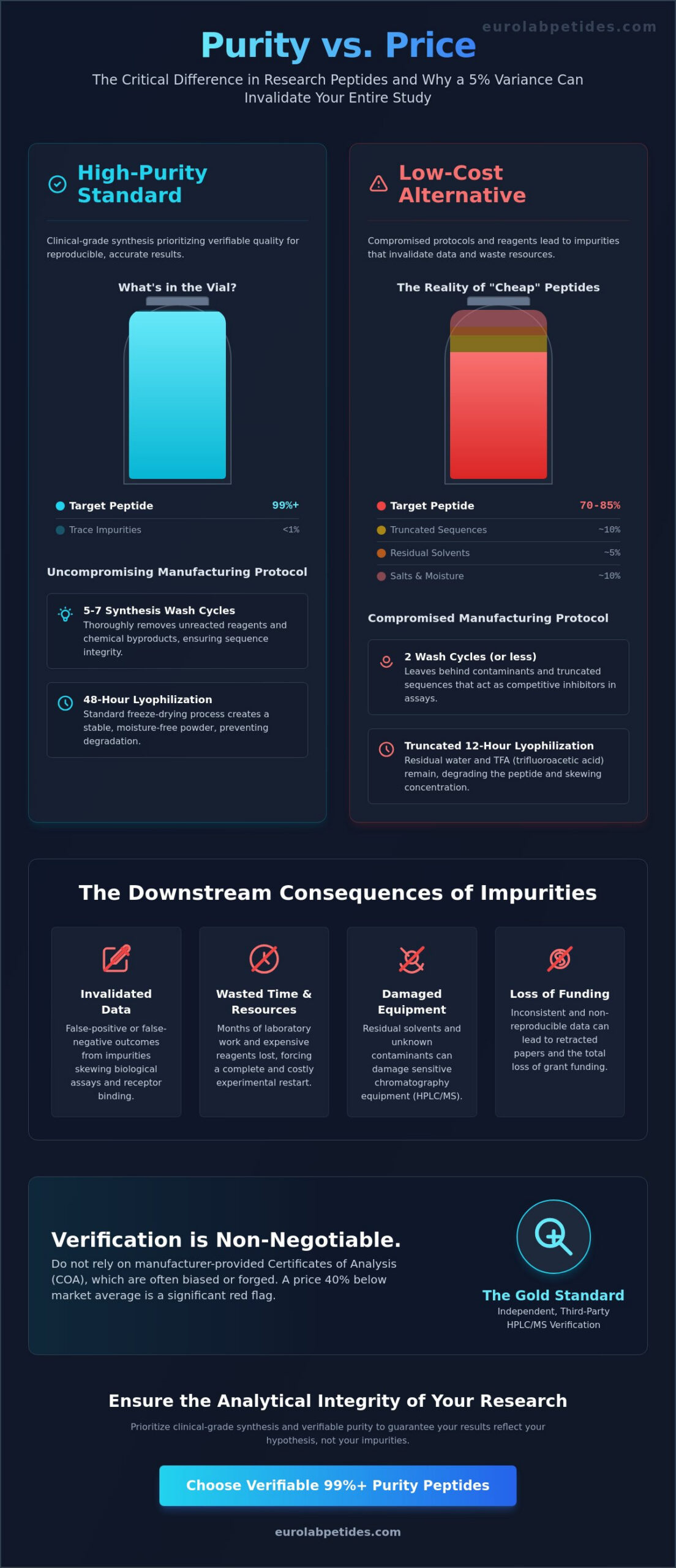
Cost drivers in the process of peptide synthesis, specifically Solid Phase Peptide Synthesis (SPPS), are primarily dictated by the quality of protected amino acids and the selection of specialized resins. Budget suppliers often reduce overhead by limiting the number of wash cycles during the coupling phase. While a standard protocol requires five to seven washes to remove unreacted reagents, a low-cost facility might utilize only two. This leaves behind truncated sequences and chemical byproducts that contaminate the final yield. Additionally, product stability is frequently compromised when lyophilization cycles are shortened. A standard 48-hour freeze-drying process ensures a stable, moisture-free powder, whereas a truncated 12-hour cycle leaves residual water and trifluoroacetic acid (TFA). This residual content degrades the peptide over time and skews concentration calculations during reconstitution.
Research Integrity vs. Budget Constraints
The acquisition of chemicals from “gray market” sources creates a significant barrier to data reproducibility. Inconsistent reagents lead to non-reproducible results in in-vitro models, particularly when trace impurities interfere with cellular signaling pathways. In metabolic and tissue repair studies, even a 5% variance in purity can alter the observed biological response, leading to false-negative or false-positive outcomes. It’s a common pitfall in high-stakes environments. Research integrity in the context of chemical reagent purity is the absolute alignment between the declared molecular specifications and the actual chemical composition as verified by independent mass spectrometry. Choosing price-competitive sourcing over high-risk acquisition is the difference between a successful study and a failed experiment that requires a complete restart. The risks of buying cheap research peptides eventually manifest as lost time, which is the most expensive resource in any laboratory.
- Purity is verified through stringent HPLC analysis to ensure 99%+ consistency.
- Each batch is analyzed using mass spectrometry to confirm sequence identity.
- European standards dictate the manufacturing environment to prevent cross-contamination.
Chemical Impurities: Beyond the 99% Purity Claim
A “99% purity” claim is often used as a marketing shield, yet it remains one of the most misunderstood metrics in biochemistry. In analytical terms, purity refers only to the ratio of the target peptide sequence relative to other peptide-based impurities. It doesn’t define the total mass of the vial. The net peptide content in low-grade products often fluctuates between 70% and 85%, with the remainder comprised of moisture, residual solvents, and salts. One specific FDA warning on unapproved peptides highlights how these products frequently contain incorrect ingredients or contaminants that aren’t disclosed on the label. The risks of buying cheap research peptides involve these hidden variables that can invalidate months of laboratory work through inconsistent dosing and unexpected chemical interactions.
Truncated Sequences and Deletion Peptides
Incomplete coupling during the Solid Phase Peptide Synthesis (SPPS) process is a hallmark of budget manufacturing. When a coupling step fails in an automated synthesizer, the resulting chain is missing an amino acid, creating a deletion peptide. These “near-miss” sequences are biologically active but functionally incorrect. They can bind to receptors with different affinities, acting as competitive inhibitors that skew signaling data. While standard HPLC might miss these subtle mass differences, high-resolution mass spectrometry is required to confirm the absolute sequence integrity. Researchers must ensure their peptide sourcing includes full sequence validation to avoid these truncated artifacts that mimic target behavior while producing false results.
Residual Solvents and Counter-Ions
Synthesis requires aggressive reagents like acetonitrile, piperidine, and Trifluoroacetic acid (TFA). Cheap manufacturing processes often fail to utilize the multiple lyophilization cycles required to purge these solvents to safe levels. TFA is particularly problematic; as a strong acid, it can shift the pH of a research culture to acidic levels, often below 5.0. This acidity interferes with cellular viability and enzyme kinetics. High-stakes research typically requires the conversion of TFA salts to more stable acetate or hydrochloride forms to maintain physiological relevance. Excess salt content also impacts the physical properties of the product. A salt concentration exceeding 15% can lead to poor solubility and rapid degradation after the peptide is reconstituted in a buffer solution.
- Residual TFA: High levels cause cytotoxic effects in delicate cell lines and alter protein folding.
- Acetonitrile: This synthesis solvent must be reduced to parts-per-million levels to avoid interference with metabolic assays.
- Moisture Content: Excessive water in the lyophilized cake leads to peptide hydrolysis and a significant loss of potency over time.
The risks of buying cheap research peptides are not merely financial; they are analytical. When the chemical foundation of a study is compromised by residual piperidine or incorrect counter-ions, the resulting data lacks the reproducibility required for peer-reviewed publication. Precision in the laboratory begins with the uncompromising verification of the chemical mass.
The Mirage of In-House COAs and Independent Verification
The proliferation of fraudulent documentation is a primary factor in the risks of buying cheap research peptides. Many budget suppliers present Certificates of Analysis (COA) that are either “borrowed” from legitimate manufacturers or fabricated entirely using digital editing software. In-house testing lacks the necessary objectivity to ensure scientific integrity; when a manufacturer validates their own product, the inherent conflict of interest often leads to the suppression of data regarding impurities or synthesis byproducts. True 99%+ purity is only confirmed through independent, third-party validation conducted by ISO-accredited facilities that have no financial stake in the product’s sale.
Researchers must remain vigilant against reports featuring generic headers, missing timestamps, or low-resolution HPLC chromatograms. A common tactic involves using a high-resolution scan of a legitimate report and overlaying new text to match a different product. These visual discrepancies often mask the dangers of unregulated online peptides, where secondary peaks on a graph represent truncated sequences, residual trifluoroacetic acid (TFA), or leftover reagents from the synthesis process. Laboratory reports that appear blurred or lack a verifiable QR code should be treated as high-risk anomalies.
How to Validate a Peptide Lab Report
Verification begins with the testing facility’s credentials. Legitimate laboratories, such as those used by Eurolab Peptides, provide a searchable database or a direct contact method to verify report authenticity. During analysis, the HPLC chromatogram must show a flat baseline with minimal noise. Any secondary peaks indicate chemical impurities that could compromise experimental results. The Mass Spec (MS) data must align with the theoretical molecular weight of the peptide. For instance, if the target mass is 4123.5 Da, a variance exceeding 0.1% suggests an incorrect sequence or significant contamination. Understanding how to buy research peptides requires a technical grasp of these analytical metrics to ensure the integrity of the chemical reagents.
The “Representative Batch” Fallacy
A significant risk in the discount market is the use of “representative” COAs. A report dated March 2024 provides zero clinical assurance for a batch synthesized in January 2026. Batch-to-batch variability is high in unregulated environments where synthesis parameters aren’t strictly controlled. Each unique synthesis run requires its own analytical profile to confirm sequence identity and purity levels. Relying on outdated data ignores the potential for degradation or synthesis errors in newer lots. Secure sourcing involves reviewing how to buy research peptides from entities that provide batch-specific, real-time testing data rather than generic templates.
- Missing Timestamps: Indicates a report may be reused across multiple years.
- Baseline Noise: Suggests the presence of unidentified small molecules or salts.
- Generic Headers: Reports lacking a specific lab technician’s signature or facility address are often forged.
Supply Chain Volatility and Sourcing Risks
The primary risks of buying cheap research peptides often stem from the opaque nature of global supply chains. When sourcing occurs outside of European regulatory frameworks, the lack of oversight regarding labor standards and chemical precursors introduces significant variables into the final product. Many low-cost distributors utilize “re-labeling” tactics to mask the origin of substandard raw materials; this practice deliberately obscures the true chemical history of the compound. European-based manufacturing ensures that every stage of the synthesis process adheres to stringent safety protocols, preventing the introduction of heavy metals or cross-contaminants during the early stages of production.
The Impact of Long-Haul Logistics
Peptide stability is highly dependent on environmental conditions during transit. While lyophilized powders are more resilient than liquid formulations, they remain sensitive to extreme temperature fluctuations. “Free shipping” offers from international gray-market suppliers typically indicate a reliance on standard postal services rather than climate-controlled logistics. Exposure to temperatures exceeding 25°C for extended periods can induce degradation of the peptide’s secondary structure, rendering the research data invalid. For sequences containing Cysteine or Methionine residues, the risk of oxidation increases significantly during long-haul transit. This chemical alteration results in a loss of biological activity and the formation of impurities that aren’t easily identified without advanced mass spectrometry.
European Standards vs. Global Gray Markets
Synthesis facilities in Europe operate under rigorous ISO 9001:2015 standards, ensuring that every batch is produced with uncompromising precision. This framework mandates full traceability; it allows researchers to track a peptide back to the specific precursor reagents used in its creation. High-complexity sequences require even stricter adherence to these protocols to prevent truncation or incorrect amino acid folding. For instance, the BPC-157 technical guide illustrates the necessity of specific synthesis parameters for maintaining the integrity of the pentadecapeptide sequence. Selecting EU-based logistics ensures that the 99%+ purity verified at the point of manufacture is the same purity that arrives at the laboratory bench.
The “re-labeling” trap is a common industry tactic where bulk industrial-grade chemicals are repackaged as research-grade materials. This transition often bypasses the necessary HPLC (High-Performance Liquid Chromatography) validation required for scientific inquiry. By prioritizing European sourcing, researchers eliminate the uncertainty associated with these gray-market practices. EU-based logistics provide a shorter, more secure chain of custody, which is essential for maintaining the integrity of the peptide’s primary structure.
To ensure your research is supported by verified chemical integrity, source your peptides through our EU-compliant laboratory.
Ensuring Analytical Integrity with EuroLab Peptides
Scientific inquiry relies on the reproducibility of data, a metric that’s directly tethered to the quality of the reagents employed. EuroLab Peptides operates a multi-level quality protocol that bridges the gap between initial synthesis and final independent verification. We establish a 99%+ purity baseline for every research-grade product in our catalog. This stringent threshold isn’t a marketing target; it’s a fundamental requirement for eliminating the risks of buying cheap research peptides, which often contain truncated sequences or residual solvents that skew experimental results.
Transparent data serves as the only viable foundation for credible scientific work. Without verifiable chemical profiles, a researcher cannot account for variables introduced by impurities. In fields such as longevity and tissue repair research, where cellular responses are highly sensitive to peptide concentration and sequence accuracy, using validated reagents is mandatory. EuroLab provides the analytical certainty required to ensure that observed biological effects are the result of the peptide itself, not an unidentified contaminant.
Our Uncompromising Testing Standards
Every vial distributed by EuroLab undergoes batch-specific High-Performance Liquid Chromatography (HPLC) and Mass Spectrometry (MS) analysis. These processes confirm both the purity levels and the exact molecular weight of the peptide sequence. We utilize independent European laboratories for unbiased verification to ensure that our internal quality controls meet international benchmarks. This third-party oversight eliminates the conflict of interest inherent in self-reported data from low-cost suppliers.
EuroLab maintains a strict policy of non-distribution for any research chemical that lacks an accompanying, batch-specific analytical dossier, as a substance without verifiable data represents an unacceptable risk to experimental reproducibility. This commitment to transparency allows researchers to download and review the exact chemical profile of the batch they receive. We don’t compromise on the “language of the laboratory,” where quality is quantified through hard data rather than anecdotal claims.
A Partner in Scientific Progress
Supporting the global research community requires more than just high-purity synthesis; it demands logistical precision and stability. High-purity peptides are sensitive molecules that can degrade if handled incorrectly during the final stages of the supply chain. Our focus on maintaining product structure ensures that the lyophilized powder remains stable until it’s ready for reconstitution in the lab.
EU-based shipping plays a critical role in maintaining product potency. By avoiding the prolonged transit times and extreme temperature fluctuations common with overseas shipping from unregulated regions, we protect the fragile peptide bonds from premature degradation. This logistical reliability is a hallmark of European manufacturing standards. You can secure your research integrity by sourcing certified peptides from EuroLab Peptides, ensuring that your work is built on a foundation of chemical excellence and 99%+ purity. Eliminating the risks of buying cheap research peptides is the first step toward achieving professional, publishable results.
Upholding Experimental Standards with Verified Chemical Synthesis
Maintaining the integrity of biochemical research requires a total rejection of compromised materials. The risks of buying cheap research peptides extend far beyond financial loss; they introduce uncontrolled variables like truncated sequences and residual solvents into your data sets. When a certificate of analysis isn’t backed by independent HPLC and mass spectrometry validation, the 99%+ purity claim is statistically irrelevant. These analytical uncertainties are eliminated by EuroLab Peptides. Each batch is analyzed through independent third-party lab testing to ensure purity is verified at 99%+ levels. By sourcing within the European Union, your laboratory benefits from fast, secure shipping that adheres to uncompromising regulatory standards. Scientific progress relies on the accuracy of its tools. You’ve worked hard to design your protocols; don’t let substandard reagents undermine your results. It’s time to choose a partner that values the cold, hard data of chemical analysis as much as you do. Your next breakthrough depends on the precision of your starting materials.
Explore Our Range of Third-Party Tested Research Peptides
Frequently Asked Questions
Why are some online peptides significantly cheaper than others?
Lower prices typically indicate a lack of stringent purification and third-party verification. High-volume manufacturing in facilities without ISO 9001 certification reduces overhead by 40% to 60% but compromises chemical integrity. These vendors often skip the secondary HPLC stage, which is essential to remove truncated sequences and residual solvents. Quality is a verifiable metric that requires investment in analytical precision.
Can low-purity peptides affect my in-vitro research results?
Contaminants in low-purity batches introduce uncontrolled variables that frequently invalidate experimental data. If a peptide is only 85% pure, the remaining 15% contains trifluoroacetic acid salts or bacterial endotoxins that trigger non-specific cellular responses. These confounding factors make it impossible to attribute observed effects solely to the target peptide. Understanding the risks of buying cheap research peptides is vital for maintaining data reproducibility.
How can I tell if a peptide Certificate of Analysis (COA) is fake?
A legitimate COA must contain a unique batch number, a date of analysis within the last 12 months, and a verifiable signature from an independent laboratory. You can cross-reference the report by contacting the third-party facility directly to confirm the HPLC chromatogram matches their records. Fake reports often lack a clear baseline on the mass spectrometry graph or display identical results for different product batches.
What are the most common impurities found in cheap research peptides?
Analytical testing frequently identifies residual solvents, heavy metals, and diastereomers as primary contaminants. In a 2023 study of non-verified samples, levels of acetonitrile and dichloromethane exceeded safety thresholds by 200% in several instances. Truncated sequences, where the peptide chain is incomplete, also occur when synthesis cycles are shortened to reduce costs. These impurities pose significant threats to the integrity of biochemical assays.
Is 99% purity always sufficient for high-level biochemical research?
While 99% purity is a standard benchmark, specific applications require even higher precision to avoid off-target effects. For sensitive assays such as NMR spectroscopy or X-ray crystallography, even a 0.5% impurity can obscure structural data. Eurolab Peptides ensures each batch undergoes rigorous sequence validation to maintain a 99%+ purity profile. This meets the uncompromising requirements of European research standards and ensures absolute security for the researcher.
How does shipping temperature affect the quality of research peptides?
Thermal degradation occurs when lyophilized peptides are exposed to temperatures exceeding 30 degrees Celsius for more than 48 hours. This heat causes peptide bonds to hydrolyze, reducing the active concentration by 10% to 15% per exposure cycle. Using EU-based shipping ensures shorter transit times and controlled environments. This logistics strategy preserves the structural integrity of the molecules from the laboratory to the final destination.
What is the difference between pharmaceutical-grade and research-grade peptides?
Pharmaceutical-grade peptides are manufactured under cGMP conditions and must meet 99.9% purity with strict endotoxin limits below 0.5 EU/mg. Research-grade materials are intended for laboratory use and, while still highly pure, don’t require the same level of regulatory filing for human clinical trials. However, the risks of buying cheap research peptides often involve receiving sub-research grade material that fails to meet even basic 95% purity standards.
Why is third-party testing more reliable than manufacturer testing?
Independent third-party verification eliminates the conflict of interest inherent in self-reported data. A manufacturer might use a biased HPLC method to inflate purity percentages, whereas an external lab provides an objective analysis of the chemical composition. This transparency is a non-negotiable standard for researchers who require verifiable metrics. Each batch is analyzed to ensure that quality is an objective reality rather than a marketing claim.
