

A single mathematical error during the transition from lyophilized powder to liquid solution can invalidate months of rigorous laboratory inquiry. As the global peptide therapeutics market is projected to reach $70.7 billion by 2032, the requirement for uncompromising accuracy in the lab has never been more critical. Many researchers face significant confusion when navigating the precise math of a peptide reconstitution calculator mg to ml ratio, where a misplaced decimal point between milligrams and micrograms leads to catastrophic data loss.
It’s understood that even minor deviations in diluent volume can compromise peptide stability and the overall integrity of the chemical sequence. This technical guide delivers a foolproof mathematical formula and standardized laboratory protocols designed to eliminate calculation errors entirely. You’ll gain absolute control over concentration variables and learn to maintain the stringent standards expected in high-level biochemical analysis. This ensures every vial is prepared with the verifiable precision required for modern scientific inquiry.
Key Takeaways
- Master the fundamental mathematical framework required to convert lyophilized mass into precise research-grade liquid concentrations.
- Learn to utilize a peptide reconstitution calculator mg to ml protocol to eliminate common errors when transitioning between milligram and microgram measurements.
- Implement standardized laboratory procedures for managing vial vacuum pressure and sterilization to ensure long-term peptide stability.
- Account for technical variables such as syringe dead space and solubility saturation points that directly impact the accuracy of experimental data.
- Discover why 99%+ purity, verified through HPLC and mass spectrometry, is the essential foundation for any successful reconstitution process.
Understanding the Principles of Peptide Reconstitution
Reconstitution is the clinical process of restoring a lyophilized peptide to its liquid state for experimental application. This transition involves two primary components: the solute, which is the freeze-dried peptide mass, and the solvent, the liquid medium used for dissolution. Precise concentration control is the hallmark of professional laboratory standards. Researchers utilize a peptide reconstitution calculator mg to ml to determine the exact volume of diluent required to reach a target concentration. Without this mathematical rigor, the risk of delivering an incorrect dose is high, which invalidates experimental results and wastes valuable resources. It’s critical to remember that mass and volume are distinct metrics. Mass, measured in milligrams (mg), refers to the weight of the peptide powder, while volume, measured in milliliters (ml), refers to the liquid diluent. Confusion between these units is a frequent source of error in laboratory settings.
The Chemistry of Lyophilized Peptides
Peptides are synthesized and then subjected to a process of dehydration to ensure long-term stability. This procedure follows the Principles of Lyophilization, which involves freezing the material and then reducing the surrounding pressure to allow the frozen water to sublimate. The resulting “cake” protects the delicate amino acid sequences from degradation. High-stakes research demands 99%+ purity as a non-negotiable starting point. Purity is verified through HPLC and mass spectrometry; every batch must undergo third-party verification to confirm its chemical identity. Researchers should be aware that the appearance of the lyophilized cake, whether it’s solid or granular, doesn’t necessarily indicate the mass. Residual moisture content, typically less than 5%, is factored into the final weight of the product to ensure the reported mass is accurate.
Solvent Selection: Bacteriostatic Water vs. Sterile Saline
The choice of solvent directly impacts the longevity and solubility of the reconstituted peptide. Bacteriostatic water is the most common choice for research purposes. It’s distilled water containing 0.9% benzyl alcohol, which acts as a preservative to prevent the growth of potentially contaminating bacteria. This allows the solution to be used for multiple draws over several weeks when stored at 2 to 8 degrees Celsius. Certain laboratory environments require sterile saline (0.9% sodium chloride). Saline is often used when the presence of benzyl alcohol might interfere with sensitive cellular assays or specific biological responses. Solvent pH also plays a decisive role in solubility. Peptides with high hydrophobicity or specific isoelectric points may require a specific pH range to dissolve fully. Using a peptide reconstitution calculator mg to ml helps maintain the ratio, but the chemical nature of the solvent ensures the peptide remains in a monomeric, active state.
The Mathematical Framework for mg to ml Conversion
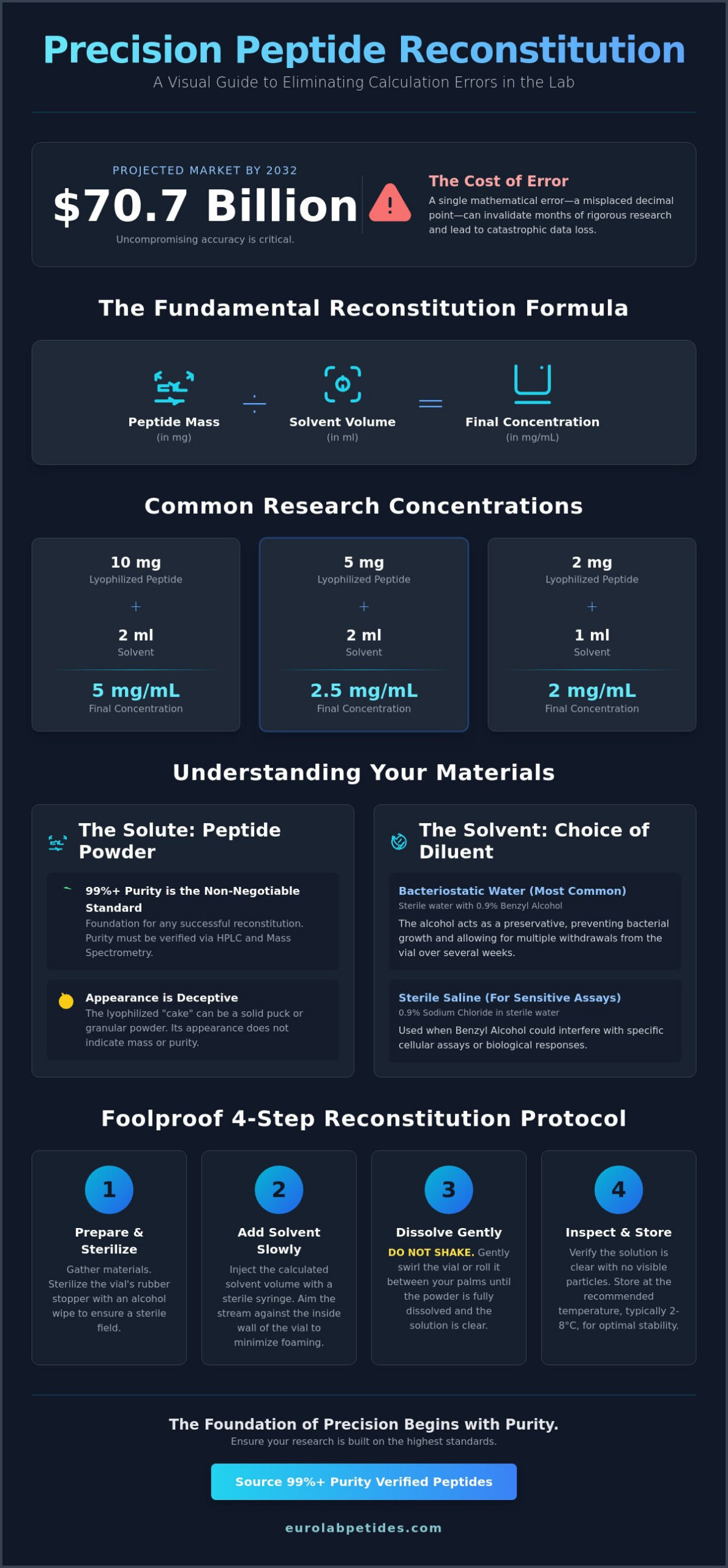
Precision in the laboratory environment is contingent upon the mathematical integrity of the conversion process. A researcher must master the peptide reconstitution calculator mg to ml conversion to maintain the absolute integrity of their data. The fundamental formula for determining concentration is the division of total peptide mass by the total volume of the diluent: Total mg / Total ml = Concentration (mg/mL). For instance, a researcher reconstituting a 5mg vial with 2ml of bacteriostatic water achieves a standardized concentration of 2.5mg/mL. While manual calculations are foundational, using a peptide reconstitution calculator serves as a critical verification step to prevent human error. This dual-verification approach ensures that experimental variables remain controlled and reproducible. It’s essential to perform these calculations before any physical manipulation of the lyophilized product occurs.
Standard Concentration Ratios in Research
Standardized protocols typically utilize 1ml or 2ml volumes to facilitate ease of measurement and ensure complete dissolution of the lyophilized cake. For a 2mg vial, adding 1ml of solvent creates a 2mg/mL concentration, whereas a 10mg vial with 2ml results in 5mg/mL. The ratio of 5mg to 2ml results in a concentration of 2.5mg/mL for easy extraction. These standardized volumes are favored because they provide sufficient solvent to overcome the surface tension of the lyophilized powder without diluting the peptide beyond a detectable range. When researchers deviate from these volumes, they must re-calibrate their peptide reconstitution calculator mg to ml inputs to maintain data consistency across different batches. Adhering to these conventions significantly reduces the likelihood of math fatigue during high-volume sample preparation.
Calculating Micrograms (mcg) per Syringe Unit
Converting mg/mL into research-specific doses requires an understanding of the 100-unit insulin syringe scale, where 1ml is equivalent to 100 units. Because most research doses are measured in micrograms, the initial milligram concentration must be multiplied by 1,000 to convert units correctly. To determine the volume for a specific dose, the formula is: (Desired mcg / Total mcg in vial) x Total units of solvent. For a 2.5mg/mL solution (2,500mcg/mL), each unit on a 100-unit syringe contains 25mcg of the peptide. According to the Advanced Peptide Reconstitution Protocol, maintaining this level of granularity is essential for assays requiring sub-milligram precision. If a researcher requires a 250mcg dose from this solution, they’d draw 10 units. To ensure the highest baseline of data integrity, researchers should always start with verified high-purity peptides before beginning these calculations. This prevents impurities from skewing the actual mass used in the formula and ensures the mathematical model matches the chemical reality within the vial.
Standard Laboratory Protocol for Reconstitution
Aseptic technique is the non-negotiable foundation of any successful laboratory procedure. Before any vial is accessed, the researcher must sterilize the rubber stopper and the immediate workspace with 70% isopropyl alcohol to mitigate the risk of microbial contamination. This initial step is critical for maintaining the 99%+ purity that defines high-caliber research materials. Once the environment is secure, the physical process of reconstitution begins with the measured introduction of the diluent. It’s at this stage that the mathematical values derived from a peptide reconstitution calculator mg to ml are translated into physical volume. Precision at this juncture prevents the accidental degradation of the peptide’s molecular structure, which is sensitive to both thermal and mechanical stress. This protocol reflects the stringent requirements of third-party verification, where every variable is managed to ensure the final solution matches the validated chemical profile.
Handling Vacuum-Sealed Vials
Most research-grade vials are vacuum-sealed to preserve chemical integrity during long-term storage and transport. This vacuum presents a technical challenge during the introduction of the solvent. If the needle is inserted without controlling the flow, the vacuum will pull the liquid into the vial with excessive force. This “spraying” effect causes immediate agitation and potential denaturation of the peptide sequence. To prevent this, the researcher should allow the solvent to be drawn in slowly by maintaining a firm grip on the syringe plunger. The needle should be directed at an angle toward the glass wall of the vial rather than directly onto the lyophilized cake. This technique allows the liquid to flow down the side of the glass, gently saturating the powder from the base up. Equalizing the pressure by drawing a small amount of air into the syringe before withdrawal prevents the common issue of solution “spitting” when the needle is removed.
Post-Reconstitution Storage and Stability
The transition from a lyophilized solid to a liquid solution initiates a degradation timer that varies by compound. Standard laboratory protocol dictates that reconstituted solutions must be stored at temperatures between 2°C and 8°C to slow enzymatic and chemical breakdown. Light sensitivity is another critical variable; many sequences are susceptible to UV-induced degradation, making it necessary to store vials in a dark environment or opaque containers. While storing lyophilized peptides correctly is essential for shelf life, the stability of the liquid form is significantly more precarious. Researchers should perform a visual inspection before every use. The solution must remain clear and free of visible particulates or cloudiness. If any turbidity is observed, the vial is considered compromised and should be discarded to maintain the integrity of the research data. Adhering to these European standards of handling ensures that the unrivaled quality of the synthesis is preserved throughout the duration of the study.
Variables Affecting Concentration and Research Accuracy
Technical precision in the laboratory requires more than a correct output from a peptide reconstitution calculator mg to ml. Physical variables such as syringe dead space and solubility saturation points dictate the actual concentration delivered during an experiment. High-precision High-Performance Liquid Chromatography (HPLC) is the only way to verify that the mass in the vial matches the label. If a researcher begins with a product that isn’t 99%+ pure, the mathematical model is fundamentally flawed from the start. Impurities occupy mass that the researcher assumes is active peptide, leading to a lower effective concentration than calculated. Over-dilution also presents a significant risk; certain sequences exhibit accelerated degradation when the concentration falls below a specific threshold, as the increased solvent-to-solute ratio exposes more of the molecular chain to oxidative stress.
Saturation and Precipitation Issues
Every peptide sequence possesses a unique solubility limit, which is the maximum amount of solute that can dissolve in a specific volume of solvent. When this limit is exceeded, “floaters” or undissolved cake particles become visible. While BPC-157 is characterized by high solubility in bacteriostatic water, more hydrophobic sequences may require pH adjustment or specialized solvents to achieve full dissolution. It’s vital to avoid high-pressure reconstitution, as the force can cause molecular “shearing,” effectively breaking the peptide bonds before the research begins. If precipitation occurs after cooling, the solution may need to reach room temperature before the solute re-enters the liquid phase. To maintain the highest standards of data integrity, researchers should utilize HPLC-verified peptides that guarantee the mass matches the mathematical model.
Syringe Calibration and Tick Mark Accuracy
The hardware used to measure the solvent is just as critical as the math itself. Volumetric precision varies significantly between 0.3ml, 0.5ml, and 1.0ml syringes. A 0.3ml syringe provides the highest resolution for small-volume draws, reducing the margin of error for concentrated solutions. Researchers must distinguish between U-100 and U-40 syringes, as the tick marks represent different volumes. One unit on a U-100 syringe represents 0.01ml of volume. Misinterpreting these markings is a primary cause of research data skew. Syringe “dead space”—the small amount of liquid remaining in the needle hub after the plunger is fully depressed—can also lead to a consistent under-delivery of the peptide. In protocols requiring micro-gram precision, these fractional losses must be accounted for to ensure the experimental results remain reproducible and scientifically valid.
EuroLab Peptides: Ensuring Precision in Your Research
The utility of a peptide reconstitution calculator mg to ml is fundamentally limited by the chemical integrity of the starting material. At EuroLab Peptides, 99%+ purity isn’t a marketing claim but a verifiable metric established through rigorous analytical chemistry. When a researcher inputs 5mg into a calculator, they must have absolute certainty that the vial contains 5mg of the specified sequence, free from truncated fragments or residual trifluoroacetic acid (TFA). Sourcing certified research peptides from within the European Union ensures both logistical reliability and adherence to stringent manufacturing oversight. Standardized vial dimensions are maintained across our catalog to simplify volumetric calculations, allowing for consistent laboratory results across multiple experimental cohorts. This commitment to standardization eliminates the variables that often lead to calculation errors in less regulated environments.
Uncompromising Quality Control
Quality is verified at multiple stages of the synthesis cycle. From the initial solid-phase peptide synthesis to the final lyophilization process, each batch is analyzed to confirm molecular weight and sequence accuracy. High-Performance Liquid Chromatography (HPLC) is utilized to determine purity levels, while mass spectrometry provides definitive sequence validation. A Certificate of Analysis (CoA) is provided for every research compound, documenting the exact metrics of each lot. This transparency allows researchers to proceed with the assurance that their peptide reconstitution calculator mg to ml outputs reflect the actual biochemical reality of the solution. By eliminating the uncertainty associated with unregulated suppliers, EuroLab Peptides functions as a meticulous scientific partner. Integrity is maintained through third-party verification, ensuring that every metric is an objective fact rather than an estimate.
Professional Support for the Research Community
Access to comprehensive technical data is essential for maintaining standardized laboratory protocols. We provide detailed data sheets that include specific reconstitution and storage guidance tailored to the chemical properties of each molecule. European manufacturing standards represent an unrivaled level of integrity in the chemical synthesis space, ensuring that every vial meets the rigorous demands of the global scientific community. Our EU-based shipping infrastructure provides a shorthand for regulatory compliance and reliability, reducing the risk of transit-related degradation. Researchers are invited to explore our range of high-purity research peptides and integrate these elite tools into their ongoing inquiries. Reliability is not just a goal; it’s a verifiable standard that we uphold through uncompromising analytical testing and transparent data reporting.
Advancing Laboratory Standards Through Precise Methodology
Precision in the laboratory isn’t a result of chance; it’s the outcome of rigorous adherence to standardized protocols and mathematical accuracy. By mastering the variables of a peptide reconstitution calculator mg to ml, researchers eliminate the catastrophic data risks associated with concentration errors. Success depends on the synergy between precise volumetric measurements and the physical handling techniques discussed, such as vacuum equalization and stringent temperature control. These steps ensure that the molecular integrity of the compound is preserved from the moment of solvent introduction through to final analysis.
Experimental integrity begins with the quality of the lyophilized mass. At EuroLab Peptides, every batch undergoes third-party verification, where 99%+ purity is guaranteed through HPLC and mass spectrometry analysis. These European standards ensure that the chemical identity of your sample is unrivaled. When research demands absolute certainty, relying on verified data is the only path forward. Order High-Purity Research Peptides with HPLC Verification to ensure your next study is built on a foundation of uncompromising quality. We look forward to supporting your scientific progress with our EU-based shipping and stringent synthesis standards.
Frequently Asked Questions
How much bacteriostatic water do I add to a 5mg peptide vial?
Adding 2ml of bacteriostatic water to a 5mg vial is a standard laboratory ratio, which results in a final concentration of 2.5mg/mL. This specific volume ensures the lyophilized cake is fully saturated without over-diluting the solution. Using a peptide reconstitution calculator mg to ml helps verify that 10 units on a U-100 syringe will deliver exactly 250mcg of the compound, ensuring precise dosage for sensitive assays.
What is the difference between mg and mcg in peptide dosage?
The difference lies in a 1,000-unit scale of mass, where 1 milligram (mg) equals 1,000 micrograms (mcg). Precise conversion is mandatory for research integrity; a 0.1mg measurement translates to 100mcg. Misinterpreting this factor is a primary cause of experimental data skew. It can lead to delivering a dose that is 10 times higher or lower than the intended protocol, effectively invalidating the study results.
Can I use sterile water instead of bacteriostatic water for reconstitution?
Sterile water is suitable only for immediate, single-use applications because it lacks an antimicrobial preservative. Bacteriostatic water contains 0.9% benzyl alcohol, which inhibits bacterial growth for up to 28 days. For multi-draw research vials, bacteriostatic water is the non-negotiable standard for maintaining an aseptic environment. It ensures the stability of the peptide sequence throughout the duration of the experimental window.
How long do peptides stay stable after they are reconstituted?
Stability typically ranges from 14 to 28 days when the solution is maintained at 2°C to 8°C. Certain fragile sequences may degrade faster, losing 5% to 10% of their potency if they’re exposed to light or temperature fluctuations. Visual inspection for turbidity is essential before every draw. Any cloudiness indicates that the peptide has begun to precipitate or has been compromised by microbial contamination, necessitating immediate disposal.
Why is there a vacuum in my peptide vial when I add water?
Vials are vacuum-sealed during the final stages of lyophilization to remove oxygen and moisture, which are primary drivers of molecular degradation. This negative pressure ensures the long-term integrity of the 99%+ purity cake. When adding solvent, the vacuum should be allowed to draw the liquid in slowly against the glass wall. This prevents the violent agitation and denaturation of the peptide bonds that occurs if the liquid is sprayed directly onto the powder.
What happens if I shake the peptide vial after adding the solvent?
Shaking a vial introduces kinetic energy that leads to “shearing,” a process where the delicate amino acid chains are physically broken. This mechanical stress denatures the peptide, rendering the solution biologically inactive and useless for research. To ensure complete dissolution, gently swirl the vial in a circular motion until the liquid is clear. This preserved molecular integrity is vital for maintaining the 99%+ purity baseline required for accurate data.
How do I calculate the mcg per unit on an insulin syringe?
To calculate mcg per unit, divide the total micrograms in the vial by the total units of solvent added. If a 5mg vial (5,000mcg) is reconstituted with 100 units (1ml), each unit contains 50mcg. Verifying these values with a peptide reconstitution calculator mg to ml provides a necessary layer of security. It ensures that the calculated concentration matches the intended laboratory protocol and prevents math fatigue during high-volume sample preparation.
Is it possible to add too much water to my peptide vial?
Excessive dilution reduces the concentration to a level where the peptide becomes more susceptible to oxidative stress and surface adsorption. Over-diluting also makes it difficult to measure precise micro-gram doses using standard 100-unit syringes. Adhering to a 1ml or 2ml volume for most 2mg to 5mg vials maintains an optimal balance. This balance is necessary to ensure both the solubility of the solute and the long-term stability of the reconstituted solution.
