

The finalization of the European Medicines Agency (EMA) Guideline on the Development and Manufacture of Synthetic Peptides on June 1, 2026, established an uncompromising benchmark for analytical precision in biochemical research. This regulatory framework demands that impurities exceeding 0.5% are identified and those surpassing 1.0% are qualified, setting a stringent standard for the procurement of euro-gen peptides. Researchers frequently encounter the risks of batch-to-batch inconsistency and the chemical degradation inherent in long-distance international shipping, which can compromise the integrity of complex study designs.
You understand that verifiable 99%+ purity is the only acceptable metric for serious inquiry into longevity, metabolic function, and tissue repair. This technical guide outlines the protocols for verifying sequence validation through HPLC and mass spectrometry while leveraging EU-based logistics for maximum stability. We will analyze the 2026 European Pharmacopoeia standards and the implications of the April 27, 2026, Court of Justice ruling to ensure your laboratory sourcing meets the highest requirements for scientific accuracy.
Key Takeaways
- Identify the specific 2026 EMA regulatory benchmarks that define the quality and purity requirements for sourcing euro-gen peptides.
- Utilize High-Performance Liquid Chromatography (HPLC) and Mass Spectrometry (MS) data to verify sequence validation and ensure a 99%+ purity threshold.
- Compare the stability advantages of EU-based shipping protocols against unregulated global alternatives to prevent chemical degradation during transit.
- Implement standardized laboratory handling techniques, including aseptic reconstitution and long-term storage of lyophilized compounds, to preserve research integrity.
Defining the Euro-Gen Standard in Peptide Synthesis
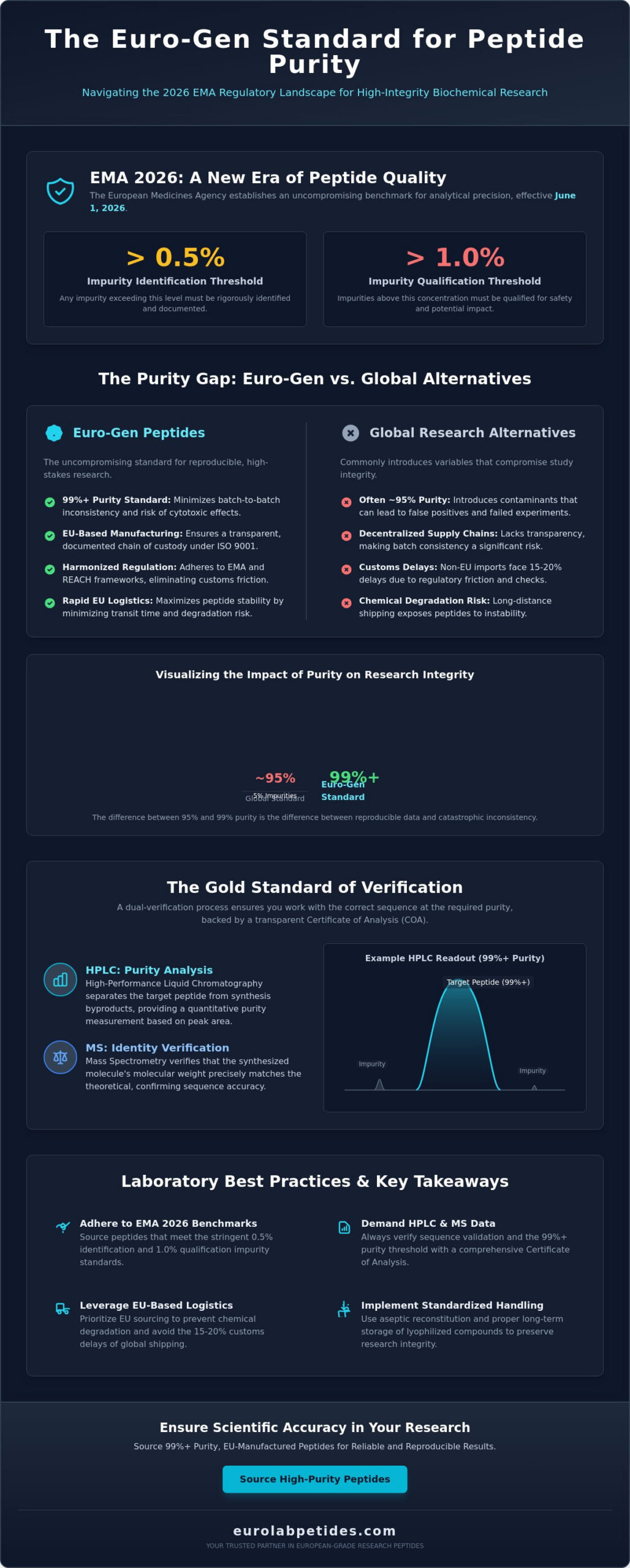
The term “Euro-Gen” distinguishes a specific tier of laboratory reagents manufactured within the European Union. It serves as a hallmark of chemical integrity. While global markets often settle for 95% purity, Peptide synthesis under the Euro-Gen designation adheres to the updated EMA guidelines effective June 1, 2026. This standard ensures that precursor chemicals meet stringent safety and quality profiles before the synthesis process begins. By centralizing production within the EU, manufacturers maintain a transparent chain of custody that is often absent in decentralized global supply chains.
For high-stakes in-vitro research, the difference between 95% and 99% purity isn’t negligible; it’s the difference between reproducible data and catastrophic batch-to-batch inconsistency. Contaminants in lower-grade sequences can interfere with cellular assays, leading to false positives or unintended cytotoxic effects. Standardizing on euro-gen peptides provides researchers with a baseline of 99%+ purity, which is the non-negotiable threshold for modern biochemical analysis. Every batch is analyzed to ensure that the molecular weight and sequence accuracy align with the intended research design.
Distinguishing between catalog-grade and custom-synthesized research sequences is critical for laboratory planning. Catalog-grade sequences are pre-validated and stocked for immediate dispatch, whereas custom sequences require specific sequence validation for unique research targets. Both tiers must adhere to the same analytical rigor to ensure the integrity of the resulting data remains uncompromising.
The Evolution of European Peptide Manufacturing
European manufacturing has shifted from industrial-scale production toward high-precision synthesis designed for the 2026 research market. This transition is driven by the 5.53% CAGR projected for the European peptide market through 2034. ISO 9001 certifications in European facilities ensure that every step of the workflow is documented and reproducible. Euro-Gen represents an uncompromising commitment to 99% analytical purity as verified through stringent laboratory protocols.
Regulatory Framework for Research-Grade Chemicals
All products within this category carry a “strictly for research” designation, ensuring they aren’t diverted for unauthorized use. Compliance with the REACH framework ensures that every chemical substance used in the synthesis process is registered and evaluated for safety. Sourcing euro-gen peptides within the EU reduces documentation friction because the regulatory landscape is harmonized across member states. This eliminates the 15% to 20% delay often associated with customs clearance for non-EU chemical imports. Furthermore, the April 27, 2026, Court of Justice ruling on generic peptide pathways highlights the increasing transparency and maturity of the European regulatory environment, providing researchers with absolute security in their sourcing choices.
Technical Specifications: HPLC and Mass Spectrometry Validation
Analytical precision is the cornerstone of reproducible research. High-Performance Liquid Chromatography (HPLC) is the standard method for determining the chemical purity of euro-gen peptides. By separating the target compound from synthesis byproducts, HPLC provides a quantitative measure of purity based on peak area. Purity alone isn’t enough to ensure research integrity. Mass Spectrometry (MS) is utilized to verify that the synthesized molecule matches the theoretical molecular weight. This dual-verification process ensures researchers work with the correct sequence at the required concentration, preventing the use of degraded or incorrectly synthesized material.
Independent third-party verification is a non-negotiable requirement in modern biochemistry. Relying solely on internal manufacturer data introduces potential bias that can lead to experimental failure. Each batch is accompanied by a Certificate of Analysis (COA) that includes raw HPLC and MS data. Interpreting a COA requires attention to specific retention times and the signal-to-noise ratio. High-quality sourcing depends on these verifiable metrics. Researchers can review the FDA guidance on peptide purity to understand current expectations for impurity profiling and characterization. Sourcing euro-gen peptides through transparent channels guarantees that these analytical steps are executed without compromise.
Deciphering HPLC Chromatograms
In a standard HPLC report, the primary peak represents the target peptide. Residual impurities appear as smaller peaks or shoulders adjacent to the main signal. A 99%+ purity threshold is required because even a 1% impurity can introduce exogenous variables that compromise sensitive cellular assays, leading to skewed metabolic or immunological data. Every chromatogram is analyzed for baseline stability and peak symmetry. If the baseline’s erratic, the data integrity’s compromised.
Mass Spectrometry and Sequence Validation
Mass Spectrometry confirms the identity of the synthesized peptide by measuring the mass-to-charge ratio of ions. This step’s critical for detecting truncated sequences or incomplete deprotection where protecting groups remain attached to amino acid side chains. Without MS analysis, a sample might show high HPLC purity but contain the wrong sequence. Sequence validation ensures the peptide interacts with biological targets as predicted. For those requiring validated compounds, the analytical standards of EuroLab Peptides provide the necessary transparency for complex study designs.
Comparing Euro-Gen Peptides vs. Global Research Alternatives
Sourcing laboratory reagents from unregulated global markets introduces variables that compromise experimental reproducibility. While a lower price point from offshore suppliers might seem attractive, the hidden costs of failed assays and sequence inaccuracies often exceed the initial savings. The euro-gen peptides standard mitigates these risks by operating under a harmonized regulatory framework that prioritizes chemical integrity. European manufacturing facilities are subject to periodic audits and must comply with the 2026 EMA guidelines, ensuring that precursor quality and synthesis environments meet high-precision benchmarks. This level of accountability is rarely mirrored in regions where third-party verification is optional rather than a non-negotiable standard.
Transparency is the primary differentiator between European sourcing and global alternatives. When a researcher procures euro-gen peptides, they’re not just purchasing a compound; they’re accessing a documented chain of custody. European suppliers provide verifiable data through HPLC and mass spectrometry for every batch. In contrast, unregulated markets frequently suffer from “batch-hopping,” where a single COA is used to represent multiple distinct synthesis runs. This practice leads to the batch-to-batch inconsistency that plagues longitudinal studies. With over €127.9 billion allocated to EU research and development in 2024, the infrastructure supporting these standards is robust and designed for high-stakes scientific inquiry.
Stability and Logistics in the Research Supply Chain
Shipping duration directly correlates with the risk of peptide degradation. Lyophilized powders are sensitive to the extreme temperature fluctuations common in long-haul international transit. Customs delays, which can exceed 15% of the total shipping time for non-EU imports, often leave sensitive sequences in unmonitored environments. EU-to-EU shipping utilizes climate-controlled logistics and avoids the friction of external customs, preserving the “cold chain” and ensuring the product arrives in its intended state. Reduced transit times mean the time between synthesis and laboratory arrival is minimized, protecting the 99%+ purity threshold.
Quality Assurance Protocols Across Regions
The stringency of third-party testing in Europe is unrivaled. While some regions allow for self-certification, the European standard requires independent validation to identify impurities above the 0.5% threshold. This prevents the distribution of under-dosed or counterfeit products that are prevalent in unregulated marketplaces. Researchers must prioritize security when selecting their chemical partners. Understanding how to buy research peptides safely in 2026 involves verifying that the supplier adheres to these European Pharmacopoeia benchmarks. Choosing a partner with EU-based logistics ensures that the integrity of the research remains the priority, rather than the convenience of the supply chain.
Laboratory Handling: From Lyophilization to Reconstitution
Lyophilization is the standard method for stabilizing euro-gen peptides for long-term storage and distribution. This process involves the sublimation of water from the frozen state under vacuum, which preserves the secondary and tertiary structures of the sequence. By removing moisture, the rate of chemical degradation is significantly reduced, allowing the product to maintain its 99%+ purity throughout the supply chain. Researchers must verify the vacuum seal upon receipt; a compromised seal often indicates moisture ingress and potential degradation. This freeze-drying technique ensures that the chemical identity remains unchanged during transit, provided the temperature remains within the specified range.
Aseptic reconstitution is required to maintain the integrity of the research environment. Before adding any diluent, the vial must be allowed to reach room temperature to prevent condensation. Precision is maintained by using a peptide reconstitution calculator to determine the exact volume of solvent needed for the target concentration. This eliminates the risk of dosage errors that can skew experimental results. For high-stakes inquiry, even minor deviations in concentration can lead to non-reproducible data. The laboratory environment must be controlled, ideally using a laminar flow hood, to prevent microbial contamination during the transition from powder to solution.
Storage requirements are determined by the physical state of the compound. Lyophilized powders are stable at 4°C for short durations, but long-term preservation requires storage at -20°C or -80°C. Once reconstituted, the peptide’s shelf life is drastically shortened. Reconstituted solutions should be stored at 2-8°C and utilized within a specific timeframe, typically 14 to 30 days depending on the sequence’s inherent stability. It’s critical to note that once a peptide is in solution, it becomes highly susceptible to bacterial growth and enzymatic degradation.
Reconstitution Protocols for Precision Research
Choosing the right solvent is the first step in successful reconstitution. Bacteriostatic water, containing 0.9% benzyl alcohol, is preferred for its ability to inhibit microbial growth. Sterile saline is an alternative for isotonic requirements. Shaking the vial is prohibited because it causes shear stress and can lead to peptide denaturation. Instead, the “gentle swirl” technique is employed, where the solvent is allowed to run down the side of the glass to slowly dissolve the lyophilized cake. For short-term storage, 2-8°C is the ideal temperature, while long-term stability of the dry powder is best maintained at -20°C.
Maintaining Stability In-Vitro
Exposure to light and oxygen must be minimized to prevent oxidation. Peptides containing methionine or cysteine are particularly susceptible to oxidative damage. Best practices include aliquoting the reconstituted solution into single-use vials to prevent repeated freeze-thaw cycles, which can cause aggregate formation and loss of potency. Researchers can consult the BPC-157 technical guide for specific handling examples involving regenerative sequences. Maintaining these standards ensures the euro-gen peptides used in your study perform as validated. To ensure your laboratory utilizes only validated compounds, source your high-purity research materials from verified European suppliers.
Sourcing High-Purity Peptides via EuroLab Peptides
EuroLab Peptides operationalizes the Euro-Gen standard by integrating the latest European Pharmacopoeia benchmarks into every stage of the procurement workflow. While the baseline cost for a single Reference Standard (CRS) for peptide mapping is established at €90 as of May 2026, we internalize these rigorous calibration costs to ensure our catalog remains accessible for independent researchers. Our commitment to the 99%+ purity threshold is enforced through a multi-layered verification process that exceeds the reporting requirements of the EMA. By choosing euro-gen peptides through our platform, laboratories gain access to compounds that have been scrutinized for sequence integrity and molecular weight accuracy before they ever leave our climate-controlled environment.
The accountability provided by EuroLab Peptides extends beyond the analytical laboratory into the logistical chain. We recognize that the 5.53% projected CAGR in the European peptide market through 2034 is driven by a demand for absolute security in sourcing. Our infrastructure is designed to support high-stakes research in longevity, muscle tissue recovery, and cognitive function without the risks associated with non-EU supply chains. Every batch is analyzed not just for purity, but for the absence of residual solvents and cross-contaminants that could compromise in-vitro cellular assays.
The EuroLab Peptides Quality Protocol
Each batch undergoes a dual-validation cycle involving in-house HPLC analysis followed by independent third-party mass spectrometry. This protocol ensures that every vial of euro-gen peptides delivered to your facility matches its theoretical mass exactly. We provide transparent access to Certificates of Analysis for all items, including advanced research tools like SLU-PP-332 and our specialized metabolic stacks. For example, our profile on Ipamorelin illustrates the depth of the analytical standards we apply to our growth hormone secretagogue research sequences.
Supporting the European Scientific Community
Order fulfillment is managed through our centralized facility in Belgium, which serves as the primary hub for secure EU-based distribution. This strategic location allows us to maintain the cold chain and minimize transit times to under 48 hours for most member states, preventing the degradation risks discussed in previous sections. EuroLab Peptides provides dedicated technical support to assist researchers with complex inquiries regarding sequence validation and specialized reconstitution requirements. To access validated compounds for your 2026 study designs, explore the EuroLab Peptides research catalog and download the latest third-party verification reports.
Advancing Research Integrity with European Analytical Standards
The 2026 research landscape requires a transition from anecdotal quality claims to verifiable metrics. Establishing 99%+ purity through HPLC and mass spectrometry ensures that in-vitro studies remain free from experimental noise caused by synthesis byproducts. By adhering to the stringent thresholds of the European Pharmacopoeia, researchers eliminate the variables that often compromise longitudinal data. Sourcing euro-gen peptides provides the necessary sequence validation and logistical security to maintain chemical stability from the laboratory to the final assay.
Reliable sourcing remains the foundation of reproducible science. Every batch distributed through EuroLab Peptides undergoes multi-level quality control, supported by transparent third-party laboratory analysis and Belgian-based logistics. This meticulous approach ensures that your reagents arrive in their intended lyophilized state, ready for aseptic reconstitution according to established protocols. You can rely on these uncompromising standards to advance your inquiries into longevity, metabolism, and tissue repair with absolute precision. Secure High-Purity Euro-Gen Peptides for Your Research and ensure your laboratory sourcing meets the highest analytical requirements of 2026.
Frequently Asked Questions
What exactly does the term “Euro-Gen” mean in peptide sourcing?
The Euro-Gen designation serves as a technical descriptor for research chemicals synthesized within the European Union that adhere to the 2026 EMA guidelines for synthetic peptides. It signifies a standardized manufacturing environment where precursor safety and chemical integrity are verified at every stage of the synthesis. This term distinguishes high-purity European sequences from those produced in unregulated global markets where oversight is often decentralized.
Why is 99% purity required for research if 95% is standard?
Standard 95% purity allows for a 5% impurity margin, which frequently contains truncated sequences or residual reagents that cause cytotoxic interference in sensitive assays. A 99%+ purity threshold is required for high-stakes in-vitro research to ensure that observed biological responses are attributable solely to the target peptide. Reducing experimental noise through higher purity is the only way to achieve the level of reproducibility demanded by modern biochemistry.
How can I verify the third-party test results of my peptide batch?
Verification is performed by cross-referencing the unique batch number found on the Certificate of Analysis (COA) with the records of the independent analytical laboratory. Researchers should examine the HPLC chromatogram for a single dominant peak and verify that the Mass Spectrometry data aligns with the theoretical molecular weight of the sequence. Any discrepancy between the manufacturer’s internal data and the independent report indicates a compromise in the quality control chain.
What are the risks of using peptides that have not been lyophilized?
Peptides in an aqueous state are highly susceptible to hydrolysis and enzymatic degradation, often losing structural integrity within hours at room temperature. Lyophilization removes moisture through sublimation, effectively halting these chemical reactions and stabilizing the peptide for long-term storage. Using non-lyophilized compounds for research introduces unknown variables, as the actual concentration of the active sequence cannot be guaranteed once degradation begins.
Can Euro-Gen peptides be shipped outside of the European Union?
Shipment outside the EU is possible, but it introduces logistical friction and potential customs delays that can exceed 10 days. Sourcing euro-gen peptides within the European Union is preferred because it utilizes harmonized logistics that maintain a stable environment for the compounds. Researchers outside the EU must account for the increased risk of temperature fluctuations during extended international transit, which can impact the stability of the lyophilized powder.
How long do lyophilized peptides remain stable at room temperature during shipping?
Most lyophilized peptide sequences maintain their chemical integrity for 7 to 14 days when exposed to ambient temperatures during transit. While the powder is robust, exposure to heat exceeding 30°C for prolonged periods can begin to compromise the secondary structure of the molecule. Rapid EU-based shipping protocols are designed to minimize this window, ensuring the product arrives at the laboratory well before any significant degradation occurs.
What is the most accurate way to calculate reconstitution ratios?
The most precise method involves using a digital reconstitution calculator to determine the exact volume of Bacteriostatic water required for a specific milligram mass. Precision is maintained by using graduated laboratory pipettes rather than standard syringes for the initial dilution. This ensures that the resulting concentration (e.g., 5mg/mL) is accurate, which is critical for maintaining the integrity of the experimental design and ensuring the euro-gen peptides perform as expected.
Are Euro-Gen peptides suitable for clinical trials or human use?
No, these compounds are strictly designated for in-vitro research and laboratory development use only. Despite their 99%+ purity and rigorous sequence validation, they aren’t manufactured under the GMP conditions required for human applications. They aren’t pharmaceuticals or medicines, and any use outside of a controlled laboratory setting is strictly prohibited under current European chemical safety regulations.
