

The integrity of longevity research is fundamentally compromised when reagent purity falls below the 99% threshold. When your laboratory investigates the epitalon peptide, the primary challenge isn’t just the complexity of telomerase activation, but the scarcity of third-party verified data. You’ve likely encountered the frustration of inconsistent stability in lyophilized compounds and the difficulty of reconciling conflicting dosing data between rodent models and in-vitro applications.
This review provides a comprehensive scientific analysis of the biochemical pathways through which Epitalon influences cellular senescence. It’s our objective to clarify the molecular interactions required for telomere maintenance while establishing precise laboratory handling protocols. We’ll examine the impact of the June 2026 EMA guidelines on synthetic peptide manufacturing and why 99.8% purity, as documented in October 2025 analytical reports, is critical for sequence validation. This technical overview moves from molecular theory to the rigorous chemical standards required for modern geroprotective research.
Key Takeaways
- Understand the precise tetrapeptide sequence (Ala-Glu-Asp-Gly) and its development as a synthetic analogue of bovine pineal gland extracts.
- Analyze the molecular pathways through which the epitalon peptide facilitates telomerase activation and chromosomal protection in research models.
- Review the peptide’s role in stimulating endogenous melatonin production and restoring circadian rhythms in aged biological systems.
- Establish high-precision laboratory standards using HPLC and mass spectrometry to ensure 99%+ chemical purity and sequence validation.
- Navigate the evolving European regulatory landscape for research peptides, ensuring compliance with the latest EMA manufacturing guidelines.
Molecular Structure and Primary Mechanism of Epitalon (Ala-Glu-Asp-Gly)
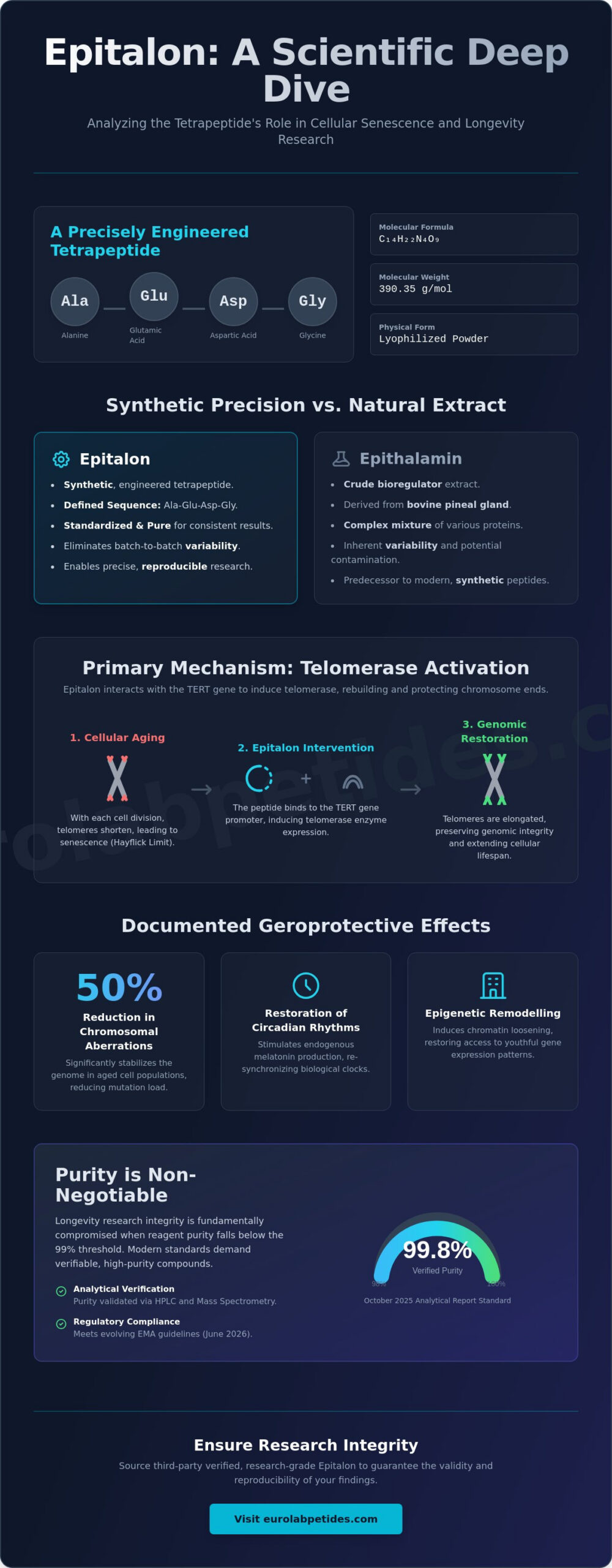
The epitalon peptide is a short-chain tetrapeptide defined by the precise sequence L-Alanyl-L-glutamyl-L-aspartyl-glycine. Its molecular formula is C14H22N4O9, which yields a molecular weight of 390.35 g/mol. In analytical environments, it’s provided as a high-purity, lyophilized powder; recent batches analyzed in October 2025 demonstrate purity levels exceeding 99.8%. This physical state ensures long-term stability when stored under cryogenic conditions, though it remains highly soluble in aqueous solutions. The primary research objective driving current inquiry is the bypass of the Hayflick limit, the finite number of divisions a cell population can undergo before reaching replicative senescence.
The Discovery and Evolutionary Context
Researchers must distinguish between Epithalamin and the synthetic epitalon peptide. Epithalamin is a crude bioregulator extract derived from the bovine pineal gland, containing a complex mixture of proteins. Epitalon was engineered as a refined, synthetic analogue to isolate the specific biological activity observed in those extracts. By focusing on the Ala-Glu-Asp-Gly sequence, chemists achieved a standardized reagent that eliminates the batch-to-batch variability inherent in animal-derived products. This transition from animal extracts to synthetic tetrapeptides allows researchers to avoid the variability and potential contamination associated with biological reagents. Detailed historical data and structural information are available in this Epitalon peptide overview. Modern research has evolved from initial animal studies to sophisticated human cell line analysis, targeting fibroblast and epithelial models.
Fundamental Mechanism: Telomerase Activation
Epitalon’s mechanism of action is centered on its interaction with the TERT (Telomerase Reverse Transcriptase) gene promoter. In somatic cells, telomerase activity is normally suppressed, leading to progressive telomere shortening with each division. Research indicates that Epitalon facilitates the induction of telomerase expression by binding to specific regulatory regions of the TERT gene. This activation allows for the elongation of telomeres, effectively preserving genomic integrity across successive cell cycles. Epitalon peptide activates the telomerase enzyme by inducing the expression of the TERT gene, thereby facilitating the restoration of telomeric DNA at the ends of chromosomes. By modulating this pathway, the peptide serves as a precision tool for studying cellular rejuvenation and the mitigation of chromosomal aberrations in vitro.
For healthcare students and professionals seeking to master the underlying science of these pathways, PharmEDU offers a comprehensive pharmacology review that supports advanced research and clinical education.
Telomere Maintenance and DNA Protection in Research Models
The primary utility of the epitalon peptide in gerontology centers on its capacity to modulate telomere length within human fibroblast and epithelial cell lines. In vitro studies demonstrate that exposure to this tetrapeptide results in a measurable elongation of telomeres, effectively extending the replicative lifespan of somatic cells. This phenomenon is critical for understanding cellular senescence, as it suggests a mechanism for maintaining genomic stability. Research involving aged cell populations has documented a reduction in chromosomal aberrations by up to 50% following standardized application protocols. This stabilization of the genome is accompanied by a significant decrease in the overall mutation load, reinforcing the peptide’s role as a potent geroprotective agent. Comprehensive reviews on longevity and epitalon highlight these protective effects across diverse tissue types, including myocardial and neuronal models.
Epigenetic regulation serves as a secondary but equally vital pathway. The epitalon peptide facilitates the remodeling of the epigenome through a process often described as chromatin loosening. By inducing the decondensation of heterochromatin, the peptide restores accessibility to specific genomic regions that typically become silenced during the aging process. This structural shift is essential for maintaining the fidelity of protein synthesis and cellular response mechanisms in experimental environments. These laboratory observations confirm that the peptide’s influence extends beyond simple enzymatic activation to encompass structural genomic preservation.
Epigenetic Remodelling and Gene Expression
Restoration of youthful gene expression patterns is observed when aged cell models are treated with this tetrapeptide. This process involves precise modifications to DNA methylation and histone acetylation, which effectively recalibrate the cellular clock. When integrated into broader longevity research, the synergistic effects on gene regulation become more pronounced. These interactions suggest that Epitalon acts as a foundational component for multi-pathway cellular inquiry. Researchers seeking to explore these interactions may find the Longevity Research Stack provides the necessary chemical precision for complex study designs.
Oxidative Stress and Mitochondrial Integrity
Protection against cellular degradation is further supported by the activation of the Nrf2 pathway. This activation leads to the enhanced synthesis of endogenous antioxidant enzymes, such as superoxide dismutase and catalase. By neutralizing reactive oxygen species (ROS), the peptide provides a shield for mitochondrial DNA (mtDNA), which is particularly susceptible to oxidative damage. Improved mitochondrial integrity results in more efficient cellular respiration and optimized metabolic output. These findings establish a direct link between telomere maintenance and the preservation of energy-producing organelles in aged biological models.
Neuro-Endocrine and Circadian Rhythm Research Potential
The epitalon peptide serves as a critical reagent for investigating the neuro-endocrine axis, specifically regarding the pineal gland’s role in systemic aging. Endogenous melatonin production typically undergoes a sharp decline in aged models, leading to disrupted biological rhythms and accelerated cellular decay. Research conducted in laboratory settings indicates that this tetrapeptide facilitates the restoration of melatonin synthesis to levels observed in younger cohorts. This modulation isn’t merely a hormonal supplement; it’s a fundamental recalibration of the gland’s secretory capacity. Such findings are pivotal for researchers studying how the Telomere protection mechanisms discussed in previous sections translate into systemic physiological stability. By stabilizing the neuro-endocrine pathways, the peptide provides a framework for cognitive function research and the study of hormonal homeostasis in aged rodent models.
Analyzing the neuroprotective observations associated with this compound requires a focus on high-stakes precision. When your laboratory utilizes reagents with verified 99.8% purity, as documented in October 2025 certificates of analysis, the resulting data on cognitive preservation remains objective and reproducible. Inconsistent purity levels in lower-grade peptides often lead to conflicting data in rodent models, particularly when measuring neuro-endocrine responses. By utilizing a standardized synthetic tetrapeptide, researchers can isolate the specific pathways responsible for maintaining neuronal integrity and hormonal balance without the interference of biological impurities found in glandular extracts.
The Pineal Gland Axis
Interaction with core clock genes like Per1, Per2, and Bmal1 remains a primary focus of epitalon peptide inquiry. These genes regulate the biological oscillations that dictate sleep-wake cycles and metabolic timing. Structural protection of the pineal gland during cellular aging is a critical observation in these studies, suggesting that the peptide mitigates the calcification and atrophy typically seen in aged specimens. By maintaining the integrity of this gland, researchers can explore the mitigation of age-related circadian disruptions and their subsequent impact on systemic health.
Immune Recalibration and Cytokine Modulation
Restoration of T-cell ratios in aged immune system models is facilitated through the upregulation of IL-2 expression and neuroimmune integration. This process represents a targeted recalibration of the immune response rather than a generalized stimulation, which is a crucial distinction for serious scientific inquiry. Laboratory data shows that the peptide influences the differentiation of thymocytes, leading to a more youthful immune profile. This neuro-immune integration perspective allows for a deeper understanding of how hormonal signals from the pineal gland influence the body’s primary defense mechanisms.
Laboratory Standards: Purity, HPLC, and Sequence Validation
Precision in longevity research is dictated by chemical integrity. When investigating the epitalon peptide, achieving 99%+ purity isn’t a luxury; it’s a prerequisite for reproducible data. Lower purity levels introduce unknown variables that can compromise cellular assays. High-Performance Liquid Chromatography (HPLC) serves as the primary tool for sequence validation, ensuring that the Ala-Glu-Asp-Gly structure is intact. This is paired with Mass Spectrometry (MS) to confirm the molecular weight of 390.35 g/mol, providing a dual-layer verification of the compound’s identity. Third-party testing remains non-negotiable for serious inquiry. Independent analysis from October 2025 confirms that high-grade batches can achieve 99.8% purity with bacterial endotoxins below 0.001 EU/mg. This level of transparency is essential for researchers who must account for every milligram of reagent in their protocols.
Quality Assurance Protocols at EuroLab
Purity is verified through a multi-stage validation process. Each batch undergoes rigorous independent analysis before being released for research use. This commitment to transparency is reflected in the provision of batch-specific Certificates of Analysis (COA), which detail HPLC and MS results. By utilizing certified peptides, laboratories minimize experimental variables and align with the upcoming June 2026 EMA guidelines for synthetic peptide manufacturing. For researchers requiring uncompromising quality, you can buy epitalon peptide directly from our European facility to ensure the integrity of your longitudinal studies.
Stability and Reconstitution of Lyophilized Epitalon
Stability depends heavily on storage conditions. Lyophilized epitalon peptide should be stored at -20°C for long-term preservation, which protects the powder from moisture and thermal degradation. Exposure to light and oxygen must be strictly controlled to prevent oxidative damage to the amino acid chain. Reconstitution should be performed using bacteriostatic water or sterile saline within a controlled laboratory environment. Once in solution, the peptide’s stability window narrows significantly. Reconstituted reagents should be stored at 2°C to 8°C and utilized within 14 days to ensure maximum potency. Failure to adhere to these storage parameters leads to rapid degradation, rendering the research data unreliable. Researchers must also avoid repeated freeze-thaw cycles, which can cause mechanical stress to the peptide bonds and reduce the effective concentration of the reagent.
Sourcing Research-Grade Epitalon in Europe
The procurement of the epitalon peptide for European laboratories is governed by rigorous quality control mandates that prioritize chemical stability. As the June 2026 EMA guidelines on synthetic peptide manufacturing take effect, the necessity for documented purity and impurity control has reached a critical threshold. Sourcing from a Belgian chemical supplier provides a distinct logistical advantage, as European manufacturing standards are among the most stringent globally. This geographic proximity ensures that the cold-chain integrity of lyophilized reagents is maintained during transit. When reagents are synthesized within the EU, they’re subject to standardized sequence validation protocols that guarantee 99%+ purity as a baseline metric.
Logistical reliability is essential for longitudinal research studies where interruptions in reagent supply can invalidate months of data. EuroLab Peptides’s distribution network facilitates efficient shipping across the European Union, providing research institutions with a reliable partner for high-stakes inquiry. Professional support is characterized by the delivery of objective data rather than anecdotal claims. Every batch of epitalon peptide is analyzed via HPLC and mass spectrometry to ensure sequence fidelity. Recent batch publications from October 2025 demonstrate that our synthesis processes consistently yield purity levels exceeding 99.8%. This proof-first approach respects the intelligence of the researcher and provides the absolute security required for serious scientific inquiry.
EU Standards and Logistical Reliability
European manufacturing standards ensure that peptide consistency remains unrivaled across different production cycles. By centralizing distribution within Belgium, we provide a streamlined logistical pathway for time-sensitive research across all EU member states. Professional support for research institutions and private labs is prioritized, ensuring that technical queries are met with data-driven responses. This infrastructure is designed to support complex study designs where reagent precision is the primary variable.
Strict Research Use Only (RUO) Compliance
Adherence to the Research Use Only (RUO) legal framework is a non-negotiable standard for institutional compliance. The sale of these peptides is restricted to laboratory environments, and the non-human consumption disclaimer is strictly enforced to align with MHRA and EMA regulations. This clear boundary ensures that the focus remains on biochemical analysis and cellular models. Researchers are encouraged to View the EuroLab Peptides Epitalon technical specifications to access the latest Certificates of Analysis and sequence validation data. By prioritizing third-party verification and European manufacturing standards, your laboratory secures a supply chain defined by transparency and uncompromising integrity.
Advancing Geroprotective Inquiry Through Chemical Precision
The investigation into the epitalon peptide highlights its role as a precision tool for telomerase activation and genomic stabilization. By modulating the TERT gene promoter, researchers can explore the bypass of the Hayflick limit in human cell models with high fidelity. This technical review has established that the integrity of such research depends on the uncompromising chemical standards of the reagents used. Purity levels of 99.8%, as verified in October 2025 analytical reports, ensure that experimental outcomes aren’t skewed by sequence variations or bacterial endotoxins. Utilizing reagents that meet these stringent European manufacturing standards allows for reproducible data in neuro-endocrine and cellular aging studies.
Secure your laboratory’s supply chain by choosing a partner that prioritizes third-party verification and logistical reliability. Each batch is analyzed via HPLC and mass spectrometry to confirm sequence validation before distribution from our Belgian facility. This proof-first approach ensures your longitudinal studies remain compliant with the June 2026 EMA guidelines. We look forward to supporting your next phase of cellular research. Order High-Purity Epitalon for Research Use
Frequently Asked Questions
What is the molecular sequence of the Epitalon peptide?
The molecular sequence is L-Alanyl-L-glutamyl-L-aspartyl-glycine, commonly abbreviated as Ala-Glu-Asp-Gly. This tetrapeptide has a precise molecular weight of 390.35 g/mol. In a laboratory setting, the sequence’s identity is confirmed through mass spectrometry to ensure the synthetic compound matches the intended chemical structure without variation.
How does Epitalon differ from Epithalamin in a research context?
Epitalon is a synthetic, single-sequence tetrapeptide, whereas Epithalamin is a crude extract derived from bovine pineal glands. The epitalon peptide provides a standardized reagent that eliminates the batch variability and potential biological contaminants inherent in animal-derived extracts. This precision allows researchers to isolate specific biochemical pathways without interference from the complex protein mixtures found in Epithalamin.
Is Epitalon stable at room temperature for shipping?
Lyophilized Epitalon is stable at room temperature for approximately 30 days during transit. While short-term exposure to ambient temperatures doesn’t compromise the peptide’s chemical integrity, it must be moved to -20°C upon arrival for long-term preservation. Maintaining the compound in its lyophilized state is essential for preventing premature degradation before it reaches the laboratory.
What purity level is required for in-vitro telomerase research?
A purity level of 99% or higher is the mandatory standard for sensitive in-vitro telomerase assays. Data from October 2025 indicates that 99.8% purity is the current benchmark for high-stakes longevity research. Lower purity levels introduce unknown impurities that can confound results when measuring TERT gene expression or telomere elongation in human cell lines.
How should Epitalon be stored to prevent peptide degradation?
Store the lyophilized powder at -20°C and reconstituted solutions at 2°C to 8°C. Protecting the vial from light and avoiding repeated freeze-thaw cycles is necessary to prevent mechanical stress on the peptide bonds. Reconstituted reagents should be utilized within 14 days to ensure the concentration remains consistent with the original laboratory protocol.
What are the most common research applications for Epitalon in 2026?
Current research applications focus on telomerase induction, the restoration of circadian rhythms, and the study of neuro-endocrine homeostasis. Scientists are specifically investigating the peptide’s influence on Per1 and Bmal1 clock genes in aged rodent models. There’s also significant inquiry into bypassing the Hayflick limit within human fibroblast models to study cellular rejuvenation.
Can Epitalon be used in combination with other longevity peptides?
Researchers frequently investigate the epitalon peptide in combination with other bioregulators, often as part of a Longevity Research Stack. These studies aim to identify synergistic effects on DNA methylation and immune system recalibration. It’s critical that every peptide in the combination meets the same 99%+ purity standard to ensure the resulting data remains objective and reproducible.
What solvent is best for reconstituting Epitalon in a lab?
Bacteriostatic water or sterile 0.9% saline are the preferred solvents for reconstitution in a controlled environment. These solutions ensure the peptide remains stable while preventing microbial growth during the study period. The solvent should be added slowly to the vial to allow the lyophilized powder to dissolve without aggressive agitation, which can damage the molecular structure.
