

The assumption that TB-500 and full-length Thymosin Beta-4 are functionally identical in a laboratory setting often leads to compromised data and skewed metabolic observations. While both molecules share a sequence, the synthetic Ac-LKKTETQ fragment possesses unique metabolic stability and G-actin binding properties that are critical for precise tb-500 research applications in vitro. Many investigators struggle with inconsistent reagent purity and the absence of standardized reconstitution protocols, which can introduce unwanted variables into sensitive migration assays. Given the upcoming FDA PCAC review in July 2026, the demand for standardized, high-purity data has never been more critical for the scientific community.
It’s clear that establishing a baseline of high-purity, third-party verified materials is the only way to ensure reproducible results in tissue repair and recovery research. This technical profile offers a comprehensive scientific analysis of TB-500 signaling pathways and standardized laboratory handling procedures. You’ll gain a clear understanding of the molecular mechanisms at play, along with the rigorous quality benchmarks, such as 98% purity verified via HPLC, that define elite research reagents. We’ll examine the specific methodologies required to maintain peptide integrity and ensure your investigation meets the highest analytical standards.
Key Takeaways
- Analyze the interaction between the Ac-LKKTETQ domain and G-actin to understand how it modulates cytoskeletal dynamics in tissue repair and recovery research.
- Implement standardized assay models for tb-500 research applications in vitro, specifically regarding scratch closure rates in fibroblast cultures and cardiomyocyte survival under hypoxic stress.
- Master reconstitution and stability protocols by evaluating the peptide’s half-life in DMEM and RPMI media to ensure experimental precision.
- Confirm chemical identity and sequence accuracy through detailed Mass Spectrometry validation and HPLC analysis to meet rigorous laboratory quality benchmarks.
Defining TB-500 (Ac-LKKTETQ) in Molecular Research
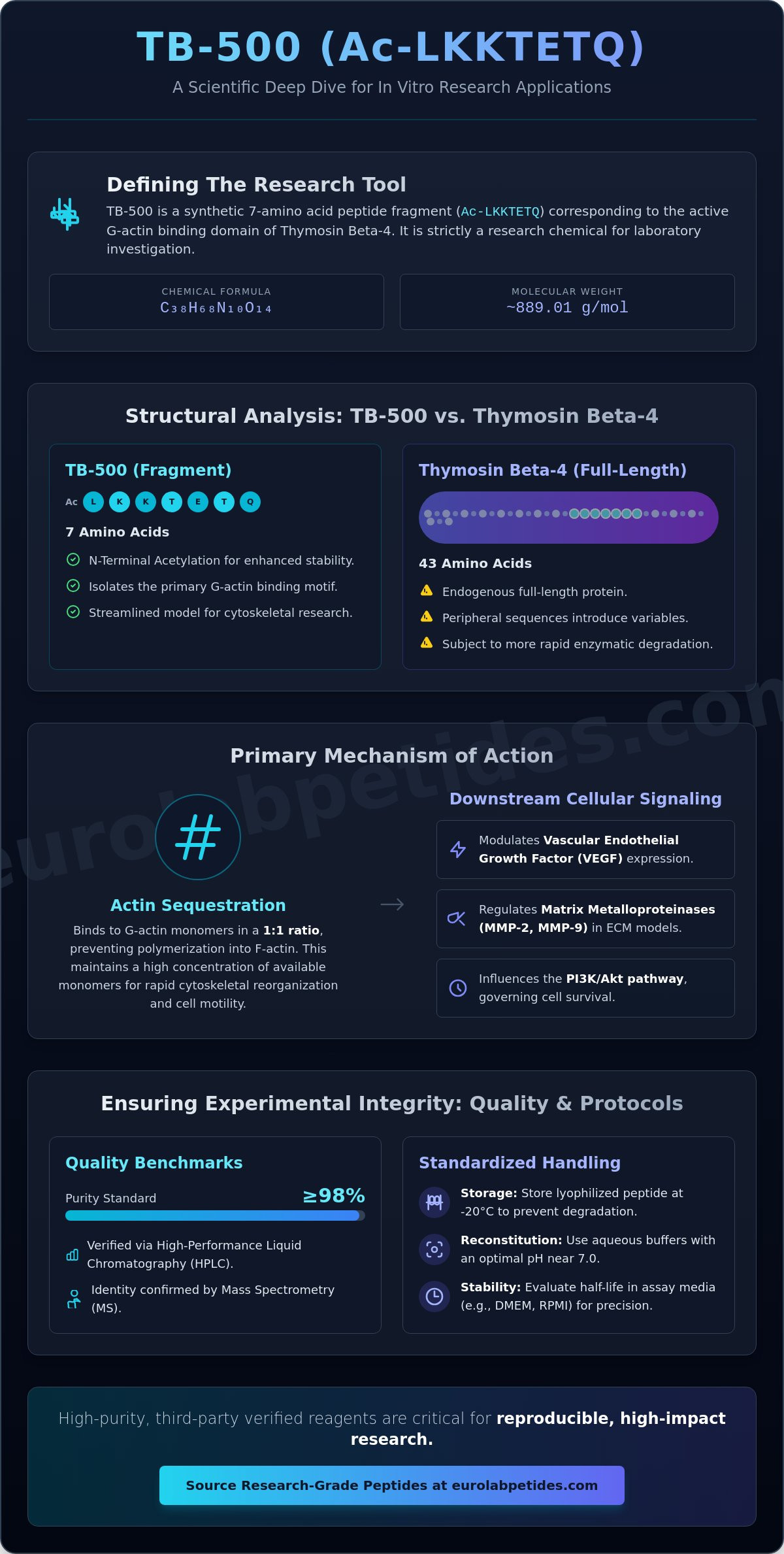
TB-500 is synthesized as a specialized, seven-amino acid peptide that corresponds precisely to the active domain of the endogenous protein Thymosin Beta-4. Specifically, TB-500 (Ac-LKKTETQ) represents the 17 to 23 sequence of the parent molecule. It is defined by the chemical formula C38H68N10O14 and maintains a molecular weight of approximately 889.01 g/mol. In the scope of tb-500 research applications in vitro, the peptide serves as a primary tool for evaluating cellular migration, actin sequestration, and angiogenesis models. It’s strictly classified as a research chemical for laboratory investigation, providing a controlled medium for tissue repair and recovery research without the confounding variables of full-length protein interactions.
Structural Differences: TB-500 vs. Thymosin Beta-4
The structural divergence between these two molecules is significant for experimental design. While native Thymosin Beta-4 is a 43-amino acid protein, TB-500 is a truncated synthetic analog consisting only of the essential 7-amino acid fragment. The N-terminal acetylation of the sequence is a deliberate modification designed to improve peptide stability within experimental assays. This modification prevents rapid enzymatic degradation, allowing for more consistent data collection during prolonged cellular observations. Researchers prioritize the 17-23 fragment because it contains the primary G-actin binding motif. This truncated structure offers a streamlined model for studying cytoskeletal dynamics, as it eliminates the peripheral sequences of the full protein that don’t directly participate in actin sequestration.
Physicochemical Properties and Solubility
The peptide’s physicochemical profile is characterized by high hydrophilicity, making it readily soluble in aqueous buffers. Maintaining an optimal pH near 7.0 is necessary to preserve the molecular structure during reconstitution. TB-500 is typically provided in a lyophilized state to ensure maximum shelf life. Standard laboratory protocols require storage at -20°C to prevent hydrolysis or oxidation of the peptide bonds. The reduced molecular weight and simplified sequence length influence cellular permeability in culture models. This property is advantageous for in vitro assays, as it facilitates a more rapid interaction with intracellular targets. When investigating tb-500 research applications in vitro, investigators must account for these solubility parameters to ensure that the peptide remains bioavailable throughout the duration of the experiment.
Mechanisms of Action in Cellular Signaling Models
The primary mechanism of TB-500 involves its high-affinity interaction with monomeric G-actin. This binding prevents the polymerization of G-actin into filamentous F-actin, thereby sequestering the monomeric pool. These interactions facilitate various tb-500 research applications in vitro, particularly in models focusing on cellular motility and structural reorganization. Research conducted on in vitro/ex vivo TB-500 metabolism demonstrates that the peptide’s structural stability is paramount for sustained signaling in laboratory environments. Such stability ensures that the Ac-LKKTETQ fragment remains active throughout the duration of the assay.
Beyond actin dynamics, the peptide exerts a measurable influence over vascular endothelial growth factor (VEGF) expression levels in various cell cultures. It facilitates the modulation of matrix metalloproteinases (MMPs), specifically MMP-2 and MMP-9, within extracellular matrix (ECM) models. This enzymatic regulation is a critical step in studying invasive cellular behavior and basement membrane degradation. Investigators frequently utilize these signaling properties to explore the PI3K/Akt pathway, which governs cellular survival and anti-apoptotic responses under metabolic stress or hypoxic conditions. For laboratories focused on high-stakes tissue repair and recovery research, establishing these signaling baselines is essential for experimental validity.
Actin Sequestration and Cytoskeletal Dynamics
TB-500 functions as a potent actin-sequestering molecule by binding to monomeric G-actin in a 1:1 ratio. This inhibition of spontaneous polymerization maintains a high concentration of available monomers, providing the cell with necessary resources for rapid cytoskeletal remodeling. In vitro observations of treated cell lines often reveal increased lamellipodia and filopodia formation. These structures are the primary drivers of directed cellular migration across a substrate. Researchers utilize high-resolution imaging to quantify these morphological changes, establishing a direct link between peptide concentration and the velocity of cellular displacement.
Angiogenic Signaling and Endothelial Cell Response
The peptide’s role in angiogenic signaling is frequently studied through endothelial cell migration assays, such as the Boyden chamber model. TB-500 appears to work synergistically with other growth factors to promote the formation of capillary-like structures in tube formation assays. This makes it a valuable reagent for investigating tb-500 research applications in vitro regarding microvascular density and vessel stability. Scientists employ scaffold-based research to observe how the peptide influences endothelial cell organization within complex three-dimensional environments. These models provide objective data on the chemical’s ability to facilitate organized cellular responses within synthetic matrices.
Primary In Vitro Research Applications and Assay Models
The investigation of TB-500 involves several validated assay models designed to isolate specific cellular responses. In fibroblast cultures, such as the NIH-3T3 line, investigators utilize scratch assays to evaluate the rate of monolayer repair. These models provide objective data on the peptide’s ability to facilitate directed migration. Beyond dermal models, cardiomyocyte survival studies under hypoxic conditions allow for the analysis of anti-apoptotic pathways. These experiments often measure the ratio of Bcl-2 to Bax proteins to quantify survival signals. In macrophage models like RAW 264.7, TB-500 is used to measure the suppression of pro-inflammatory cytokines, specifically IL-6 and TNF-alpha, which are critical markers in tissue repair and recovery research. Additionally, corneal epithelial research utilizes ocular surface models to study cell migration, providing insights into the peptide’s role in specialized tissue environments.
Establishing these parameters is a prerequisite for any serious investigation into tb-500 research applications in vitro. By utilizing high-resolution imaging and precise cytokine quantification, researchers can bypass the anecdotal claims often found in less rigorous literature. The focus remains on the measurable interaction between the synthetic fragment and the cellular environment, ensuring that every observation is backed by empirical data. This methodological rigor is what defines professional-grade laboratory inquiry.
Wound Healing and Scratch Assays
Standardized protocols for evaluating the influence of TB-500 on cell monolayer repair typically involve the creation of a linear “scratch” in a confluent cell population. The subsequent closure is monitored via time-lapse microscopy to quantify migration distance and velocity. This model is frequently used in comparative analyses with other regenerative agents. For instance, researchers may integrate BPC-157 into multi-peptide recovery models to determine if synergistic effects exist between the 17-23 fragment and the pentadecapeptide. Such studies are essential for defining the precise tb-500 research applications in vitro across different connective tissue types. By isolating the migration component from proliferation, investigators can attribute wound closure specifically to the peptide’s actin-binding properties.
Inflammation and Cytokine Modulation Studies
The modulation of inflammatory signaling is another critical area of laboratory inquiry. Research often focuses on the suppression of NF-κB signaling in stimulated cell lines, which is a primary mediator of the inflammatory response. By measuring the reduction of oxidative stress markers and the down-regulation of reactive oxygen species (ROS), scientists can assess the peptide’s protective capacity. This research is particularly relevant for understanding the transition from the inflammatory phase to the proliferative phase in tissue repair models. The use of TB-500 as a tool for investigating these transitions allows for a more granular analysis of how synthetic fragments influence endogenous recovery mechanisms. Precise titration of the peptide in these models ensures that the observed cytokine suppression is a direct result of the molecular intervention rather than experimental artifact.
Standardizing Laboratory Handling and Stability Protocols
Precision in the preparation and maintenance of peptide reagents is a fundamental requirement for reproducible data in tb-500 research applications in vitro. One of the most overlooked variables in low-concentration assays is the phenomenon of peptide adsorption to plastic surfaces. Due to the hydrophobic patches on the Ac-LKKTETQ sequence, the peptide can adhere to the walls of standard microcentrifuge tubes or pipette tips, significantly reducing the effective concentration in the final medium. Utilizing low-protein binding plastics or pre-coating surfaces with a 0.1% bovine serum albumin (BSA) solution can mitigate these losses. Maintaining rigorous control over these environmental factors ensures that the observed cellular responses are a direct result of the intended molarity rather than experimental artifacts caused by material loss.
Reconstitution and Concentration Calculations
The reconstitution process must be executed with methodical care to preserve the primary structure of the peptide. Optimal solubility is achieved using bacteriostatic water or sterile saline, depending on the requirements of the specific cell culture medium. Investigators should avoid vigorous agitation; instead, a technique of gentle swirling is employed to dissolve the lyophilized powder without inducing mechanical stress that could lead to peptide denaturation. Precise dosing is critical for establishing a dose-response curve. Utilizing a peptide reconstitution calculator allows for the exact determination of microliter volumes required to reach target micromolar concentrations in the assay. This level of mathematical accuracy is essential when comparing results across different laboratory settings.
Assessing Metabolic Stability in Research Media
The half-life of TB-500 varies considerably based on the composition of the research media used. In serum-supplemented media like DMEM or RPMI, the presence of endogenous proteases can accelerate peptide degradation, whereas serum-free conditions typically extend stability. The metabolic stability for TB-500 is fundamentally defined by its degradation profile during S9 fraction research, which identifies the primary metabolites generated through enzymatic cleavage. To extend the window of observation during 37°C incubation, the addition of specific protease inhibitors may be necessary to maintain peptide integrity. Identifying degradation products in human plasma ex vivo via HPLC-MS/MS provides a baseline for understanding how the 17-23 fragment behaves in complex biological fluids. For laboratories focused on high-stakes tissue repair and recovery research, establishing these stability baselines is a non-negotiable standard for validating longitudinal data.
Quality Benchmarks for Sourcing Research-Grade TB-500
The integrity of tb-500 research applications in vitro is fundamentally dependent on the chemical purity of the reagents utilized. A minimum purity threshold of 98% is established as the industry standard, verified through High-Performance Liquid Chromatography (HPLC). This analytical method ensures that synthesis byproducts and truncated sequences don’t interfere with sensitive cellular signaling assays. Mass Spectrometry (MS) validation is equally critical, as it confirms the exact molecular weight of 889.01 g/mol and the specific Ac-LKKTETQ sequence identity. Without these verifiable metrics, investigators risk introducing uncontrolled variables into their tissue repair and recovery research, leading to irreproducible results.
A significant risk factor in peptide synthesis is the presence of residual Trifluoroacetic acid (TFA) salts. TFA is commonly used during the cleavage and purification stages of solid-phase synthesis, but its retention in the final lyophilized powder can be detrimental to cell culture models. High concentrations of TFA salts can exert direct cytotoxic effects or cause significant shifts in the pH of the culture medium, potentially masking the peptide’s true biological influence. Sourcing from a certified European supplier ensures that these reagents undergo secondary purification and desalting processes to maintain the highest standards of experimental safety.
Analytical Validation: HPLC and MS Interpretation
Technical proficiency in interpreting a Certificate of Analysis (COA) is a prerequisite for professional laboratory investigation. When reviewing HPLC data, researchers must examine the chromatogram for baseline noise and the presence of secondary peaks that indicate impurities. MS data should reflect a single clear mass-to-charge ratio peak corresponding to the target peptide. Third-party testing provides an essential layer of external validation, eliminating the batch-to-batch variability that often plagues the research chemical market. This rigorous verification process is the only reliable method for ensuring that tb-500 research applications in vitro yield precise and actionable data.
The EuroLab Peptides Quality Protocol
The synthesis of every batch follows a strict multi-level quality protocol that includes both in-house analytical checks and independent laboratory verification. This commitment to high-purity synthesis is specifically tailored for specialized in vitro research where molecular precision is the primary metric of success. Investigators can access detailed documentation regarding these standards through the EuroLab TB-500 technical profile. By providing transparent access to purity standards and HPLC/MS results, the protocol projects a persona of radical accountability. This transparency allows the research community to focus on advanced metabolic signaling and cellular dynamics without the burden of reagent validation concerns.
Advancing Analytical Precision in Peptide Investigation
Establishing a rigorous framework for tb-500 research applications in vitro requires a transition from anecdotal observations to standardized, data-driven methodologies. The molecular specificity of the Ac-LKKTETQ fragment, combined with its distinct G-actin binding properties, offers a unique model for investigating cytoskeletal dynamics and angiogenic signaling. Success in the laboratory hinges on the elimination of experimental artifacts, which is achieved through precise reconstitution protocols and the use of high-purity reagents. By prioritizing analytical validation, investigators ensure that every observation within tissue repair and recovery research is both reproducible and scientifically sound.
EuroLab Peptides supports these rigorous demands through a multi-level quality protocol that includes independent third-party HPLC and Mass Spectrometry testing for every batch. A 99%+ purity standard is guaranteed, ensuring that volatile contaminants like TFA salts don’t compromise sensitive cell assays. With secure European logistics and strict regulatory compliance, the laboratory environment remains focused on empirical discovery rather than reagent validation. Access High-Purity TB-500 for In Vitro Research at EuroLab Peptides and elevate the precision of your next laboratory investigation.
Frequently Asked Questions
Is TB-500 the same as Thymosin Beta-4 in a research context?
TB-500 is not identical to Thymosin Beta-4; it represents the synthetic 17-23 amino acid domain (Ac-LKKTETQ) of the parent protein. While the full-length protein consists of 43 amino acids, TB-500 is a truncated fragment specifically utilized to isolate actin-binding effects. In the context of tb-500 research applications in vitro, using the fragment allows investigators to study specific signaling pathways without the interference of the broader protein’s auxiliary functions, ensuring more targeted data collection.
What is the recommended storage temperature for lyophilized TB-500?
Lyophilized TB-500 should be stored at -20°C for long-term stability and preservation of its primary structure. While the peptide remains stable at room temperature for brief periods during transit, extended exposure to ambient temperatures can lead to gradual degradation. Upon reconstitution, the solution should be refrigerated at 2°C to 8°C and utilized within a timeframe that prevents the loss of molecular integrity due to hydrolysis or bacterial growth.
Can TB-500 be used for human clinical trials?
TB-500 is strictly classified as a research chemical and is not approved for human consumption or clinical trials by the FDA. Its use is limited to in vitro laboratory development and animal-based research models. The chemical is intended for professional use in controlled environments to investigate biochemical pathways. It’s not a pharmaceutical or medicine, and any application outside of a laboratory setting is strictly prohibited by regulatory standards.
What is the optimal solvent for reconstituting TB-500 for in vitro assays?
Bacteriostatic water or sterile 0.9% saline are the preferred solvents for reconstituting the lyophilized peptide powder. The choice of solvent often depends on the specific requirements of the cell culture medium and the sensitivity of the assay being performed. It’s essential to allow the powder to dissolve through gentle swirling rather than vigorous agitation. This methodical approach ensures the resulting solution maintains the target molar concentration without mechanical denaturation of the peptide bonds.
How long does TB-500 remain stable in cell culture media at 37°C?
The metabolic half-life of TB-500 in cell culture media varies significantly based on the presence of serum-derived proteases. In serum-supplemented DMEM or RPMI, the peptide may degrade within several hours without the addition of protease inhibitors. For longitudinal tb-500 research applications in vitro, investigators must monitor degradation rates to ensure that the active Ac-LKKTETQ fragment remains at sufficient concentrations to elicit a measurable cellular response throughout the entire incubation period.
What are the primary metabolites of TB-500 identified in metabolic studies?
Metabolic studies utilizing S9 fractions and human liver microsomes have identified several C-terminal degradation products resulting from proteolytic cleavage. These metabolites are typically characterized using HPLC-MS/MS to determine their sequence and molecular weight relative to the parent Ac-LKKTETQ molecule. Understanding these degradation pathways is critical for distinguishing between the activity of the primary peptide and its metabolic derivatives during complex ex vivo or in vitro investigations involving multi-stage signaling.
Why is N-terminal acetylation important for TB-500 research applications?
N-terminal acetylation is a strategic modification that enhances the stability of the 17-23 fragment against aminopeptidase degradation. This modification mimics the natural state of endogenous Thymosin Beta-4, allowing the synthetic peptide to persist longer in biological media. For researchers, this increased stability ensures more consistent binding to G-actin and more reliable data collection during assays focused on cytoskeletal remodeling and directed cellular migration across synthetic or biological substrates.
Does EuroLab Peptides provide third-party testing results for TB-500?
EuroLab Peptides provides comprehensive third-party testing results, including High-Performance Liquid Chromatography (HPLC) and Mass Spectrometry (MS) data, for every batch. These certificates of analysis confirm that the product meets a 99% purity standard and matches the exact molecular weight required for high-precision laboratory use. This commitment to external validation ensures that researchers receive reagents that are free from Trifluoroacetic acid (TFA) salts and other synthesis byproducts that could skew results.
