

While endogenous GHRH possesses a half-life of less than seven minutes, the addition of a trans-3-hexenoyl group to the N-terminal position extends this metabolic window without compromising receptor affinity. Researchers often encounter ambiguous data regarding how these precise structural modifications influence the tesamorelin peptide mechanism of action at the cellular level. You likely recognize the difficulty in separating clinical outcomes, such as the 18% reduction in visceral adipose tissue observed in specific cohorts, from the underlying biochemical signaling that drives these results.
This technical review provides a comprehensive analysis of the peptide’s interaction with the GHRH receptor and its subsequent modulation of downstream metabolic pathways. The kinetics of dipeptidyl peptidase IV resistance, the specifics of signal transduction via the cAMP pathway, and the resulting pulsatile release of endogenous growth hormone are examined in detail. By the end of this analysis, you’ll have a rigorous understanding of the molecular framework that distinguishes this synthetic analogue from its natural counterparts. Protocol-level insights into peptide handling are also included to ensure analytical precision in laboratory settings.
Key Takeaways
- Analyze the structural enhancements of the 44-amino acid sequence that facilitate dipeptidyl peptidase IV resistance while maintaining native receptor affinity.
- Examine the tesamorelin peptide mechanism of action through the selective activation of G-protein coupled receptors on pituitary somatotrophs.
- Evaluate the modulation of the somatotropic axis, focusing on the induction of pulsatile growth hormone secretion and subsequent hepatic IGF-1 synthesis.
- Understand the biochemical signaling pathways of GH-mediated lipolysis, specifically the activation of hormone-sensitive lipase within visceral adipose tissue research models.
- Establish standardized laboratory protocols for the reconstitution of 99% plus purity lyophilised peptides to ensure experimental stability and data reproducibility.
Structural Overview: Tesamorelin as a Stabilised GHRH Analogue
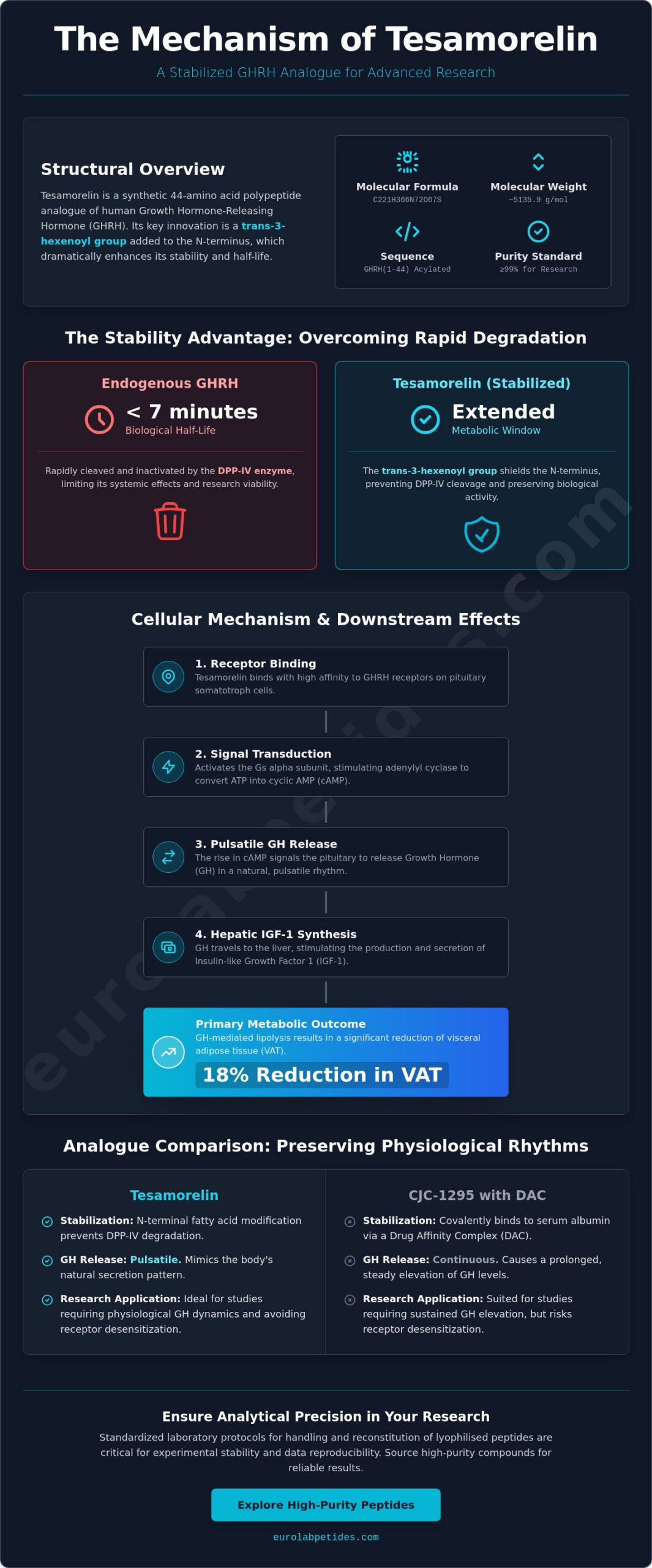
Tesamorelin is a synthetic 44-amino acid polypeptide that functions as a stabilised analogue of endogenous growth hormone-releasing hormone (GHRH). While it shares the primary sequence of the native human hormone, its chemical identity is distinct due to the addition of a trans-3-hexenoyl group at the N-terminal tyrosine residue. This specific modification is the primary driver behind the tesamorelin peptide mechanism of action, as it dictates the molecule’s resistance to rapid enzymatic degradation. The molecular specifications for this peptide include:
- Molecular Formula: C221H366N72O67S
- Molecular Weight: Approximately 5135.9 g/mol
- Sequence: Identical to GHRH(1-44) with N-terminal acylation
- Purity Standard: 99% or higher for rigorous research applications
According to this Tesamorelin Overview, the peptide retains the full biological potency of the native hormone while significantly improving metabolic stability. Endogenous GHRH is notoriously unstable in systemic circulation, primarily because the enzyme dipeptidyl peptidase IV (DPP-IV) cleaves the Tyr1-Ala2 bond within minutes. By shielding this specific N-terminal site, the hexenoyl moiety ensures the peptide remains intact long enough to achieve sustained receptor occupancy and subsequent signaling.
Chemical Modification and Proteolytic Stability
The N-terminal trans-3-hexenoyl group acts as a steric barrier that prevents DPP-IV from accessing the cleavage site. This resistance is vital for research because the first 29 amino acids of the GHRH sequence are essential for receptor binding and activation. Without structural stabilisation, the peptide’s half-life is insufficient for meaningful metabolic study. Structural integrity allows the molecule to maintain its bioactive conformation during transport to the pituitary somatotrophs. This preservation of the 1-29 fragment ensures high-affinity interaction with the GHRH receptor, facilitating the pulsatile release of growth hormone rather than an uncontrolled surge.
Comparative Structure: Tesamorelin vs. CJC-1295
Researchers must distinguish between different stabilisation strategies when selecting analogues for metabolic models. While CJC-1295 often utilizes a Drug Affinity Complex (DAC) to bind covalently to serum albumin, tesamorelin relies on its terminal fatty acid modification. These structural differences fundamentally alter the pharmacokinetic profile. CJC-1295 typically results in a prolonged, continuous elevation of growth hormone levels, which can lead to receptor desensitisation. In contrast, the tesamorelin peptide mechanism of action preserves the natural pulsatile rhythm of the somatotropic axis. This makes it a superior tool for research requiring physiological GH secretion patterns. In-vitro assay designs must account for these binding kinetics, as the hexenoyl modification influences solubility and receptor binding duration differently than albumin-bound alternatives.
The GHRH Receptor Pathway: Primary Mechanism of Action
The primary tesamorelin peptide mechanism of action is defined by its high-affinity interaction with the growth hormone-releasing hormone receptor (GHRH-R). This receptor is a Class B G-protein coupled receptor (GPCR) predominantly localized on the plasma membrane of pituitary somatotrophs. When the peptide occupies the binding site, the Gs alpha subunit of the heterotrimeric G-protein complex dissociates. This subunit subsequently stimulates membrane-bound adenylyl cyclase, an enzyme that catalyzes the conversion of adenosine triphosphate (ATP) into cyclic adenosine monophosphate (cAMP). This surge in cAMP serves as the critical intracellular signal for the somatotropic axis.
Binding Affinity and Receptor Specificity
Binding assays demonstrate that the N-terminal trans-3-hexenoyl modification doesn’t interfere with the molecule’s spatial fit within the GHRH-R binding pocket. The peptide maintains high selectivity for somatotrophs, ensuring that other pituitary cell populations, such as lactotrophs or gonadotrophs, aren’t stimulated. The dissociation constant (Kd) represents the molar concentration of the peptide at which 50% of the GHRH receptors are occupied under equilibrium conditions. Maintaining receptor specificity is vital when utilizing metabolic research models in laboratory environments to prevent off-target effects and ensure data integrity.
Signal Transduction: The cAMP-PKA Pathway
Following the elevation of cAMP, protein kinase A (PKA) is activated. This enzyme mediates the phosphorylation of L-type voltage-gated calcium channels, leading to a rapid influx of extracellular calcium. This calcium surge triggers the immediate exocytosis of growth hormone from secretory granules into the systemic circulation. Beyond immediate release, the signaling cascade influences nuclear activity. According to the NIH analysis of Tesamorelin’s Mechanism of Action, PKA phosphorylates the cAMP response element-binding protein (CREB). This transcription factor then recruits co-activators to the growth hormone gene promoter, stimulating the synthesis of new GH mRNA.
The phosphorylation of CREB at Ser133 is the defining event for long-term somatotroph adaptation. This modification allows CREB to recruit the CREB-binding protein (CBP), which acts as a scaffold for the transcriptional machinery. This process facilitates the expression of the GH1 gene, ensuring that the pituitary gland’s biosynthetic capacity matches the increased secretory demand. Understanding this tesamorelin peptide mechanism of action is fundamental for researchers evaluating the long-term stability of the somatotropic axis and the physiological regulation of growth hormone levels.
Somatotropic Axis Modulation: GH and IGF-1 Secretion
The tesamorelin peptide mechanism of action extends beyond the initial receptor binding to modulate the entire somatotropic axis. By mimicking endogenous GHRH, the peptide facilitates a physiological increase in growth hormone (GH) levels while preserving the natural regulatory architecture of the hypothalamic-pituitary system. It’s an approach that differs fundamentally from the administration of exogenous recombinant human growth hormone (rhGH), which often bypasses pituitary control and suppresses endogenous production through aggressive negative feedback. In research models, utilizing a GHRH analogue allows for the observation of systemic GH effects while maintaining the underlying sensitivity of the somatotrophs to inhibitory signals.
Pulsatile Growth Hormone Release
Preserving the pulsatile rhythm of GH secretion is a critical distinction of this peptide. Rather than inducing a continuous, non-physiological elevation often described as a GH “bleed,” the acylated analogue stimulates the pituitary to release GH in discrete bursts. This rhythmic secretion is essential for maintaining receptor sensitivity in peripheral tissues. Researchers comparing different secretagogue kinetics can refer to the technical profile of Ipamorelin, which highlights how different classes of peptides interact with ghrelin receptors versus GHRH receptors. The tesamorelin peptide mechanism of action ensures that the amplitude of these pulses is increased without disrupting the frequency, a nuance that’s vital for metabolic homeostasis in long-term study designs.
Feedback Loops and IGF-1 Regulation
Once GH enters the systemic circulation, it stimulates the liver to synthesize Insulin-like Growth Factor 1 (IGF-1). This secondary messenger mediates many of the anabolic and metabolic effects observed in growth hormone research. As detailed in this discussion of the Tesamorelin mechanism of action, the resulting rise in IGF-1 triggers a sophisticated negative feedback loop. Elevated serum IGF-1 and GH levels stimulate the release of somatostatin from the hypothalamus, which acts to inhibit further GH secretion from the pituitary. This regulatory mechanism prevents the pathological GH levels often associated with direct GH administration. In controlled environments, IGF-1 elevation typically follows a dose-dependent curve. This allows researchers to quantify the metabolic response in peripheral tissues like skeletal muscle and adipose depots. The presence of these intact feedback loops ensures the somatotropic axis doesn’t lose responsiveness to physiological demands throughout the duration of the research protocol.
Research Applications in Metabolic and Adipose Tissue Models
The tesamorelin peptide mechanism of action is primarily examined through its targeted impact on visceral adipose tissue (VAT) within metabolic research environments. Visceral fat is more metabolically active and possesses a higher density of growth hormone receptors than subcutaneous fat, making it a specific focal point for GHRH analogue studies. When growth hormone (GH) levels rise pulsatilly, they trigger a cascade that activates hormone-sensitive lipase (HSL) within adipocytes. This enzyme facilitates the hydrolysis of stored triglycerides into free fatty acids and glycerol, which are then released for oxidation. Understanding these cellular interactions is fundamental for researchers focusing on weight management and metabolic dysfunction models.
Beyond adipose tissue, the presence of GHRH receptors in the central nervous system has prompted interest in cognitive function research. Evidence suggests that GHRH signaling in the hippocampus might influence proteostasis and neurogenesis. Because this peptide maintains the endogenous rhythm of the somatotropic axis, it provides a more controlled model for studying these pathways than direct GH administration. Direct GH can disrupt the delicate balance of the blood-brain barrier and hypothalamic signaling, whereas an analogue works within existing regulatory frameworks.
Cellular Lipolysis and Lipid Oxidation
The breakdown of triglycerides in adipocytes is the primary pathway through which VAT reduction occurs. GH elevation promotes lipolysis by increasing the expression of beta-adrenergic receptors and inhibiting lipoprotein lipase, the enzyme responsible for lipid storage. In metabolic studies, researchers have documented up to an 18% decrease in visceral fat, while subcutaneous fat remains relatively unaffected. This tissue specificity is a key feature of the tesamorelin peptide mechanism of action. Some laboratory models also explore synergistic effects when investigating this peptide alongside BPC-157 in tissue models, specifically to examine how enhanced lipolysis interacts with accelerated tissue repair signaling.
Glucose Metabolism and Research Considerations
Monitoring glucose homeostasis is a critical component of any metabolic research protocol involving GHRH analogues. While GH promotes lipolysis, it can also decrease peripheral glucose uptake, potentially leading to insulin resistance in susceptible models. Researchers must maintain rigorous monitoring of blood glucose and HbA1c levels to quantify these effects. Tesamorelin is preferred over direct GH administration for metabolic stability studies because it preserves the endogenous feedback mechanisms that mitigate the risk of chronic hyperglycemia. This physiological control allows for a more accurate assessment of long-term metabolic shifts without the confounding variables of GH-induced glucose intolerance. For those conducting high-stakes metabolic studies, sourcing validated compounds for weight management research is essential for achieving reproducible data.
Laboratory Handling: Purity, Stability, and Reconstitution
Maintaining the structural integrity of the 44-amino acid sequence is a prerequisite for ensuring the tesamorelin peptide mechanism of action remains predictable in laboratory settings. High-purity (99%+) lyophilised material is the standard for rigorous inquiry, as impurities can introduce confounding variables into metabolic signaling data. Reconstitution requires precision; the use of Bacteriostatic Water (0.9% benzyl alcohol) or sterile saline is recommended depending on the intended duration of the assay. Once the diluent is introduced, the peptide becomes significantly more susceptible to degradation through hydrolysis or oxidation.
Stability of the reconstituted solution is maintained at 2-8°C for approximately 14 days, though researchers should verify this against specific assay requirements. Mechanical agitation must be avoided. Shaking the vial can lead to the denaturation of the peptide’s secondary structure, rendering the N-terminal hexenoyl modification ineffective. Instead, a gentle swirling motion should be employed to ensure complete dissolution. This careful handling preserves the molecule’s ability to engage the GHRH receptor without loss of affinity.
Storage and Shelf-Life of Lyophilised Peptides
Long-term storage of the lyophilised powder is most effective at temperatures between -20°C and -80°C. These conditions minimize the risk of peptide degradation over extended periods. Moisture ingress is a primary concern during storage; vials must remain hermetically sealed to prevent the formation of degradants. Repeated freeze-thaw cycles of reconstituted aliquots should be strictly avoided as they compromise the molecular bond integrity. For comprehensive vendor validation and quality benchmarks, researchers should consult the 2026 guide to purity and sourcing for vendor verification.
Analytical Verification of Peptide Purity
Verification of product identity and purity is achieved through High-Performance Liquid Chromatography (HPLC) and Mass Spectrometry (MS). HPLC provides a quantitative metric of purity by separating the target peptide from any synthesis byproducts or truncated sequences. MS is utilized for sequence verification, confirming that the molecular weight aligns with the expected profile of the acylated 44-amino acid chain. Third-party testing remains a non-negotiable standard for research-grade materials. It provides an objective layer of accountability, ensuring that the tesamorelin peptide mechanism of action isn’t compromised by substandard chemical synthesis or inaccurate concentration levels within the vial.
Advancing Somatotropic Research through Molecular Precision
The structural integrity provided by the trans-3-hexenoyl group distinguishes this peptide as a high-affinity GHRH analogue capable of resisting DPP-IV degradation. This stability is the foundation of the tesamorelin peptide mechanism of action, ensuring that the somatotropic axis is modulated within physiological parameters. By maintaining pulsatile GH release and hepatic IGF-1 synthesis, researchers can accurately evaluate lipolytic signaling and metabolic shifts in complex adipose tissue models. Data reproducibility in these studies depends entirely on the chemical purity and conformational stability of the ligands used in the assay.
Precision in laboratory development requires materials that meet rigorous analytical standards. Our compounds are the result of specialized European laboratory synthesis and undergo third-party HPLC and Mass Spectrometry validation to confirm 99% plus purity benchmarks. These materials are produced strictly for in-vitro research and laboratory development. We invite you to View Technical Specifications for Research-Grade Tesamorelin to support your next phase of inquiry. High-stakes research demands the absolute security of verified chemical excellence.
Frequently Asked Questions
How does tesamorelin differ from endogenous GHRH structurally?
Tesamorelin is distinguished from endogenous GHRH by the attachment of a trans-3-hexenoyl moiety to the N-terminal tyrosine residue. This modification protects the Tyr1-Ala2 bond from proteolytic cleavage by dipeptidyl peptidase IV. While the native hormone has a biological half-life of less than seven minutes, this acylated analogue maintains structural integrity for significantly longer durations in metabolic research environments.
What is the primary intracellular signaling pathway activated by tesamorelin?
The tesamorelin peptide mechanism of action involves the activation of the cAMP-PKA signaling cascade following GHRH-R binding. This G-protein coupled receptor interaction stimulates adenylyl cyclase, leading to an intracellular surge in cyclic AMP. Subsequent activation of protein kinase A (PKA) facilitates calcium influx and the exocytosis of growth hormone from pituitary somatotrophs.
Does tesamorelin increase IGF-1 levels in laboratory models?
Hepatic synthesis of IGF-1 increases as a direct consequence of pulsatile growth hormone release into the systemic circulation. In controlled research models, serum IGF-1 levels typically rise by 30% to 50% from baseline. This elevation is regulated by a natural negative feedback loop involving hypothalamic somatostatin, ensuring that levels remain within a physiological range during laboratory study.
What is the half-life of tesamorelin after reconstitution?
Once reconstituted, the peptide maintains biochemical stability for approximately 14 days when stored at 2-8°C. Stability in vivo is significantly enhanced compared to native GHRH, but the molecule remains sensitive to thermal degradation and mechanical stress. Researchers should avoid multiple freeze-thaw cycles and mechanical agitation to prevent denaturation of the 44-amino acid sequence.
How does tesamorelin affect visceral fat at the cellular level?
Cellular lipolysis is induced through the GH-mediated activation of hormone-sensitive lipase (HSL) within visceral adipocytes. This process facilitates the breakdown of stored triglycerides into free fatty acids and glycerol. The tesamorelin peptide mechanism of action is specifically targeted toward visceral adipose tissue, which possesses a higher density of growth hormone receptors than subcutaneous fat depots.
Can tesamorelin be used for in-vitro CNS research?
Research into the central nervous system (CNS) pathways of GHRH-R is a growing area of interest for cognitive function models. Evidence suggests that GHRH analogues may influence proteostasis and neurogenesis within the hippocampus. These in-vitro studies focus on the peptide’s ability to cross the blood-brain barrier and interact with extra-pituitary GHRH receptors involved in cognitive maintenance.
What are the recommended storage conditions for research-grade tesamorelin?
Optimal storage for research-grade lyophilized powder is between -20°C and -80°C in a moisture-controlled environment. These temperatures ensure long-term stability and prevent the formation of degradants. Vials must remain hermetically sealed until reconstitution to avoid contamination. Following the addition of a diluent, the solution should be kept refrigerated and protected from light.
Is tesamorelin compatible with other growth hormone secretagogues in a research stack?
Laboratory protocols frequently investigate the synergy between GHRH analogues and ghrelin mimetics in specialized research stacks. Combining these compounds can produce a more robust pulsatile GH release than using either agent in isolation. Such stacks are utilized in recovery and muscle tissue research to examine the combined effects of multiple somatotropic signaling pathways on metabolic homeostasis.
