

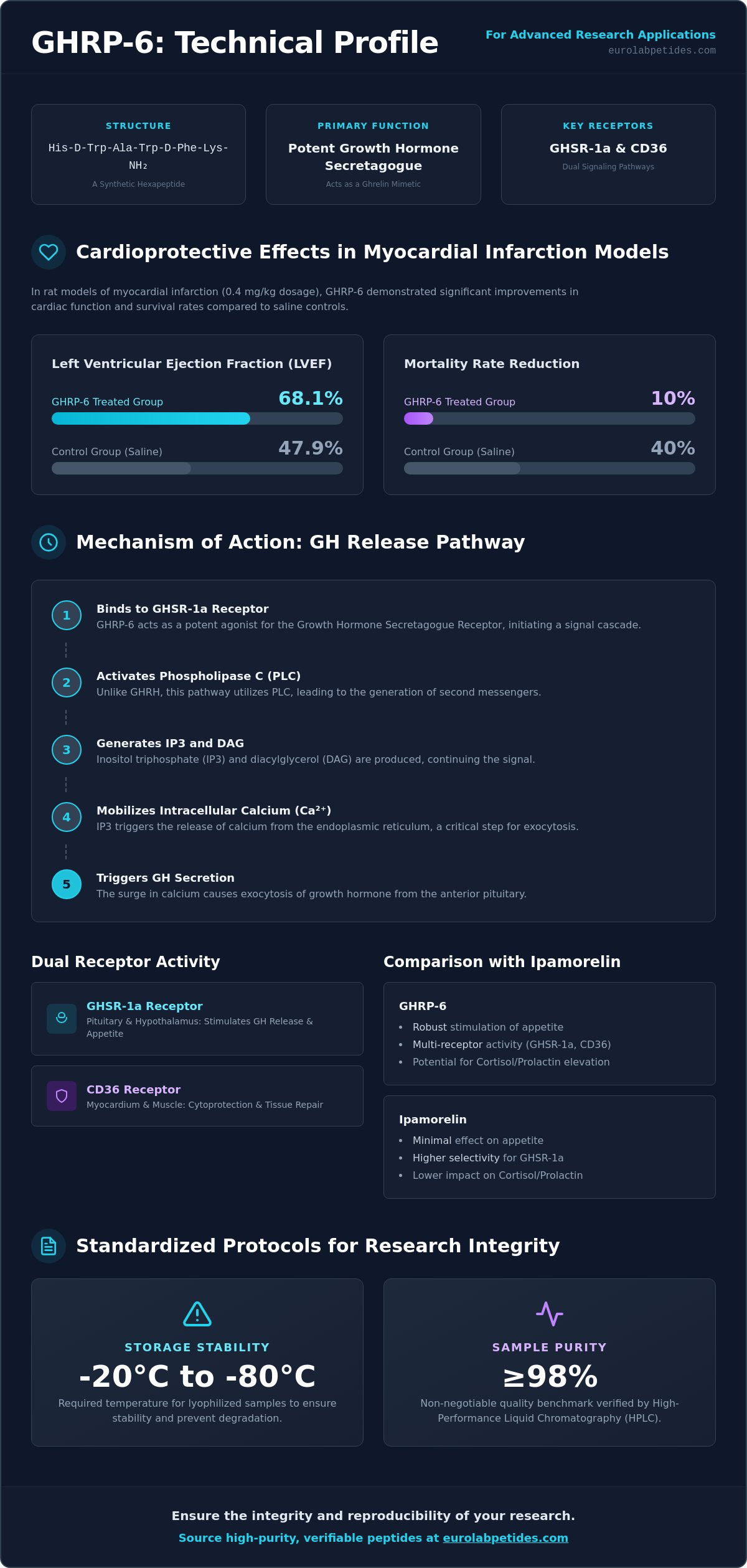
In rat models of myocardial infarction, GHRP-6 administration at 0.4 mg/kg has demonstrated the capacity to increase Left Ventricular Ejection Fraction to 68.1 percent, compared to just 47.9 percent in saline-treated control groups. This data underscores why ghrp-6 research applications remain a focal point for laboratories investigating tissue repair and metabolic signaling. Most investigators recognize that the primary challenge lies in sample volatility and the absence of standardized protocols for distinguishing this hexapeptide from other secretagogues like Ipamorelin. You require a framework that moves beyond anecdotal evidence toward verifiable, technical benchmarks for 2026 research environments.
This review provides a comprehensive analysis of GHSR-1a and CD36 signaling pathways, offering the precision necessary for high-stakes biochemical inquiry. You’ll gain a clear understanding of standardized storage protocols, such as maintaining lyophilized samples at -20 degrees Celsius to ensure 98 percent purity, and the specific methodologies required to achieve synergistic growth hormone release. We conclude with a detailed review of contemporary laboratory models that define the current state of cytoprotective and metabolic research.
Key Takeaways
- The structural profile of GHRP-6 is defined by its role as a potent agonist of the Growth Hormone Secretagogue Receptor (GHSR-1a).
- Specialized ghrp-6 research applications are examined through the lens of cytoprotective signaling and the modulation of apoptosis in ischemia models.
- The impact of ghrelin-mimetic properties is investigated within hypothalamic orexigenic pathways and gastric motility models.
- Standardized handling protocols are maintained by storing lyophilized peptides at temperatures between -20 and -80 degrees Celsius to ensure sample stability.
- Laboratory integrity is preserved by utilizing high-purity materials that meet the non-negotiable 98 percent HPLC-verified quality benchmark.
Biochemical Profile and Mechanism of Action of GHRP-6
Structural identity defines the functional capacity of this compound. GHRP-6 is a synthetic hexapeptide defined by the primary amino acid sequence His-D-Trp-Ala-Trp-D-Phe-Lys-NH2. It serves as a potent agonist for the Growth Hormone Secretagogue Receptor (GHSR-1a), a G-protein coupled receptor. This ligand-receptor interaction triggers a complex signal transduction cascade. Unlike Growth Hormone Releasing Hormone (GHRH), which utilizes the GHRH receptor and the adenylate cyclase pathway, GHRP-6 functions through the phospholipase C (PLC) pathway. This mechanism leads to the production of inositol triphosphate (IP3) and the subsequent mobilization of intracellular calcium stores. Key components of this signal transduction include:
- Binding to the G-protein coupled GHSR-1a receptor.
- Activation of phospholipase C (PLC) at the plasma membrane.
- Generation of second messengers, specifically inositol triphosphate (IP3) and diacylglycerol (DAG).
- Release of calcium from the endoplasmic reticulum to trigger exocytosis of growth hormone.
This specific pathway is a critical phase in ghrp-6 research applications focusing on the induction of pulsatile growth hormone secretion from the anterior pituitary. Because it bypasses the GHRH receptor, GHRP-6 maintains efficacy in models where GHRH signaling is impaired or absent.
Receptor Affinity and Dual Signaling Pathways
GHSR-1a is predominantly expressed in the anterior pituitary and the hypothalamus, where GHRP-6 binding stimulates the release of somatotropes. However, research indicates that its utility isn’t limited to the central nervous system. A secondary interaction occurs with the CD36 scavenger receptor found in peripheral tissues, including the myocardium and skeletal muscle. This dual signaling capacity allows for the investigation of systemic effects beyond simple endocrine regulation. GHRP-6 exhibits a sub-nanomolar binding affinity to the ghrelin receptor, establishing it as a foundational benchmark for 2026 research environments investigating non-GHRH mediated somatotropic stimulation.
Differentiation from Other Growth Hormone Secretagogues
Distinguishing GHRP-6 from its successors is essential for precise experimental design. While GHRP-2 and Ipamorelin also target the GHSR-1a receptor, their selectivity profiles vary significantly across different laboratory models. GHRP-6 is specifically characterized by its robust stimulation of appetite via hypothalamic orexigenic pathways, a trait that’s significantly less pronounced in Ipamorelin. This divergence is largely attributed to the specific N-terminal sequence, where the His-D-Trp-Ala motif influences receptor binding kinetics and the resulting side-effect profiles, such as cortisol and prolactin elevation, which are observed in certain in-vivo models.
The evolution of these compounds reflects a shift from first-generation peptides toward molecules with higher specificity. GHRP-6 remains a primary tool for studying gastric motility and cardiac cytoprotection due to its multi-receptor activity. Its independence from the GHRH pathway allows investigators to explore GH secretion even in models where endogenous GHRH signaling is compromised. This makes it a versatile component in ghrp-6 research applications, particularly when analyzing the interplay between metabolic signaling and tissue recovery.
Cardioprotective and Cytoprotective Research Models
GHRP-6 exhibits systemic cytoprotective properties that extend far beyond its endocrine function. In ischemia and reperfusion (I/R) models, the peptide demonstrates a capacity to mitigate oxidative stress and reduce overall infarct size. Specifically, a March 2026 study utilizing a 0.4 mg/kg dose in rats with myocardial infarction showed a statistically significant improvement in Left Ventricular Ejection Fraction (LVEF) to 68.1 percent, compared to 47.9 percent in saline controls. Mortality in the treated group was reduced to 10 percent from a baseline of 40 percent in the control group. These outcomes are central to ghrp-6 research applications involving acute cardiac injury.
The biochemical mechanism driving these results involves antiapoptotic signaling pathways. GHRP-6 modulates the Bcl-2/Bax ratio and inhibits caspase-3 activation, effectively preventing programmed cell death in stressed myocytes. Interaction with the CD36 scavenger receptor influences extracellular matrix (ECM) remodeling and attenuates inflammatory responses. This dual-receptor approach is particularly evident in studies investigating doxorubicin-induced cardiotoxicity, where the hexapeptide serves as a protective agent against chemotherapy-induced structural degradation. For investigators focusing on these mechanisms, utilizing materials validated for tissue repair and recovery research is a prerequisite for data integrity.
Myocardial Reperfusion Damage Attenuation
In acute myocardial infarction (AMI) research models, GHRP-6 administration is linked to the preservation of myocardial structural integrity. Research indicates a positive influence on left ventricle global contractility, measured by the rate of pressure change (dP/dt). The peptide’s ability to reduce fibrosis is quantified through the downregulation of connective tissue growth factor (CTGF) expression. By limiting the expansion of fibrotic tissue, GHRP-6 helps maintain the mechanical efficiency of the heart wall in post-ischemic environments.
Extra-Cardiac Cytoprotective Action
While cardiac models are prominent, ghrp-6 research applications increasingly encompass extra-cardiac tissues. In hepatoprotective models, the peptide is studied for its impact on liver cirrhosis and acute hepatic failure, where it appears to modulate necrotic progression. Renal protection studies focus on attenuating drug-induced nephrotoxicity, specifically protecting tubular cells from oxidative damage. Furthermore, the peptide’s influence on the gastric mucosa and accelerated wound healing in diabetic models suggests a broad spectrum of cytoprotective utility. These findings indicate that the CD36 and GHSR-1a pathways provide a multi-layered defense mechanism against various forms of chemically or physically induced cellular stress.
Metabolic Regulation and Appetite Signaling Studies
GHRP-6 acts as a potent ghrelin mimetic, directly influencing the central regulation of energy balance. This activity is mediated through the Growth Hormone Secretagogue Receptor (GHSR-1a) located in the arcuate nucleus of the hypothalamus. Unlike many other peptides in the somatotropic category, GHRP-6 triggers a significant orexigenic response, typically observed within 15 to 30 minutes of administration in laboratory models. This rapid onset makes it a critical tool for ghrp-6 research applications focusing on metabolic dysfunction and wasting syndromes.
Hypothalamic Orexigenic Signaling
The stimulation of food intake is driven by the activation of Neuropeptide Y (NPY) and Agouti-related protein (AgRP) neurons. These neurons are central to the orexigenic pathway, where GHRP-6 binding suppresses the activity of pro-opiomelanocortin (POMC) neurons. This dual action facilitates a comprehensive study of eating disorder pathophysiology and energy expenditure. Additionally, investigators utilize GHRP-6 to examine the modulation of adenosine monophosphate-activated protein kinase (AMPK) pathways in metabolic tissues. This research is vital for understanding how cellular energy sensors respond to exogenous secretagogues in the context of a Longevity Research Stack or similar metabolic homeostasis studies.
Beyond appetite, the influence on glucose metabolism is a growing area of inquiry. In-vitro observations suggest that GHRP-6 may affect insulin sensitivity and lipid profiles, though the specific mechanisms of action regarding adipocyte signaling require further validation through high-stakes precision testing.
Gastric Emptying and Motility Research
Prokinetic effects represent a significant differentiator for GHRP-6 compared to other growth hormone secretagogues. Research applications in gastroparesis and cachexia models highlight the peptide’s ability to accelerate gastric emptying, particularly in diabetic and post-operative ileus environments. This is achieved through the activation of ghrelin receptors in the enteric nervous system, which stimulates smooth muscle contractility throughout the gastrointestinal tract.
When compared to other agonists, GHRP-6 provides a unique data set for specialized motility research due to its intense ghrelin-mimetic profile. For laboratories seeking to understand complex systemic interactions, these findings are often integrated into broader inquiries involving the Advanced Metabolic Stack. This methodical approach ensures that metabolic signaling is analyzed as a verifiable metric of physiological health, maintaining the rigorous standards required for elite professional inquiry.
Standardized Laboratory Handling and Stability Protocols
The biochemical integrity of the GHRP-6 hexapeptide sequence is contingent upon rigorous adherence to thermal and mechanical handling standards. In its lyophilized state, the peptide remains stable at room temperature for approximately three weeks if it’s protected from light and moisture. For extended preservation, samples must be stored desiccated at -20°C or -80°C. These parameters are non-negotiable for ghrp-6 research applications where biochemical consistency is the primary metric of success. Any deviation from these temperature ranges can lead to deamidation or peptide cleavage, compromising the validity of the experimental data.
Reconstitution and Solution Stability
Aseptic technique is mandatory during the reconstitution process to prevent microbial contamination. Bacteriostatic water, containing 0.9 percent benzyl alcohol, or sterile saline is utilized as the standard solvent. To achieve exact concentrations for in-vitro or in-vivo models, investigators should utilize a peptide reconstitution calculator. The solvent is introduced slowly along the side of the vial wall to avoid direct impact on the lyophilized cake. Mechanical agitation, such as vigorous shaking, must be avoided because it induces peptide shearing and denaturation. A gentle swirling motion is employed until the solution is clear.
Once reconstituted, the solution’s stability is significantly reduced. Samples are stable for up to 30 days when refrigerated at 2 to 8°C. If researchers require longer storage for liquid-phase GHRP-6, the solution is aliquoted into single-use volumes and frozen at -20°C for up to four months. Chemical factors, including pH shifts and UV light exposure, accelerate degradation, so opaque vials or foil wrapping are recommended during the active phase of an experiment.
Storage and Handling for Maximum Purity
Aliquoting is the most effective method for preventing the degradation caused by repeated freeze-thaw cycles. Each cycle subjects the peptide to thermal stress that can break fragile molecular bonds. Standardized protocols require that each aliquot is clearly labeled with the date of reconstitution and the specific concentration. Visual inspection is the first line of defense; any cloudiness, precipitation, or discoloration indicates that the sample is no longer suitable for high-precision research. For definitive verification, high-performance liquid chromatography (HPLC) is used to confirm that the peptide maintains its baseline 98 percent purity level.
To ensure the highest degree of experimental reliability, researchers should source materials from validated catalogs such as those specializing in Recovery, Muscle Tissue & Inflammation Research. Maintaining a “proof-first” methodology in handling ensures that the data collected reflects the true biochemical potential of the compound rather than artifacts of sample degradation. Standardized shipping protocols, involving temperature-controlled environments and moisture-resistant packaging, further protect the peptide’s structural identity from the point of synthesis to the laboratory bench.
Sourcing High-Purity GHRP-6 for Research Integrity
The integrity of ghrp-6 research applications is fundamentally linked to the analytical purity of the peptide utilized. A baseline threshold of 98 percent purity, as verified by High-Performance Liquid Chromatography (HPLC), is required to ensure that experimental outcomes are the result of specific ligand activity rather than unintended interactions with synthesis byproducts. In the 2026 global market, where sample quality varies significantly, professional investigators rely on objective data rather than anecdotal claims of excellence. Impurities, even at low concentrations, can introduce confounding variables into metabolic or cytoprotective models, leading to skewed results that compromise the validity of the entire study.
The EuroLab Quality Protocol
The manufacturing process is characterized by a “proof-first” methodology that prioritizes technical transparency. Every batch is subjected to multi-level quality control, including in-house assessment and independent third-party validation. Key metrics analyzed include Trifluoroacetic acid (TFA) removal and residual solvent analysis to prevent cytotoxic interference in sensitive laboratory models. European-based synthesis ensures compliance with regional regulatory standards, providing a reliable logistical framework for researchers who require localized accountability. This regional focus acts as a shorthand for reliability in a global market where quality concerns are frequent. Ethical consistency is framed as a verifiable metric, where manufacturing excellence is documented through batch-specific data rather than generalized marketing claims.
Verification of COAs involves a meticulous review of the HPLC trace and Mass Spectrometry reports. The HPLC trace should exhibit a singular, sharp peak with minimal baseline noise, indicating the absence of truncated sequences or deleted amino acids. Mass Spectrometry must provide a clear mass-to-charge ratio that aligns with the theoretical molecular weight of the hexapeptide. These reports aren’t merely supplementary; they’re the primary evidence of product identity and the cornerstone of professional scientific inquiry.
Researcher’s Checklist for Peptide Procurement
When procuring materials for scientific inquiry, specific technical benchmarks must be demanded. A Certificate of Analysis (COA) is considered valid only when it includes both HPLC and Mass Spectrometry (MS) reports for the specific batch being delivered. Investigators should maintain a checklist to ensure the materials meet the rigorous demands of their community.
- Sequence verification: Mass Spectrometry must confirm the molecular weight corresponds to the His-D-Trp-Ala-Trp-D-Phe-Lys-NH2 sequence.
- Purity levels: HPLC chromatograms must show a primary peak representing 98 percent or more of the total area.
- Moisture content: Lyophilized samples must show minimal moisture to ensure long-term stability and prevent degradation.
- Batch-specific data: Professional suppliers provide data for the specific vial received, not “typical” analysis reports.
Unrealistic pricing or the absence of third-party validation are primary red flags that suggest compromised sample integrity. To maintain the rigorous standards of your laboratory, you can secure high-purity GHRP-6 for research applications through EuroLab’s certified catalog, where quality is presented as a standardized metric of professional reliability. This commitment to precision ensures that the focus remains on the biochemical mechanisms of the peptide, free from the confounding variables of substandard synthesis.
Advancing Precision in GHSR-1a and CD36 Research
The evolution of ghrp-6 research applications is defined by a transition from simple growth hormone secretagogue studies toward complex multi-receptor investigations. Validated data confirms that the hexapeptide sequence’s utility extends into myocardial cytoprotection and hypothalamic metabolic signaling. Maintaining the integrity of these laboratory models requires strict adherence to the standardized handling and storage protocols established for 2026 research environments. It’s essential to utilize materials that meet non-negotiable quality benchmarks to ensure that results are the product of ligand activity rather than sample degradation.
You can Purchase Research-Grade GHRP-6 with Third-Party Validation to ensure your data remains free from the confounding variables of synthesis impurities. Each sample is produced under ISO-compliant laboratory standards and includes batch-specific HPLC and Mass Spectrometry reports to verify a minimum 98 percent purity level. Specialized European logistics are utilized to maintain the thermal stability of these temperature-sensitive chemicals during transit. Equipping your laboratory with verified, high-purity compounds ensures that your focus remains on the objective discovery of biochemical mechanisms. Rigorous adherence to these analytical standards ensures that your research contributes meaningful data to the specialized scientific community.
Frequently Asked Questions
Is GHRP-6 intended for human consumption or clinical use?
GHRP-6 is strictly intended for laboratory research and is not for human consumption or clinical use. As of June 2026, the FDA maintains GHRP-6 in Category 2, which prohibits its use in compounded medications for humans. It’s also classified as a prohibited substance at all times under WADA regulations. All ghrp-6 research applications must adhere to these legal restrictions, ensuring the compound is utilized only within controlled experimental environments.
What is the difference between GHRP-6 and Ipamorelin in a research setting?
The primary differentiator is receptor selectivity and the resulting physiological response in experimental models. GHRP-6 is a non-selective agonist that interacts with both the GHSR-1a and CD36 receptors, which frequently induces a significant orexigenic response. In contrast, Ipamorelin is a highly selective GHSR-1a agonist. It doesn’t typically stimulate the same appetite response or influence cortisol and prolactin levels, making it a more focused tool for isolated growth hormone secretion studies.
How should lyophilized GHRP-6 be stored for multi-year stability?
Long-term stability is achieved by storing the lyophilized powder desiccated at -20°C or -80°C. While the peptide remains stable at room temperature for approximately three weeks, thermal degradation occurs rapidly in suboptimal conditions. Protecting the vials from light and moisture is mandatory to prevent deamidation. When stored at -80°C, the peptide sequence remains structurally intact for several years, provided the vacuum seal is not compromised.
Can GHRP-6 be used in studies involving CD36 receptor signaling?
Yes, GHRP-6 is a validated ligand for the CD36 scavenger receptor, which makes it a valuable tool for studying extra-cardiac cytoprotection. This interaction allows investigators to explore its influence on inflammatory pathways and extracellular matrix remodeling. These ghrp-6 research applications are distinct from its endocrine functions, providing a specialized framework for analyzing tissue repair and recovery in various ischemia-reperfusion laboratory models.
What are the common reconstitution solvents used for GHRP-6 in laboratory models?
Bacteriostatic water and sterile saline are the standard solvents for reconstituting this hexapeptide. Bacteriostatic water is often preferred for multi-dose vials because the 0.9 percent benzyl alcohol inhibits microbial growth. For single-use in-vivo applications where benzyl alcohol might interfere with the model, sterile saline is selected. The solvent should be introduced slowly along the vial wall to avoid mechanical stress on the peptide molecules during dissolution.
What purity level is required for GHRP-6 to be considered research-grade?
A minimum purity level of 98 percent, verified by High-Performance Liquid Chromatography (HPLC), is the non-negotiable standard for research-grade materials. Purity levels below this threshold introduce unknown impurities that act as confounding variables in sensitive biochemical assays. Analytical reports must also include Mass Spectrometry to verify that the molecular weight aligns with the His-D-Trp-Ala-Trp-D-Phe-Lys-NH2 sequence, ensuring the identity of the compound is absolute.
How does GHRP-6 influence gastric motility in experimental models?
GHRP-6 functions as a prokinetic agent by mimicking endogenous ghrelin to stimulate the enteric nervous system. In laboratory models of gastroparesis or post-operative ileus, it accelerates gastric emptying by increasing smooth muscle contractility. This mechanism is independent of its growth hormone-releasing properties. It provides a specific pathway for investigating gastrointestinal motility and the management of cachexia in various chronic disease models.
Does GHRP-6 require a specific peptide calculator for dosage in rodent studies?
Precise volumetric calculations are required to ensure accurate delivery of the intended dosage in rodent studies. Using a dedicated reconstitution calculator helps researchers determine the exact volume of solvent needed to reach a specific concentration, such as 1 mcg/kg. This precision is critical because GHRP-6 exhibits a potent dose-response relationship. Standardizing these calculations across all phases of a study ensures that the resulting data is reproducible and verifiable.
