

What if the primary cause of your inconsistent experimental data isn’t the peptide sequence itself, but a failure in environmental control during the initial handling phase? For many researchers, the loss of expensive material due to degradation or microbial ingress is a recurring obstacle that compromises the validity of longitudinal studies. Effectively avoiding contamination in peptide experiments requires more than basic cleanliness; it demands a multi-layered biological and chemical barrier system. You likely recognize that even minor deviations in aseptic technique can lead to catastrophic data drift or the complete loss of high-value research assets.
This protocol provides the technical framework necessary to master the rigorous aseptic techniques and environmental controls required to maintain peptide purity. By implementing these standardized laboratory procedures, you’ll achieve a zero-contamination workflow and ensure the extended stability of reconstituted peptides. We’ll examine the latest regulatory standards, including the EMA guidelines effective June 1, 2026, and ICH Q2(R2) validation procedures. This discussion details the precise methodologies for atmospheric management, solvent purity, and analytical verification to secure reproducible research data across independent laboratory settings.
Key Takeaways
- Differentiate between microbial ingress and chemical cross-contamination to protect the integrity of peptide secondary and tertiary structures in high-sensitivity assays.
- Implement a multi-layered barrier system for avoiding contamination in peptide experiments by mitigating human and environmental vectors like respiratory droplets and airflow patterns.
- Standardize reconstitution protocols using pressure equalization techniques and appropriate media selection to prevent aerosolization and maintain long-term peptide stability.
- Establish rigorous environmental monitoring using settling plates and surface swabs alongside visual inspection for the early detection of precipitation or discoloration.
- Validate data integrity by accurately interpreting Certificates of Analysis (COAs) to verify technical metrics, including purity levels, peptide content, and TFA concentrations.
The Fundamentals of Aseptic Technique in Peptide Research
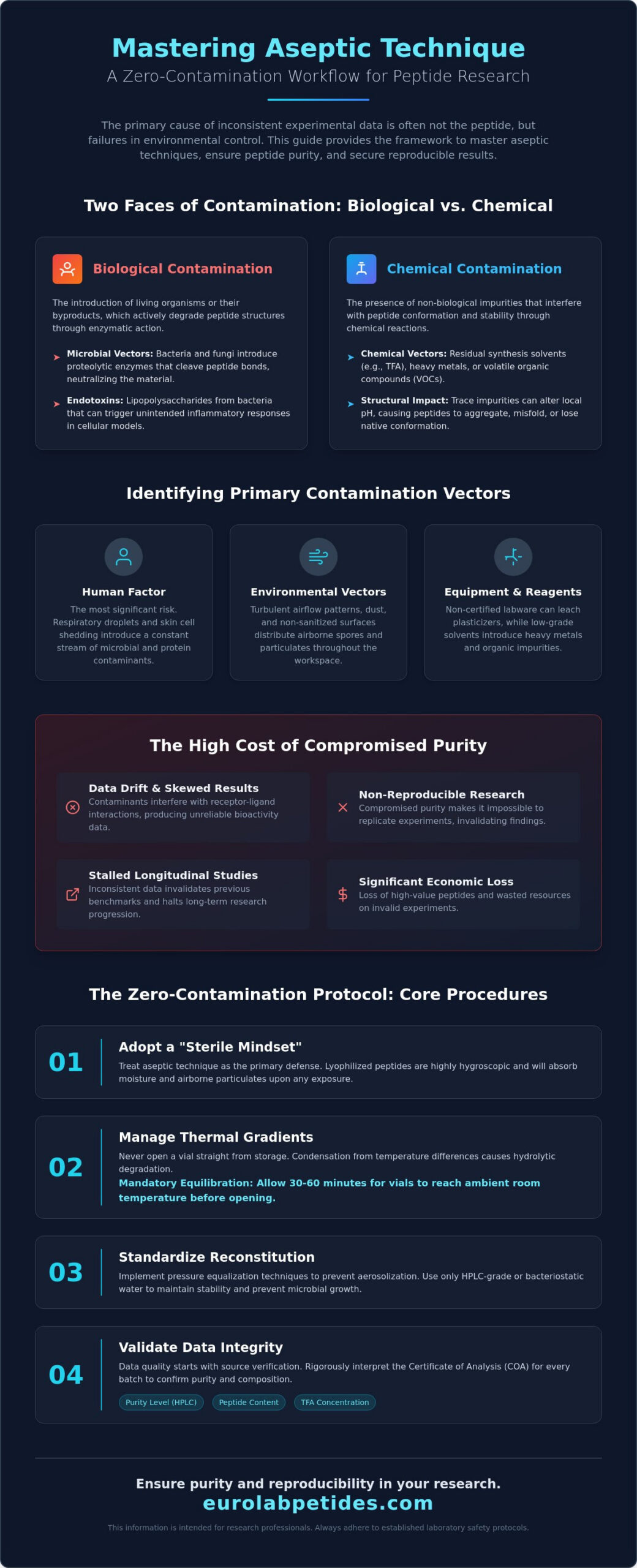
Maintaining the structural integrity of synthetic peptides requires a sophisticated understanding of environmental variables. Avoiding contamination in peptide experiments begins with the adoption of a rigorous aseptic technique, which serves as the primary defense against exogenous pollutants. This “sterile mindset” is essential because lyophilized research chemicals are highly hygroscopic. They readily absorb moisture and airborne particulates upon the slightest exposure to non-controlled atmospheres. Establishing this baseline of precision ensures that the chemical identity of the sample remains uncompromised from the moment the vial seal is breached.
The management of thermal gradients is a non-negotiable component of professional laboratory protocol. Thermodynamic stability is frequently compromised during the transition from cryogenic or sub-zero storage to ambient laboratory temperatures. If vials are opened before reaching thermal equilibrium, atmospheric moisture condenses on the cold powder. This condensation facilitates hydrolytic degradation and provides a medium for microbial proliferation. A mandatory equilibration period of at least 30 to 60 minutes is required to prevent these dew point transitions. Strict adherence to these environmental barriers is the foundation for avoiding contamination in peptide experiments.
Biological vs. Chemical Contamination
Biological contamination is characterized by the presence of bacteria, fungi, or metabolic byproducts such as endotoxins. These agents introduce proteolytic enzymes that cleave peptide bonds, effectively neutralizing the research material. Chemical contamination involves residual solvents from the synthesis process or cross-contamination from previous assays. Unlike small-molecule compounds, peptides possess complex folding patterns that are sensitive to local pH shifts. Even trace chemical impurities can cause a peptide to aggregate or lose its native conformation. This sensitivity necessitates more stringent handling standards than those applied in general organic chemistry. Primary vectors include:
- Microbial vectors: Airborne spores and surface-bound bacteria that compromise sterile environments.
- Chemical vectors: Residual trifluoroacetic acid (TFA), heavy metal catalysts, or volatile organic compounds (VOCs).
- Endotoxins: Lipopolysaccharides that can trigger unintended inflammatory responses in cellular models.
The Consequences of Compromised Purity
Contaminants interfere with receptor-ligand interactions in in-vitro models, leading to skewed bioactivity data and unreliable experimental outcomes. When purity is compromised, the resulting data drift renders research non-reproducible. This inconsistency stalls the progression of longitudinal studies and invalidates previous benchmarks. Such failures result in significant economic loss, particularly when utilizing specialized assets like a Recovery Research Stack or a Longevity Research Stack. Ensuring a zero-contamination environment is the only method to protect these high-value investments and maintain the absolute security of the research data.
Identifying and Mitigating Primary Contamination Vectors
Personnel represent the most significant risk factor in the laboratory environment. Human desquamation sheds thousands of skin cells per minute, while respiratory droplets introduce exogenous proteins and microbial flora into the workspace. These biological materials interfere with the analytical precision of high-sensitivity assays. Environmental vectors, such as turbulent airflow and dust accumulation on non-sanitized surfaces, further compromise the integrity of the research area. Avoiding contamination in peptide experiments requires a comprehensive audit of all physical inputs, including labware and reagents. Non-certified pipettes, vials, and stoppers often harbor plasticizers or mold-release agents that leach into the peptide solution, altering its chemical profile. Reagent quality is equally critical. Low-grade solvents introduce unpredictable variables, such as heavy metal traces or organic impurities, that can catalyze peptide degradation. Utilizing HPLC-grade reagents is a non-negotiable standard for maintaining the stability of a Longevity Research Stack.
Personnel Protocols and PPE
A standardized donning sequence is mandatory to minimize the introduction of particulates. Laboratory-grade PPE must be applied in a specific order: hair net, face mask, lab coat, and finally, sterile gloves. Double-gloving is implemented as a secondary barrier when handling sensitive sequences like BPC-157 to prevent any contact with skin oils or accidental vial breach. Hand hygiene standards must exceed basic washing. Surgical-grade antisepsis using povidone-iodine or chlorhexidine gluconate is required before donning gloves to ensure the suppression of resident skin flora. This protocol creates a redundant defense system that protects the peptide from the primary source of biological ingress.
Surface and Airflow Management
Surface decontamination is achieved through a dual-cycle sanitization process. 70% Isopropyl Alcohol (IPA) is utilized for routine disinfection, while specialized sporicidal agents are applied periodically to eliminate resistant fungal spores that IPA cannot neutralize. The physical workspace must be managed within a Laminar Flow Hood or Biosafety Cabinet. These units maintain a HEPA-filtered air stream that effectively isolates the “Zone of Sterility” from the ambient laboratory atmosphere. Detailed facility standards for these configurations are provided in the Biosafety in Microbiological and Biomedical Laboratories (BMBL). Adhering to these guidelines ensures that airflow patterns don’t carry contaminants into open vials. Avoiding contamination in peptide experiments relies on the continuous maintenance of this sterile field, where the path between the HEPA filter and the sample remains unobstructed by non-sanitized equipment.
Standard Operating Procedures for Reconstitution and Handling
Reconstitution represents the most vulnerable phase for chemical stability in the laboratory. Pressure equalization is a critical first step that researchers often overlook. Lyophilized vials are typically sealed under a vacuum; failing to equalize the internal pressure before introducing a solvent causes rapid aerosolization of the powder. This leads to inaccurate dosing and the potential cross-contamination of the sterile field. Researchers must introduce a volume of air equal to the intended solvent volume through the septum using a sterile syringe before liquid transfer. This methodical approach ensures a controlled environment within the vial, which is essential for maintaining the integrity of the sample.
The choice of reconstitution media depends on the intended timeline and the specific requirements of the assay. Sterile Water for Injection (SWFI) is suitable for immediate, single-use applications, whereas Bacteriostatic Water is preferred for multi-use vials. Bacteriostatic water contains 0.9% benzyl alcohol, which serves as a preservative by inhibiting microbial proliferation through the disruption of bacterial cell membrane integrity. While this additive extends the shelf life of the solution, its compatibility with the peptide’s specific amino acid sequence must be verified to ensure no unintended chemical interactions occur.
Mechanical stress must be minimized to preserve the peptide’s primary and secondary structures. Vigorous shaking induces mechanical shear, which can break fragile bonds or cause irreversible aggregation. Gentle inversion of the vial is the only validated method for achieving a homogeneous solution without compromising molecular integrity. Once reconstituted, aliquotting the solution into single-use volumes is a standard strategy for avoiding contamination in peptide experiments. This practice eliminates the need for repeated freeze-thaw cycles, which are known to cause cumulative degradation and proteolysis. By isolating specific volumes, the researcher protects the bulk material from repeated atmospheric exposure.
The Reconstitution Protocol
The protocol begins with the mandatory temperature equilibration discussed in previous sections. Vials must reach room temperature before the septum is breached to prevent internal condensation. After swabbing the septum with 70% IPA, the solvent is introduced slowly, allowing it to run down the interior wall of the vial rather than dropping directly onto the lyophilized cake. This prevents the formation of bubbles and reduces the risk of aerosolization. Maintaining a closed system during this process is fundamental to avoiding contamination in peptide experiments and ensuring the precision of the final concentration.
Storage and Stability Post-Reconstitution
Post-reconstitution stability is highly temperature-dependent and varies by sequence. Short-term storage is typically managed at 2°C to 8°C for periods not exceeding 24 to 48 hours. For long-term stability, aliquots should be stored at -20°C or -80°C in specialized laboratory freezers. Light sensitivity is a critical variable for many research chemicals; amber vials or opaque storage containers are required to prevent photodegradation. Comprehensive documentation must accompany every vial, including the batch number, reconstitution date, and verified purity levels. This metadata is essential for tracking batch-to-batch consistency and maintaining rigorous data integrity.
Environmental Control and Analytical Validation
Active environmental monitoring serves as the empirical validation of aseptic protocols. While previous sections detailed the physical barriers to ingress, regular assessment of the laboratory atmosphere is required to confirm their efficacy. Settling plates and surface swabs provide quantifiable data on microbial load, ensuring that the “Zone of Sterility” remains within acceptable parameters. Avoiding contamination in peptide experiments necessitates this data-driven approach, where visual confirmation is supplemented by microbiological assays. If settling plates show colony-forming units (CFUs) exceeding baseline thresholds, immediate recalibration of sanitation cycles is mandatory. This methodical oversight transforms cleaning from a routine task into a verifiable metric of laboratory safety.
Visual inspection provides the first line of detection for gross contamination. Identifying cloudiness, precipitation, or unexpected discoloration in a reconstituted solution suggests a failure in purity or a thermodynamic shift. However, visual clarity doesn’t guarantee molecular integrity. High-Performance Liquid Chromatography (HPLC) and Mass Spectrometry (MS) are the definitive tools for analytical verification. These methods confirm that the peptide’s primary sequence hasn’t undergone oxidation, deamidation, or truncation during handling. Professional researchers utilize these metrics to maintain the absolute data integrity of an Advanced Metabolic Stack. Rigorous waste management, including the immediate segregation of biohazardous materials, prevents cross-contamination between separate experimental workflows.
Routine Environmental Monitoring
A weekly sanitation schedule must be implemented for all high-touch laboratory equipment, including centrifuges, vortex mixers, and freezer handles. Automated dispensing systems and pipettes require monthly calibration to prevent volume inaccuracies that skew concentration calculations. Baseline purity expectations and sourcing standards are detailed in How to Buy Research Peptides, providing a benchmark for laboratory-wide quality control. Ensuring that the physical environment meets these rigorous standards is a prerequisite for avoiding contamination in peptide experiments. Every equipment calibration and sanitation event should be logged to provide a transparent audit trail for external validation.
Validation of Reagent Purity
Reconstitution media must undergo testing for pH consistency and the presence of particulate matter before use. Even certified solvents can exhibit batch-to-batch variability that affects peptide solubility. The use of 0.22-micron sterile filtration systems provides an additional layer of security by removing residual microbial contaminants from the solvent. For longitudinal stability studies, maintaining a “Control Sample” from each batch allows for the retrospective analysis of degradation patterns. This systematic validation is a non-negotiable requirement for securing reproducible results and protecting the longevity of your research assets. By verifying the purity of every reagent, you eliminate hidden variables that could otherwise compromise the entire experimental outcome.
Sourcing Purity: The Role of Third-Party Testing in Data Integrity
The efficacy of aseptic technique is ultimately limited by the baseline purity of the starting material. Contamination control isn’t a process that begins at the laboratory bench; it’s a metric established during chemical synthesis. Process-related impurities, such as deletion sequences, truncated peptides, or residual catalysts, represent a form of systemic contamination that no amount of sterile handling can mitigate. Avoiding contamination in peptide experiments therefore requires a “source-first” approach, where the chemical identity of the compound is verified before it enters the sterile field. EuroLab Peptides addresses this through a multi-level validation protocol, utilizing both internal analytical checks and independent third-party verification to ensure that every batch meets rigorous professional standards.
Interpreting a Certificate of Analysis (COA) requires a technical understanding of analytical benchmarks. A professional COA provides empirical data from High-Performance Liquid Chromatography (HPLC) and Mass Spectrometry (MS). The HPLC chromatogram confirms the purity level by measuring the area under the primary peak relative to secondary peaks, while MS verifies the molecular weight against the theoretical mass. Researchers must distinguish between “purity” and “peptide content.” While purity refers to the percentage of the target sequence relative to other peptidic impurities, peptide content indicates the actual weight of the peptide in the lyophilized cake, with the remainder usually consisting of water and counter-ions like acetate or trifluoroacetic acid (TFA).
Analytical Benchmarks for Research Peptides
In-vitro research generally requires a minimum purity standard of >98%. Lower purity levels introduce uncharacterized variables that can interfere with cellular signaling or ligand-receptor binding assays. Residual TFA levels are particularly critical; as a strong acid used in the cleavage process, excess TFA can alter the pH of the reconstitution media and induce cytotoxicity in sensitive models. EuroLab Peptides ensures consistent molecular integrity in sequences such as Ipamorelin by implementing stringent de-salting procedures and verifying the final product through external validation. This level of scrutiny is an integral component of avoiding contamination in peptide experiments at the molecular level.
Securing the Supply Chain
Supply chain integrity is the final barrier to data reliability. Grey market peptides often lack temperature-controlled logistics, leading to pre-delivery degradation that the researcher cannot detect without immediate analytical testing. Professional-grade sourcing utilizes localized logistics and temperature-monitored shipping to prevent the thermal fluctuations that invite moisture ingress or bond cleavage. Third-party testing remains a non-negotiable standard, serving as the objective proof of quality that protects a researcher’s time and resources. By integrating sourcing excellence with the meticulous laboratory protocols detailed in this guide, you establish a robust framework for achieving optimal research outcomes and maintaining the absolute security of your experimental data.
Securing Experimental Integrity Through Standardized Protocols
Achieving reproducible results requires a synthesis of rigorous environmental control and analytical verification. The implementation of a multi-layered defense system, ranging from surgical-grade antisepsis to precise pressure equalization during reconstitution, is non-negotiable for professional research. These protocols ensure that the chemical identity of the research material remains uncompromised by microbial or chemical vectors throughout the experimental lifecycle. Maintaining these standards is the only verifiable method for avoiding contamination in peptide experiments and securing the long-term stability of high-value research assets.
To support these rigorous laboratory standards, researchers must prioritize the acquisition of verified materials that meet high-stakes precision requirements. Explore our third-party tested research peptides for guaranteed purity and consistency. Every batch undergoes independent 3rd-party lab validation and a multi-level quality control protocol to ensure all technical specifications are met. Specialized European shipping is utilized to maintain molecular stability from the point of synthesis to the laboratory bench. Adherence to these professional protocols establishes a reliable foundation for precise and serious scientific inquiry.
Frequently Asked Questions
What is the most common cause of contamination in peptide experiments?
Personnel represent the primary source of biological ingress in the laboratory environment. Human desquamation sheds thousands of skin cells per minute, while respiratory droplets introduce exogenous proteins and microbial flora into the workspace. These biological materials interfere with the analytical precision of high-sensitivity assays. Establishing a redundant defense system through surgical-grade antisepsis and rigorous PPE protocols is the most effective method for mitigating this risk.
Can I reuse syringes or needles if I am working with the same peptide batch?
Reusing syringes or needles is strictly prohibited in professional laboratory protocols. Even within the same batch, the initial draw exposes the needle to the ambient atmosphere, compromising its sterility. Re-entry into a vial with a used needle introduces environmental particulates and microbial contaminants into the bulk material. Single-use, medical-grade consumables are required to maintain the absolute security of the research sample.
How do I know if my reconstituted peptide has been contaminated?
Visual indicators such as turbidity, precipitation, or unexpected discoloration serve as early warning signs of microbial proliferation or molecular aggregation. However, sub-visible chemical contamination or minor degradation cannot be detected by the naked eye. Analytical verification through High-Performance Liquid Chromatography (HPLC) or Mass Spectrometry is the only definitive method to confirm that the peptide’s primary sequence remains uncompromised after handling.
Is it necessary to use a laminar flow hood for all peptide handling?
A laminar flow hood or biosafety cabinet is mandatory for all open-vial manipulations. These units provide a HEPA-filtered air stream that isolates the sterile field from turbulent laboratory airflow and airborne particulates. Utilizing these controlled environments is a non-negotiable standard for avoiding contamination in peptide experiments. Failure to maintain this “Zone of Sterility” during reconstitution leads to inaccurate data and material loss.
What is the difference between sterile water and bacteriostatic water for research?
Sterile Water for Injection (SWFI) is a single-use solvent that contains no antimicrobial agents, making it suitable for immediate applications where additives might interfere with the assay. Bacteriostatic water contains 0.9% benzyl alcohol, which serves as a preservative by inhibiting bacterial proliferation through the disruption of cell membrane integrity. The choice depends on the intended timeline and the specific sensitivity of the research model.
How should I clean a spill involving research peptides to avoid cross-contamination?
Spills must be managed using a dual-cycle decontamination process to prevent cross-contamination between different experimental workflows. The area is first treated with 70% Isopropyl Alcohol (IPA) to neutralize vegetative bacteria and surface oils. This is followed by the application of a specialized sporicidal agent to eliminate resistant fungal spores. All cleaning materials must be disposed of as biohazardous waste to maintain laboratory-wide safety standards.
What temperature is best for storing lyophilised vs. reconstituted peptides?
Lyophilized powders reach maximum stability when stored at -20°C or -80°C in a specialized laboratory freezer. Reconstituted peptides are significantly more fragile and should be maintained at 2°C to 8°C for short-term use not exceeding 48 hours. For longer durations, the solution must be aliquotted into single-use volumes and frozen at -20°C to prevent the cumulative molecular damage caused by repeated freeze-thaw cycles.
Does the presence of benzyl alcohol in bacteriostatic water affect in-vitro results?
Benzyl alcohol can act as a chemical variable by altering the pH of the reconstitution media or inducing cytotoxicity in sensitive cellular models. Researchers must conduct a baseline compatibility check when avoiding contamination in peptide experiments to ensure the preservative doesn’t skew bioactivity data. If the assay is highly sensitive to organic solvents, SWFI is the preferred medium to ensure the purity of the ligand-receptor interaction.
