

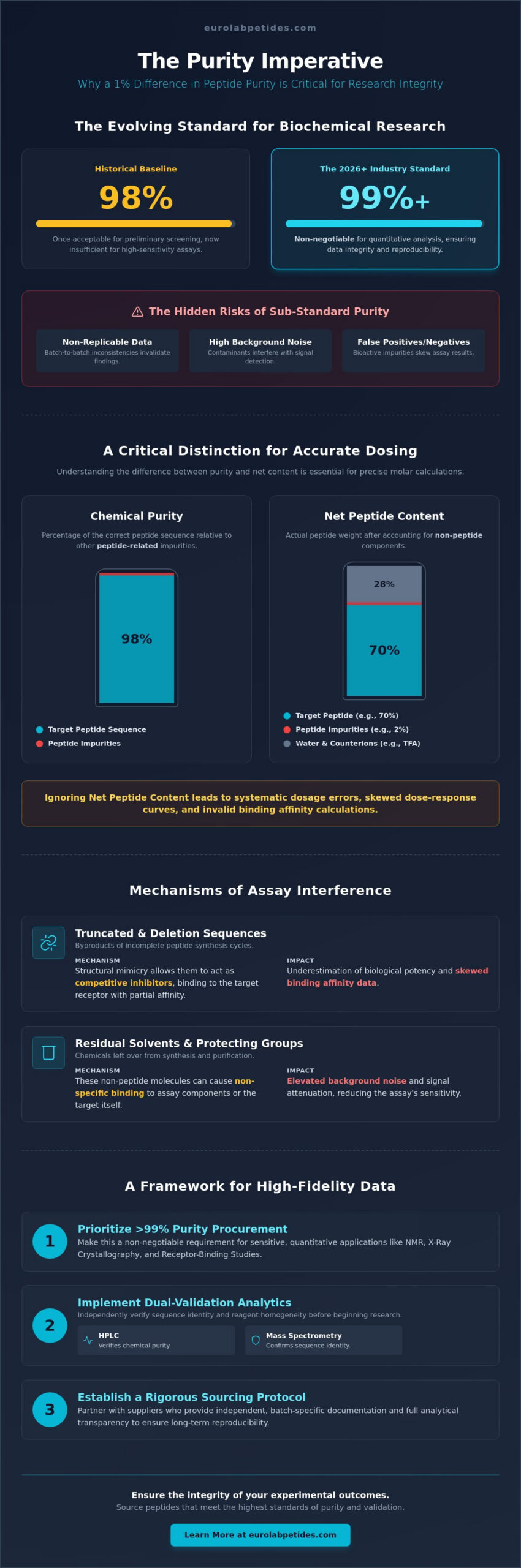
Could a single percentage point of chemical variance be the primary driver behind high background noise and non-replicable experimental data? While 98% purity was once the baseline for biochemical research, the 2026 industry standard has shifted to a 99% minimum to mitigate the systematic impact of peptide purity on assay results. You’ve likely encountered the frustration of batch-to-batch inconsistency that complicates the validation of findings for peer-reviewed publication. These deviations aren’t just statistical noise. They represent bioactive contaminants that actively interfere with ligand-binding assays and cellular signaling pathways, leading to false positives or signal attenuation.
This technical examination explores how specific impurities, such as truncated sequences or residual solvents, compromise signal specificity and the validity of in-vitro biochemical data. We’ll move beyond surface-level metrics to analyze the biochemical risks inherent in sub-standard synthesis. This article provides a framework for establishing a reliable procurement protocol that utilizes advanced analytical techniques like UHPLC and HRAM MS. By prioritizing rigorous external validation, researchers can achieve the high-fidelity data necessary for serious professional inquiry and ensure the long-term integrity of their experimental outcomes.
Key Takeaways
- Distinguish between chemical purity and net peptide content to ensure precise molar calculations and avoid dosage inaccuracies in biochemical assays.
- Understand how structural analogs and deletion sequences function as competitive inhibitors, demonstrating the significant impact of peptide purity on assay results and signal specificity.
- Identify the specific risks of truncated sequences and residual protecting groups that contribute to non-specific binding and elevated background noise.
- Implement a dual-validation analytical framework using HPLC and Mass Spectrometry to verify sequence identity and reagent homogeneity before commencing high-sensitivity research.
- Establish a rigorous procurement protocol that prioritizes independent laboratory verification and batch-specific documentation to maintain long-term experimental reproducibility.
Defining Peptide Purity: Beyond the 95% Benchmark
Peptide purity is defined as the percentage of the target sequence relative to the total amount of peptide-related impurities. These impurities typically consist of truncated sequences, deletion products, and diastereomers generated during the manufacturing process. In the context of analytical chemistry, the impact of peptide purity on assay results is often the difference between a successful validation and a failed experiment. While a 95% purity level was historically accepted for preliminary screening, it’s increasingly insufficient for modern high-sensitivity fluorescence or radioactive assays where minor contaminants can interfere with signal detection.
The process of Peptide synthesis involves complex coupling cycles that are never 100% efficient. Consequently, even a high-grade product contains trace amounts of modified sequences. Lyophilization is employed post-synthesis to remove volatile solvents and stabilize the peptide; however, this process doesn’t eliminate non-volatile peptide impurities. For researchers conducting quantitative analysis, relying on a generic 95% benchmark introduces unacceptable variables into the experimental model. Precision requires a shift toward 98% or 99% purity to ensure that observed biological effects are attributable solely to the target sequence.
Peptide Purity vs. Net Peptide Content
A frequent point of confusion in laboratory settings is the distinction between chemical purity and net peptide content. Chemical purity refers only to the percentage of the correct peptide sequence relative to other peptides. It does not account for non-peptide components like residual water or counterions such as trifluoroacetate (TFA) or acetate. These salts are necessary for peptide stability and solubility, but they contribute significantly to the total mass of the lyophilized powder.
If a researcher assumes that 100% of the vial weight is active peptide, the resulting molarity during reconstitution will be fundamentally incorrect. For example, a vial with 98% purity might only have a net peptide content of 70% to 80% due to the presence of counterions. Ignoring this distinction leads to systematic errors in stoichiometry, which negatively influences the impact of peptide purity on assay results by skewing dose-response curves and binding affinity calculations.
The 99% Threshold for Quantitative Analysis
For applications such as NMR spectroscopy, X-ray crystallography, or receptor-binding studies, the 99% purity threshold is a non-negotiable requirement. These sensitive methodologies are highly susceptible to the presence of structural analogs that may bind to the target receptor with varying degrees of affinity. While lower purity levels might suffice for early-stage qualitative screening, quantitative research demands the removal of nearly all synthesis byproducts to ensure data integrity. Peptide content is defined as the actual weight of the peptide minus counterions and residual moisture. Adhering to this rigorous definition allows for the high-stakes precision required in advanced biochemical research.
Mechanistic Interference: How Impurities Skew Assay Signals
The presence of contaminants in a peptide batch is rarely a benign occurrence. These impurities often function as bioactive agents that systematically degrade the signal-to-noise (S/N) ratio in luminescence and fluorescence-based assays. When synthesis byproducts exhibit structural similarity to the target sequence, they can alter the physicochemical properties of the stock solution, including its solubility and isoelectric point (pI). Such deviations directly influence the impact of peptide purity on assay results, as poorly soluble contaminants may precipitate or sequester the active peptide, leading to an underestimation of biological potency. This chemical heterogeneity introduces unpredictable variables that compromise the reproducibility of in-vitro biochemical data.
Competitive Binding and Structural Mimicry
Truncated sequences and deletion products represent a significant risk factor in receptor-binding studies. Because these byproducts often retain a portion of the original amino acid sequence, they may possess partial affinity for the target receptor. This structural mimicry allows them to act as competitive inhibitors, effectively blocking the binding sites intended for the target peptide. The result is a quantifiable shift in pharmacological profiling, specifically in the calculation of IC50 and EC50 values. A 5% impurity level consisting of a high-affinity analog can skew binding data significantly, leading to the misidentification of a lead compound’s potency. Research published in the American Society for Microbiology Journals regarding Peptide Impurities…and Their Implications highlights how even a 1% impurity can trigger false-positive signals in high-stakes clinical assessments, emphasizing that purity is a non-negotiable metric for research integrity.
Non-Specific Interaction in Immunoassays
In immunoassays like ELISA or Western Blot, the specificity of the primary antibody is paramount. However, polyclonal antibodies frequently exhibit cross-reactivity with synthesis byproducts that share epitopes with the target molecule. This interaction elevates background noise and increases the risk of false positives, particularly in immunohistochemistry (IHC) where spatial resolution is critical. Ensuring the absolute specificity of peptides within complex biological matrices requires a purity level that eliminates these interfering species. Researchers aiming for high-fidelity data should prioritize reagents that undergo rigorous multi-step purification. For those conducting tissue repair and recovery research, utilizing verified high-purity sequences is the only way to ensure that observed signal intensity reflects actual biological activity rather than technical artifact. High-stakes precision in these assays is only achievable when the chemical identity of the reagent is verified through objective analytical data.
Common Synthesis Byproducts and Their Biochemical Risks
Synthesis byproducts are the direct result of sub-optimal reaction conditions during Solid-Phase Peptide Synthesis (SPPS). Truncated sequences and deletion products occur when coupling cycles fail to reach completion, leaving behind shorter fragments that often co-elute with the target peptide during purification. Incomplete deprotection remains another significant concern, where residual side-chain protecting groups such as Pbf (pentamethylbenzofuran-5-sulfonyl) or tBu (tert-butyl) remain covalently attached to the sequence. These hydrophobic moieties fundamentally alter the peptide’s chemical profile and binding affinity. The impact of peptide purity on assay results is most evident when these structural variants interfere with molecular recognition, leading to non-specific signaling or reduced biological activity.
Racemization presents a more subtle but equally disruptive risk to experimental accuracy. This process involves the conversion of L-amino acids into D-enantiomers during the activation or coupling stages of synthesis. Because D-amino acid variants are diastereomers rather than different chemical formulas, they are exceptionally difficult to detect without specialized chiral analysis. These enantiomers often exhibit increased resistance to proteolysis and altered spatial configurations. Such deviations can lead to unpredictable results in receptor-binding assays, where the stereochemistry of the ligand is critical for proper docking and activation.
The Toxicity of Residual Trifluoroacetic Acid (TFA)
Trifluoroacetic acid is a standard counterion used during HPLC purification to improve peak resolution and peptide solubility. However, its persistence in the final lyophilized product poses a direct threat to cellular health. TFA is cytotoxic. It can significantly lower the pH of culture media, which disrupts pH-sensitive in-vitro assays and compromises cell viability. For researchers working with primary cells or sensitive biological models, a TFA-to-Acetate exchange is a necessary step to ensure that experimental observations reflect the peptide’s activity rather than solvent toxicity. This exchange process replaces the harsh TFA ions with more biocompatible acetate ions, preserving the integrity of the cellular environment.
Oxidation and Deamidation Post-Synthesis
Even after successful synthesis and purification, chemical aging can compromise the reagent’s purity. Cysteine and Methionine residues are particularly vulnerable to oxidative degradation, forming disulfides or sulfoxides that negate the peptide’s intended function. Similarly, Asparagine and Glutamine are prone to deamidation, a process that converts these residues into Aspartic or Glutamic acid. This modification changes the net charge of the molecule, further complicating the impact of peptide purity on assay results by altering solubility and binding kinetics. Implementing rigorous protocols for storing lyophilized peptides is critical for maintaining long-term stability and preventing these post-synthesis modifications from degrading research integrity.
Analytical Frameworks for Validating Research Reagents
Objective validation of reagent quality is the only method to ensure experimental reproducibility. The impact of peptide purity on assay results is often determined by the precision of the analytical techniques used during quality assurance. High-Performance Liquid Chromatography (HPLC) remains the gold standard for determining chemical purity, while Mass Spectrometry (MS) provides the necessary confirmation of molecular weight and sequence identity. A rigorous Certificate of Analysis (COA) must include both metrics to provide a complete profile of the material. Relying on vendor-provided data without independent third-party validation introduces a significant risk of bias, particularly in a market where 99% purity has become the expected baseline for high-stakes research.
Reading the HPLC Chromatogram
Interpreting an HPLC chromatogram requires more than a cursory glance at the reported purity percentage. One must scrutinize the baseline for instability and the presence of ‘shoulder peaks’ that suggest the co-elution of closely related impurities. Purity is typically calculated using the Area-under-the-curve (AUC) method, where the integration of the main peak is compared to the total area of all detected peaks. It’s a common misconception that a single, sharp peak guarantees 100% purity. Resolution limits of the column or the specific mobile phase used can sometimes mask contaminants that have similar retention times. Professional researchers should verify that the HPLC method used is appropriate for the specific peptide’s hydrophobicity and charge.
Mass Spectrometry: Confirming Identity
While HPLC measures homogeneity, Mass Spectrometry confirms that the synthesized molecule is indeed the target sequence. Analysis of the mass-to-charge (m/z) ratio allows for the differentiation between the target mass and common adducts, such as sodium (Na+) or potassium (K+), which can shift the observed peaks. MS is also critical for detecting synthesis errors like double-coupling or incomplete deprotection, which manifest as specific mass shifts corresponding to the weight of the extra amino acid or protecting group. LC-MS provides the most robust verification by combining physical separation with mass-to-charge identity. For those establishing a cognitive research stack, ensuring that every component meets these analytical benchmarks is essential for data validity.
Red flags in a COA often include inconsistent integration parameters or missing mass spectra. If the COA doesn’t provide the raw HPLC data and the corresponding MS result for the specific batch being used, the integrity of the reagent cannot be verified. Radical honesty in reporting these metrics is the hallmark of a reliable partner. Third-party validation serves as a non-negotiable standard, providing an objective layer of security that protects the researcher’s time and resources from the systematic errors caused by chemical impurities.
Sourcing High-Purity Peptides for Rigorous Laboratory Standards
The final stage of experimental design involves the selection of a reagent supplier capable of meeting the rigorous demands of the specialized scientific community. Selecting a research-grade peptide supplier in the European market requires a focus on verifiable metrics rather than anecdotal claims. Because the impact of peptide purity on assay results is a primary determinant of research integrity, procurement protocols must prioritize transparency and objective data. Transitioning from preliminary screening to advanced metabolic or longevity research necessitates reagents that are free from the biochemical risks associated with synthesis byproducts and residual solvents.
This rigorous approach to quality control is mirrored in other sectors; for instance, My Whey provides lab-tested wellness supplements that meet similar demands for purity and batch consistency.
The EuroLab Peptides Multi-Level Quality Protocol
Radical honesty in manufacturing is achieved through a multi-step validation process. This protocol utilizes both in-house HPLC/MS analysis and independent third-party laboratory audits to eliminate vendor bias. Such a dual-verification system ensures absolute security for the professional user, particularly when conducting long-term longitudinal studies that require high consistency across batches. Every order from EuroLab Peptides is accompanied by comprehensive analytical documentation, which includes raw chromatograms and mass spectra. This commitment to data transparency allows researchers to account for the impact of peptide purity on assay results before any experimental work begins. Regional manufacturing standards are strictly observed, reflecting a sophisticated craftsmanship in the chemical synthesis space.
Procurement Checklist for Researchers
Establishing a reliable procurement protocol is essential for maintaining laboratory standards. A methodical approach to sourcing involves a sequence of validations before any commitment is made. Researchers should utilize the following checklist when evaluating potential reagents:
- Verify HPLC Purity: A minimum purity of >98% is recommended for most assays, with 99% required for high-sensitivity quantitative analysis.
- Confirm Sequence Identity: Mass Spectrometry data must be batch-specific to confirm the molecular weight and sequence accuracy.
- Request Net Peptide Content: Ensure the Certificate of Analysis distinguishes between chemical purity and the actual peptide mass to avoid molarity errors.
- Demand External Validation: Independent lab results serve as a non-negotiable standard for verifying manufacturer claims and ensuring regional regulatory compliance.
For a detailed examination of sourcing standards and localized logistics, refer to the guide on how to buy research peptides. By adhering to these rigorous criteria, professional users can ensure their reagents function as elite tools for serious inquiry, protecting the validity of their biochemical data and the integrity of their published findings.
Advancing Research Reliability through Analytical Rigor
The integrity of biochemical data depends on the precision of the reagents utilized. Research demonstrates that the impact of peptide purity on assay results is not merely a statistical concern but a fundamental determinant of signal fidelity and receptor specificity. Investigators effectively mitigate risks like structural mimicry and competitive inhibition by shifting to a 99% purity standard. This transition requires a methodical approach to analytical documentation. HPLC chromatograms and Mass Spectrometry data provide the objective evidence of chemical identity required for peer-reviewed validation.
Establishing a reliable procurement protocol ensures that every batch maintains the consistency required for longitudinal studies. We specialize in high-purity synthesis for European research institutions, where external validation is a non-negotiable standard. To secure the validity of your experimental findings, explore our range of third-party tested research peptides for your next assay. Every batch is accompanied by comprehensive HPLC and MS data, providing the radical transparency necessary for serious professional inquiry. High-fidelity data is within reach when reagents are verified by independent laboratory audits.
Frequently Asked Questions
What is the difference between 95% and 98% peptide purity in actual research?
The primary difference lies in the concentration of bioactive contaminants like truncated sequences or deletion products. A 95% purity level allows for 5% sequence-related impurities, which is often sufficient for qualitative screening but introduces variables that compromise high-sensitivity quantitative research. At 98%, the impact of peptide purity on assay results is significantly reduced, ensuring that observed biological effects are attributable to the target sequence rather than synthesis byproducts.
Can I use a 95% pure peptide for cell culture studies?
Utilizing 95% pure peptides in cell culture is generally discouraged for sensitive applications. Synthesis byproducts and residual solvents in lower-purity batches can exert cytotoxic effects or trigger non-specific cellular signaling pathways, leading to false positives. For primary cell lines or longevity research, a minimum purity of 98% is recommended to ensure that cellular responses are not skewed by chemical contaminants or residual manufacturing reagents.
How does residual TFA affect my in-vitro assay results?
Residual Trifluoroacetic acid (TFA) functions as a cytotoxic agent that can fundamentally alter the pH of in-vitro assay environments. This acidity disrupts pH-sensitive biochemical reactions and compromises cell viability, potentially leading to signal attenuation. To mitigate this risk, researchers should consider TFA-to-Acetate exchange for assays involving live cells or sensitive protein-protein interaction studies where ion concentration is a critical variable influencing molecular stability.
Why does my peptide batch show different results than the previous one?
Inconsistent results between batches are typically caused by variations in the impurity profile, such as the presence of different truncated sequences or varying levels of residual counterions. Even if the reported purity percentage is identical, the specific chemical identity of the 2% or 5% impurity can differ significantly. This underscores the necessity of reviewing batch-specific HPLC and MS data to ensure long-term experimental reproducibility and data integrity.
Is peptide content the same as peptide purity?
Peptide content and peptide purity are distinct analytical metrics. Purity refers to the percentage of the target sequence relative to other peptide-related impurities. In contrast, peptide content measures the actual weight of the peptide in the vial after accounting for non-peptide components like water and counterions. Correct molar calculations require both values to prevent systematic errors in dose-response modeling and ensure the impact of peptide purity on assay results is properly managed.
How often should I re-verify the purity of stored peptides?
Stored peptides should be re-verified every 6 to 12 months, particularly if they contain oxidation-prone residues like Cysteine or Methionine. Even when stored at -20°C or -80°C in lyophilized form, chemical aging through deamidation or oxidation can occur. The accumulation of degradation products over time can shift assay signals, necessitating periodic HPLC analysis to confirm reagent integrity before commencing new experimental phases.
What are the signs of peptide degradation on an HPLC report?
Typical indicators of degradation on an HPLC report include the emergence of shoulder peaks, baseline instability, or significant peak broadening. These features suggest the presence of closely related chemical species, such as oxidized variants or deamidated sequences, that co-elute with the target peptide. If the main peak area decreases relative to previous reports, it’s an objective signal that the reagent’s homogeneity has been compromised by post-synthesis modifications.
Does high purity guarantee that the peptide is bioactive?
High chemical purity confirms sequence accuracy but does not inherently guarantee biological activity. Bioactivity depends on the correct spatial configuration of the molecule and its ability to interact with the target receptor under specific assay conditions. While purity ensures that the observed effect isn’t caused by contaminants, researchers must still conduct functional assays to verify that the peptide exhibits the expected pharmacological profile in their specific biological model.
