

The June 2026 enforcement of the EMA/CHMP/CVMP/QWP/367182/2025 guideline has established a new baseline for the manufacturing and analytical control of synthetic compounds. When validating a new peptide supplier for your lab, the presence of a “Research Use Only” disclaimer no longer serves as a viable shield against regulatory scrutiny or technical failure. You’re operating in an environment where quality is a verifiable metric rather than a marketing claim. Reliance on legacy vendors without updated, interoperable tracing and package-level electronic data risks both the integrity of your research and your institutional standing.
It’s understood that reagent impurities are the primary drivers of data variance, often rendering complex studies irreproducible. This technical framework outlines a repeatable protocol for securing 99%+ purity through rigorous analytical verification and logistical transparency. We’ll detail the requirements for batch-specific HPLC and mass spectrometry data, the impact of the Drug Supply Chain Security Act on traceability, and the specialized protocols required for temperature-sensitive European logistics. This guide ensures your procurement process meets the high-stakes precision required for modern biochemical inquiry.
Key Takeaways
- Establish the 99% purity benchmark through high-performance liquid chromatography (HPLC) and mass spectrometry (MS) as the non-negotiable standard for sequence identity.
- Implement a repeatable framework for validating a new peptide supplier for your lab that prioritizes batch-specific analytical data over static certificates of analysis.
- Navigate the 2026 European regulatory landscape by distinguishing between ethical “Research Use Only” mandates and high-risk lifestyle marketing.
- Mitigate the risk of data variance by executing a multi-level verification protocol involving both in-house pilot testing and independent third-party validation.
- Secure research continuity by assessing supplier logistical integrity, specifically focusing on transit-time impacts on the stability of lyophilized compounds within Europe.
The Criticality of Vendor Validation in Laboratory Research
Vendor validation is defined as a multi-layered audit encompassing analytical verification, operational standards, and rigorous regulatory compliance. It’s the process of ensuring that a supplier’s output matches the technical requirements of the research protocol. When validating a new peptide supplier for your lab, the objective is to eliminate the variables introduced by reagent impurities. These impurities aren’t merely inert fillers; they’re often chemically active byproducts that can compromise the validity of an entire study. A comprehensive validation protocol includes:
- Analytical verification through HPLC and Mass Spectrometry to confirm 99%+ purity benchmarks.
- Operational audits of synthesis facilities to ensure batch-to-batch consistency.
- Compliance checks against the 2026 EMA guidelines and DSCSA regulatory frameworks.
Institutional risk is also at stake. Ethics committees and grant-funding bodies increasingly require documented proof of material provenance. Failure to provide package-level electronic tracing, as mandated by the Drug Supply Chain Security Act (DSCSA), can result in the loss of funding or the rejection of research for publication. Establishing a rigorous vetting process is no longer optional; it’s a fundamental requirement for modern scientific inquiry, and specialized sources like 157Peptides provide the high-purity compounds necessary to meet these standards.
The Reproducibility Crisis and Reagent Integrity
The reproducibility crisis in preclinical and in-vitro studies is frequently traced back to reagent integrity. Sub-standard peptides can lead to false-positive or false-negative metabolic data, particularly when impurities interfere with signal transduction pathways. During the process of chemical peptide synthesis, various byproducts like truncated sequences or incompletely deprotected molecules can be generated. These contaminants confound biological assay results by competing for binding sites or inducing toxicological responses. Research integrity in 2026 is defined as the verifiable assurance that sourced chemical reagents are free from uncharacterized contaminants that could skew empirical outcomes.
Cost-Benefit Analysis of Quality vs. Price
A narrow focus on the initial purchase price often ignores the hidden economic burden of unverified materials. Calculating the true cost of a failed 30-day study reveals that the price premium for high-purity, certified peptides is negligible compared to the loss of labor, facility resources, and experimental time. Validating a new peptide supplier for your lab involves looking beyond the invoice to assess long-term value. Batch-to-batch consistency is mandatory for longitudinal research programs where even minor variance can mask the physiological effects being studied. Localized European sourcing provides a strategic advantage by reducing transit times. This is critical for maintaining the stability of temperature-sensitive lyophilized compounds, as extended exposure to fluctuating temperatures during international customs delays can lead to peptide degradation before the material even reaches the bench.
Analytical Verification: Deconstructing the Certificate of Analysis (CoA)
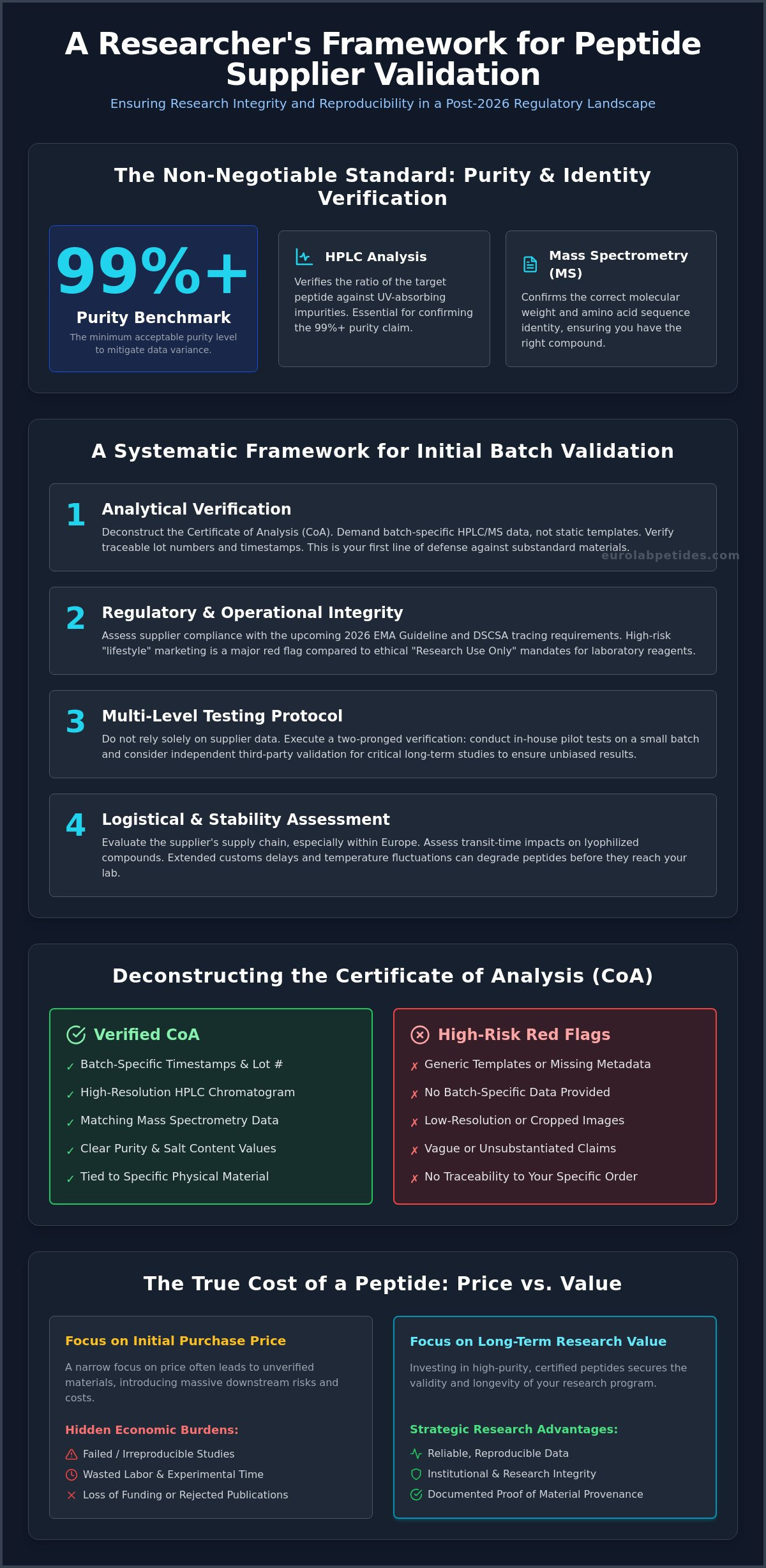
The Certificate of Analysis (CoA) is the foundational document in the process of validating a new peptide supplier for your lab. It shouldn’t be accepted as a static guarantee of quality. Instead, it must be treated as a raw data set requiring rigorous internal audit. Legitimate documentation is characterized by batch-specific timestamps, traceable lot numbers, and high-resolution chromatograms. Generic templates or missing metadata are immediate indicators of operational failure. Following a formal protocol for purchasing and supplier evaluation ensures that analytical reports are tied to the specific physical material received. HPLC purity measures the ratio of the target peptide to other UV-absorbing impurities, whereas salt content represents the non-peptide mass that must be accounted for when calculating exact stoichiometric dosages.
HPLC and Mass Spectrometry Standards
High-Performance Liquid Chromatography (HPLC) is employed to verify the 99% purity benchmark. The chromatogram must be inspected for any secondary peaks that indicate truncated sequences or synthesis byproducts. A clear baseline and minimal noise floor are essential for confirming the absence of uncharacterized contaminants. Mass Spectrometry (MS) is then utilized to confirm the exact molecular weight and sequence identity. The primary ‘M+H’ peak in the MS report should correspond precisely to the theoretical mass of the peptide sequence. Verification must be performed by independent third-party laboratories to eliminate any conflict of interest inherent in self-reported data.
Purity vs. Net Peptide Content
A critical distinction must be made between ‘Purity’ and ‘Net Peptide Content.’ While HPLC confirms the purity of the peptide fraction, it doesn’t account for non-peptide components such as counter-ions and residual moisture. Peptides are typically synthesized as salts, often containing Trifluoroacetic acid (TFA) or Acetate. A sample with 99% HPLC purity may only contain 70% to 80% actual peptide by weight. This stoichiometric variance significantly impacts molar concentration calculations in-vitro. Failure to adjust for net peptide content results in inaccurate dosing, which directly compromises the reproducibility of metabolic data. Labs must ensure that the supplier provides the specific counter-ion profile and moisture analysis for each batch.
Establishing a baseline for analytical excellence when validating a new peptide supplier for your lab begins with sourcing from vendors who provide fully transparent chromatographic data for every research batch.
Operational Integrity and European Regulatory Context
Operational integrity in 2026 requires a strict adherence to the “Research Use Only” (RUO) mandate. When validating a new peptide supplier for your lab, the distinction between ethical scientific marketing and lifestyle branding is critical. Vendors that employ consumer-style hyperbole or target non-professional audiences create significant institutional risk. This risk extends to the potential for non-compliance with regional regulatory bodies that monitor the distribution of unapproved substances. A professional supplier provides technical support capabilities capable of addressing complex biochemical inquiries rather than relying on anecdotal testimonials. Marketing that mirrors pharmaceutical or lifestyle products is an immediate red flag indicating a lack of professional rigor.
Transparency in synthesis origin is a non-negotiable metric of reliability. Suppliers must disclose the geographical location of their manufacturing facilities and the specific laboratories used for analytical testing. This transparency is necessary to ensure that the material is produced under standardized conditions that prevent cross-contamination. In a market where global supply chains are increasingly fragmented, knowing the exact provenance of a compound allows for better risk assessment regarding potential impurities or synthesis variations.
RUO Compliance and Marketing Ethics
Ethical marketing within the biochemical sector prioritizes empirical data and technical specifications. Vendors that maintain institutional compliance avoid lifestyle descriptors that could imply human consumption. Instead, they focus on the physicochemical properties of the compound and its validated applications in in-vitro or preclinical models. Evaluating a vendor’s technical support involves assessing their ability to provide detailed methodology for reconstitution, buffer compatibility, and stability profiles. This level of support is essential for labs conducting high-stakes research where reagent behavior must be predictable.
Logistical Precision in the European Market
Logistical integrity is as critical as analytical purity. In the European market, transit times must be minimized to preserve the structural integrity of lyophilized peptides. While lyophilization provides a degree of thermal stability, extended exposure to ambient temperatures can initiate degradation. Standardized storage protocols require -20°C for short-term use and -80°C for long-term preservation to ensure maximum stability. Cold-chain verification is necessary for specific temperature-sensitive compounds that cannot remain stable at room temperature for any duration.
Securing material through a reliable regional supply chain is essential for maintaining experimental timelines. Researchers looking to buy research peptides Europe should prioritize suppliers that utilize localized logistics to bypass the customs delays associated with international shipping. These delays often compromise the cold chain, leading to unquantified degradation. By validating a new peptide supplier for your lab based on their logistical precision, you ensure that the chemical identity of the reagent remains intact from the point of synthesis to the laboratory bench.
A Systematic Framework for Initial Batch Validation
Adopting a structured onboarding protocol is the only method to mitigate the risks associated with validating a new peptide supplier for your lab. This framework moves beyond the passive acceptance of vendor claims toward an active verification model. A formal vendor qualification file should be established for every new source to document each stage of the audit process. This file serves as a non-negotiable component of laboratory Quality Assurance (QA) and is essential for maintaining institutional compliance and research reproducibility.
- Step 1: Pre-Purchase Data Audit. Request batch-specific analytical data, including raw HPLC and MS chromatograms, before finalizing procurement. Static or outdated reports are insufficient for 2026 standards.
- Step 2: In-House Pilot Verification. Conduct independent testing on a small initial sample for crucial pilot studies. This step confirms that the material behaves as expected within your specific assay environment.
- Step 3: Physical Integrity Assessment. Evaluate the lyophilized cake. A solid, uniform structure indicates successful sublimation and proper vacuum sealing, while a collapsed or shrunken cake may suggest moisture ingress or thermal stress during transit.
- Step 4: Longitudinal Variance Monitoring. Track batch-to-batch consistency over a minimum of three separate orders. Document any shifts in purity or net peptide content that could skew longitudinal research outcomes.
The Pilot Batch Protocol
Initial quality benchmarking is best performed using a well-characterized compound such as ipamorelin. As a foundational growth hormone secretagogue, its physical properties and reconstitution behavior are highly predictable. Upon arrival, assess the solution clarity post-reconstitution. The resulting liquid must be colorless and free of particulate matter. Researchers should utilize the vendor’s peptide reconstitution calculator to verify that the suggested diluent volumes align with precise stoichiometric requirements for your specific concentration needs.
In-depth technical overviews, such as the profile from Bluefin Peptides regarding the selective properties and analytical benchmarks of ipamorelin, can serve as a vital reference during this pilot verification phase.
Establishing Long-Term Vendor KPIs
Reliability is measured through consistent performance across multiple metrics. Tracking delivery timelines and cold-chain integrity during seasonal temperature fluctuations is mandatory for assessing logistical competence. Technical support responsiveness must also be documented. A reliable vendor provides immediate access to analytical biochemists who can address inquiries regarding peptide stability or counter-ion profiles. Finally, ensure the supplier maintains updated firmware and software for their analytical equipment to guarantee the highest resolution in reported data. You may review our verified batch analytics to establish a baseline for these performance indicators.
EuroLab Peptides: A Multi-Level Quality Protocol
EuroLab Peptides utilizes a multi-level quality control protocol to provide absolute security for professional researchers. When validating a new peptide supplier for your lab, the synergy between synthesis-level verification and independent third-party analysis is the primary metric of reliability. Every batch undergoes a dual-verification process where initial in-house HPLC and Mass Spectrometry data are cross-referenced against results from external, accredited laboratories. This methodology ensures the 99%+ purity benchmark is a verifiable fact rather than a marketing projection. By maintaining localized fulfillment within Europe, transit risks are minimized. This preserves the structural integrity of lyophilized compounds by reducing exposure to environmental fluctuations and bypassing the customs delays typical of international shipping.
The commitment to quality is presented as a verifiable metric, prioritizing scientific accuracy over marketing hyperbole. The brand’s signature is its refusal to use anecdotal evidence, relying instead on the objective data of technical analysis. Sentence structures are kept direct and declarative to lead with critical technical specifications. This creates an atmosphere of high-stakes precision, suggesting that the business understands the rigorous demands of the specialized community it serves. By prominently featuring empirical results and formal certifications, EuroLab projects a persona of radical honesty and accountability.
The Proof-First Philosophy
EuroLab relies exclusively on empirical data to confirm product identity. This approach exceeds standard RUO requirements by providing researchers with access to a comprehensive analytical library for every compound. Each lot is accompanied by high-resolution chromatographic data confirming sequence identity and purity. This level of transparency allows labs to maintain precise records for institutional audits and grant compliance. It’s a protocol built on radical accountability, ensuring reagents meet the high-stakes precision required for modern biochemistry. We don’t rely on conventional marketing; we rely on the objective data of technical analysis to instill trust in the professional user.
Advanced Research Support
Specialized peptides for longevity research and metabolic studies are synthesized under these exacting standards. Whether the focus is on Tissue Repair & Recovery Research or Immune System Research, the professional researcher requires tools that eliminate variables caused by reagent impurities. Our commitment to technical excellence is evident in our specialized offerings, including our Muscle Research Stack and Cognitive Research Stack. These products are positioned as elite tools for serious inquiry into Weight Management Research and Cognitive Function Research. We ensure that every compound, from SLU-PP-332 to our Advanced Metabolic Stack, meets the same non-negotiable standards of purity and logistical integrity.
Review our multi-level quality protocol and current batch reports to verify the analytical standards required for your research.
Standardizing Reagent Excellence for 2026 Research
The transition toward a data-driven procurement model is mandatory for maintaining the integrity of modern biochemical inquiry. Effective protocols for validating a new peptide supplier for your lab must prioritize empirical evidence over marketing claims. This involves a rigorous audit of batch-specific HPLC and mass spectrometry data alongside a verification of localized logistical standards. By ensuring that every compound meets a non-negotiable 99%+ purity benchmark, researchers can eliminate the variables that drive the reproducibility crisis in metabolic and longitudinal studies.
Operational security is further reinforced through independent third-party lab verification and the utilization of European-based cold chain logistics. These standards protect the chemical identity of reagents from the point of synthesis to the laboratory bench. Maintaining this level of technical oversight ensures that your research remains compliant with evolving EMA and DSCSA regulations. You’re invited to secure high-purity reagents for your next study at EuroLab Peptides, where absolute quality is presented as a verifiable metric. Achieving high-stakes precision in your results begins with a commitment to radical transparency and analytical rigor.
Frequently Asked Questions
What is the minimum purity required for research-grade peptides?
The standard minimum purity for research-grade peptides is 99%. Lower purity levels, such as 95% or 98%, often contain synthesis byproducts that can interfere with sensitive biological assays or signal transduction pathways. Maintaining this stringent benchmark is necessary to ensure that metabolic or physiological observations are attributable solely to the target compound rather than uncharacterized impurities. High-stakes research demands this level of analytical precision to avoid unquantified data variance.
How can I verify if a Certificate of Analysis (CoA) is genuine?
A genuine Certificate of Analysis (CoA) must contain batch-specific lot numbers, precise timestamps, and high-resolution raw chromatograms. Generic or templated documents lacking these unique identifiers are significant red flags. Verification involves contacting the independent testing facility to confirm that the report corresponds to the specific material lot in their analytical database. Professional suppliers provide these documents as a standard component of their transparency protocol for every batch produced.
What is the difference between HPLC purity and net peptide content?
HPLC purity represents the ratio of the target peptide to other UV-absorbing impurities, while net peptide content accounts for the actual mass of the peptide relative to counter-ions and moisture. A sample with 99% HPLC purity might only contain 75% peptide by weight due to the presence of salts like TFA or Acetate. This distinction is critical for stoichiometric accuracy and precise laboratory dosing calculations in all in-vitro and preclinical models.
Why is lyophilization important for peptide stability during shipping?
Lyophilization, or freeze-drying, is essential because it removes water through sublimation, creating a stable solid structure that resists chemical degradation. This process significantly extends the shelf life of the compound and provides a degree of thermal stability during transit. A well-formed lyophilized cake is a primary indicator of successful processing and vacuum-sealed integrity. It prevents the peptide from undergoing hydrolysis or oxidation before it reaches the laboratory environment.
Can research peptides be stored at room temperature?
Lyophilized peptides shouldn’t be stored at room temperature for extended periods. While they may remain stable during short-term transit, long-term preservation requires storage at -20°C or -80°C to prevent degradation. Exposure to ambient temperatures accelerates peptide bond hydrolysis and oxidation, which compromises the chemical identity and potency of the reagent. Reconstituted peptides are even more sensitive and must be kept refrigerated and used within a strictly defined timeframe to ensure data integrity.
How do I choose between a domestic and international peptide supplier?
Choosing a regional or domestic supplier is superior for maintaining cold-chain integrity and ensuring regulatory compliance with local frameworks like the 2026 EMA guidelines. International shipping often involves prolonged customs delays, which expose temperature-sensitive compounds to thermal stress and potential degradation. Localized logistics are a shorthand for reliability and reduced transit-related risk. This proximity ensures that the structural integrity of the lyophilized material remains intact from the facility to the bench.
What are the common contaminants found in low-quality peptides?
Low-quality peptides frequently contain truncated sequences, deletion peptides, and residual solvents from the synthesis process. Other common contaminants include incompletely deprotected amino acid residues and high levels of Trifluoroacetic acid (TFA). These impurities can induce unintended toxicological effects or compete for binding sites, leading to false data in metabolic studies. Identifying these byproducts requires high-resolution mass spectrometry and rigorous HPLC analysis to ensure the final product meets established research standards.
Is it necessary to test every batch of peptides I receive?
Testing every batch is a non-negotiable requirement for research reproducibility because even established vendors experience synthesis variance between production runs. Validating a new peptide supplier for your lab involves continuous monitoring of each lot’s purity and net peptide content to ensure results are consistent. This systematic approach ensures that experimental variables remain controlled and that longitudinal data remains valid. Relying on historical performance without batch-specific verification introduces unnecessary risk into the research protocol.
