

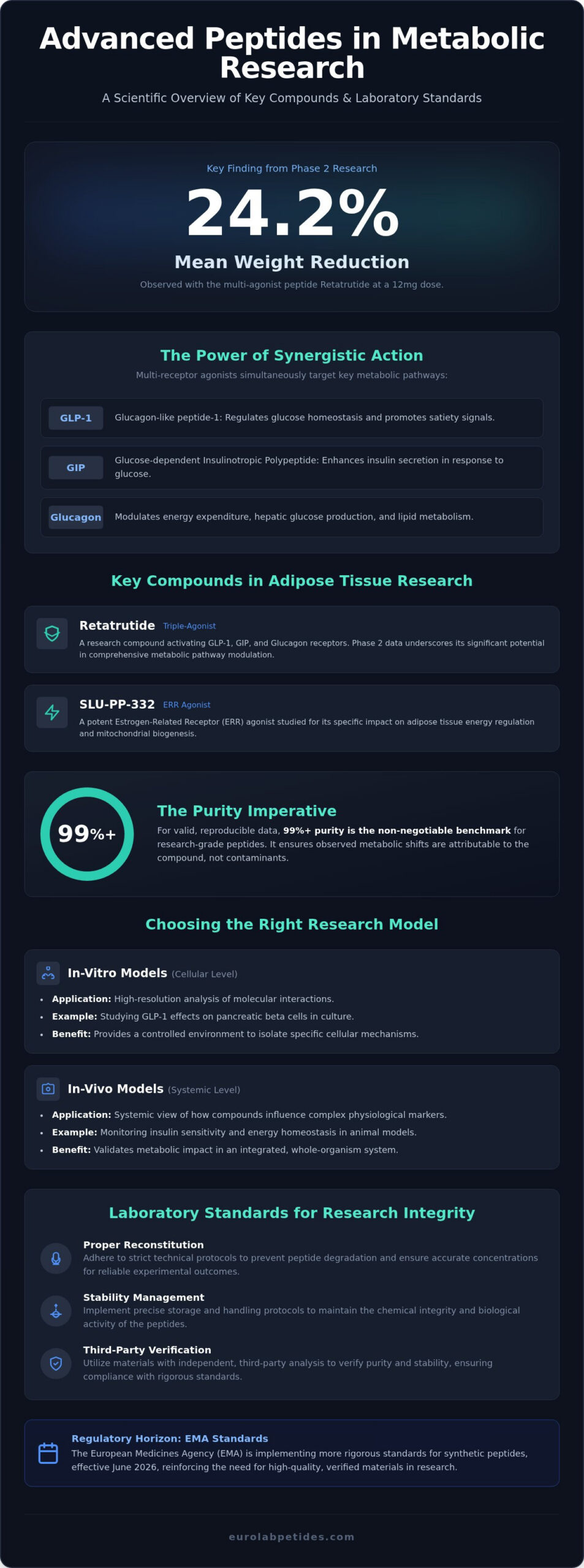
Phase 2 research for Retatrutide has documented a mean weight reduction of 24.2 percent at a 12mg dose, a figure that underscores the significant potential of multi-agonist compounds in metabolic studies. For scientists investigating peptides for weight management research, these statistics highlight the need for extreme precision in molecular modeling. It’s well understood that the transition from clinical observation to laboratory validation requires materials of uncompromising quality. Inconsistent purity in research chemicals remains a primary barrier to reproducible results, especially as the European Medicines Agency (EMA) implements more rigorous standards for synthetic peptides in June 2026.
This review offers a rigorous scientific overview of peptide-mediated pathways, focusing on the molecular mechanisms of emerging compounds like SLU-PP-332 and established GLP-1 receptor agonists. You’ll gain a technical understanding of the Advanced Metabolic Stack and the specific protocols required for reconstitution and stability. We also address the logistical requirements for sourcing third-party verified materials within Europe. By prioritizing empirical data and analytical methodology, this analysis provides the framework necessary to select appropriate research models and ensure that laboratory standards meet the highest benchmarks of biochemical excellence.
Key Takeaways
- Analyze the synergistic effects of multi-receptor agonists to understand how they modulate glucose homeostasis and lipid metabolism in controlled laboratory settings.
- Evaluate the role of SLU-PP-332 as a potent Estrogen-Related Receptor (ERR) agonist and its specific impact on adipose tissue energy regulation.
- Establish rigorous laboratory standards by identifying why 99% plus purity is the non-negotiable benchmark for valid data when utilizing peptides for weight management research.
- Implement the EuroLab Peptides quality protocol to ensure regional regulatory compliance and verify material stability through independent third-party analysis.
- Master the technical requirements for proper reconstitution and stability protocols to prevent peptide degradation and maintain the integrity of metabolic research models.
Introduction to Peptides for Weight Management Research
Peptides are biochemically defined as short-chain polymers of amino acids linked by peptide bonds, typically comprising fewer than fifty residues. Within the context of metabolic pathways, these molecules function as critical signaling ligands that initiate complex intracellular cascades. The investigation of peptides for weight management research is essential for elucidating the molecular underpinnings of lipid metabolism and glucose homeostasis. This technical review is restricted to laboratory and in-vitro applications; the compounds discussed are research-grade chemicals not intended for human consumption or clinical use.
Distinguishing between endogenous signaling and the introduction of synthetic analogs is a primary requirement for robust experimental design. Synthetic variants are often engineered to exhibit enhanced stability or receptor affinity, providing a controlled method to study metabolic disturbances without the rapid degradation seen in natural molecules. These analogs allow researchers to isolate specific metabolic effects that occur when signaling pathways are consistently activated or inhibited.
The Role of Peptides in Metabolic Signaling
Metabolic regulation is largely governed by the interaction between peptides and G-protein coupled receptors (GPCRs). When a peptide ligand binds to its cognate GPCR, it triggers signal transduction pathways that can alter the metabolic rate of the target cell. In adipocyte differentiation studies, these signals determine the rate at which precursor cells mature into functional fat cells. Understanding these pathways is paramount for researchers mapping the bioenergetics of obesity models. Metabolic research peptides are tools for investigating energy expenditure through the targeted modulation of biochemical signaling pathways.
Research Applications: In-Vitro vs. In-Vivo Models
The choice between in-vitro and in-vivo models depends on the specific metabolic question being addressed. In-vitro cell culture models allow for high-resolution analysis of molecular interactions, such as the effect of Glucagon-like peptide-1 (GLP-1) on insulin secretion within pancreatic beta cells. These models provide a controlled environment to study cellular mechanisms without the interference of systemic variables.
Conversely, animal metabolic studies provide a systemic view of how these compounds influence complex physiological markers like mitochondrial biogenesis and insulin sensitivity. Researchers frequently monitor changes in energy homeostasis and glucose disposal rates to validate the metabolic impact of specific compounds. For those requiring a deeper understanding of peptide chemistry and synthesis, a comprehensive guide for researchers is available to establish foundational knowledge. Selecting high-purity peptides for weight management research ensures that observed metabolic shifts are attributable to the compound rather than contaminants, preserving the integrity of the research data.
Mechanistic Pathways: Incretin Mimetics and Secretagogues
Incretin mimetics represent a primary focus in peptides for weight management research due to their ability to modulate metabolic flux through specific receptor pathways. Glucagon-Like Peptide-1 (GLP-1) receptor agonists are utilized in laboratory settings to investigate the attenuation of postprandial glucose excursions and the regulation of satiety signals within the central nervous system. These synthetic ligands are characterized by structural modifications that resist dipeptidyl peptidase-4 (DPP-4) degradation, extending their metabolic activity in research models. By examining these pathways, researchers can better understand how specific peptide sequences influence energy balance and metabolic flexibility.
GLP-1 and GIP Receptor Research
The shift toward multi-receptor agonists has redefined the landscape of metabolic investigation. Multi-agonist compounds target the GLP-1, Glucose-dependent Insulinotropic Polypeptide (GIP), and glucagon receptors simultaneously. This synergistic activation aims to mimic endogenous hormonal responses while maximizing metabolic efficiency. For example, Phase 2 data for Retatrutide, a triple-agonist, demonstrated a mean weight reduction of 24.2 percent at a 12mg dose in clinical trials, providing a robust benchmark for researchers analyzing triple-pathway interactions in peptides for weight management research.
The binding affinity of these molecules determines the rate of gastric emptying and the intensity of anorexigenic signaling in animal models. Researchers interested in a broader evidence-based overview of weight loss peptides often focus on how dual agonists like Tirzepatide achieve higher efficacy than single-pathway analogs. High-purity materials are essential to ensure that receptor binding data isn’t skewed by peptide degradation or chemical impurities during longitudinal studies.
Growth Hormone Secretagogues in Metabolism
Growth hormone secretagogues (GHS) like Ipamorelin and CJC-1295 are employed to study the preservation of lean tissue during induced caloric deficits. Ipamorelin is a selective ghrelin receptor agonist that stimulates the pulsatile release of endogenous growth hormone. This pulsatile rhythm is critical in metabolic studies as it avoids the pituitary desensitization often associated with sustained elevation. These compounds are frequently used to analyze the biochemical markers of lipolysis and nitrogen retention in controlled research environments.
For a detailed analysis of molecular behavior, the technical profile of Ipamorelin provides specific data on its selectivity and metabolic stability. When combined with CJC-1295, a GHRH analog, these compounds facilitate the investigation of mitochondrial efficiency and tissue repair. Investigating these complex pathways requires precise laboratory standards to maintain the integrity of body composition research. Scientists seeking to explore these mechanisms often utilize an Advanced Metabolic Stack to facilitate comprehensive multi-pathway investigation.
Emerging Compounds in Adipose Tissue Research
Research into adipose tissue regulation has shifted toward the investigation of mitochondrial-derived peptides (MDPs) and nuclear receptor agonists. These compounds offer a localized approach to metabolic modulation compared to the systemic incretin mimetics discussed in previous sections. For scientists utilizing peptides for weight management research, mitochondrial signaling represents a critical frontier in understanding cellular energy expenditure and substrate utilization. These emerging compounds provide the means to isolate specific biochemical triggers within white and brown adipose tissue, allowing for a more granular analysis of lipid storage and oxidation.
Tesamorelin, a synthetic analog of growth hormone-releasing factor, is frequently utilized in research to study the selective reduction of visceral adipose tissue (VAT). Clinical benchmarks for this compound show a 15 to 20 percent reduction in visceral fat area over 26 weeks, providing a quantitative baseline for laboratory investigation. Additionally, Tesofensine is examined for its role as a triple monoamine reuptake inhibitor. By modulating the synaptic concentrations of serotonin, noradrenaline, and dopamine, it provides a model for studying the neurological drivers of metabolic rate and appetite suppression in weight management research models. These compounds represent distinct mechanistic approaches, targeting both hormonal and neurotransmitter pathways.
Mitochondrial Peptides: MOTS-c and Metabolic Flexibility
MOTS-c is a 16-amino acid peptide encoded by the mitochondrial genome that plays a vital role in metabolic homeostasis. It functions by activating the AMPK pathway and promoting GLUT4 translocation, which directly enhances glucose uptake in skeletal muscle. This exercise-mimetic effect is a focal point in metabolic flexibility studies, where the goal is to improve the body’s ability to switch between fuel sources. Researchers utilize MOTS-c to investigate the biochemical pathways of mitochondrial biogenesis and the mitigation of insulin resistance in diet-induced metabolic models. The peptide’s ability to regulate nuclear gene expression in response to metabolic stress makes it a unique tool for investigating the mitonuclear communication axis.
ERR Agonists: The SLU-PP-332 Research Profile
SLU-PP-332 serves as a non-hormonal pan-agonist for the Estrogen-Related Receptors, specifically targeting ERRα, ERRβ, and ERRγ. These nuclear receptors are essential for the transcription of genes involved in mitochondrial oxidative phosphorylation and fatty acid oxidation. In laboratory models, SLU-PP-332 has demonstrated the ability to increase fat oxidation and enhance endurance by shifting metabolic preference toward lipids. This compound is a primary tool for investigating exercise-mimetic pathways, where significant metabolic shifts occur independently of physical exertion. By activating the ERR pathway, researchers can study the expansion of oxidative muscle fibers and the subsequent impact on systemic glucose disposal. Maintaining rigorous laboratory standards is necessary when investigating these complex interactions to ensure that metabolic data remains reproducible and valid.
Laboratory Standards: Purity, Reconstitution, and Stability
The integrity of metabolic research is dependent upon the chemical purity of the compounds utilized. For studies involving peptides for weight management research, a purity threshold of 99 percent or higher is the established benchmark for ensuring valid, reproducible data. Lower purity levels, specifically those falling below 95 percent, introduce exogenous variables such as residual trifluoroacetic acid (TFA) or truncated peptide sequences. These contaminants can induce off-target cellular responses, effectively compromising the accuracy of lipid metabolism or glucose homeostasis models. Quality is treated as a verifiable metric rather than a marketing claim, requiring rigorous analytical validation before any material is utilized in a laboratory setting.
Verifying Purity via HPLC and MS
Identity and purity are confirmed through a multi-level quality control process. High-Performance Liquid Chromatography (HPLC) is the primary analytical tool used to determine the percentage of the target peptide relative to impurities. This process involves the separation of chemical components based on their interaction with a stationary phase, producing a chromatogram that provides a quantitative measure of purity. While HPLC confirms the concentration of the material, it doesn’t verify the molecular identity of the compound itself.
Mass Spectrometry (MS) is employed as a secondary validation tool to confirm the molecular weight of the peptide. By measuring the mass-to-charge ratio of ionized particles, MS ensures that the synthesized sequence matches the theoretical molecular weight of the target compound. Independent third-party laboratory reports are a non-negotiable standard for professional inquiry. These reports provide external validation, ensuring that every batch meets the specific technical requirements of the research community. Researchers requiring high-purity materials can source peptides for weight management research from the EuroLab Peptides third-party verified catalog.
Reconstitution and Stability Protocols
Proper handling of lyophilized peptides is critical to prevent degradation and maintain assay consistency. Reconstitution is performed using bacteriostatic water or sterile 0.9 percent saline, depending on the specific solubility requirements of the compound. The diluent is introduced slowly along the side of the vial to avoid mechanical stress; vigorous agitation or shaking is avoided to prevent the denaturing of the peptide’s delicate secondary structure. Once the peptide is in solution, it becomes significantly more susceptible to enzymatic degradation and temperature fluctuations.
Storage requirements are strictly dictated by the physical state of the compound. Lyophilized peptides are stable for extended periods when stored at minus 20 degrees Celsius or minus 80 degrees Celsius, which preserves the structural integrity of the amino acid chain. Reconstituted solutions require constant refrigeration at 2 to 8 degrees Celsius and typically maintain stability for a duration of 14 to 28 days. Maintaining a consistent cold chain from manufacturing to the laboratory bench is a primary factor in ensuring that metabolic research data isn’t skewed by degraded materials. Adhering to these standardized protocols allows for the precise investigation of metabolic pathways without the risk of material failure.
Sourcing Peptides for Weight Management Research in Europe
Sourcing peptides for weight management research within the European Union provides significant advantages regarding regulatory alignment and logistical precision. Regional manufacturing ensures that compounds are synthesized under strict oversight, mitigating the risks of purity variance often found in materials sourced from unregulated global markets. Localized logistics also facilitate the maintenance of the cold chain, which is critical for preserving the structural integrity of sensitive lyophilized sequences. As the European Medicines Agency (EMA) implements more rigorous standards for synthetic peptides in June 2026, sourcing from established regional partners becomes a necessity for maintaining compliance with evolving laboratory standards.
EuroLab Peptides: A Multi-Level Quality Protocol
The EuroLab Peptides quality protocol is designed to instill absolute security in the professional user through a meticulous, data-driven validation cycle. Every production batch is subjected to internal HPLC analysis to verify purity levels before being submitted for independent third-party testing. This secondary validation serves as a non-negotiable standard, providing an objective metric of quality that is transparent and verifiable. By relying on empirical analytical data rather than marketing hyperbole, the protocol ensures that researchers receive materials that meet the high-stakes precision required for metabolic modeling. For more information on navigating these requirements, refer to the 2026 guide on sourcing and laboratory standards. This objective approach to product validation projects a persona of radical honesty and accountability in the chemical synthesis space.
Research Stacks for Metabolic Investigation
Specialized metabolic stacks are utilized to investigate the complex interactions between different biochemical pathways. The Advanced Metabolic Stack is a curated tool that allows for the simultaneous study of incretin signaling, mitochondrial biogenesis, and nuclear receptor activation. By combining compounds like SLU-PP-332 with established secretagogues, researchers can analyze multi-pathway synergies that would be difficult to isolate using single-compound models. This method is particularly useful for studying energy expenditure and substrate utilization in a comprehensive manner. To explore these combinations, researchers should review the full range of research peptides at EuroLab Peptides to select the appropriate analogs for their specific investigative models.
The ethical and legal framework surrounding peptides for weight management research is defined by the strict prohibition of human consumption. These materials are provided exclusively for in-vitro and laboratory development; their classification as research-grade chemicals places them outside the scope of medicinal products. Adhering to this distinction reinforces professional credibility and ensures that the focus remains on the rigorous demands of the scientific community. By sourcing materials within Europe, researchers benefit from localized logistics and regional regulatory compliance, which serve as a shorthand for reliability in an increasingly scrutinized market.
Advancing Metabolic Research Standards
The investigation of metabolic mechanisms requires a transition from generalized clinical observations to high-precision biochemical analysis. This technical review has established the critical role of multi-agonist pathways and nuclear receptor ligands in understanding energy homeostasis. Achieving reproducible results in peptides for weight management research depends entirely on material integrity. Utilizing compounds verified at 99 percent plus purity through independent third-party laboratory testing eliminates the chemical variance that often compromises longitudinal studies. These rigorous standards ensure that observed metabolic shifts aren’t attributable to synthesis byproducts or residual contaminants.
As European regulatory standards evolve toward the June 2026 EMA guidelines, sourcing from partners with regional manufacturing and localized logistics ensures continued compliance and material stability. Establishing a foundation of analytical excellence allows for the precise mapping of metabolic models and signaling cascades. Browse Research-Grade Peptides for Metabolic Studies to access materials synthesized for high-stakes professional inquiry. We look forward to supporting your next breakthrough in metabolic science.
Frequently Asked Questions
Are these peptides intended for human weight loss?
These compounds are strictly synthesized for in-vitro laboratory investigation and are not intended for human consumption or therapeutic use. Their classification as research chemicals places them outside the regulatory definition of medicinal products. Any utilization in a clinical or diagnostic setting is prohibited. Research grade peptides for weight management research must be handled within a controlled laboratory environment by qualified professionals to ensure adherence to safety and ethical standards.
How should research peptides be stored to maintain maximum stability?
Maximum stability is maintained by storing lyophilized peptides at temperatures of minus 20 degrees Celsius or minus 80 degrees Celsius. These conditions prevent the hydrolytic degradation of the amino acid chain over extended periods. Once reconstituted, solutions must be kept refrigerated between 2 and 8 degrees Celsius. It’s essential to minimize exposure to light and avoid repeated freeze-thaw cycles, which can denature the peptide’s secondary structure and compromise experimental results.
What is the standard reconstitution protocol for metabolic research peptides?
The standard protocol involves the introduction of bacteriostatic water or sterile 0.9 percent saline into the lyophilized vial. The diluent should be aimed at the side of the glass to allow for a slow, gentle dissolution of the powder. Agitation or vigorous shaking is avoided as mechanical stress can denature the peptide. Researchers must calculate the desired concentration based on the vial’s milligram content to ensure precise dosing in metabolic models.
Why is third-party testing critical for research-grade peptides?
Independent third-party testing provides an objective validation of a compound’s purity and molecular identity. This external analysis utilizes High-Performance Liquid Chromatography (HPLC) and Mass Spectrometry (MS) to ensure the material meets the 99 percent purity benchmark. Relying on external verification eliminates manufacturer bias and provides researchers with a Certificate of Analysis for every batch. This transparency is critical for maintaining the integrity and reproducibility of metabolic research data.
Can SLU-PP-332 be used in in-vitro metabolic studies?
SLU-PP-332 is specifically utilized in in-vitro studies to investigate the activation of Estrogen-Related Receptors (ERRs). As a pan-agonist, it allows researchers to model the transcription of genes involved in mitochondrial oxidative phosphorylation and fatty acid oxidation. Its application in cell culture models is essential for isolating the biochemical triggers of exercise-mimetic pathways. This compound is a primary component of the Advanced Metabolic Stack used for comprehensive multi-pathway investigation.
What is the difference between a GLP-1 agonist and a GIP agonist in research?
GLP-1 receptor agonists are primarily used to study glucose homeostasis and central satiety signaling in animal models. GIP receptor agonists focus on the modulation of insulin secretion and lipid storage within adipose tissue. While they target different receptors, their synergistic interaction is a major focus in peptides for weight management research. Investigating these differences allows scientists to understand how multi-receptor ligands achieve higher metabolic efficiency compared to single-pathway analogs.
How does EuroLab Peptides ensure the purity of its metabolic research compounds?
Purity is ensured through a multi-level quality control protocol that includes both in-house analysis and independent third-party validation. Each batch undergoes HPLC to confirm a purity threshold of 99 percent or higher and Mass Spectrometry to verify molecular weight. This data-driven approach is supported by regional European manufacturing standards and localized logistics. By providing batch-specific Certificates of Analysis, EuroLab Peptides projects a persona of radical honesty and accountability to the scientific community.
