

The assumption that BPC-157 and TB-500 function as redundant analogs is a significant oversight in modern biochemical inquiry. While both peptides are central to regenerative models, the comparison of bpc-157 vs tb-500 isn’t about superiority but about distinct molecular targets. It’s often difficult to reconcile “bro-science” anecdotes with the rigorous demands of peer-reviewed data, particularly following the 2026 regulatory shifts that have brought these compounds into sharper focus. This article provides a technical analysis of these peptides, focusing on their unique roles in angiogenesis and cellular migration research.
You’ll gain a clear understanding of how BPC-157 influences Vascular Endothelial Growth Factor (VEGF) expression versus the G-actin sequestration mechanisms of TB-500. We examine the rationale for utilizing both in a combined research stack to optimize tissue regeneration studies. Finally, this analysis identifies the necessity of sourcing reagents with verified HPLC purity within the European logistics framework to ensure experimental stability and reproducible results in a market where quality is a verifiable metric.
Key Takeaways
- Differentiate the structural profiles of BPC-157 as a synthetic pentadecapeptide and TB-500 as a synthetic fragment of the Thymosin Beta-4 protein.
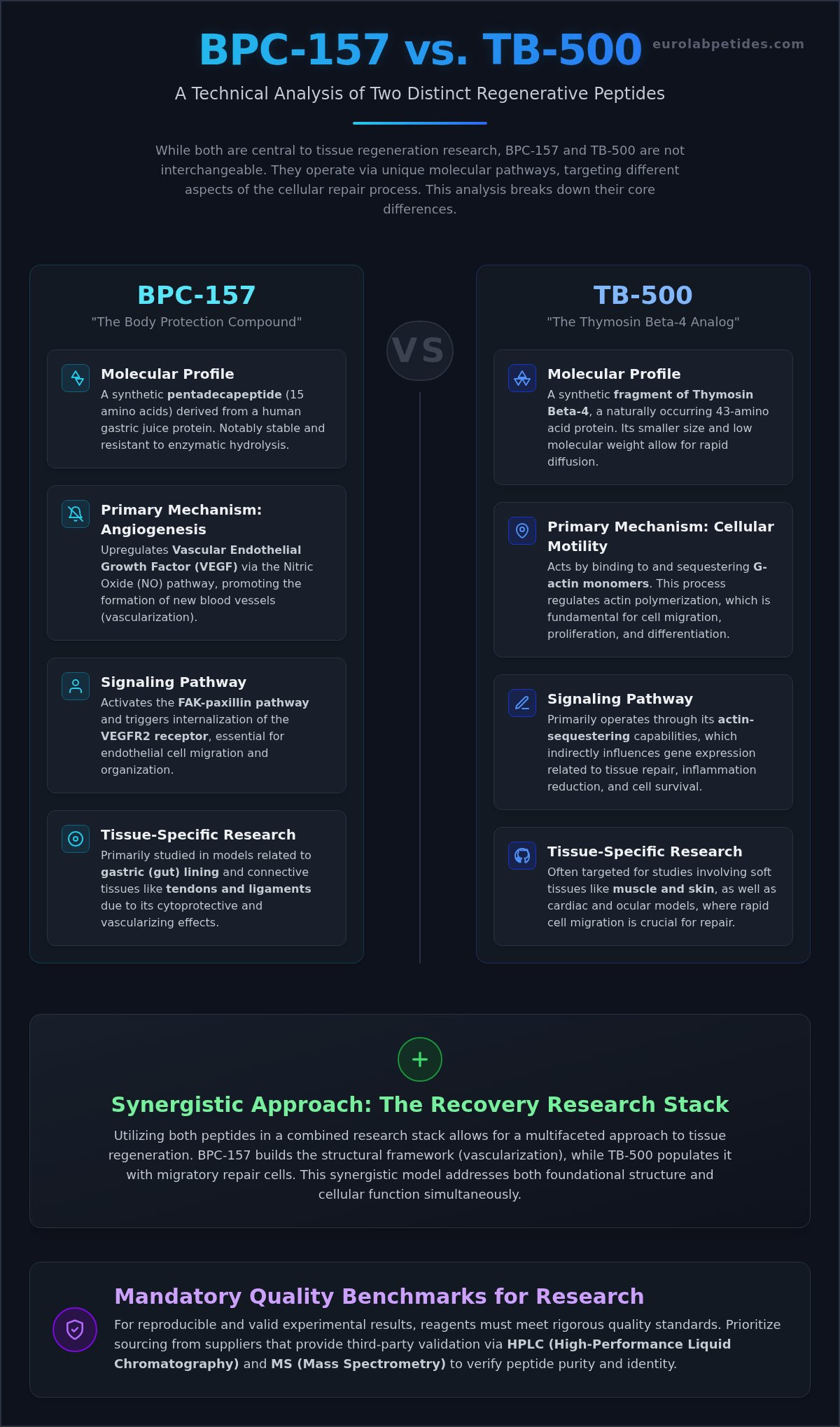
- Analyze the distinct signaling pathways in the bpc-157 vs tb-500 comparison, specifically the contrast between VEGF-mediated angiogenesis and actin-sequestering cellular motility.
- Identify tissue-specific research applications, mapping BPC-157 to gastric and tendon models while targeting muscle and skin regeneration with TB-500.
- Evaluate the biochemical rationale for utilizing the Recovery Research Stack to address multifaceted repair mechanisms through a synergistic approach.
- Establish rigorous quality benchmarks by prioritizing third-party HPLC and MS validation to ensure high-purity reagents for professional laboratory inquiry.
Molecular Profiles: BPC-157 and TB-500 in Research Settings
The molecular profiles of BPC-157 and TB-500 represent two distinct classes of biochemical reagents used in regenerative research models. While both are categorized under tissue repair research, their origins and structural configurations are fundamentally different. BPC-157 is a synthetic pentadecapeptide derived from a sequence found in human gastric juice proteins. Conversely, TB-500 is a synthetic fragment of the naturally occurring 43-amino acid protein, Thymosin Beta-4. Understanding the nuances of bpc-157 vs tb-500 requires a granular look at these molecular architectures. This analysis is limited to in-vitro and laboratory development purposes, excluding any clinical or human consumption applications.
BPC-157: The Pentadecapeptide Structure
BPC-157 is defined by its specific 15-amino acid sequence: Gly-Pro-Pro-Pro-Gly-Lys-Pro-Ala-Asp-Asp-Ala-Gly-Leu-Val. This specific arrangement contributes to the peptide’s exceptional stability. Unlike many signaling proteins that degrade rapidly outside controlled environments, BPC-157 exhibits high resistance to enzymatic hydrolysis. This robustness was originally observed in gastric environments but is a critical metric for laboratory storage and experimental consistency. Researchers don’t rely on less stable analogs when precision is required; instead, they reference the technical guide to BPC-157 to verify the chemical properties of the acetate-bound or lyophilized forms. Its primary identity as a “Body Protection Compound” stems from its ability to maintain structural integrity across varying pH levels in research models. In a laboratory setting, the compound’s purity is often verified via HPLC to ensure no truncated sequences interfere with the observed biological signaling.
TB-500: The Thymosin Beta-4 Analog
TB-500 serves as a synthetic analog representing the active domain of Thymosin Beta-4 (Tβ4). While Tβ4 is a full-length protein consisting of 43 amino acids, TB-500 is typically synthesized as a shorter fragment to isolate specific regenerative properties. Its low molecular weight facilitates rapid diffusion through research buffers and cellular membranes in culture models. Historically, thymic peptides were explored for their immunological roles, but research shifted toward their actin-sequestering capabilities. TB-500 is highly soluble in aqueous solutions, making it an efficient reagent for assays focusing on cellular motility. When evaluating bpc-157 vs tb-500, it’s clear that the latter operates through a thymic-derived signaling pathway that is structurally independent of the gastric-derived pentadecapeptide. The molecular weight of TB-500 is significantly lower than the parent protein, which alters its pharmacodynamic profile in laboratory assays. High-stakes precision in research demands that these analogs are free from residual TFA to prevent confounding variables in immunological data sets.
Mechanisms of Action: BPC-157 and Angiogenesis
BPC-157’s primary research utility lies in its capacity to modulate the angiogenic environment. Unlike TB-500, which primarily targets cellular motility, BPC-157 facilitates the upregulation of Vascular Endothelial Growth Factor (VEGF). This process isn’t merely an increase in protein concentration; it involves a sophisticated activation of the Nitric Oxide (NO) pathway. NO modulation ensures adequate vasodilation, which is a prerequisite for effective repair signaling in ischemic tissue models. Researchers often prioritize this peptide when investigating the revascularization of damaged microenvironments, as it provides a stable framework for new capillary formation.
Angiogenic Signaling Pathways
The molecular mechanism involves the specific internalization of the VEGFR2 receptor, which triggers downstream proliferative signals in endothelial cells. While some agents produce systemic angiogenic spikes, BPC-157 is often characterized by its localized response within specific injury sites in laboratory models. BPC-157 facilitates accelerated angiogenesis through the activation of the FAK-paxillin signaling pathway, which is essential for endothelial cell migration and structural organization. This precision is why researchers investigating bpc-157 vs tb-500 often select the former for studies requiring structural vascularization and the establishment of new blood vessel networks.
Cytoprotective Effects in Gastric and Connective Tissue
Beyond vascularization, BPC-157 demonstrates significant cytoprotective properties that extend into the extracellular matrix. In connective tissue research, it promotes collagen type I synthesis, which is critical for the mechanical integrity of ligaments and tendons. Published research on BPC 157’s healing properties highlights its influence on growth hormone receptors in tendon fibroblasts. These fibroblast interactions lead to a more organized extracellular matrix (ECM), particularly in tendon-to-bone healing models where structural failure is common. The peptide’s ability to facilitate the cross-linking of collagen fibers provides a verifiable metric for structural recovery in laboratory assays.
Laboratory models also explore its interaction with the brain-gut axis, a unique regulatory system. Its origin as a gastric-derived peptide allows for specialized applications in inflammatory bowel disease (IBD) analogues, where it maintains mucosal integrity through NO-dependent pathways. This systemic influence is a key differentiator when comparing bpc-157 vs tb-500 for multifaceted biological inquiry. For those conducting high-precision tissue repair and recovery research, understanding these specific signaling cascades is vital for experimental design. These pathways distinguish BPC-157 as a structurally stabilizing reagent in complex biological environments.
Mechanisms of Action: TB-500 and Cellular Motility
TB-500’s functionality in research models is primarily defined by its role as a G-actin sequestering molecule. In eukaryotic cells, the regulation of the cytoskeleton is a critical determinant of cellular motility. TB-500 prevents the polymerization of globular actin (G-actin) into filamentous actin (F-actin). This sequestration maintains a high concentration of G-actin within the cytoplasm. It provides the necessary precursor pool for rapid cytoskeletal reorganization. This mechanism is fundamentally different from the angiogenic pathways discussed previously. It highlights a core divergence in the bpc-157 vs tb-500 comparison.
Actin Sequestration and Cytoskeletal Dynamics
The molecular interaction between TB-500 and G-actin is highly specific. By binding to the actin monomers, TB-500 regulates the rate of actin assembly and disassembly. This process directly influences chemotaxis and cell motility in laboratory assays. In these environments, the peptide facilitates the accelerated migration of myoblasts and keratinocytes to sites of tissue disruption. Research in longevity models often utilizes TB-500 to study dermal repair and hair follicle stimulation. These processes depend heavily on the migration of progenitor cells. The presence of the Ac-SDKP sequence within the Thymosin Beta-4 structure has also been identified as a potent inhibitor of fibrosis. It prevents the excessive deposition of collagen in soft tissue models, ensuring that repair processes don’t lead to pathological scarring.
Anti-Inflammatory Signaling in Soft Tissue
TB-500 exhibits pronounced anti-inflammatory signaling within specialized research environments. It downregulates pro-inflammatory cytokines, which contrasts with the nitric oxide-mediated repair mechanisms of BPC-157. This specific profile makes TB-500 a preferred reagent for corneal and cardiac tissue repair research. In these models, inflammatory control is paramount to preventing scar formation. While these peptides are often prohibited by the World Anti-Doping Agency for use in competitive athletics, their utility in strictly controlled laboratory development continues to expand. The distinction in bpc-157 vs tb-500 becomes most apparent when observing these varied tissue responses. Technical precision in reagent selection allows for the isolation of these motility-based effects from purely angiogenic ones.
Comparative Analysis: BPC-157 vs. TB-500
The comparative analysis of bpc-157 vs tb-500 reveals significant differences in molecular weight and origin that dictate their research utility. BPC-157, with a molecular weight of approximately 1,419 Da, is synthesized based on a sequence from gastric juice proteins. TB-500 is a larger molecule at approximately 4,963 Da, derived from the thymic protein Thymosin Beta-4. These structural differences influence their primary biological targets in experimental protocols. While BPC-157 is often utilized for its stability in varying pH environments, TB-500 is valued for its high solubility in research buffers. Experimental precision requires an understanding of how these origins affect tissue specificity and signaling reach.
Divergent Biological Pathways
The divergence in signaling pathways is the primary factor when choosing between these reagents. BPC-157 drives vascularization through VEGF upregulation and collagen organization. This makes it the standard for research involving tendons, ligaments, and gastric mucosa. Conversely, TB-500 focuses on cellular migration and actin regulation, making it the preferred reagent for skeletal muscle and dermal repair models. BPC-157 often exhibits localized effects at the site of administration in laboratory models. TB-500’s low-affinity binding to actin allows for broader systemic diffusion across research models. The table below summarizes these biochemical metrics for laboratory comparison.
| Biochemical Metric | BPC-157 | TB-500 |
|---|---|---|
| Molecular Weight | ~1,419 Da | ~4,963 Da |
| Primary Signaling | VEGF / Nitric Oxide | G-Actin Sequestration |
| Structural Target | Collagen Type I | Cytoskeletal Actin |
| Tissue Specificity | Tendon / Gastric | Muscle / Dermal |
| Experimental Reach | Often Localized | Primarily Systemic |
The Rationale for Co-Administration in Research
The use of a Recovery Research Stack allows for a multi-modal approach to tissue regeneration research. By combining the collagen-organizing properties of BPC-157 with the actin-regulating motility of TB-500, researchers can address complex multi-tissue repair scenarios. This synergy is particularly evident in models requiring both the establishment of new vascular networks and the migration of progenitor cells to an injury site. It’s a strategy that mimics the multifaceted nature of endogenous repair mechanisms. Ensuring the stability of these reagents is paramount; lyophilized peptides should be stored at -20°C to maintain sequence integrity. Researchers should consult the 2026 guide on how to buy research peptides safely in Europe to ensure reagents meet required HPLC benchmarks. For those conducting high-stakes precision inquiry, sourcing from a reliable tissue repair and recovery research provider is a non-negotiable standard for experimental validity.
Quality Standards for Peptide Research in 2026
The demand for high-stakes precision in biochemical inquiry necessitates the implementation of rigorous analytical benchmarks. In a global market where quality is often presented as a subjective claim, EuroLab Peptides establishes quality as a verifiable metric through standardized testing. The technical comparison of bpc-157 vs tb-500 is only scientifically valid when the reagents utilized are free from confounding impurities. For researchers in 2026, the reliance on third-party validation isn’t optional; it’s a non-negotiable standard for experimental integrity. This commitment to transparency ensures that every molecular repair model is built on a foundation of empirical data rather than anecdotal marketing.
Analytical Validation Protocols
Analytical excellence is achieved through the dual application of High-Performance Liquid Chromatography (HPLC) and Mass Spectrometry (MS). HPLC is utilized to determine the precise purity percentage of the peptide, identifying any truncated sequences or residual synthesis byproducts. Mass Spectrometry provides the necessary sequence confirmation, ensuring the molecular weight aligns with the theoretical profile of the pentadecapeptide or the thymic analog. A purity threshold of 99% is established as the minimum standard to ensure that observed biological responses are not confounded by truncated peptide sequences or residual synthesis byproducts. Beyond purity, the identification of counter-ions is critical. High levels of Trifluoroacetic acid (TFA) can induce cytotoxicity in cell culture models. Professional research reagents prioritize acetate content to maintain physiological relevance in sensitive tissue models.
Sourcing and Logistics in Europe
The stability of BPC-157 and TB-500 is highly dependent on environmental factors during transit and storage. European researchers benefit from localized supply chains that minimize exposure to temperature fluctuations, which can lead to peptide degradation. In the laboratory, lyophilized peptides must be stored at -20°C to ensure long-term sequence stability, while reconstituted solutions require refrigeration at 2°C to 8°C for immediate use. The 2026 regulatory landscape has evolved significantly following the July 23, 2026, FDA Pharmacy Compounding Advisory Committee recommendation. While this shifting status impacts compounding, the requirement for high-purity reagents in strictly controlled research environments remains absolute. EuroLab Peptides maintains a European-based supply chain that ensures consistent stability and compliance with regional laboratory standards. Researchers can Explore the EuroLab Recovery Research Stack for your laboratory requirements to access reagents that have undergone rigorous external validation. This methodical approach to sourcing and testing respects the intelligence of the specialized community and provides the absolute security required for professional inquiry.
Advancing Precision in Molecular Repair Research
The comparative analysis of bpc-157 vs tb-500 confirms that these peptides aren’t interchangeable but are complementary tools for specialized biological inquiry. BPC-157 provides a stable framework for structural vascularization and collagen organization, while TB-500 drives the cellular motility required for rapid cytoskeletal reorganization. Understanding these distinct pathways allows for the design of more sophisticated research protocols, particularly when addressing multifaceted tissue repair models. Experimental validity depends entirely on the analytical integrity of the reagents used in the laboratory.
EuroLab Peptides provides standardized European laboratory-grade purity, ensuring that every batch meets the rigorous demands of the scientific community. Independent third-party HPLC and MS reports are available for every product to verify sequence accuracy and purity levels. By utilizing the specialized Recovery Research Stack, researchers can explore the synergistic potential of these compounds with absolute security. We invite you to View our third-party tested BPC-157 and TB-500 research reagents to advance your laboratory development objectives. Your commitment to high-stakes precision ensures reproducible and meaningful results in the field of peptide science.
Frequently Asked Questions
Can BPC-157 and TB-500 be used together in research models?
Yes, BPC-157 and TB-500 are frequently co-administered in multi-tissue repair models to investigate synergistic effects. This combination allows for simultaneous analysis of VEGF-mediated angiogenesis and G-actin-regulated cellular motility. The use of a combined research stack ensures that both structural organization and migratory pathways are addressed within the same experimental framework. Such dual-reagent protocols are standardized in laboratory settings to simulate complex, multifaceted endogenous repair environments.
What is the primary difference between BPC-157 and TB-500 mechanisms?
The fundamental distinction in the bpc-157 vs tb-500 comparison lies in their primary molecular targets. BPC-157 primarily modulates the upregulation of Vascular Endothelial Growth Factor (VEGF) and nitric oxide signaling for vascularization. In contrast, TB-500 functions as a primary actin-sequestering protein that regulates the polymerization of G-actin into F-actin. This difference dictates whether a research model focuses on establishing new capillary networks or facilitating the migration of progenitor cells to repair sites.
Are BPC-157 and TB-500 stable at room temperature for research purposes?
Lyophilized BPC-157 and TB-500 exhibit short-term stability at room temperature, but long-term storage requires a temperature of -20°C to maintain sequence integrity. Once reconstituted, these peptides degrade rapidly and must be maintained at 2°C to 8°C. Exposure to excessive heat or ultraviolet light can lead to enzymatic hydrolysis and peptide fragmentation. Standardized laboratory protocols mandate that reagents are kept in temperature-controlled environments to ensure that experimental data remains reproducible and free from degradation-based variables.
What is the recommended reconstitution liquid for BPC-157 and TB-500?
Bacteriostatic water or sterile 0.9% sodium chloride (saline) are the standard reconstitution liquids for laboratory research. Bacteriostatic water is often preferred for multi-use vials as it contains 0.9% benzyl alcohol, which inhibits microbial growth. For sensitive in-vitro cell culture assays, sterile water for injection may be utilized to avoid interference from preservatives. The choice of diluent is determined by the specific requirements of the assay and the desired stability of the resulting peptide solution.
Does TB-500 occur naturally in the human body?
TB-500 doesn’t occur naturally in the human body; it’s a synthetic analog representing the active fragment of the naturally occurring Thymosin Beta-4 protein. While Thymosin Beta-4 is a 43-amino acid protein found in high concentrations in platelets and white blood cells, TB-500 is synthesized to isolate its regenerative properties. This synthetic derivation allows for precise control over molecular weight and solubility in research buffers, facilitating the study of specific actin-regulating signaling pathways without the complexity of the full protein.
What are the common purity standards for BPC-157 and TB-500 research reagents?
High-purity research reagents for bpc-157 vs tb-500 studies must meet a minimum threshold of 99% as verified by HPLC. This standard ensures that the biological effects observed in research models are attributable to the peptide itself rather than synthesis byproducts or residual contaminants. Independent third-party laboratory testing provides Mass Spectrometry (MS) data to confirm the exact amino acid sequence. Standardized purity benchmarks are essential for maintaining the high-stakes precision required in biochemical and analytical science environments.
Is BPC-157 considered a growth hormone secretagogue?
BPC-157 is not classified as a growth hormone secretagogue. Unlike secretagogues that stimulate the pituitary gland to release endogenous growth hormone, BPC-157 is observed to modulate the expression of growth hormone receptors on fibroblasts. This interaction enhances the sensitivity of target tissues to existing growth hormone rather than increasing systemic concentrations. It’s a critical distinction for researchers investigating the molecular repair mechanisms of the pentadecapeptide within specific connective tissue and gastric research models.
How do researchers track the efficacy of these peptides in-vitro?
Researchers typically utilize scratch assays to measure cellular migration rates in response to TB-500. For BPC-157, Enzyme-Linked Immunosorbent Assays (ELISA) are employed to quantify the upregulation of VEGF and other angiogenic markers. Western blotting is frequently used to analyze protein expression levels, while fluorescence microscopy allows for the visualization of cytoskeletal organization. These methodical analytical techniques provide the empirical results needed to validate the efficacy of each peptide within controlled laboratory development environments.
