

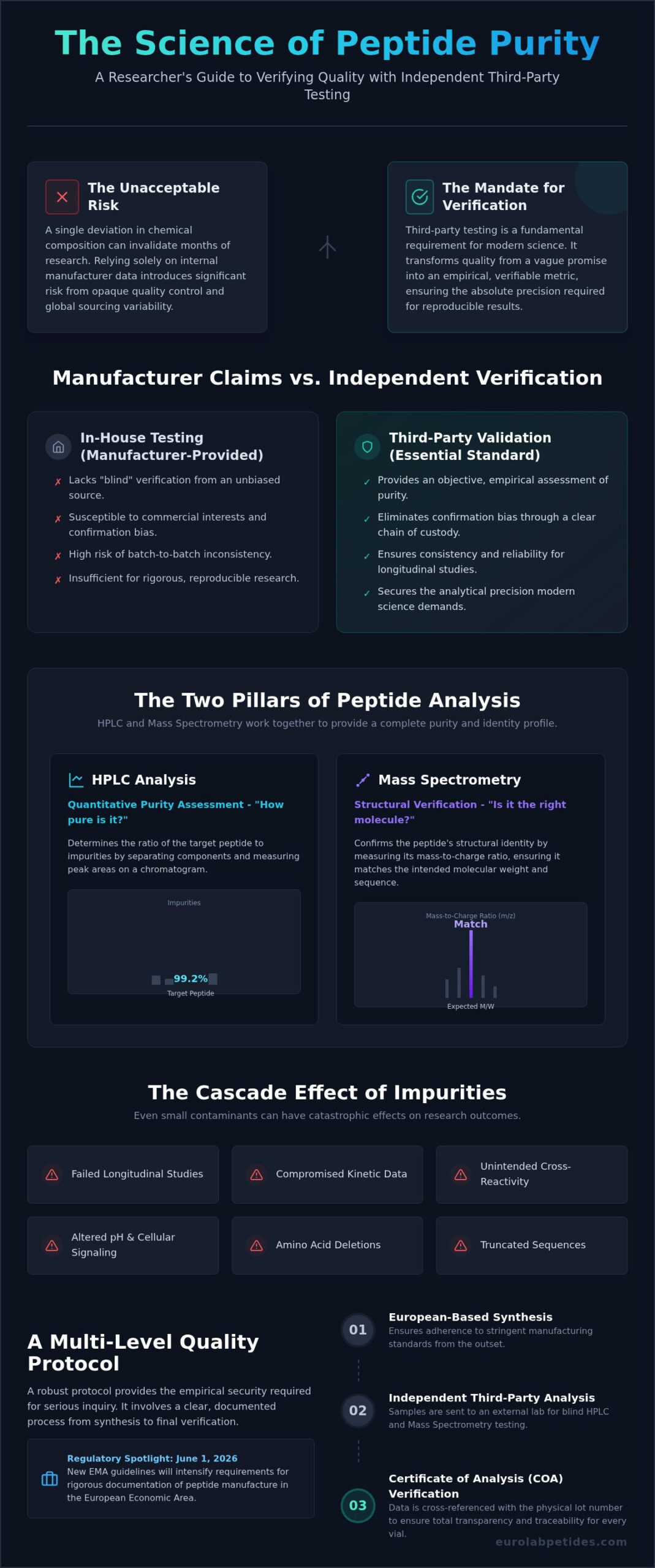
In high-stakes laboratory research, a single deviation in chemical composition can invalidate months of longitudinal data and compromise the integrity of an entire study. You recognize that relying solely on internal manufacturer data introduces unacceptable risks, particularly when navigating the complexities of global sourcing and opaque quality control protocols. Procuring third-party tested peptides is no longer a luxury; it’s a fundamental requirement for maintaining the rigorous analytical standards that modern science demands.
This guide provides a technical framework for verifying peptide purity through independent HPLC and Mass Spectrometry analysis, ensuring your reagents meet the exact specifications necessary for reproducible results. We’ll examine the interpretation of Certificates of Analysis, the impact of the June 2026 EMA guidelines on synthetic peptide manufacture, and the validation protocols that eliminate batch-to-batch variability. By prioritizing empirical data over marketing claims, you secure the absolute precision required for serious professional inquiry and long-term research success. You’ll gain the tools to transform quality from a vague promise into a verifiable metric.
Key Takeaways
- Identify the distinct roles of HPLC and Mass Spectrometry in establishing a peptide’s purity profile and verifying its molecular sequence.
- Recognize why sourcing third-party tested peptides is essential for bypassing the limitations of manufacturer-provided documentation and ensuring objective validation.
- Develop a systematic approach to interpreting Certificates of Analysis (COAs), focusing on lot-specific data and the detection of potential contaminants.
- Evaluate the technical impact of chemical impurities on research reproducibility, specifically regarding the prevention of unintended cross-reactivity in complex research stacks.
- Discover how multi-level quality control protocols, including European-based synthesis and independent screening, provide the empirical security required for longitudinal studies.
The Critical Role of Third-Party Validation in Peptide Research
The integrity of laboratory research is fundamentally dependent on the chemical purity of the reagents employed. Within the specialized field of peptide synthesis, “research grade” is defined by a minimum purity threshold of 99%. Any deviation from this standard introduces uncontrolled variables that can compromise the kinetic data of in-vitro assays. Establishing this level of precision requires more than internal verification; it necessitates the procurement of third-party tested peptides to ensure that every lot meets established analytical benchmarks. Quality is not a subjective attribute but a verifiable metric that must be confirmed through external scrutiny.
The Volatility of the Global Peptide Supply Chain
The global synthesis market is characterized by a high degree of variability, particularly when reagents are sourced from overseas facilities with opaque quality control measures. Batch-to-batch inconsistency remains a primary cause of failed longitudinal studies. Without external validation, researchers risk utilizing compounds with significant amino acid deletions, truncated sequences, or residual trifluoroacetic acid (TFA) salts. These impurities can alter the pH of research environments and interfere with cellular signaling pathways. The implementation of the new EMA guideline on June 1, 2026, has intensified the requirements for scientific integrity in the European Economic Area, mandating more rigorous documentation of peptide manufacture. Independent laboratories serve as a critical quality audit, providing an objective assessment that manufacturer-provided data often lacks.
Why In-House Testing Alone Is Insufficient
Manufacturer-provided Certificates of Analysis (COAs) are often generated in environments where commercial interests can influence reporting. In-house testing protocols, while necessary for initial screening, lack the “blind” verification provided by an independent facility. A robust validation process requires a clear chain of custody, where samples are sent to an external laboratory without pre-existing performance expectations. This prevents the confirmation bias often found in internal quality assurance departments.
Analytical techniques such as Peptide mass fingerprinting are utilized to confirm the structural identity of the sequence, ensuring that the synthesized compound aligns exactly with the intended molecular weight and predicted cleavage patterns. Relying on third-party tested peptides mitigates the risk of bias, offering a verifiable metric of quality that supports reproducible laboratory research. Every analytical report should be cross-referenced with the physical lot number on the vial to ensure total transparency. These compounds are strictly for in-vitro research and laboratory development only; they are not intended for human consumption or clinical use.
Decoding Analytical Methodology: HPLC and Mass Spectrometry
HPLC is a technique used to separate, identify, and quantify each component in a mixture. Within the framework of biochemical validation, this methodology provides the primary quantitative assessment of a sample’s chemical composition. While manufacturer reports may claim high purity, only third-party tested peptides subjected to rigorous chromatographic separation offer the objective data required for sensitive in-vitro applications. It’s the baseline for ensuring that research reagents align with the strict demands of modern laboratory standards.
HPLC for Quantitative Purity Assessment
The process of HPLC operates by passing the peptide sample through a stationary phase column under high pressure, utilizing a liquid mobile phase to facilitate separation based on molecular affinity. The resulting chromatogram displays various peaks, where the primary peak represents the target compound. Purity is determined through peak area integration, calculating the ratio of the target peptide’s area to the total area of all detected peaks. Minor peaks represent synthesis byproducts, such as diastereomers or residual protective groups, which must be minimized to achieve the 99% purity threshold. Analytical screening for identity and purity typically starts at approximately $195 per sample, providing a cost-effective barrier against the risks of research contamination.
Mass Spectrometry for Structural Verification
While HPLC quantifies purity, Mass Spectrometry (MS) confirms the structural identity of the sequence by measuring the mass-to-charge ratio of ionized particles. Electrospray ionization (ESI) is the preferred method for peptide analysis, as it allows for the transition of large, polar molecules into the gas phase without significant fragmentation. The resulting mass spectrum is compared against the theoretical molecular weight of the peptide sequence. This process identifies “deletant” sequences where specific amino acids weren’t successfully coupled during synthesis. LC-MS/MS identity verification, priced at approximately $295 per sample, ensures that the vial contains the exact molecular structure intended for the study.
The synergy between these two methodologies is non-negotiable for reproducible research. HPLC may indicate 99% purity, but without MS, there’s no confirmation that the 99% represents the correct peptide. Conversely, MS can confirm identity but cannot accurately quantify the presence of trace impurities. For researchers requiring absolute precision, utilizing independent validation protocols ensures that every lot meets these dual analytical requirements before laboratory deployment. This multi-level approach eliminates the variables associated with unverified reagents, providing a secure foundation for longitudinal data collection.
How to Interpret a Certificate of Analysis (COA)
A Certificate of Analysis (COA) serves as the definitive empirical record for any research-grade compound. It’s the final validation that bridges the gap between manufacturing claims and laboratory reality. The procurement of third-party tested peptides is only the initial step; the researcher must then validate that the provided documentation is both authentic and lot-specific. Every vial is assigned a unique lot number that must correspond exactly to the analytical report. If this number is missing or mismatched, the reagent’s identity and purity remain unverified, rendering it unsuitable for controlled studies.
When reviewing a report, prioritize three primary metrics: appearance, molecular weight, and purity percentage. The appearance should typically be described as a white, lyophilized powder. The molecular weight must align with the theoretical sequence mass, and the purity should meet or exceed the 99% benchmark. Red flags include generic report dates, inconsistent fonts that suggest document tampering, or the absence of contact information for the independent testing facility. These compounds are strictly for in-vitro research and laboratory development only, and their integrity is non-negotiable.
Analyzing the Chromatogram and Peak Integration
The HPLC chromatogram provides a visual representation of the sample’s composition. A professional report is characterized by a stable baseline, where the x-axis represents elution time and the y-axis represents intensity. A single, sharp peak indicates high-purity synthesis and successful separation. Minor fluctuations, or “noise,” are expected at high sensitivities, but secondary peaks indicate the presence of impurities or synthesis byproducts. Peak integration is the mathematical process used to calculate the area under these curves. The purity percentage is derived from the ratio of the main peak’s area to the total integrated area of all detected peaks. If the baseline is erratic or the peaks are broad, the synthesis or purification process was likely suboptimal.
Identifying Residual Solvents and TFA Levels
Peptide synthesis involves various reagents that can remain in the final product as trace contaminants. Trifluoroacetic acid (TFA) is frequently employed as a counter-ion during the purification stage to ensure peptide stability. While TFA is standard, excessive levels can alter the pH of research environments, potentially interfering with sensitive cellular assays. A comprehensive COA for third-party tested peptides should ideally specify acetate or TFA levels to ensure they fall within acceptable thresholds. Moisture content is another critical metric; high moisture levels can lead to weight inaccuracies and accelerated degradation. Ensuring these residual components are minimized is essential for maintaining the precision required in modern biochemical inquiries.
The Impact of Purity on Research Reproducibility
The reproducibility crisis in biochemical research is frequently traced to the use of unverified reagents. When in-vitro metabolic data fails to align across multiple trials, the root cause is often identified as chemical impurities within the peptide lot. Procuring third-party tested peptides is the only method to ensure that experimental variables are restricted to the biological model itself rather than the reagent’s composition. Inconsistent batch quality ruins longitudinal studies by introducing uncontrolled inflammatory markers or secondary chemical interactions that skew quantitative results. Maintaining absolute purity is a non-negotiable standard for any laboratory aiming for peer-reviewed validation.
Unverified compounds carry the risk of unintended cross-reactivity, particularly in complex research stacks where multiple peptides are introduced to a single cellular environment. If a compound contains even 2% of a truncated sequence or a residual protective group, the resulting data may reflect a synergistic reaction to these impurities rather than the target peptide’s mechanism. This risk is especially high in longevity and tissue repair models where subtle signaling pathways are the primary focus of inquiry. Establishing a baseline of 99% purity through external validation is the prerequisite for data integrity.
Contaminants and Cellular Assay Interference
Biological contaminants, specifically bacterial endotoxins and heavy metals, exert a profound influence on cellular signaling pathways. These impurities can trigger innate immune responses in cell cultures, leading to what is technically termed “ghost” effects. In weight management research, these effects can manifest as metabolic shifts that are actually the result of an inflammatory response to contaminants rather than the peptide’s intended action. Researchers focused on musculoskeletal models should consult the BPC-157 technical guide for detailed purity requirements specific to tissue repair assays. Ensuring that reagents are free of endotoxins prevents the invalidation of sensitive assay data.
Batch-to-Batch Inconsistency as a Research Variable
Standardized synthesis protocols are essential for maintaining the validity of longitudinal data. Batch-to-batch inconsistency occurs when synthesis facilities fail to replicate exact purification parameters, resulting in vials that vary in TFA levels or moisture content. Lyophilization, or freeze-drying, is the preferred method for maintaining long-term peptide stability, yet even this process must be monitored to prevent degradation. Establishing a reliable baseline in cognitive function research requires third-party tested peptides that have been validated for structural consistency across every lot. To ensure your study remains compliant with strict laboratory standards, review our validated research-grade compounds before initiating your next protocol.
Sourcing Verified Peptides: The EuroLab Quality Protocol
EuroLab Peptides implements a multi-level quality control framework designed to provide absolute empirical security for the professional researcher. This protocol transitions from initial internal High-Performance Liquid Chromatography (HPLC) screening to definitive external validation, ensuring that every lot meets the rigorous 99% purity threshold. The procurement of third-party tested peptides through our regional network eliminates the logistical uncertainties and quality variances often associated with global sourcing. By prioritizing data-driven transparency, we establish a standardized chain of custody that supports the demands of high-stakes laboratory research.
European Synthesis and Rigorous Internal Screening
Adherence to regional laboratory safety and purity regulations is a non-negotiable component of our manufacturing process. The implementation of the EMA guideline on June 1, 2026, has established more stringent standards for scientific integrity within the European Economic Area, and our synthesis facilities operate in full compliance with these mandates. European-based synthesis offers significant advantages, including reduced transit times and the elimination of customs-related degradation risks for sensitive compounds. Researchers can utilize our how to buy research peptides checklist to evaluate sourcing standards and ensure their laboratory inventory meets these regional benchmarks. Every batch undergoes internal HPLC analysis to verify purity before moving to independent secondary testing.
Independent Verification for Every Research Compound
Transparency is maintained through a dedicated partnership with leading independent analytical laboratories. We publish lot-specific Certificates of Analysis for our entire inventory, including specialized compounds such as SLU-PP-332 and Ipamorelin. These reports provide the necessary HPLC and Mass Spectrometry data to confirm both purity and structural identity before the compound is deployed in an in-vitro environment. Access to lot-matched data allows researchers to maintain a precise record of reagent quality, which is essential for the reproducibility of longitudinal studies. These products are strictly for in-vitro research and laboratory development only; they aren’t intended for human consumption or clinical use. To secure the reagents necessary for your next protocol, Explore our full catalog of third-party tested research peptides and access the analytical validation required for serious scientific inquiry.
Securing Analytical Integrity in Longitudinal Research
The transition from manufacturer claims to empirical validation is a prerequisite for any reproducible laboratory study. As established throughout this guide, the integration of third-party tested peptides into research protocols mitigates the risks of chemical contamination and batch-to-batch variability. By prioritizing lot-specific HPLC and Mass Spectrometry data, you ensure that every reagent aligns with the theoretical sequence and the 99% purity threshold required for sensitive in-vitro assays. These compounds are strictly for in-vitro research and laboratory development only; they aren’t intended for human consumption or clinical use.
EuroLab Peptides supports these rigorous demands through a multi-level quality control protocol where independent verification is performed on all lots. European-based logistics and technical support are provided to establish a secure foundation for researchers navigating the complexities of the global supply chain. This data-driven approach transforms quality from a marketing variable into a verifiable metric, allowing you to focus on the advancement of biochemical science with absolute security. Browse Third-Party Tested Research Peptides to access the analytical documentation necessary for your next protocol. We look forward to supporting your commitment to scientific excellence.
Frequently Asked Questions
What does third-party tested mean for research peptides?
Third-party testing refers to the independent validation of a compound’s chemical profile by a laboratory unaffiliated with the manufacturer. This process provides an objective audit of the reagent’s purity and structural identity, removing the potential for commercial bias found in internal reports. For the professional researcher, procuring third-party tested peptides ensures that the reagents meet the rigorous analytical standards required for reproducible in-vitro data and longitudinal study integrity.
How do I verify the purity of the peptides I purchased?
Verification is achieved by cross-referencing the unique lot number on the physical vial with the corresponding Certificate of Analysis (COA). Researchers should evaluate the HPLC chromatogram to ensure a stable baseline and the presence of a single, sharp peak representing the target compound. Additionally, the Mass Spectrometry data must be audited to confirm that the measured molecular weight aligns exactly with the theoretical mass of the intended peptide sequence.
Why is HPLC/MS testing necessary if the manufacturer claims 99% purity?
Manufacturer claims are often generated in environments focused on commercial output rather than absolute scientific precision. While a producer may claim 99% purity, only external HPLC/MS analysis can objectively quantify impurities such as truncated sequences or residual synthesis solvents. This secondary validation is essential because HPLC identifies the percentage of the target compound, while Mass Spectrometry confirms the structural identity, ensuring the sample isn’t an incorrectly synthesized analogue.
Can I use these peptides for clinical or human trials?
No, these compounds are strictly intended for in-vitro research and laboratory development purposes only. They aren’t intended for human consumption, clinical use, or therapeutic applications. The use of research-grade peptides in human trials is a violation of established laboratory protocols and regulatory standards. Researchers must ensure that all protocols are conducted within controlled laboratory environments and adhere to regional safety and ethical guidelines regarding chemical reagents.
What are the most common impurities found in unverified peptides?
Common impurities in unverified lots include “deletant” sequences where specific amino acids failed to couple during synthesis. Residual solvents from the purification process, such as trifluoroacetic acid (TFA) salts or acetonitrile, may also remain in the final lyophilized powder. These contaminants can alter the pH of cellular environments or trigger unintended inflammatory responses in assays, which is why sourcing third-party tested peptides is a non-negotiable standard for maintaining data validity.
How should I store my peptides to maintain the purity verified in the COA?
Peptides should be stored as lyophilized powder at -20°C for short-term use or -80°C for long-term stability to prevent degradation. Exposure to moisture, light, and repeated freeze-thaw cycles must be avoided, as these factors compromise the chemical integrity verified in the COA. Proper storage ensures that the compound remains stable and that the analytical benchmarks established during third-party validation are maintained throughout the duration of the research protocol.
Does EuroLab provide a COA for every individual lot?
EuroLab provides a lot-matched Certificate of Analysis for every individual batch in our inventory. Our multi-level quality control protocol dictates that 100% of lots undergo both internal screening and independent third-party laboratory verification. This rigorous approach ensures that researchers have access to verifiable empirical data for every compound, supporting the high-stakes precision required in fields such as longevity research, tissue repair assays, and metabolic signaling studies.
What is the difference between a manufacturer COA and a third-party COA?
A manufacturer COA is an internal document that may lack the objectivity of an external audit. In contrast, a third-party COA is generated by an independent facility using “blind” testing protocols, providing a neutral assessment of the compound’s purity and identity. This external validation acts as a critical safeguard against the batch-to-batch variability often found in the global supply chain, ensuring that the reagents meet strict professional laboratory standards.
