

In a discipline where a 1% deviation in molecular integrity can invalidate months of immunological data, the June 1, 2026, EMA guidelines have established a new baseline for scientific rigor. Research professionals often face the challenge of inconsistent peptide purity across suppliers, which complicates the mapping of specific immune pathways and hinders the reproducibility of in-vitro models. You likely recognize that high-stakes precision isn’t just a preference but a fundamental requirement for credible data acquisition.
This technical review offers an authoritative analysis of the primary peptides for immune system research, focusing on their biochemical mechanisms and the exacting laboratory handling protocols they demand. We’ll examine the specific pathways influenced by these compounds and provide the technical data necessary for precise research planning. By focusing on 99%+ purity as a verifiable metric, this analysis serves as a guide for sourcing research-grade materials that meet the stringent demands of the specialized scientific community. We’ll conclude with a detailed overview of the analytical benchmarks required to ensure that every batch meets the highest standards of chemical synthesis.
Key Takeaways
- Analyze the specific biochemical pathways of Thymosin Alpha-1 and TB-500, focusing on their influence on T-cell maturation and cellular migration within in-vitro models.
- Examine the modulation of the Th1/Th2 balance and the impact of peptide signaling on Toll-like receptor (TLR) pathways to refine research objectives.
- Identify critical laboratory handling requirements, including temperature-controlled storage and optimal solvent selection, to maintain the secondary structure of lyophilized fragments.
- Ensure the reproducibility of experimental data by sourcing peptides for immune system research that exceed 99% purity as verified by independent HPLC and Mass Spectrometry reports.
- Understand how multi-level quality control and third-party validation serve as the standard for analytical rigor in the development of immunological research stacks.
The Role of Peptides in Immunological Research Models
Peptides serve as fundamental signaling molecules within complex immunological frameworks. They act as precise ligands that dictate cellular communication and response. Historically, research relied on whole-protein models, yet these often introduced confounding variables due to the complexity of multi-domain interactions. The shift toward utilizing specific peptide fragments allows for the isolation of discrete biochemical signals. This modular approach is essential for mapping the intricate pathways of the innate and adaptive immune systems. Research into Antimicrobial peptides highlights how these short amino acid chains function as primary effectors in host defense, providing a template for understanding innate immunity at the molecular level.
Synthetic peptides offer distinct advantages in laboratory settings. Unlike naturally derived proteins, synthetic variants are manufactured to exact specifications, ensuring batch-to-batch consistency. This precision is critical for in-vitro assays where minor deviations in sequence or purity can alter experimental outcomes. Synthetic production also allows for the modification of specific residues to study structure-activity relationships. Primary research areas utilizing these tools include the investigation of chronic inflammation, the modulation of cytokine signaling cascades, and the observation of lymphocyte activation patterns.
Peptide-Protein Interactions in Immune Signaling
Ligand-receptor binding in immune cells is governed by highly specific spatial and electrostatic configurations. The accuracy of research data depends heavily on the secondary structure and conformation of the peptide. If a peptide fails to mimic the native fold of its corresponding protein domain, binding affinity is compromised. Specific peptide motifs serve as the essential recognition elements for Major Histocompatibility Complex (MHC) molecules, facilitating the presentation of antigens to T-cells.
In-Vitro Models for Immune Response Analysis
In-vitro models provide a controlled environment for observing cellular behavior without the systemic interference of live organisms. Cell cultures are frequently utilized to quantify changes in cytokine expression following the introduction of specific peptides. Researchers measure lymphocyte proliferation to determine the immunogenicity of various sequences. High-purity peptides for immune system research, typically verified at 99%+ by HPLC, are necessary to reduce experimental noise and ensure that observed effects are attributable solely to the target molecule. EuroLab Peptides maintains these standards through rigorous third-party validation, supporting the integrity of in-vitro immunological research.
Primary Peptides Investigated for Immune Response Modulation
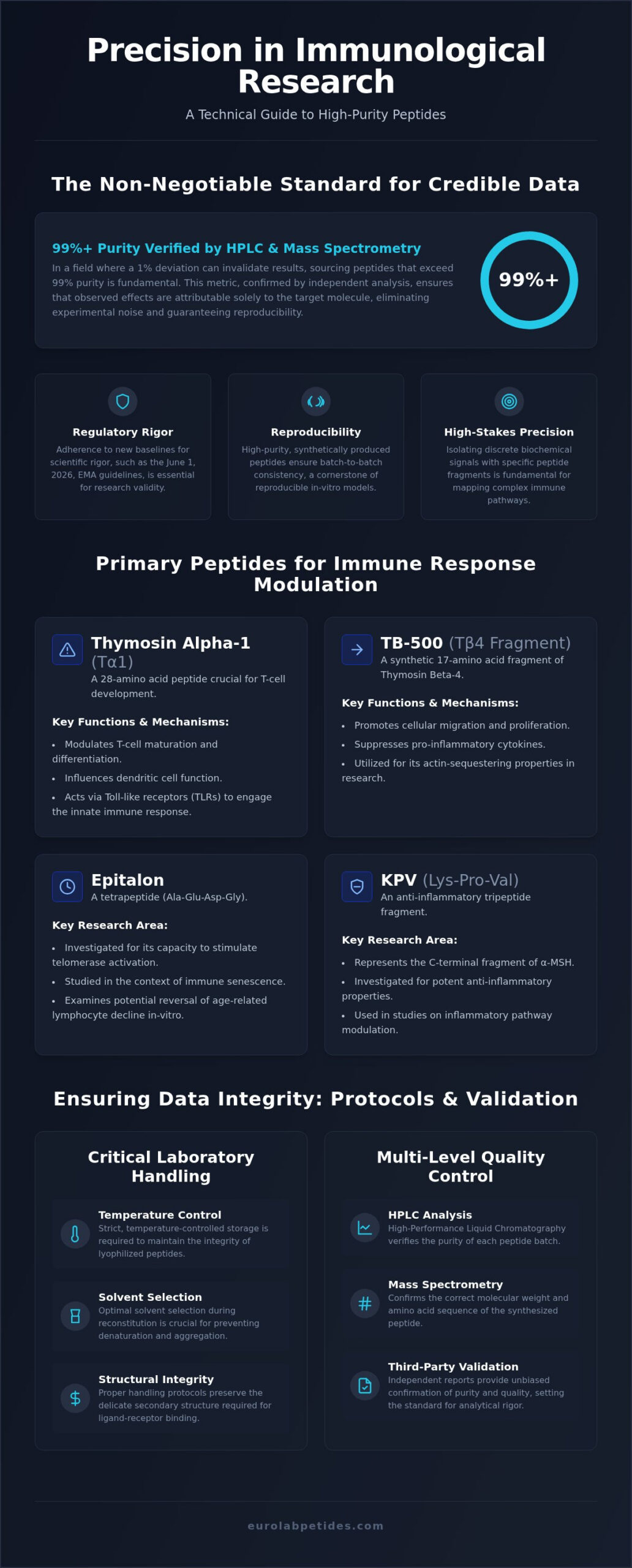
The identification of specific ligands is critical for advancing peptides for immune system research. Among the most extensively documented compounds are the thymic peptides. Thymosin Alpha-1 (Tα1) is a 28-amino acid peptide that modulates T-cell maturation and dendritic cell function. It acts through Toll-like receptors (TLRs) to influence the innate immune response. Epitalon, a tetrapeptide with the sequence Ala-Glu-Asp-Gly, is investigated for its capacity to stimulate telomerase activation. This mechanism is studied in the context of immune senescence, where researchers observe the potential reversal of age-related lymphocyte decline in controlled in-vitro models.
Thymosin-Derived Peptides in Laboratory Studies
Thymic peptides are isolated from the thymus gland or synthesized as precise analogues to ensure experimental consistency. A distinction is made between naturally occurring Thymosin Beta-4 (Tβ4) and its synthetic derivative, TB-500. While Tβ4 is a full-length 43-amino acid protein, TB-500 typically refers to the active 17-amino acid fragment. This fragment is utilized to study cellular migration and the suppression of pro-inflammatory cytokines. Current research trends prioritize these molecules for their actin-sequestering properties and their role in wound healing assays. Synthetic variants are preferred in laboratory settings to eliminate the variability associated with biological extraction processes.
KPV and Anti-Inflammatory Research
KPV (Lysine-Proline-Valine) represents the C-terminal fragment of alpha-melanocyte-stimulating hormone (α-MSH). It interacts with the MC1R receptor, which is expressed on various immune cells. This interaction is linked to the inhibition of the NF-κB pathway, leading to a reduction in pro-inflammatory cytokine production. For a comprehensive analysis of these biochemical pathways, researchers may consult data on What is KPV Peptide’s Role in Inflammation Studies?. The study of Peptides and Peptidomimetics as Immunomodulators confirms that these small molecules provide a high degree of specificity compared to broader pharmacological agents. KPV’s small molecular size and high stability make it an ideal candidate for studying cytokine suppression in complex cell cultures.
Maintaining analytical rigor is non-negotiable for reproducible results. Researchers requiring verified materials for these studies can access 99%+ pure Immune System Research sequences through EuroLab’s validated catalog. Utilizing high-purity peptides for immune system research ensures that biochemical observations are the result of the target molecule rather than batch contaminants.
Biochemical Mechanisms: Cytokine Signaling and T-Cell Regulation
The efficacy of peptides for immune system research is often measured by their ability to modulate the Th1/Th2 balance within in-vitro models. This equilibrium is central to the adaptive immune response. When researchers introduce specific synthetic sequences, they observe shifts in the production of pro-inflammatory cytokines such as TNF-α, IL-6, and IL-1β. These molecules also influence Toll-like receptor (TLR) signaling pathways, which serve as the primary sensors for innate immune activation. By interacting with TLRs, peptides can either amplify or dampen the initial inflammatory cascade, providing a controlled environment for studying immune sensitivity. Macrophage polarization represents another critical area of investigation. Peptides are utilized to study the transition between M1 pro-inflammatory and M2 pro-resolution phenotypes. This shift is essential for understanding how the immune system transitions from an active defense state to a tissue repair phase. Researchers utilize these models to determine the precise concentration-response curves required for achieving polarization without inducing cellular toxicity.
Intracellular Signaling Pathways
Intracellular cascades are a primary focus for analytical rigor. Peptides target the JAK-STAT signaling pathway, the principal mechanism for transmembrane cytokine signaling. By inhibiting specific STAT proteins, these compounds alter gene expression in lymphocytes. The MAPK/ERK cascade is also monitored to assess immune cell activation and proliferation. Research into NLRP3 inflammasome inhibition is critical, as this complex triggers the maturation of IL-1β. Synthetic fragments interfering with NLRP3 assembly allow for the study of chronic inflammatory suppression at the molecular level, providing insights into innate immunity control.
T-Cell Differentiation and Proliferation
Inducing Treg cells is a vital mechanism for maintaining self-tolerance in research models. Peptides facilitate the differentiation of these regulatory cells to suppress effector T-cell activity. This is studied alongside apoptosis in autoreactive lymphocytes, where sequences trigger programmed cell death to prevent non-specific activation. The BPC-157 guide explains how this pentadecapeptide influences tissue-specific immune responses by modulating growth factors and inflammatory mediators. High-purity peptides for immune system research are required to isolate these specific biochemical effects from background experimental noise, ensuring data reproducibility.
Laboratory Protocols: Handling and Reconstitution of Research Peptides
Maintaining the structural integrity of peptides for immune system research is essential for obtaining valid empirical data. Lyophilized peptides aren’t merely powders; they’re delicate chemical structures that require specific environmental controls to prevent degradation. While these molecules remain stable at room temperature during brief transit periods, long-term preservation of the secondary structure necessitates strict thermal parameters. Aseptic preparation must be prioritized to prevent microbial contamination. Such contamination can introduce exogenous proteins that invalidate cytokine expression assays or alter lymphocyte behavior. Repeated freeze-thaw cycles are discouraged because they induce mechanical stress and promote molecular aggregation. Instead, the stock solution should be aliquoted into single-use volumes immediately following the initial reconstitution process.
Optimizing Peptide Stability
Long-term storage of dry peptide powder is best achieved at temperatures between -20°C and -80°C. These ranges minimize residual enzymatic activity and slow chemical degradation. Light sensitivity is a critical variable; peptides should be stored in opaque containers to prevent photo-oxidation. Oxidation of methionine or cysteine residues can significantly alter a peptide’s binding affinity, leading to inconsistent in-vitro results. It’s vital to ensure that storage vials are tightly sealed to prevent moisture absorption. For detailed criteria on identifying high-quality samples, refer to the How to Buy Research Peptides guide.
Reconstitution and Concentration Calculation
The selection of a solvent depends on the specific requirements of the immunological model. Bacteriostatic water is frequently utilized for its antimicrobial properties, while Phosphate-Buffered Saline (PBS) is preferred when maintaining a physiological pH is necessary for bioactivity. Solubilizing peptides for immune system research often requires careful adjustment of the pH, as hydrophobic sequences may precipitate in neutral buffers. Precise molarity must be calculated to ensure that the concentration applied to cell cultures remains consistent with the experimental design. Utilizing a peptide reconstitution calculator facilitates these complex calculations and reduces the risk of human error during research planning. High-stakes precision in immunological studies requires materials that meet these rigorous handling standards. Researchers can source 99%+ pure immune research peptides from EuroLab to ensure baseline analytical consistency across every batch.
EuroLab Peptides: Ensuring Analytical Rigor in Immune Research Sourcing
Analytical rigor is the cornerstone of reproducible science. For investigators utilizing peptides for immune system research, the validity of a study’s conclusion depends entirely on the chemical identity and purity of the ligands used. EuroLab Peptides implements a multi-level quality control protocol that mandates independent validation for every batch. This process eliminates the inherent bias of in-house analysis and ensures that every vial conforms to a 99%+ purity benchmark. By prioritizing objective data over anecdotal claims, the brand establishes a foundation of absolute security for the professional user. This commitment to transparency is essential in a market where specialized technical terminology must be backed by verifiable metrics.
Third-Party Laboratory Validation
In-house testing alone is insufficient for professional research environments due to the potential for internal error and lack of external accountability. Independent third-party validation provides an unbiased metric of quality that instills trust. High-Performance Liquid Chromatography (HPLC) is utilized to assess purity by separating chemical components based on their interactions with a stationary phase. A single, sharp peak on the HPLC chromatogram indicates a homogeneous sample free from synthesis byproducts. Mass Spectrometry (MS) is then employed to verify the amino acid sequence accuracy by measuring the mass-to-charge ratio of the ions. This dual-verification process ensures that the molecular weight and sequence identity match the theoretical specifications exactly.
Sourcing Peptides for Specialized Research
EuroLab Peptides specializes in providing research-grade sequences within the Immune System Research category. Every product is strictly for in-vitro research and laboratory development only, adhering to the June 1, 2026, EMA guidelines for synthetic peptide standards. Regional European manufacturing ensures that high-end craftsmanship is combined with localized logistical efficiency. This proximity reduces transit times and maintains the cold-chain requirements necessary for preserving peptide stability during delivery. Transparent analytical reports are provided for every batch, allowing researchers to verify batch-specific HPLC and MS data before beginning their protocols. This proof-first flow respects the user’s intelligence and the high-stakes precision of their work.
The commitment to radical honesty is demonstrated through the public availability of these empirical results. You can explore our full range of Immune System Research peptides to identify the specific tools required for your next laboratory study. By integrating specialized technical terminology with verifiable metrics, EuroLab serves as a meticulous partner for the global scientific community, ensuring that every research stack meets the highest standards of analytical rigor.
Advancing Immunological Precision Through Analytical Excellence
The evolution of immunological research depends on the transition from broad protein analysis to the precise application of synthetic ligands. Successful in-vitro models require a meticulous understanding of cytokine signaling and T-cell regulation pathways. By utilizing high-purity peptides for immune system research, investigators can isolate discrete biochemical interactions without the interference of synthesis contaminants. Maintaining these standards requires strict adherence to established laboratory protocols regarding storage and reconstitution to preserve molecular integrity.
EuroLab Peptides supports this level of scientific rigor through a proof-first methodology. Every batch is subjected to independent third-party laboratory testing to ensure 99%+ purity verified by HPLC and MS analysis. Specialized European research logistics are utilized to facilitate the secure delivery of these elite tools to the global community. You can Browse Analytical Grade Peptides for Immune Research to secure materials that meet the highest standards of chemical synthesis. Precision in the laboratory remains the most reliable path toward significant discovery.
Frequently Asked Questions
What are the most common peptides used in immune system research?
The most frequently utilized compounds include Thymosin Alpha-1, TB-500, and KPV. These sequences are synthesized to study discrete immune signaling pathways without the complexity of whole-protein interactions. Researchers prioritize these specific fragments to observe their influence on T-cell maturation and cytokine expression in-vitro. Every sequence must be verified for identity and purity to ensure that experimental data remains consistent across different laboratory batches and research models.
How do peptides modulate the inflammatory response in laboratory models?
Peptides modulate inflammation by acting as ligands for specific cell-surface receptors, such as Toll-like receptors or melanocortin receptors. This binding often leads to the inhibition of pro-inflammatory cascades like the NF-κB pathway. In laboratory models, this results in the measurable suppression of cytokines such as TNF-α and IL-6. Researchers also utilize these tools to observe macrophage polarization, specifically the transition from pro-inflammatory M1 to pro-resolution M2 phenotypes.
Why is 99%+ purity essential for immunological peptide research?
Achieving 99%+ purity is critical because even minor synthesis byproducts can introduce significant experimental noise. Impurities may trigger non-specific immune responses in cell cultures, leading to false-positive data or skewed results in cytokine assays. High-purity peptides for immune system research ensure that all observed biochemical changes are directly attributable to the target amino acid sequence. This level of analytical rigor is necessary for the reproducibility required in professional scientific publications.
Can peptides be used to study autoimmune disease mechanisms in-vitro?
Peptides are essential tools for investigating the molecular basis of autoimmunity within controlled in-vitro environments. Researchers utilize specific sequences to study the induction of regulatory T-cells and the restoration of self-tolerance. These models allow for the observation of how certain ligands influence the apoptosis of autoreactive lymphocytes. By modulating the Th1/Th2 balance, scientists can map the specific biochemical triggers that lead to or resolve immune-mediated cellular damage.
What is the difference between Thymosin Alpha-1 and Thymosin Beta-4 in research?
Thymosin Alpha-1 primarily serves as an immunomodulator that influences T-cell maturation and dendritic cell function through TLR signaling. In contrast, Thymosin Beta-4 is characterized by its actin-sequestering properties and its role in cellular migration and tissue repair. While Tα1 is a 28-amino acid sequence, research often utilizes the 17-amino acid fragment of Tβ4 known as TB-500. These molecules target distinct pathways within the broader immunological framework in laboratory settings.
How should lyophilized peptides for immune research be stored long-term?
Long-term preservation of lyophilized peptides requires storage at temperatures between -20°C and -80°C to minimize enzymatic degradation. Vials must be kept in opaque containers because many sequences are sensitive to photo-oxidation, which can alter their binding affinity. It’s also vital to maintain a moisture-free environment to prevent hydrolysis. Once reconstituted, the solution should be aliquoted to avoid repeated freeze-thaw cycles that can induce mechanical stress and molecular aggregation.
What role do peptides play in cytokine signaling studies?
Peptides serve as the primary ligands that initiate or inhibit cytokine signaling cascades in research models. They are used to study the JAK-STAT pathway, which is the principal mechanism for transmembrane signaling in immune cells. By introducing specific peptides for immune system research, scientists can observe changes in the MAPK/ERK cascade during lymphocyte activation. This allows for a precise analysis of how signaling molecules dictate gene expression and subsequent cellular responses.
How do I interpret an HPLC report for a research peptide?
An HPLC report is interpreted by examining the chromatogram for a single, sharp peak, which signifies molecular homogeneity. The retention time indicates when the peptide eluted from the column, while the area under the peak provides the percentage of purity. A successful report for research-grade materials should show a purity level of 99% or higher. Any secondary peaks suggest the presence of synthesis byproducts or degraded fragments that could compromise experimental integrity.
