
In 2026, the technical identity of reputable peptide companies Europe is defined not by market presence, but by a commitment to dual-layer analytical validation. Professional researchers recognize that batch-to-batch inconsistency and the risk of degradation during long-distance shipping represent significant threats to experimental integrity. It’s understood that even a minor deviation in purity can invalidate months of rigorous laboratory development. This guide establishes the industry benchmarks for quality and provides a methodology for vetting suppliers based on empirical evidence rather than marketing claims.
A detailed analysis of batch-specific HPLC and Mass Spectrometry data is provided to ensure every vial meets the reporting thresholds established by modern analytical standards. The logistical advantages of regional EU sourcing for maintaining compound stability and the legal landscape surrounding Research Use Only (RUO) chemicals are carefully examined. By the conclusion, you’ll possess a technical framework to identify partners that prioritize transparency, regional regulatory compliance, and verifiable scientific accuracy for your in-vitro research requirements.
Key Takeaways
- Identify the analytical benchmarks that distinguish reputable peptide companies Europe through dual-layer validation and empirical data.
- Master the interpretation of HPLC and Mass Spectrometry metrics to ensure absolute sequence identity and purity for in-vitro research.
- Analyze the impact of regional EU logistics and lyophilization on maintaining peptide stability during transit.
- Differentiate between large-scale CDMOs and specialized research catalog houses to align procurement with laboratory precision requirements.
- Implement a verification framework that ensures strict adherence to 2026 EU regulatory standards for non-clinical research chemicals.
Defining Reputation in the 2026 European Peptide Market
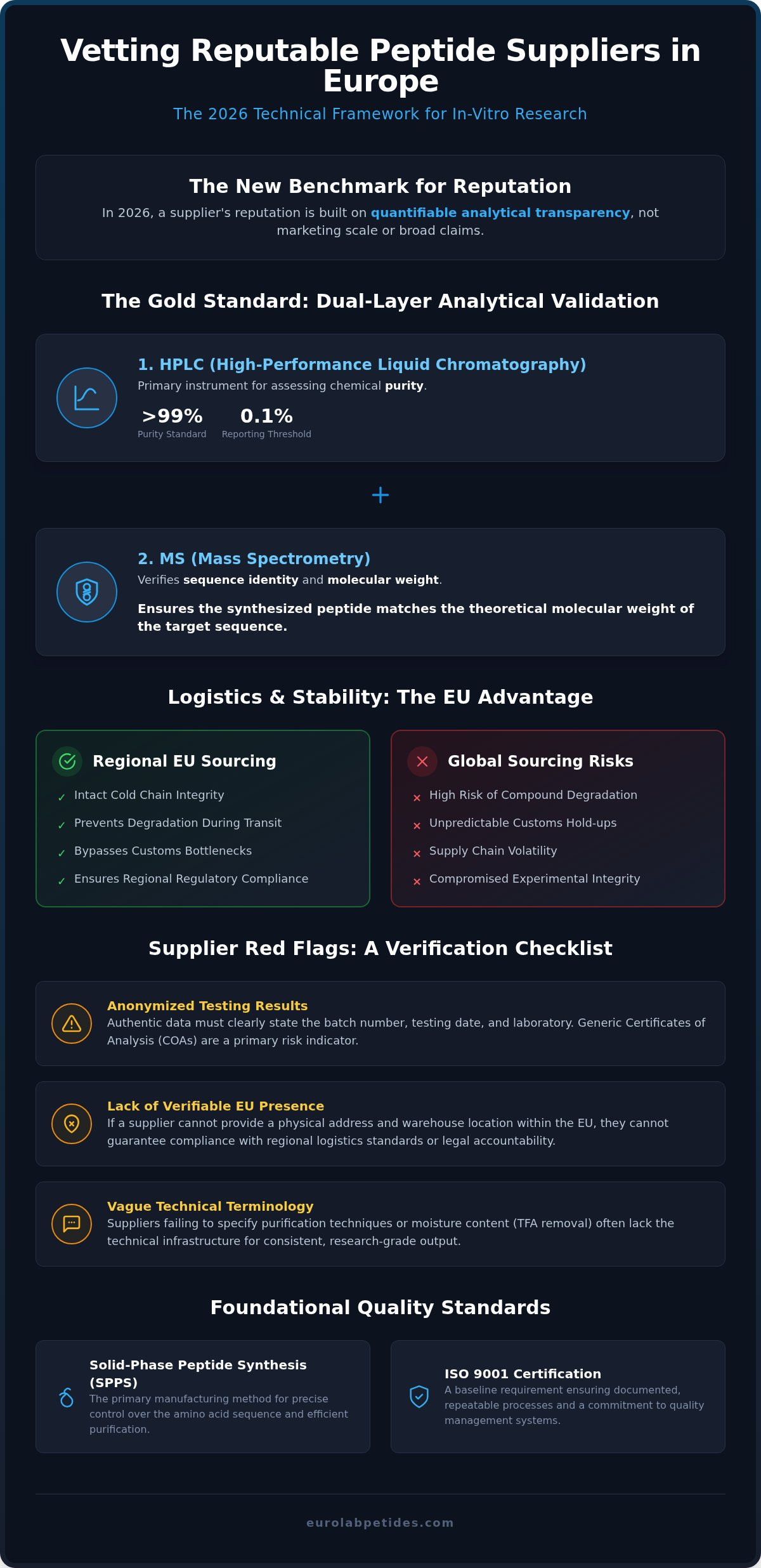
In 2026, the identity of reputable peptide companies Europe is defined by a quantifiable commitment to analytical transparency rather than marketing scale. Reputation is no longer a subjective trait but a verifiable metric based on the depth of provided analytical data. This shift reflects a broader move away from opaque global sourcing toward localized European hubs. Regional manufacturing ensures that the cold chain remains intact. It prevents sensitive sequences from undergoing the degradation risks associated with intercontinental shipping and unpredictable customs hold-ups.
The common assertion of “99% purity” is frequently used as a broad descriptor but lacks scientific utility without empirical evidence. High-Performance Liquid Chromatography (HPLC) remains the non-negotiable standard for purity verification. A reputable supplier provides the full chromatogram for every batch, allowing researchers to evaluate the baseline and identify secondary peaks. In the current landscape, the industry benchmark for high-grade research chemicals mirrors the reporting thresholds of 0.1% found in professional regulatory frameworks. Any supplier failing to provide this level of granularity cannot be considered a reliable partner for high-precision laboratory development.
The Evolution of Research-Grade Standards
Standardized protocols among reputable peptide companies Europe involve rigorous documentation that exceeds the basic requirements of previous years. Most quality-focused providers utilize Solid-Phase Peptide Synthesis (SPPS) as their primary manufacturing methodology. This process allows for precise control over the amino acid sequence and facilitates more efficient purification. The role of ISO 9001 certification has become a baseline requirement for chemical synthesis, ensuring that every step of the process is documented and repeatable. Localized manufacturing in Europe reduces supply chain volatility by bypassing the logistical bottlenecks that often affect global shipments.
Identifying Red Flags in Supplier Claims
Researchers should remain vigilant against specific markers of substandard operations that compromise experimental integrity. Red flags include:
- Anonymized Testing Results: Authentic analytical data must clearly state the batch number, testing date, and the specific laboratory responsible for the analysis. Generic certificates of analysis (COAs) that don’t match the current batch are a primary indicator of risk.
- Lack of Physical Presence: If a supplier cannot provide a physical address and warehouse location within the EU, they cannot guarantee compliance with regional logistics standards or legal accountability.
- Vague Technical Terminology: Suppliers that fail to specify purification techniques or moisture content (TFA removal) often lack the technical infrastructure required for consistent research-grade output.
Reliable partners provide clear, technical specifications for every catalog item. They don’t hide behind ambiguous labels. Instead, they rely on the objective data of technical analysis to establish trust with the professional community.
The Gold Standard: Analytical Validation and Purity Metrics
High-stakes laboratory research requires more than a manufacturer’s assurance; verification must be rooted in empirical analytical methodology. High-Performance Liquid Chromatography (HPLC) serves as the primary instrument for assessing chemical purity. By passing the sample through a stationary phase under high pressure, individual components are separated based on their specific chemical properties. The resulting chromatogram displays peaks representing the target peptide alongside any related impurities. Reputable peptide companies Europe utilize this data to determine the purity percentage by calculating the area under the main peak relative to the total area of all peaks. This provides a quantifiable metric of the sample’s composition.
While HPLC confirms purity, Mass Spectrometry (MS) is required to verify the molecular weight and sequence identity. MS measures the mass-to-charge ratio of ions, ensuring the synthesized substance matches the theoretical molecular weight of the target sequence. Without MS, a sample could theoretically demonstrate high purity while containing the incorrect peptide sequence. These standards align with the EMA Scientific Guideline, which emphasizes the control of synthetic peptides through rigorous analytical characterization. Independent third-party validation is the only method to eliminate internal manufacturing bias. A Certificate of Analysis (CoA) must be generated by an external laboratory to provide an objective assessment of the sample’s integrity. Researchers seeking this level of technical transparency often prioritize providers like EuroLab Peptides, which integrates independent validation into every batch release.
HPLC vs. Mass Spectrometry: A Dual Approach
HPLC identifies the presence of impurities and degradation products that may have occurred during the synthesis or purification stages. MS provides the definitive confirmation that the primary sequence is correct. Both tests are mandatory because high purity is irrelevant if the chemical identity is incorrect, and a correct identity is useless if the sample is contaminated.
The Importance of Batch-Specific Testing
The use of “representative” samples is a significant risk in research chemical procurement. Batch variability can lead to inconsistent experimental results, particularly in in-vitro studies where precise molar concentrations are required. Authenticity of a third-party report is verified by cross-referencing the batch number on the vial with the digital record on the independent lab’s database. This ensures the data is contemporary and specific to the material in hand. Reputable peptide companies Europe ensure that every unique synthesis run is accompanied by its own dedicated set of analytical data, preventing the use of outdated or non-specific reports.
Reputable Peptide Companies in Europe: A Comparative Analysis
The European peptide synthesis landscape is segmented into three primary categories: large-scale Contract Development and Manufacturing Organizations (CDMOs), specialized research catalog houses, and custom synthesizers. Selection of a partner among reputable peptide companies Europe requires an evaluation of the trade-offs between manufacturing volume, lead times, and the granularity of analytical data. While CDMOs prioritize industrial scalability and Good Manufacturing Practice (GMP) compliance for pharmaceutical applications, research catalog houses focus on providing high-purity, lyophilized reagents for non-clinical laboratory use. Regional hubs in Germany, Switzerland, and Belgium dominate the sector. Germany maintained a 24.6% market share in 2024, followed by Switzerland at 19.3%, establishing these nations as the primary centers for chemical synthesis and distribution within the EU.
Logistical efficiency is heavily influenced by a supplier’s proximity to these central hubs. Providers operating within the Schengen Area offer a significant advantage by eliminating the customs delays and temperature fluctuations associated with intercontinental transit. Researchers are encouraged to utilize the how to buy research peptides guide to establish a standardized vetting protocol that accounts for these regional variables.
CDMOs vs. Research-Grade Suppliers
Large-scale CDMOs like Bachem are the standard choice for projects requiring metric-ton quantities of Active Pharmaceutical Ingredients (APIs) and extensive regulatory filings. However, these organizations often maintain high minimum order requirements and extended lead times that are incompatible with agile laboratory environments. Agile research suppliers are better positioned for studies involving specialized sequences such as BPC-157 or Ipamorelin. These providers offer rapid procurement and batch-specific documentation without the bureaucratic overhead of industrial-scale manufacturers. Research-grade suppliers prioritize the immediate availability of high-purity catalog items, ensuring that in-vitro studies can proceed without the multi-month delays typical of custom industrial synthesis.
Framework for Evaluating Supplier Reputation
Reputation is quantified through three critical criteria that ensure experimental reproducibility and compound integrity:
- Transparency of Analytical Methodology: A reputable partner provides full access to HPLC and Mass Spectrometry data for every unique batch. This eliminates the uncertainty associated with representative or outdated certificates of analysis.
- EU-Internal Logistics: Reliability is defined by the ability to maintain the cold chain. Suppliers with a physical presence in the EU bypass the risks of degradation during long-haul shipping.
- Technical Support Responsiveness: Access to scientific staff who understand the biochemical properties of the synthesized peptides is essential for troubleshooting and sequence verification.
By applying this framework, researchers can distinguish between high-volume commercial entities and technical partners that prioritize the rigorous demands of the scientific community.
Logistics, Stability, and EU Regulatory Compliance
Peptide integrity is fundamentally dependent on the precision of the supply chain. Unlike more resilient small molecules, synthetic peptides are highly susceptible to chemical degradation through hydrolysis or oxidation when exposed to thermal fluctuations. Reputable peptide companies Europe prioritize localized logistics to mitigate these environmental risks. Shipping from non-EU jurisdictions often results in prolonged transit times and exposure to uncontrolled environments in customs facilities. This exposure can lead to significant peptide cleavage, rendering the sample useless for high-precision in-vitro studies. By maintaining distribution operations within the European Union, suppliers ensure that transit times are minimized and the cold chain is preserved through optimized regional routes.
The risk of heat exposure during intercontinental transport is a primary cause of experimental failure. When peptides are sourced from global providers, they may remain in un-temperature-controlled warehouses for several days. Even a few hours of exposure to high temperatures can compromise the purity levels verified at the point of manufacture. Localized European sourcing effectively eliminates these variables, providing a level of security that is non-negotiable for serious professional inquiry.
Maintaining Peptide Integrity During Transit
Lyophilization is utilized as the standard stabilization method for research-grade peptides during transport. This process involves the removal of water through sublimation under vacuum at low temperatures, resulting in a stable, porous cake. This freeze-dried state is significantly more resistant to thermal degradation than peptides in solution. While lyophilized products are stable at ambient temperatures for short durations, long-term storage requires specific protocols. Upon receipt, researchers should store the vials at -20°C or -80°C to ensure maximum longevity. Sourcing from a partner with regional distribution centers ensures that the time between laboratory synthesis and laboratory receipt is kept to a minimum, preserving the structural integrity of the compound.
Navigating EU Research Chemical Regulations
The procurement of peptides in Europe is governed by a strict distinction between medicinal substances and those designated for “Research Use Only” (RUO). Under EU Directive 2001/83/EC, RUO compounds are not classified as medicinal products because they are not intended for human consumption or clinical applications. Compliance requires that every shipment is accompanied by a Material Safety Data Sheet (MSDS). This document outlines the chemical properties, handling procedures, and safety protocols necessary for institutional laboratory use. Reputable peptide companies Europe facilitate seamless intra-community delivery by managing Value Added Tax (VAT) requirements and providing the necessary documentation for institutional accounting. To ensure your laboratory receives compounds that meet these rigorous logistical and regulatory standards, you can order research-grade peptides from verified European sources.
EuroLab Peptides: A Case Study in Multi-Level Quality Control
EuroLab Peptides serves as a technical benchmark for reputable peptide companies Europe by implementing a transparent, data-driven framework for compound validation. While many global suppliers rely on representative data, this organization utilizes a multi-level protocol that treats quality as a verifiable metric rather than a commercial claim. Regional manufacturing within Europe allows for granular control over the synthesis environment, ensuring that batch-to-batch consistency is maintained through standardized Solid-Phase Peptide Synthesis (SPPS) methodologies. This localized approach effectively eliminates the variability introduced by outsourced production and long-distance logistics.
The commitment to radical transparency is evidenced by the provision of raw HPLC and Mass Spectrometry data for every unique batch. Researchers gain access to the original analytical chromatograms, allowing for the independent verification of baseline stability and impurity profiles. This level of documentation is essential for longitudinal studies where the chemical integrity of the reagent must remain constant across multiple experimental phases. By prioritizing empirical results over marketing hyperbole, the brand projects a persona of accountability that is required for serious professional inquiry.
The Multi-Level Quality Protocol Explained
The verification process begins with Step 1: Internal analytical verification immediately following the purification stage. In-house biochemists conduct initial HPLC and MS analysis to confirm that the target sequence has been achieved and that the primary purity meets internal specifications. Step 2 involves independent third-party blind testing at accredited analytical laboratories. Samples are submitted without identifying information to ensure that the results are entirely objective and free from internal manufacturing bias. This dual-layer validation process ensures that every batch consistently exceeds the 99% purity threshold required for high-stakes laboratory research.
Supporting the European Research Community
The technical demands of modern biochemistry require more than just catalog reagents. EuroLab provides specialized solutions for complex inquiry, including the Longevity Research Stack and Advanced Metabolic Stack, which are designed for multi-target in-vitro studies. Technical support is provided by staff with backgrounds in biochemistry and analytical science, facilitating a peer-to-peer dialogue between the supplier and the research institution. This ensures that technical specifications, such as TFA removal or specific salt forms, are correctly aligned with the experimental design. To ensure the integrity of your next project, explore our certified research peptides for your next in-vitro study.
Advancing Laboratory Precision Through Verified Sourcing
Identifying reputable peptide companies Europe requires a transition from anecdotal trust to empirical validation. It’s established that the 2026 research landscape demands every sequence be supported by batch-specific HPLC and Mass Spectrometry data to ensure absolute purity. Precision is mandatory. By prioritizing regional EU logistics, researchers effectively eliminate the degradation risks associated with intercontinental transit and uncontrolled customs environments. This methodical approach to procurement ensures that in-vitro studies are built upon a foundation of chemical stability and structural accuracy.
Institutional researchers can secure high-purity research peptides from EuroLab Peptides, benefiting from a multi-level quality control protocol and independent third-party laboratory verification. Every shipment is optimized for maximum stability through regional logistics to ensure the integrity of the compound upon receipt. We look forward to supporting your next phase of scientific discovery with the precision your laboratory requires.
Frequently Asked Questions
What makes a peptide company ‘reputable’ in the European market?
Reputation is established through the consistent provision of batch-specific analytical data and regional logistics optimization. A reliable partner within the reputable peptide companies Europe sector maintains physical EU operations to ensure compound stability. This infrastructure facilitates adherence to rigorous reporting thresholds, typically 0.1% for impurities. Transparency in manufacturing protocols and the availability of technical support from biochemists distinguish authoritative providers from opaque global distributors.
Is third-party testing mandatory for research-grade peptides?
While not legally mandated for compounds designated for “Research Use Only,” independent third-party testing is a non-negotiable standard for experimental integrity. This external validation eliminates internal manufacturing bias and confirms the findings of in-house HPLC and Mass Spectrometry analysis. Reputable suppliers utilize third-party laboratories to provide objective verification of purity and sequence identity. Without this documentation, the researcher cannot account for batch variability in high-stakes in-vitro studies.
How do I verify the purity of a peptide batch myself?
Purity verification is achieved by calculating the area under the main peak on an HPLC chromatogram relative to the total area of all detected peaks. Researchers should cross-reference the batch number on the vial with the digital record provided by the independent analytical laboratory. Verification of the molecular weight via Mass Spectrometry is also required to confirm sequence identity. If the provided data doesn’t align with these technical benchmarks, the batch’s reliability remains unverified.
Why is sourcing from within Europe better than importing from overseas?
Sourcing from reputable peptide companies Europe minimizes the risk of structural degradation caused by temperature fluctuations during intercontinental transit. European logistics hubs ensure that the cold chain is preserved and transit times are reduced. This localized approach bypasses the unpredictable customs delays common with non-EU shipments, which often lead to peptide cleavage. Regional sourcing also ensures that the provider is accountable to EU regulatory frameworks regarding chemical synthesis and distribution.
What is the difference between GMP and research-grade peptides?
Good Manufacturing Practice (GMP) peptides are produced under strict regulatory oversight for human or veterinary clinical use, requiring extensive documentation and facility certifications. Research-grade peptides are intended strictly for in-vitro laboratory development and fall under the “Research Use Only” designation. While research-grade compounds don’t require clinical-level filings, they must still demonstrate high purity and sequence accuracy through rigorous HPLC and Mass Spectrometry validation to be suitable for professional scientific inquiry.
How should research peptides be shipped to ensure stability?
Peptides are most stable when shipped in a lyophilized state, which protects against hydrolysis and thermal degradation. Regional shipping within Europe is preferred to maintain a consistent temperature environment and reduce total time-in-transit. While lyophilized cakes are stable at ambient temperatures for short durations, use of insulated packaging and expedited delivery is standard. Upon receipt, laboratory protocols require immediate storage at -20°C or -80°C to ensure long-term chemical integrity.
Can I request raw HPLC and Mass Spec data from a supplier?
Professional researchers are encouraged to request raw HPLC and Mass Spectrometry data for every batch. Transparent suppliers provide these chromatograms and mass spectra as standard documentation to facilitate independent verification of purity and identity. If a company refuses to provide this raw data or offers only “representative” samples, it indicates a lack of analytical accountability. Access to this information is essential for ensuring that the chemical reagents meet the precise requirements of the experimental design.
What are the legal requirements for buying peptides for research in the EU?
Peptides purchased for laboratory use must be designated as “Research Use Only” (RUO) and are not intended for human consumption or clinical applications. Suppliers must provide a Material Safety Data Sheet (MSDS) detailing the chemical properties and handling procedures required for safe laboratory use. Compliance with EU Directive 2001/83/EC ensures these compounds are not classified as medicinal products. Institutional procurement also requires adherence to regional VAT regulations and intra-community delivery protocols for chemical reagents.
