
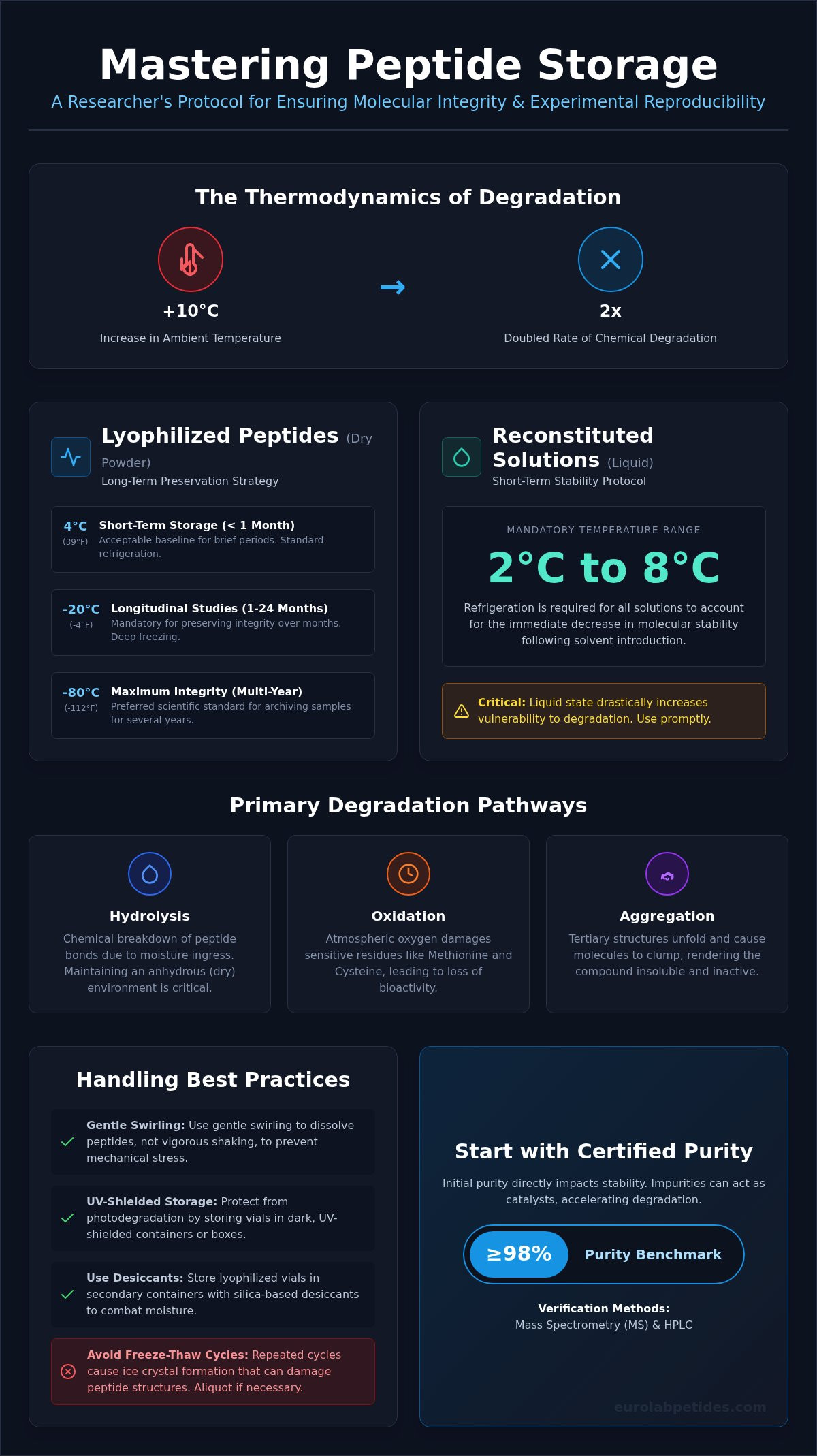
A 10°C increase in ambient temperature can double the rate of chemical degradation for synthetic peptides, effectively neutralizing the precision of high-purity research materials. For the professional researcher, mastering how to store research peptides isn’t merely a logistical detail; it’s a fundamental requirement for experimental reproducibility and the preservation of molecular integrity. You’ve likely encountered the frustration of skewed longitudinal data or the uncertainty that arises when handling multi-dose vials without standardized SOPs. It’s understood that even minor environmental fluctuations can lead to the loss of bioactivity, rendering samples useless for serious inquiry.
This article establishes a rigorous laboratory protocol based on the 2026 EMA quality benchmarks to ensure your peptides maintain their structural profile for 12 to 24 months. We’ll examine the specific thermal requirements for both lyophilized and reconstituted states, the impact of atmospheric safeguards on purity, and the technical methods to mitigate the risks associated with freeze-thaw cycles. By implementing these standardized handling procedures, you’ll secure the reliable data necessary for high-stakes molecular research and objective empirical analysis.
Key Takeaways
- Identify the thermodynamic variables, specifically thermal energy and hydrolysis, that drive peptide bond cleavage and molecular degradation in a laboratory setting.
- Establish standardized temperature benchmarks for lyophilized materials, differentiating between baseline refrigeration at 4°C and the requirements for multi-year preservation.
- Implement mandatory 2°C to 8°C refrigeration protocols for all reconstituted solutions to account for the immediate decrease in molecular stability following solvent introduction.
- Protect tertiary structures from mechanical stress and photodegradation by adopting specific handling SOPs, such as gentle swirling and UV-shielded storage.
- Master the technical requirements for how to store research peptides to ensure laboratory results align with the high-purity benchmarks established by independent third-party validation.
The Thermodynamics of Peptide Stability: Why Storage Protocols Matter
Peptide stability is defined as the rigorous maintenance of the primary amino acid sequence and the specific secondary structure over a defined temporal period. For researchers evaluating What are peptides? in a laboratory context, this stability is the primary metric for ensuring data reproducibility. The degradation of these compounds involves the cleavage of covalent peptide bonds, a process significantly accelerated by thermal energy. Elevated temperatures increase the kinetic energy within the molecular system, which facilitates the overcoming of activation energy barriers for deleterious chemical reactions.
Understanding how to store research peptides requires a fundamental grasp of these thermodynamic principles. Empirical data indicates that a 10°C increase in ambient temperature can double the rate of chemical degradation for most synthetic peptides. To mitigate this risk, lyophilization is utilized as the industry standard for long-term preservation. By removing moisture through sublimation, the peptide is rendered into a solid “cake” that significantly reduces the mobility of reactive species and inhibits spontaneous degradation pathways.
Degradation Pathways in Laboratory Settings
The most prevalent degradation mechanism is hydrolysis. This involves the chemical breakdown of peptide bonds due to moisture ingress, which is why maintaining an anhydrous environment is critical. Oxidation represents another significant risk, particularly for peptides containing Methionine or Cysteine residues. These specific amino acids are highly sensitive to atmospheric oxygen and reactive oxygen species, often leading to the formation of sulfoxides. Additionally, aggregation can occur when tertiary structures unfold, causing molecules to clump together. This physical change often renders the compound insoluble and biologically inactive, effectively terminating its utility for in-vitro analysis.
The Importance of Starting with Certified Purity
The rate of molecular decay is directly influenced by the initial chemical purity of the compound. Impurities remaining from the synthesis process, such as residual solvents or truncated sequences, often act as catalysts that accelerate the degradation of the primary material. Utilizing third-party tested peptides ensures that the starting material meets the ≥98% purity benchmark required for high-stakes research. Before long-term archiving, molecular identity must be verified through Mass Spectrometry (MS) and High-Performance Liquid Chromatography (HPLC). These analytical methods provide the baseline data necessary to distinguish between experimental variables and storage-related degradation, ensuring that the integrity of the research remains uncompromised over the 12 to 24 month storage lifecycle.
Guidelines for Long-Term Storage of Lyophilized Research Peptides
The stability of a lyophilized peptide is contingent upon the maintenance of an environment that minimizes thermal energy and moisture exposure. While lyophilized cakes are often stable at ambient temperatures for brief transit periods, long-term laboratory preservation requires specific thermal stratification. For research spanning less than one month, refrigeration at 4°C (39°F) serves as an acceptable baseline. However, for longitudinal studies requiring 1 to 24 months of storage, deep freezing at -20°C is mandatory. For maximum molecular integrity over several years, storage at -80°C is the preferred scientific standard.
Data from NIBSC peptide handling protocols confirms that moisture is the primary catalyst for hydrolysis in dry samples. Therefore, vials should be stored in secondary containers containing silica-based desiccants. This dual-layer protection ensures that any minor seal failures don’t result in immediate molecular degradation. When considering how to store research peptides, the focus must remain on eliminating the variables that facilitate chemical cleavage.
Managing the Freeze-Thaw Cycle
Repeated temperature fluctuations compromise the delicate lyophilized cake by inducing micro-condensation and structural stress. A critical laboratory protocol involves allowing vials to equilibrate to room temperature in a desiccator before opening. This prevents atmospheric moisture from condensing onto the cold powder, which would immediately initiate hydrolysis. For large-scale projects, it’s advisable to aliquot the material into single-use quantities upon arrival. This strategy minimizes the total environmental exposure for the bulk stock, preserving the baseline purity of high-grade research compounds.
Atmospheric Controls and Vial Integrity
The use of vacuum-sealed vials is a prerequisite for preventing atmospheric oxidation, particularly for sequences sensitive to oxygen exposure. Over extended periods, the integrity of the multi-dose rubber stopper must be monitored; repeated punctures introduce ambient air and potential contaminants. To maintain a stable environment, laboratory peptide archives should be kept at a relative humidity of less than 40%. Ensuring these atmospheric conditions, combined with the how to store research peptides technical standards outlined, provides the security required for serious scientific inquiry.
Handling Reconstituted Solutions: Protocols for Short-Term Stability
The introduction of a solvent to a lyophilized peptide initiates a state of heightened chemical reactivity. This transition from a stable, dry cake to a liquid solution significantly narrows the window of molecular integrity. Once solvated, the peptide’s primary sequence becomes immediately vulnerable to hydrolysis and microbial proliferation. Understanding how to store research peptides in their liquid state is critical for maintaining experimental accuracy. A strict 2°C to 8°C environment must be maintained for all reconstituted solutions. Deviations from this thermal range facilitate rapid proteolysis and a measurable loss in bioactivity.
The stability window varies by compound. For example, BPC-157 demonstrates reasonable stability in solution when refrigerated, yet it remains sensitive to prolonged exposure to ambient temperatures. While lyophilized powders require deep freezing for long-term archiving, freezing reconstituted peptides is generally discouraged. The formation of ice crystals during the freezing process causes mechanical shearing of the delicate molecular chains. This structural damage permanently alters the peptide’s secondary structure, rendering the solution unsuitable for precise in-vitro analysis.
Solvent Selection and Stability Correlation
The choice of solvent directly impacts the longevity of the research solution. Bacteriostatic water, which contains 0.9% benzyl alcohol, is the preferred choice for multi-use vials as it inhibits the growth of bacteria. Sterile water may be used for single-use applications but lacks the preservative properties required for multi-day storage. The pH of the solvent must also be considered; extreme pH levels can cause the peptide to precipitate or aggregate. Researchers should monitor vials for signs of degradation, such as cloudiness, the formation of an amorphous precipitate, or unexpected color shifts. These physical changes indicate that the molecular integrity has been compromised.
Aliquoting for Experimental Consistency
To ensure consistency across longitudinal studies, reconstituted solutions should be divided into single-use laboratory tubes. This aliquoting process reduces the frequency of needle-piercing, which helps maintain an aseptic environment and prevents the introduction of atmospheric oxygen. Each aliquot must be clearly labeled with the date of reconstitution, the concentration, and the specific solvent type used. By minimizing the total number of times a vial is accessed, the risk of contamination is mitigated. Standardizing these handling protocols ensures that the how to store research peptides requirements are met, allowing for reliable, verifiable data in subsequent laboratory procedures.
Laboratory SOPs: Environmental Variables and Handling Hazards
Laboratory Standard Operating Procedures (SOPs) must account for environmental variables that extend beyond simple thermal regulation. Photodegradation represents a significant risk to molecular stability; empirical evidence indicates that exposure to UV light can reduce the potency of specific synthetic sequences by 15% to 25% within a 48-hour window. This cleavage of peptide bonds occurs even under standard fluorescent laboratory lighting, making light-shielding a non-negotiable standard. When refining how to store research peptides, researchers must also mitigate mechanical stress. Unlike robust small molecules, peptides possess fragile tertiary structures that are highly susceptible to kinetic energy.
Standardized handling requires a gentle swirling motion rather than shaking during the reconstitution phase. Shaking induces high-shear forces that lead to protein denaturation or aggregation, often rendered visible by the formation of insoluble filaments. Additionally, the time vials spend outside of controlled thermal environments must be minimized. Utilizing digital data loggers provides a verifiable record of cold-chain integrity. These devices track the internal temperature of storage units at regular intervals, ensuring that any temperature excursions are documented for rigorous quality assurance. Maintaining the integrity of 2026 lots requires adherence to these protocols to meet the 0.1% impurity reporting threshold established by current benchmarks.
Light Shielding and Storage Containers
Amber vials or opaque secondary storage containers are mandatory for sequences known to be light-sensitive, particularly those containing aromatic amino acids like Tryptophan or Tyrosine. Many laboratory refrigerators feature clear glass doors, which expose samples to constant ambient light in high-traffic research areas. This persistent exposure facilitates oxidative pathways that compromise the molecular identity of the compound. Protocols for handling these materials should involve working under dimmed lighting or utilizing foil wraps during the reconstitution process. To ensure your samples meet these rigorous standards, you can source third-party validated research peptides here.
Vibration and Mechanical Integrity
Certain compounds, such as the growth hormone secretagogue Ipamorelin, exhibit high sensitivity to vibration and mechanical agitation. During laboratory transport or centrifugation, these materials must be handled with precision to avoid structural unfolding. Managing the internal vacuum of the vial is equally critical. When introducing a solvent, the vacuum can cause a rapid influx of liquid that aerosolizes the lyophilized powder, leading to significant sample loss. It is recommended to vent the vial with a sterile needle or introduce the solvent slowly along the side of the glass to equalize pressure. Following these how to store research peptides SOPs ensures that the physical and chemical integrity of the sample remains intact throughout the experimental lifecycle.
Sourcing and Cold Chain Integrity: The EuroLab Standard
The efficacy of any laboratory storage protocol is fundamentally limited by the quality of the initial lyophilization process. If the primary synthesis and subsequent freeze-drying fail to achieve a high-purity, anhydrous state, the rate of spontaneous molecular degradation increases regardless of environmental controls. EuroLab Peptides addresses this variable through a multi-level quality control process that integrates independent third-party laboratory testing. This ensures that the baseline purity of every lot meets the rigorous standards required for long-term experimental stability.
Mastering how to store research peptides begins with a supply chain that prioritizes molecular integrity before the material ever reaches the laboratory. EuroLab Peptides maintains a strict cold-chain protocol from the synthesis facility to the end-user. By utilizing batch-specific Certificates of Analysis (COA), researchers can verify HPLC and Mass Spectrometry (MS) data for 2026 lots, ensuring that the material hasn’t undergone thermal degradation during transit. This empirical validation allows for a “proof-first” approach to procurement, where quality is treated as a verifiable metric rather than a subjective claim.
European Standards for Research Chemicals
Adherence to regional regulatory compliance is central to the EuroLab Peptides distribution model. While the EMA Guideline on the Development and Manufacture of Synthetic Peptides (EMA/CHMP/CVMP/QWP/367182/2025) officially applies to medicinal products, it serves as the de facto quality benchmark for our research-grade materials. Localized logistics within Europe drastically reduce transit times compared to intercontinental shipping. This reduction in transit duration minimizes the cumulative thermal exposure of sensitive lyophilized compounds. Standardized packaging protocols, including insulated containers and temperature-monitored logistics, ensure that the how to store research peptides requirements are maintained throughout the delivery lifecycle.
Verifiable Quality for Experimental Accuracy
Analytical science defines the shelf-life baseline of every lot. Through the use of HPLC and Mass Spec, the exact molecular identity and purity levels are confirmed prior to distribution. EuroLab Peptides supports research reproducibility by ensuring batch-to-batch consistency, which is critical for long-term longitudinal studies. Direct-to-lab fulfillment streamlines the supply chain, removing unnecessary intermediary handling that could introduce environmental hazards. This professional efficiency provides investigators with the security that their starting materials align with the high-stakes precision demanded by the specialized scientific community. By providing raw HPLC data and auditable certifications, the brand establishes a persona of radical honesty and accountability in the chemical synthesis space.
Securing Molecular Integrity for Future Research
Maintaining the structural profile of synthetic compounds requires a hierarchical approach to environmental control. The transition from a lyophilized powder to a reconstituted solution represents a critical shift in molecular vulnerability, necessitating a move from deep-freeze archiving to strict 2°C to 8°C refrigeration. By neutralizing the variables of thermal energy, moisture ingress, and mechanical stress, the risk of peptide bond cleavage and subsequent bioactivity loss is minimized. These technical safeguards are the only way to ensure that long-term studies yield reliable, reproducible data.
Implementing these standardized protocols for how to store research peptides ensures that laboratory results remain consistent and verifiable. Storage success is fundamentally linked to the initial purity of the material and the integrity of the cold-chain logistics utilized during transit. EuroLab provides the technical foundation for this stability through a multi-level quality control process and independent third-party validation. These materials are strictly for in-vitro research and laboratory development, supported by European-based logistics to ensure maximum stability upon delivery. Secure the high-purity tools required for your next professional inquiry today.
Browse Third-Party Tested Research Peptides at EuroLab
Frequently Asked Questions
What is the ideal temperature for long-term peptide storage?
For the long-term archiving of lyophilized research peptides, a temperature of -20°C is required to maintain structural integrity for 12 to 24 months. If the research timeline extends beyond two years, storage in an ultra-low freezer at -80°C is mandatory to arrest molecular motion. These thermal benchmarks ensure that the primary sequence remains unchanged, preventing spontaneous hydrolysis and the subsequent formation of truncated impurities that could skew in-vitro experimental results.
Can I freeze research peptides once they have been reconstituted?
Freezing reconstituted peptides in solution is generally discouraged due to the formation of ice crystals. During the freezing process, the expansion of water molecules induces mechanical shearing of the delicate peptide chains, which permanently alters the secondary and tertiary structures. This structural denaturation renders the compound unsuitable for precise laboratory analysis. For optimal stability, reconstituted solutions should be maintained at a strict 2°C to 8°C environment and utilized within the verified stability window.
How long do lyophilized peptides remain stable at room temperature during transit?
Lyophilized research peptides are engineered for high stability and can typically withstand ambient temperatures during transit for one to four weeks without significant loss of bioactivity. However, chemical degradation begins immediately upon exposure to thermal energy, making fast European-based logistics essential for minimizing transit-related risks. Once received, the material should be transferred to a controlled thermal environment to preserve the high-purity baseline established by independent third-party laboratory validation.
Why is bacteriostatic water preferred over sterile water for storage?
Bacteriostatic water, containing 0.9% benzyl alcohol, is preferred for multi-dose vials because it effectively inhibits microbial proliferation. In contrast, sterile water lacks a bacteriostatic agent, making the solution vulnerable to contamination after the first needle puncture. For researchers evaluating how to store research peptides, utilizing bacteriostatic solvents ensures that the solution remains aseptic throughout the experimental period, thereby protecting the molecular integrity of the sample from enzymatic degradation caused by bacteria.
How can I tell if a research peptide has degraded in the vial?
Physical indicators of peptide degradation include the appearance of cloudiness, the formation of amorphous precipitates, or unexpected color shifts within the vial. These changes signify that the peptide has aggregated or undergone significant hydrolysis, rendering it insoluble. While these visual markers are useful, they often appear only after substantial degradation has occurred. Therefore, adherence to standardized storage protocols is the only reliable method for ensuring that the molecular identity matches the batch-specific HPLC data.
Does light exposure significantly impact peptide stability?
Light exposure significantly impacts peptide stability by inducing photodegradation, particularly in sequences containing aromatic amino acids like Tryptophan or Tyrosine. UV radiation provides sufficient energy to catalyze the cleavage of peptide bonds, which can reduce potency by up to 25% within 48 hours. To mitigate this risk, vials must be stored in amber glass or opaque secondary containers. Standard laboratory refrigerators with clear doors should be avoided to prevent constant exposure to ambient fluorescent lighting.
Should I store peptides in a standard freezer or a -80°C ultra-low freezer?
A standard laboratory freezer set to -20°C is sufficient for the preservation of most lyophilized peptides for a duration of 12 to 24 months. However, an ultra-low freezer at -80°C is the preferred standard for long-term archiving exceeding 24 months. The lower temperature significantly reduces the kinetic energy of the system, effectively arresting the chemical pathways that lead to spontaneous hydrolysis. This level of precision is necessary when conducting longitudinal studies that require absolute batch-to-batch consistency.
What is the impact of multiple freeze-thaw cycles on peptide bioactivity?
Repeated freeze-thaw cycles are highly detrimental to peptide bioactivity. Each cycle induces mechanical stress and potential micro-condensation, which facilitates hydrolysis even in lyophilized samples. When considering how to store research peptides, aliquoting the material into single-use vials is the most effective strategy for minimizing total environmental exposure. This protocol ensures that the bulk stock remains undisturbed at a constant temperature, preserving the structural profile and ensuring the accuracy of in-vitro experimental data.
