
The assumption that systemic endocrine disruption is an unavoidable byproduct of growth hormone modulation is officially obsolete. While the somatotropic axis offers significant potential for metabolic study, the primary challenge in AOD-9604 research remains the precise isolation of fat-burning mechanisms from the unwanted elevations in IGF-1 and blood glucose levels typical of full-length growth hormones. You’ve likely encountered the significant data gap between anecdotal “bro-science” and the rigorous clinical reality established by the 900 participants involved in historical Phase I and II trials. It’s difficult to maintain experimental integrity when standardized protocols for this specific C-terminal fragment, residues 177-191, are often obscured by non-technical marketing.
This analysis provides the objective data necessary for serious professional inquiry, moving past the ambiguity of discontinued pharmaceutical trials to deliver a validated biochemical profile. We’ll provide a comprehensive breakdown of the peptide’s 1815.1 g/mol molecular structure and its specific lipolytic signaling pathways. Additionally, this guide outlines the rigorous laboratory handling and reconstitution standards required for 2026 research environments. By focusing on empirical metrics rather than speculation, we’ll ensure your laboratory has a clear, standardized framework for evaluating this unique metabolic tool.
Key Takeaways
- Identify the 177–191 amino acid sequence and its 1815.1 g/mol molecular weight as the defining characteristics of this HGH-derived fragment.
- Evaluate the specific lipolytic mechanisms that facilitate adipose tissue breakdown and inhibit lipogenesis within controlled metabolic research models.
- Distinguish the unique profile of AOD-9604 research by its lack of impact on IGF-1 levels and glycemic control compared to full-length growth hormones.
- Apply precise laboratory handling protocols, including -20°C storage for lyophilized powders, to preserve peptide stability and ensure experimental reproducibility.
- Gain insights into the integration of AOD-9604 within the Advanced Metabolic Stack for sophisticated modeling of tissue repair and metabolic function.
Biochemical Profile and Structure of AOD-9604
AOD-9604, or Advanced Obesity Drug 9604, represents a specific C-terminal fragment of the human growth hormone (HGH) polypeptide. It’s designed to isolate the lipolytic effects of somatotropin while bypassing the systemic endocrine consequences often associated with the full-length hormone. AOD-9604 research relies on the precise identification of this C-terminal fragment to ensure experimental accuracy. This AOD-9604 Overview confirms that the molecule specifically targets the 177–191 amino acid sequence. To enhance chemical stability and prevent rapid degradation, a tyrosine residue is added to the N-terminal end. This modification ensures the peptide remains viable during laboratory handling and maintains structural integrity throughout experimental cycles.
The 177–191 Amino Acid Sequence
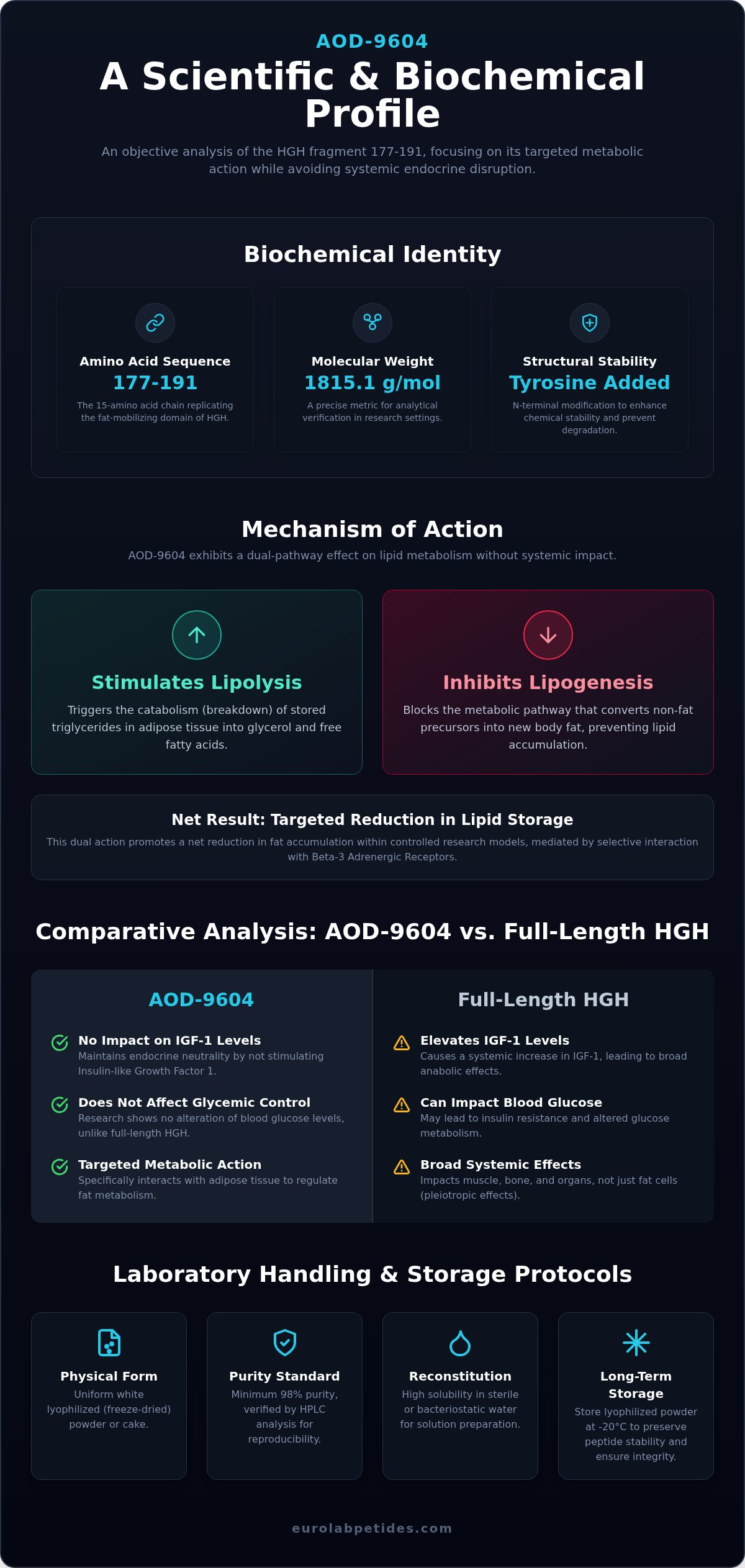
The primary focus of AOD-9604 research involves this precise 15-amino acid chain. It’s synthesized to replicate the fat-mobilizing domain of the HGH molecule. Unlike other growth hormone fragments, AOD-9604 is constrained by a disulfide bridge between cysteine residues. This bridge is critical; it maintains the specific tertiary structure required for receptor interaction in adipose tissue. Without this structural rigidity, the peptide’s ability to stimulate lipolysis would be significantly compromised. The synthetic origin allows for a targeted study of metabolic pathways without the confounding variables of IGF-1 elevation or altered glucose metabolism.
Physical Properties of Lyophilized AOD-9604
In a professional laboratory setting, AOD-9604 is typically encountered as a white, lyophilized powder. This format is preferred for its long-term stability and resistance to thermal degradation. High-purity synthesis is essential for scientific reproducibility, and the following specifications serve as baseline metrics for analytical verification:
- Molecular Weight: Approximately 1815.1 g/mol.
- Purity Level: Minimum 98% as verified by HPLC analysis.
- Solubility: High affinity for sterile or bacteriostatic water.
- Visual Profile: Uniform white lyophilized cake or powder.
Solubility remains a key metric for reconstitution. While the peptide dissolves readily, researchers must monitor pH levels to prevent unintended precipitation. Impurities in the peptide chain can lead to inconsistent data in in-vitro models, which undermines the validity of metabolic research. Using certified research-grade materials ensures that the biochemical profile remains consistent across different study phases.
Mechanism of Action in Metabolic Research Models
The efficacy of AOD-9604 is defined by its high specificity for lipid metabolism. Unlike full-length growth hormone, which exerts broad pleiotropic effects, AOD-9604 research focuses on its ability to stimulate lipolysis while simultaneously inhibiting lipogenesis. This dual pathway makes it a significant subject in the study of metabolic dysfunction. The fragment’s design allows for the isolation of these fat-burning properties without the unintended consequences of systemic growth factors. This isolation is critical for establishing reproducible data in metabolic studies where endocrine neutrality is a requirement.
Lipolysis vs. Lipogenesis Inhibition
In isolated cell cultures, the peptide triggers the catabolism of stored triglycerides into glycerol and free fatty acids. This process, lipolysis, is the primary observed effect in adipose tissue models. Concurrently, the peptide demonstrates an inhibitory effect on lipogenesis, which is the metabolic pathway responsible for converting non-fat precursors into new body fat. By modulating these two opposing pathways, researchers can observe a net reduction in lipid accumulation. This precision is essential for laboratories engaged in Weight Management Research, where the goal is to observe metabolic signaling without confounding variables. Laboratory data consistently shows a reduction in triglyceride levels within these controlled environments, providing a validated metric for assessing the peptide’s impact on cellular fat storage. This makes it a valuable tool for investigating the underlying mechanisms of metabolic syndrome.
The Role of Beta-3 Adrenergic Receptors
The fragment’s metabolic impact is largely attributed to its selective interaction with Beta-3 Adrenergic Receptors. While full-length somatotropin binds to a wider array of receptors, AOD-9604 mimics the specific C-terminal interaction that targets these specific sites in adipose tissue. This selective binding initiates a signaling cascade that activates hormone-sensitive lipase. According to AOD-9604 Safety and Metabolism, this mechanism occurs without inducing the insulin resistance or IGF-1 elevations often seen with broader growth hormone analogs. The resulting metabolic signaling cascade from the 177–191 fragment provides a unique model for studying fat oxidation. This receptor affinity is a cornerstone of AOD-9604 research, offering a pathway for metabolic inquiry that remains distinct from traditional hormonal interventions. It allows for the observation of localized lipid mobilization without the metabolic disruptions characteristic of full-length growth hormone treatments.
Comparative Analysis: AOD-9604 vs. Full-Length HGH
AOD-9604 research demonstrates a critical divergence from the pleiotropic effects of native human growth hormone (HGH). While HGH is a 191-amino acid polypeptide that influences a wide array of physiological processes, AOD-9604 isolates only the lipolytic domain. This functional separation is the primary reason researchers select this fragment over the full-length hormone. The objective is to study lipid mobilization without the systemic endocrine interference that characterizes somatotropic axis modulation. By utilizing a truncated sequence, laboratories can observe metabolic shifts in isolation.
IGF-1 and Mitogenic Risk Assessment
A primary concern in growth hormone research is the induction of cellular proliferation through the elevation of Insulin-like Growth Factor 1 (IGF-1). HGH administration consistently increases systemic IGF-1, which carries significant mitogenic risks. Analytical data from clinical evaluations involving approximately 900 participants confirms that AOD-9604 does not elevate IGF-1 levels. This lack of mitogenic activity is vital for Longevity & Vitality Research, where the goal is metabolic optimization without stimulating unintended tissue growth. This profile is distinct from growth hormone secretagogues, as detailed in Ipamorelin: A Technical Profile. The fragment’s inability to bind to the growth hormone receptor in a way that triggers the IGF-1 cascade ensures a safer profile for long-term cellular studies.
Insulin Sensitivity and Glucose Metabolism
The diabetogenic effect of full-length HGH is a well-documented challenge in biochemical literature. HGH antagonizes insulin action, often leading to decreased insulin sensitivity and elevated blood glucose levels. AOD-9604 research confirms that the 177–191 fragment bypasses these glycemic disruptions entirely. In-vitro models and historical clinical data demonstrate that AOD-9604 maintains a neutral profile regarding carbohydrate metabolism. This allows for chronic administration studies where the longevity and stability of the research model are preserved. Laboratories don’t have to account for induced hyperglycemia or insulin resistance, which are common confounding variables in HGH studies. This metabolic neutrality ensures that observed changes in adipose tissue are a direct result of lipolytic signaling rather than secondary hormonal shifts. It provides a level of precision that full-length somatotropin cannot match.
Laboratory Handling, Storage, and Reconstitution
Standardized laboratory handling is the foundation of reproducible AOD-9604 research. Because peptides are inherently fragile, maintaining structural integrity from arrival to analysis requires strict adherence to thermal and mechanical protocols. Lyophilized AOD-9604 is susceptible to thermal degradation if exposed to ambient temperatures for extended periods. For long-term preservation, the powder must be stored at -20°C. While short-term storage at 4°C is acceptable for up to four weeks, it isn’t recommended for high-stakes analytical work where maximum shelf-life is a priority. These temperature benchmarks ensure the 15-amino acid chain remains stable and biologically active for in-vitro modeling.
Mechanical stability is another critical factor. The disulfide bridge within the AOD-9604 molecule is sensitive to kinetic energy. Vigorous shaking or aggressive mechanical agitation can lead to peptide denaturation, rendering the sample useless for metabolic study. When handling the vial, researchers should use gentle swirling only. This methodical approach protects the peptide’s tertiary structure and ensures that the observed lipolytic signaling in your models is accurate and consistent.
Step-by-Step Reconstitution Methodology
Reconstitution requires precise calculations to achieve desired concentration levels. For a standard 5mg vial, the addition of 2mL of bacteriostatic water yields a concentration of 2.5mg/mL. Bacteriostatic water is generally preferred for its ability to inhibit bacterial growth over multiple uses, though sterile water is sufficient for immediate, single-use in-vitro applications. This Peptide Reconstitution Guide provides further technical specifications for calculating molarity and dosing. During the process, the diluent should be aimed at the glass wall of the vacuum-sealed vial. Allowing the liquid to trickle down slowly prevents the formation of air bubbles and protects the peptide from impact-related degradation.
Ensuring Stability and Purity
Post-reconstitution shelf life is limited. Once the peptide is in a liquid state, it must be stored at 4°C and used within 7 to 14 days. Degradation timelines accelerate significantly if the solution is left at room temperature or exposed to UV light. Light exposure induces oxidation, which can shift the molecular weight from the verified 1815.1 g/mol benchmark. Researchers should monitor for cloudiness, particulates, or discoloration, as these are clear indicators of peptide degradation or contamination. To maintain experimental validity, it’s essential to use third-party tested peptides that arrive with a verified Certificate of Analysis. This external validation confirms the initial purity levels required for serious professional inquiry.
Maintain the highest standards of scientific reproducibility by sourcing certified materials for your Weight Management Research.
Advanced Research Applications and Future Directions
AOD-9604 research is currently expanding beyond its initial focus on adipose tissue reduction. While historical data centered primarily on obesity modeling, contemporary inquiry explores the fragment’s utility in broader metabolic and regenerative frameworks. This shift is driven by the peptide’s endocrine neutrality, which allows for complex multi-peptide modeling without the confounding variables of systemic hormonal disruption. It’s this specificity that makes the 177–191 sequence a primary candidate for sophisticated longitudinal studies.
AOD-9604 in Metabolic Research Stacks
Integration into synergistic protocols is a primary trend in modern laboratory development. Researchers often utilize AOD-9604 within the context of an Advanced Metabolic Stack to observe the interplay between direct lipolytic signaling and broader secretagogue activity. For example, combining this C-terminal fragment with molecules like BPC-157 allows for the simultaneous investigation of lipid metabolism and tissue repair pathways. These multi-peptide protocols are essential for mapping the complex interactions within the somatotropic axis. By isolating specific domains, laboratories can design experiments that target distinct physiological outcomes, such as the relationship between fat oxidation and vascular integrity. This approach ensures that data remains high-resolution and reproducible.
Emerging Frontiers in Cartilage Research
Preclinical research as of September 2026 indicates a growing interest in AOD-9604’s impact on chondrocyte proliferation. Although large-scale human clinical trials in this area are currently absent, it’s clear from in-vitro and animal models that the 177–191 fragment may influence cartilage and joint regeneration. These studies focus on the peptide’s ability to stimulate the synthesis of extracellular matrix components without inducing the systemic growth effects of full-length HGH. For laboratories focused on Tissue Repair & Recovery Research, these emerging frontiers offer a pathway to study osteoarthritic models through a non-mitogenic lens. The focus remains on how the peptide modulates cellular environments to favor repair over degradation.
Future directions for AOD-9604 research also include long-term aging models. By monitoring metabolic health markers such as lipid profiles and insulin sensitivity over extended periods, researchers aim to quantify the peptide’s role in mitigating age-related metabolic decline. This inquiry is particularly relevant for Longevity & Vitality Research, where the objective is to maintain metabolic homeostasis. As analytical techniques become more refined, the scope of C-terminal fragment applications will likely expand into specialized studies of lipid-related disorders. This provides a high-stakes precision tool for the scientific community, ensuring that laboratory results meet the rigorous demands of professional inquiry.
Advancing Metabolic Inquiry with Precision Fragments
The isolation of the 177–191 amino acid sequence represents a significant evolution in the study of somatotropic signaling. AOD-9604 research allows for the targeted observation of lipolytic pathways and the inhibition of lipogenesis without the confounding variables of IGF-1 elevation or glycemic instability. This biochemical specificity is critical for laboratories focused on metabolic modeling where endocrine neutrality is a prerequisite for valid data. As the scope of inquiry expands into cartilage regeneration and synergistic research stacks, the requirement for high-purity, certified peptides becomes even more pronounced.
Experimental success depends on the absolute security of your chemical precursors. EuroLab Peptides maintains the rigorous standards necessary for professional scientific inquiry, providing the technical validation required for reproducible results. Source High-Purity AOD-9604 for Your Research at EuroLab Peptides to access independent third-party laboratory reports and strictly research-grade purity metrics. Our European-based logistics ensure maximum stability from synthesis to delivery, respecting the time and intelligence of the specialized community we serve. We’re committed to providing the elite tools your laboratory needs for precise metabolic analysis.
Frequently Asked Questions
What is the primary difference between AOD-9604 and Fragment 177-191?
AOD-9604 is a stabilized version of Fragment 177-191. It includes an additional tyrosine residue at the N-terminal end to enhance structural integrity. While 177-191 refers to the specific amino acid sequence of the human growth hormone’s C-terminus, AOD-9604 is the technical designation for the analog used in metabolic research. This modification is critical for preventing rapid enzymatic degradation during in-vitro analysis.
How should AOD-9604 be stored to ensure maximum research stability?
Lyophilized AOD-9604 must be stored at -20°C to ensure long-term stability and prevent peptide degradation. For short-term laboratory use, the powder may be held at 4°C for up to four weeks, but sub-zero temperatures are required for maximum shelf-life. Once reconstituted, the solution should be refrigerated at 4°C and utilized within 14 days. Maintaining these thermal benchmarks is non-negotiable for preserving the 1815.1 g/mol molecular profile.
Does AOD-9604 research indicate any impact on insulin sensitivity?
AOD-9604 research confirms a neutral impact on insulin sensitivity and blood glucose levels. Unlike full-length human growth hormone, which can induce a diabetogenic effect, this C-terminal fragment isolates lipolytic action without antagonizing insulin receptors. This metabolic neutrality allows researchers to study fat oxidation pathways without the confounding variable of induced hyperglycemia. It’s a preferred molecule for metabolic models where glycemic stability is a requirement for experimental reproducibility.
What is the recommended reconstitution solvent for AOD-9604 in a lab setting?
The recommended reconstitution solvent for AOD-9604 in a laboratory setting is bacteriostatic water or sterile 0.9% saline. Bacteriostatic water is preferred for multi-use vials as it contains 0.9% benzyl alcohol to inhibit bacterial growth. For immediate, single-use in-vitro applications, sterile water is sufficient. The diluent should be introduced slowly along the vial wall to prevent mechanical agitation and ensure the peptide’s structural integrity remains intact during the process.
Why is third-party testing critical for AOD-9604 research?
In AOD-9604 research, ensuring the absence of contaminants and confirming the exact 177-191 sequence is vital for scientific reproducibility. Independent third-party testing is essential to verify the purity and identity of the peptide through HPLC and MS analysis. EuroLab Peptides utilizes external validation as a non-negotiable standard to provide researchers with empirical proof of quality. This transparency instills security, ensuring that laboratory results are a direct reflection of the molecule’s biochemical properties.
Can AOD-9604 be used in studies focusing on IGF-1 elevation?
AOD-9604 is unsuitable for studies focusing on IGF-1 elevation because it lacks the mitogenic domain required to trigger the IGF-1 signaling cascade. Its primary design isolates the lipolytic C-terminal fragment, intentionally bypassing the growth-promoting effects of full-length somatotropin. Researchers seeking to observe IGF-1 modulation should utilize growth hormone secretagogues instead. AOD-9604 remains a specialized tool specifically for investigating lipid metabolism and adipose tissue breakdown without systemic endocrine disruption.
What are the common concentration levels used in AOD-9604 in-vitro models?
Concentration levels in AOD-9604 in-vitro models typically range between 2.5mg/mL and 5.0mg/mL depending on the experimental protocol. Achieving these levels usually involves reconstituting a 5mg lyophilized vial with 1mL to 2mL of diluent. Precise molarity calculations are necessary to ensure consistent dosing across various cell culture models. Standardizing these concentrations is a prerequisite for generating reliable data within Weight Management Research frameworks where lipid mobilization metrics are the primary focus.
Is AOD-9604 stable at room temperature during laboratory procedures?
AOD-9604 is not stable at room temperature for extended periods and will undergo rapid degradation if exposed to ambient heat. While it may tolerate brief exposure during reconstitution procedures, prolonged intervals at room temperature compromise the peptide’s structural integrity. Researchers must minimize light exposure and thermal fluctuations to prevent oxidation. Maintaining a cold chain during laboratory handling is a standardized requirement to ensure the peptide remains viable for accurate metabolic analysis.
