

Cardarine possesses zero affinity for androgen receptors, yet pervasive gray-market misclassification continues to compromise genuine scientific inquiry. Deploying Cardarine (GW-501516) for metabolic research requires stripping away non-academic narratives to evaluate its verified function as a selective peroxisome proliferator-activated receptor delta (PPARδ) agonist.
If you’ve encountered ambiguous supplier documentation or struggled to reconcile fitness forum speculation with validated in-vitro data, you know that chemical consistency dictates experimental validity. Achieving reproducible cellular assays depends entirely on verified compound identity and precise solubility management. This guide delivers a laboratory-focused analysis of GW-501516, detailing its high-affinity receptor interactions, cellular energetic shifts, and strict in-vitro handling standards.
Ahead, we break down the molecular mechanisms of PPARδ-RXR transcriptional activation, establish controlled reconstitution protocols to mitigate solvent cytotoxicity, and outline the analytical chromatography criteria essential for rigorous preclinical investigation.
Key Takeaways
- Understand the sub-nanomolar binding kinetics and exceptional receptor selectivity of GW-501516 for PPARδ relative to other nuclear receptor isoforms.
- Discover how deploying Cardarine (GW-501516) for metabolic research drives PPARδ-RXR heterodimerization to upregulate fatty acid oxidation cascades and PGC-1α expression.
- Differentiate reproducible in-vitro bioenergetic modulations from historical preclinical rodent safety data to evaluate metabolic parameters within strict non-clinical boundaries.
- Master precise reconstitution protocols using DMSO and organic co-solvents to maintain working vehicle thresholds at or below 0.1% (v/v) during cellular assays.
- Identify rigorous analytical testing benchmarks, including multi-tier HPLC and mass spectrometry verification, essential for validating compound integrity and assay reproducibility.
What Is Cardarine (GW-501516) in Molecular and Metabolic Research?
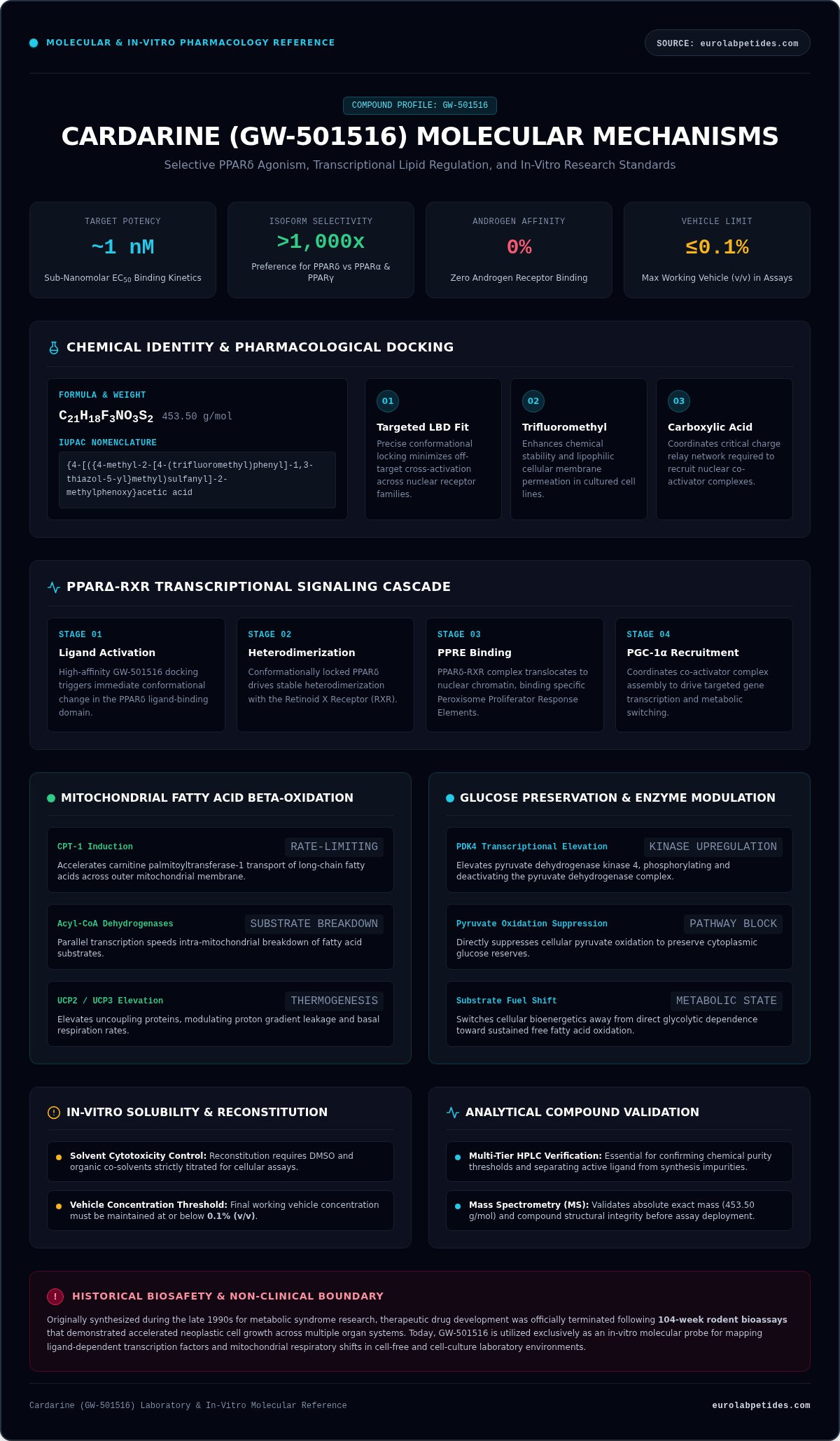
Cardarine (GW-501516) is a synthetic, non-steroidal ligand engineered to selectively activate the peroxisome proliferator-activated receptor delta (PPARδ). Demonstrating a half-maximal effective concentration (EC50) of approximately 1 nM, it exhibits over 1,000-fold functional selectivity for human PPARδ relative to alpha (PPARα) and gamma (PPARγ) isoforms. In contemporary biochemistry, deploying Cardarine (GW-501516) for metabolic research serves as a validated approach for isolating transcriptional lipid regulatory networks. All legitimate scientific investigations remain strictly restricted to in-vitro models and cell-free systems, as the molecule is reserved exclusively for laboratory developmental assays.
Chemical Identity and Structural Pharmacology
Systematic IUPAC nomenclature defines the molecule as {4-[({4-methyl-2-[4-(trifluoromethyl)phenyl]-1,3-thiazol-5-yl}methyl)sulfanyl]-2-methylphenoxy}acetic acid. Possessing the chemical formula C21H18F3NO3S2 and an exact molecular weight of 453.50 g/mol, the compound features a distinct hydrophobic phenoxyacetic acid tail linked to a substituted thiazole ring.
This architecture governs high-affinity stereo-electronic docking within the hydrophobic ligand-binding domain (LBD) of PPARδ. Critical structural parameters include:
- Targeted LBD fit: Precise conformational locking minimizes off-target cross-activation across broader nuclear receptor super-families.
- Trifluoromethyl functionalization: Enhances chemical stability and lipophilic membrane permeation in cultured cell lines.
- Carboxylic acid headgroup: Coordinates the crucial charge relay network required to recruit nuclear co-activator complexes.
Historical Development and the Research-Grade Pivot
Originally synthesized during the late 1990s through joint pharmaceutical research targeting metabolic syndrome, early trials evaluated the compound’s capacity to alter circulating lipids. However, as documented across GW501516 pharmacology and research history, therapeutic development was terminated following 104-week rodent bioassays that demonstrated accelerated neoplastic cell growth across multiple organ systems.
Following this cessation, the agent transitioned from an investigational drug into an essential molecular probe. Utilizing Cardarine (GW-501516) for metabolic research allows biochemists to map ligand-dependent transcription factors, fatty acid oxidation cascades, and mitochondrial respiratory shifts with high pharmacological fidelity.
How PPARδ Agonism Regulates Cellular Energetics
Ligand activation of PPARδ triggers an immediate conformational transition that drives heterodimerization with the retinoid X receptor (RXR). This stable heterodimer translocates to nuclear chromatin, binding specific peroxisome proliferator response elements (PPREs) positioned in the promoter sequences of metabolic target genes. Once bound, the complex coordinates the recruitment of transcription factors, most notably peroxisome proliferator-activated receptor gamma coactivator 1-alpha (PGC-1α). These interactions switch cell bioenergetics away from direct glycolytic dependence, steering cellular pathways toward sustained mitochondrial beta-oxidation.
Transcriptional Control of Fatty Acid Oxidation
Applying Cardarine (GW-501516) for metabolic research stimulates a network of lipid-clearing enzymes. Crucially, the compound induces carnitine palmitoyltransferase-1 (CPT-1) transcription, accelerating the rate-limiting transport of long-chain fatty acids through the outer mitochondrial membrane. Parallel transcription of acyl-CoA dehydrogenases speeds intra-mitochondrial breakdown of lipid substrates.
Concurrently, cellular glucose preservation is enforced through transcriptional elevation of pyruvate dehydrogenase kinase 4 (PDK4):
- PDK4 upregulation: Phosphorylates and deactivates the pyruvate dehydrogenase complex, suppressing cellular pyruvate oxidation.
- Substrate switching: Preserves cytoplasmic glucose reserves while driving elevated baseline utilization of free fatty acids.
- Thermogenic shifts: Elevates uncoupling protein (UCP2, UCP3) transcription, altering cellular proton gradient leakage and basal respiration rates.
Mitochondrial Biogenesis and Skeletal Phenotype Remodeling
Beyond isolated fatty acid catabolism, PGC-1α recruitment triggers comprehensive mitochondrial structural adaptations. As confirmed in the PubChem compound summary for GW 501516, downstream targets coordinate nuclear and mitochondrial genomic programs, enhancing respiratory complex density. In differentiated myocyte cultures, this sustained signaling remodels phenotypes toward oxidative slow-twitch (Type I) characteristics.
Researchers investigating metabolic endurance markers often contrast these nuclear receptor transcriptional profiles with signaling induced by exploratory bioregulators. For laboratories studying related longevity and energetic cascades, surveying the mechanisms of peptides provides a complementary frame of reference for mitochondrial adaptation assays. Procuring analytical-grade ligands from EuroLab Peptides ensures this cellular bioenergetic work remains grounded in high-purity, fully verified research inputs.
Preclinical Findings: Evaluating Metabolic Efficacy vs. Laboratory Biosafety Data
Preclinical evaluations of Cardarine highlight a stark divergence between robust metabolic efficacy and critical biological toxicity. In-vitro experiments consistently show improved glucose tolerance, enhanced insulin sensitivity, and accelerated clearance of lipid fractions. Yet, the translation of these parameters toward clinical settings remains permanently blocked. In prolonged rodent assays, prolonged exposure caused widespread cellular proliferation across multiple tissues. Validating Cardarine (GW-501516) for metabolic research requires contrasting these targeted cellular energetic improvements against established toxicological thresholds.
Observed Metabolic and Lipid Adaptations
In preclinical mammalian cell cultures, ligand activation prompts profound energetic realignments. Primary among these is the robust stimulation of reverse cholesterol transport, driven by elevated high-density lipoprotein (HDL) synthesis and apoA-I expression. Concurrently, researchers observe a distinct anti-inflammatory profile in vascular models.
Key in-vitro bioenergetic shifts documented during cellular nutrient-depletion stress include:
- Cytokine suppression: Inhibits NF-κB transcription, significantly attenuating vascular cell adhesion molecule-1 (VCAM-1) and monocyte chemoattractant protein-1 (MCP-1) expression in endothelial assays.
- Macrophage modulation: Diminishes inflammatory foam cell formation, reducing neutral lipid accumulation in cultured vascular segments.
- Glycogen preservation: Spares finite intracellular carbohydrate stores by enforcing continuous beta-oxidation of exogenous and endogenous free fatty acids.
Toxicological Context: The Rodent Carcinogenicity Data
Translational investigation ceased in 2007 when GlaxoSmithKline reported extensive multi-organ tumorigenesis in long-term safety studies. The comprehensive PubChem compound summary for GW 501516 details this pharmacological arrest. In 104-week bioassays using Han Wistar rats, daily oral dosing between 5 mg/kg/day and 40 mg/kg/day induced rapid, multi-focal neoplastic lesions. Neoplasms appeared in the thyroid gland, gastrointestinal tract, liver, bladder, and reproductive organs.
Online forums often claim these toxicities were simple artifacts of extreme overdosing. Pharmacological allometry refutes that assertion. Calculating the human equivalent dose (HED) reveals that 5 mg/kg/day in rats equates to approximately 50 mg daily for an adult human, a modest multiple of the 10 mg baseline evaluated in human metabolic lipid trials. Because PPARδ drives cell cycle entry, differentiation, and vascular endothelial growth factor (VEGF) signaling, chronic potent agonism systematically lowers the apoptotic threshold.
Consequently, contemporary biochemical consensus restricts this agent strictly to non-clinical, in-vitro protocols. Utilizing Cardarine (GW-501516) for metabolic research allows teams to analyze receptor dynamics under defined laboratory containment, decoupling cellular pathway discovery from in-vivo biological risks.
In-Vitro Experimental Protocols: Reconstitution, Solubility, and Assay Parameters
Aqueous insolubility represents a primary obstacle during benchtop experimentation with Cardarine. The compound exhibits negligible solubility in pure water (less than 0.1 mg/mL), requiring organic co-solvents to achieve stable, homogeneous stock preparations. When deploying Cardarine (GW-501516) for metabolic research, standardized reconstitution protocols must be applied to prevent micro-precipitation upon addition to aqueous culture media. Dimethyl sulfoxide (DMSO) and anhydrous ethanol serve as the primary solvent vehicles for laboratory applications.
Step-by-Step Laboratory Reconstitution Protocol
Executing a reliable reconstitution requires strict adherence to sterile technique and solvent purity benchmarks:
- Gravimetric analysis: Weigh the crystalline powder using a calibrated analytical microbalance within a laminar flow hood, accounting for electrostatic interference.
- Solvent addition: Add 100% molecular-biology-grade, anhydrous DMSO to yield a concentrated stock solution between 10 mM and 25 mM (4.54 mg/mL to 11.34 mg/mL).
- Solubilization: Apply low-speed vortexing for 60 seconds followed by mild ultrasonic water-bath agitation at ambient room temperature until complete optical clarity is confirmed.
- Sterile filtration: Pass the solution through a solvent-compatible, 0.22-micron polytetrafluoroethylene (PTFE) syringe filter to eliminate particulate contaminants before assay introduction.
Storage Stability and Working Concentration Ranges
Hydrophobic small molecules are exceptionally vulnerable to degradation via ambient moisture absorption and cyclic thermal stress. Reconstituted DMSO stocks should be subdivided immediately into single-use, amber microcentrifuge tubes. This eliminates repeated freeze-thaw cycles that destabilize the phenoxyacetic core. Aliquots stored at minus 20 degrees Celsius remain structurally intact for up to six months, while preservation at minus 80 degrees Celsius offers extended empirical stability.
For cellular assays, active working concentrations typically range between 1 nM and 100 nM, aligning directly with the compound’s sub-nanomolar binding kinetics. Researchers must maintain final vehicle concentrations at or beneath 0.1% (v/v) DMSO across all experimental microplate wells. Exceeding this boundary induces non-specific cellular membrane permeabilization, confounding downstream bioenergetic measurements. To establish reproducible parameters in your laboratory, source analytical-grade research compounds tested against strict purity specifications.
Analytical Validation: Sourcing Research-Grade Compounds in 2026
Experimental reproducibility in receptor pharmacology hinges entirely on chemical authenticity. In widespread marketplace distribution, products labeled for investigation frequently fail analytical verification, exhibiting sub-potent active fractions, structural isomers, or heavy solvent carryover. Procuring Cardarine (GW-501516) for metabolic research requires uncompromising verification standards. Academic laboratories must decouple empirical inquiry from unregulated supply chains by enforcing stringent chromatographic and spectrometric testing before committing reagents to cell cultures.
Decoding Certificates of Analysis (COA) for Research Purity
A legitimate Certificate of Analysis provides empirical proof of quality rather than administrative assurance. Investigators must review raw analytical data against established quantitative criteria:
- Chromatographic purity: High-performance liquid chromatography (HPLC) traces must demonstrate an absolute purity threshold of at least 98.0%, preferably exceeding 99.0% for cell-based metabolic assays. Look for a stable baseline, sharp peak symmetry, and the absence of secondary elutions.
- Mass integrity confirmation: Electrospray ionization mass spectrometry (ESI-MS) spectra must resolve the target protonated molecular ion at m/z 453.50 [M+H]+, verifying molecular identity without unassigned fragment peaks.
- Residual solvent quantification: Gas chromatography must confirm that organic synthesis residues, such as dichloromethane or triethylamine, remain beneath established non-toxic thresholds.
These verification standards mirror the analytical rigor applied when researchers buy research peptides and reference compounds for sensitive biochemical assays.
The Role of EuroLab Peptides in Research Infrastructure
European chemical distribution requires strict adherence to localized dispatch protocols and non-clinical handling standards. Operating as dedicated laboratory infrastructure, EuroLab Peptides supplies high-purity biochemicals strictly reserved for in-vitro research and developmental assays. Every compound batch undergoes multi-tier testing, pairing internal synthesis controls with independent European third-party chromatography validation.
Standardized documentation accompanies every research dispatch, giving investigators full visibility into analytical testing data. Sourcing verified Cardarine (GW-501516) for metabolic research through an accountable European partner eliminates ambiguous supply channels, ensuring your cell culture assays rest on pure, fully verified molecular tools.
Advancing In-Vitro Bioenergetics with Analytical Precision
Decoding cellular energetics requires strict methodological discipline at every phase of inquiry. Successfully deploying Cardarine (GW-501516) for metabolic research demands an uncompromised focus on empirical receptor kinetics, meticulous DMSO solvent threshold management, and a firm separation of verified in-vitro pathways from non-academic conjecture. High-resolution cellular assays can’t yield reproducible data without unyielding standards for baseline reagent integrity.
EuroLab Peptides provides the critical infrastructure necessary for rigorous scientific investigation. Operating strictly within non-clinical compliance, our dedicated European supply network delivers analytical standards tailored specifically for academic and institutional research. Independent third-party HPLC and mass spectrometry validation accompany our inventory, ensuring absolute molecular consistency across every experimental series. Equip your upcoming cellular assays with validated biochemical inputs when you review high-purity research compounds at EuroLab Peptides. Standardized chemical precision ensures your metabolic models produce clear, replicable discoveries.
Frequently Asked Questions
What is the primary cellular target of Cardarine (GW-501516) in scientific research?
The primary cellular target is the peroxisome proliferator-activated receptor delta (PPARδ), a ligand-activated nuclear transcription factor. GW-501516 binds human PPARδ with an EC50 of approximately 1 nM, demonstrating over 1,000-fold functional selectivity over PPARα and PPARγ isoforms. Upon activation, the receptor forms an active heterodimer with the retinoid X receptor (RXR), directly initiating transcription of target genes regulating cellular fatty acid oxidation and oxidative phosphorylation complexes.
How does GW-501516 differ biochemically from SARMs (Selective Androgen Receptor Modulators)?
GW-501516 exhibits zero affinity for the androgen receptor, making it mechanistically distinct from Selective Androgen Receptor Modulators. SARMs target androgen signaling pathways to selectively stimulate anabolic transcription in bone and muscle tissue. In contrast, Cardarine operates exclusively through nuclear receptor pathways governing lipid catabolism and mitochondrial respiration. Its frequent categorization alongside SARMs in commercial fitness forums represents an erroneous non-academic classification without biochemical basis.
What solvents are recommended for reconstituting Cardarine in a laboratory setting?
Anhydrous dimethyl sulfoxide (DMSO) and sterile anhydrous ethanol serve as the validated solvents for laboratory reconstitution. Because aqueous solubility is under 0.1 mg/mL, adding water or aqueous buffers directly causes rapid compound precipitation. Primary stock solutions are typically prepared in 100% molecular-grade DMSO at 10 mM to 25 mM. These concentrated stocks require stepwise dilution into pre-warmed culture media to ensure final DMSO exposure levels don’t exceed 0.1% (v/v).
Why was clinical development of GW-501516 discontinued during pharmaceutical trials?
Phase II clinical trials were abandoned in 2007 following 104-week rodent carcinogenicity bioassays that demonstrated accelerated, multi-organ tumor induction. Long-term daily administration between 5 mg/kg/day and 40 mg/kg/day caused widespread neoplastic lesions across hepatic, thyroid, gastrointestinal, and reproductive tissues in Han Wistar rats. Allometric scaling models confirmed these doses were too close to human therapeutic exposure thresholds, presenting an insurmountable biosafety risk that permanently halted pharmaceutical development.
What in-vitro concentration ranges are standard for cell culture bioenergetics assays?
Standard in-vitro assay concentrations range between 10 nM and 1 µM, with 100 nM to 500 nM representing the typical working benchmark. Applying Cardarine (GW-501516) for metabolic research within this threshold stimulates baseline gene expression for CPT1A, PDK4, and UCP3 without triggering solvent-induced cytotoxicity. Dosing below 10 nM often results in incomplete co-activator assembly, whereas exceeding 1 µM introduces risks of non-specific receptor interactions and cellular membrane stress.
Can Cardarine be legally procured for academic and industrial laboratory research?
Yes, qualified research facilities can legally procure GW-501516 exclusively for in-vitro research and laboratory development purposes. The molecule remains unscheduled under the U.S. Controlled Substances Act and European regulatory frameworks. However, introduction into commerce for human therapeutic or dietary use violates drug safety statutes. When acquiring Cardarine (GW-501516) for metabolic research, laboratories must work through verified European distributors that guarantee strict non-clinical compliance and furnish batch-specific analytical documentation.
How should reconstituted Cardarine solutions be stored to prevent chemical degradation?
Reconstituted stock solutions should be portioned into single-use microcentrifuge tubes and stored at minus 80 degrees Celsius, protected from light. Preparing isolated aliquots prevents repetitive freeze-thaw cycles and shields the hygroscopic DMSO vehicle from atmospheric moisture condensation. While dry crystalline material stored desiccated at minus 20 degrees Celsius maintains chemical stability for two to three years, liquid DMSO aliquots held at minus 20 degrees Celsius should be expended within six months.
