

A digital storefront’s Certificate of Analysis is only as dependable as the raw analytical metrics backing it. When sourcing a GHRP-2 research chemical online, principal investigators and procurement specialists routinely confront substantial quality variations, ranging from unaccredited overseas lot batches and filler salts to cold-chain shipping degradation that quietly compromises baseline experimental reproducibility. It’s a persistent operational hazard for research laboratories that can’t afford to compromise protocol validity on mislabeled vials or uncalibrated reagents.
Reliable secretagogue research hinges on verifiable chromatographic metrics rather than vendor marketing claims. This 2026 laboratory procurement guide establishes a comprehensive evaluation framework for acquiring analytical-grade GHRP-2 from verified chemical suppliers. We’ll detail how to audit high-performance liquid chromatography (HPLC) chromatograms and mass spectrometry spectra against the verified 817.9 g/mol synthetic hexapeptide sequence, analyze the operational distinctions between GHRP-2 and alternative secretagogue controls, and ensure your acquisition pipeline aligns strictly with European analytical standards.
Key Takeaways
- Confirm molecular sequence integrity by cross-referencing mass spectrometry data against the 817.9 g/mol theoretical mass and primary hexapeptide structure.
- Audit batch-specific HPLC chromatograms to verify a minimum 98% purity profile before procuring a GHRP-2 research chemical online.
- Differentiate receptor binding affinities and signaling pathways between GHRP-2, GHRP-6, and complementary GHRH analogs for precise experimental design.
- Standardize reconstitution and storage conditions to prevent ambient thermal degradation and protect peptide viability during long-term assays.
- Deploy a multi-tier vendor checklist to ensure strict adherence to European analytical standards and non-clinical research labeling compliance.
Technical Profile and Sequence Identity of GHRP-2
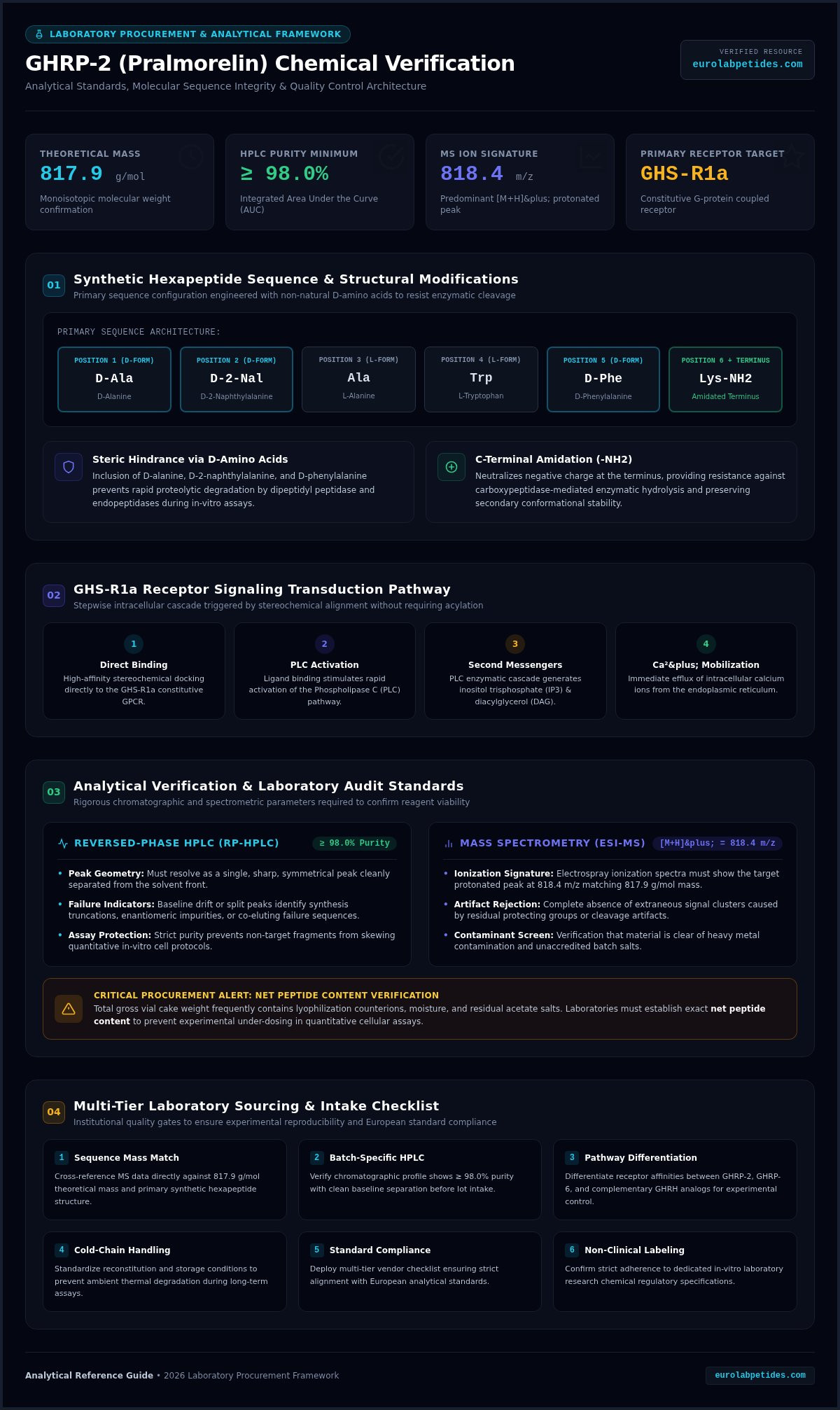
Growth Hormone Releasing Peptide-2 operates as a synthetic hexapeptide engineered specifically to target the growth hormone secretagogue receptor (GHS-R1a). Scientifically designated as Pralmorelin (GHRP-2), the molecule is defined by the strict primary amino acid sequence D-Ala-D-2-Nal-Ala-Trp-D-Phe-Lys-NH2. The strategic inclusion of non-natural D-amino acids, specifically D-alanine, D-2-naphthylalanine, and D-phenylalanine, introduces steric hindrance so it doesn’t degrade readily under proteolytic cleavage by dipeptidyl peptidase and endopeptidases. When procuring a GHRP-2 research chemical online, analytical verification must establish this exact sequence configuration, ensuring all acquired material remains dedicated solely to controlled in-vitro experimental investigations.
Receptor Binding Affinity and GHS-R1a Dynamics
At the cellular level, GHRP-2 exhibits high-affinity binding to the constitutive GHS-R1a G-protein coupled receptor. Unlike native acylated ghrelin, which depends on post-translational octanoylation at serine 3 to trigger receptor internalization, this synthetic hexapeptide activates signal transduction through direct stereochemical alignment. In vitro exposure models demonstrate that ligand binding induces rapid activation of the phospholipase C pathway. This cascade generates inositol trisphosphate and diacylglycerol, prompting an immediate efflux of intracellular calcium ions from the endoplasmic reticulum. Researchers track these intracellular calcium mobilization cascades as standardized quantitative benchmarks for secretagogue activity across cellular assays.
Structural Modifications and Molecular Integrity
Confirming chemical authenticity requires rigorous spectrometry analysis matching the exact monoisotopic molecular weight of 817.9 g/mol. Beyond its core sequence, the molecule features C-terminal amidation (-NH2), a structural modification that neutralizes negative charge at the terminus. This functional amidation prevents carboxypeptidase-mediated enzymatic hydrolysis and maintains secondary conformational stability. Understanding these foundational structural parameters clarifies what are peptides and how engineered modifications preserve chemical integrity during extended assay testing. High-resolution mass spectrometry coupled with chromatographic profiling ensures that laboratory batches of GHRP-2 research chemical online maintain the exact molecular framework required for reproducible non-clinical research.
Analytical Verification Standards for Sourcing GHRP-2 Online
Procuring analytical reagents demands empirical verification rather than passive acceptance of merchant claims. When acquiring a GHRP-2 research chemical online, analytical testing must validate both chemical identity and compound purity before an assay begins. Total vial weight frequently includes lyophilization counterions, moisture, and residual acetate salts, meaning the gross cake mass doesn’t equal active reagent content. Establishing the exact net peptide content prevents under-dosing in quantitative cellular assays. Laboratories establishing institutional intake criteria can review the foundational framework in how to buy research peptides to audit documentation systematically.
Interpreting High-Performance Liquid Chromatography (HPLC)
Reversed-phase HPLC provides the primary separation metric for detecting synthesis truncations and enantiomeric impurities. The chromatogram must display a single, sharp, symmetrical peak resolved from the solvent front. A baseline drift or split peak indicates chemical degradation or co-eluting failure sequences. Acceptance criteria require an integrated area under the curve equal to or exceeding 98.0% purity, ensuring non-target peptide fragments don’t compromise in-vitro observations.
Mass Spectrometry and Mass-to-Charge Ratio (m/z)
Mass spectrometry verifies sequence identity by measuring ionization signatures. Electrospray ionization spectra should display the predominant protonated molecular ion peak [M+H]⁺ at m/z 818.4, alongside resolved adducts matching the target peptide. These spectra must match established Pralmorelin technical data without extraneous signal clusters indicating residual protecting groups, cleavage artifacts, or heavy metal contamination.
Authenticating Vendor Certificates of Analysis (COAs)
Digital documentation must be verified against independent laboratory records to confirm batch authenticity. Laboratories should systematically evaluate incoming documentation using three mandatory verification checkpoints:
- Accreditation Validation: Confirm testing was executed by an accredited analytical facility utilizing validated HPLC-UV and ESI-MS protocols rather than uncalibrated benchtop devices.
- Temporal Alignment: Verify report issuance dates correspond to the current synthesis run rather than recycled documentation from preceding calendar years.
- Batch-Specific Traceability: Match physical vial lot numbers directly to published raw chromatograms, ensuring full sample custody from synthesis through dispatch.
Sourcing from dedicated European distributors like EuroLab Peptides provides direct access to fully traceable, batch-specific analytical testing that satisfies rigorous laboratory standards.
Comparative Assessment: GHRP-2 versus Alternative Secretagogues
Selecting appropriate controls for secretagogue research requires understanding how subtle structural modifications alter receptor interactions. While all growth hormone secretagogues target somatotropic signaling pathways, their kinetic profiles and off-target cross-reactivity differ substantially. Procuring a GHRP-2 research chemical online provides laboratories with a potent compound; however, researchers must account for secondary neuroendocrine interactions that do not occur with alternative peptides. The table below delineates the primary structural and operational distinctions across standard experimental secretagogues:
| Compound | Peptide Class | Primary Receptor | Relative Potency | Off-Target Signaling (ACTH/Prolactin) |
|---|---|---|---|---|
| GHRP-2 | Synthetic Hexapeptide | GHS-R1a | High | Moderate elevation |
| GHRP-6 | Synthetic Hexapeptide | GHS-R1a / CD36 | Moderate | Moderate elevation |
| Hexarelin | Synthetic Hexapeptide | GHS-R1a / CD36 | Very High | Significant elevation |
| Ipamorelin | Synthetic Pentapeptide | GHS-R1a | Moderate-High | Negligible / Undetectable |
GHRP-2 versus GHRP-6 in Experimental Models
GHRP-2 demonstrates significantly higher binding affinity and somatotropic potency than its first-generation predecessor, GHRP-6. This increased potency stems directly from replacing native L-amino acids with sterically constrained D-naphthylalanine residues. In non-clinical metabolic models, GHRP-6 triggers pronounced orexigenic responses due to non-specific hypothalamic cross-talk, whereas GHRP-2 yields a more measured appetite-pathway response. Additionally, GHRP-6 binds the scavenger receptor CD36 with moderate affinity, while GHRP-2 exhibits negligible CD36 interaction. This lack of off-target scavenger binding preserves cellular selectivity in isolated tissue preparations.
GHRP-2 versus Ipamorelin: Selectivity Profiles
The operational divide between GHRP-2 and pentapeptides like ipamorelin centers entirely on neuroendocrine selectivity. GHRP-2 operates as a broad-spectrum secretagogue, triggering downstream transcription that elevates adrenocorticotropic hormone (ACTH), cortisol, and prolactin alongside growth hormone in cellular assays. Conversely, ipamorelin achieves near-complete somatotrope selectivity without altering baseline cortisol or prolactin concentrations. When acquiring a GHRP-2 research chemical online, investigative teams running multi-pathway stress response assays benefit from its broad signaling reach. For assays requiring pure somatotropic isolation, however, ipamorelin serves as the cleaner reference control.
Laboratory Handling, Reconstitution, and Storage Protocols
Preserving the structural integrity of synthetic peptides requires strict adherence to standardized aseptic laboratory techniques. When a GHRP-2 research chemical online arrives at the testing facility, improper reconstitution or thermal exposure can compromise molecular conformation before in-vitro investigations commence. Solvent selection directly influences peptide stability in solution. Reagents should be reconstituted using bacteriostatic water containing 0.9% benzyl alcohol for multi-use analytical assays requiring microbial inhibition. Alternatively, sterile 0.9% sodium chloride or sterile water for injection serves single-timepoint assays. For difficult-to-dissolve sequences, introducing 10% to 30% dilute acetic acid can aid peptide dispersion without cleaving peptide bonds.
Aseptic Reconstitution Technique for Lyophilized Vials
Executing reconstitution systematically minimizes mechanical shear stress across the synthetic hexapeptide chain. Technicians should execute the process following four controlled stages:
- Thermal Equilibration: Allow the sealed lyophilized vial to adjust to ambient room temperature for 20 to 30 minutes, preventing moisture condensation inside the rubber septum upon unsealing.
- Vacuum Equalization: Insert a sterile venting needle through the septum to eliminate internal negative pressure, ensuring diluent doesn’t forcefully crash into the lyophilized cake.
- Wall-Directed Delivery: Introduce the chosen solvent slowly down the inner glass wall using a calibrated pipette rather than applying direct stream force to the powder.
- Gentle Agitation: Swirl the vial with smooth, circular motions until the cake fully dissolves into a clear liquid. Never vortex or agitate vigorously, as turbulent foam formation promotes peptide aggregation.
Thermal Stability and Aliquot Management
Lyophilized GHRP-2 maintains chemical integrity for long-term bench storage when preserved at minus 20 degrees Celsius under desiccant conditions. Once reconstituted, thermal degradation rates accelerate substantially. Liquid solutions reconstituted with bacteriostatic water remain stable for approximately 28 days when refrigerated continuously between two and eight degrees Celsius away from light. To avoid repeating freeze-thaw cycles that denature the hexapeptide backbone, immediately divide stock solutions into low-protein-binding microcentrifuge tubes for single-use aliquoting. Frozen aliquots should be preserved at minus 80 degrees Celsius until needed for assay testing.
For verified research compounds adhering to rigorous synthesis standards, explore analytical-grade peptide solutions from EuroLab Peptides to support your laboratory’s testing requirements.
Vetting Online Chemical Vendors and Procurement Checklist
Procuring institutional reagents requires an objective evaluation methodology that eliminates unqualified distributors. A vendor’s compliance posture determines both reagent reliability and regulatory standing. When sourcing a GHRP-2 research chemical online, institutional procurement teams must verify that packaging displays unequivocal research-use-only labeling, explicitly stating that compounds are intended exclusively for in-vitro laboratory research and development. Vials lacking standardized non-clinical designations or tamper-evident seals present unacceptable chain-of-custody risks.
Before issuing a purchase order, procurement departments should audit candidate suppliers against four essential operational criteria:
- Regulatory Labeling: Clear non-clinical statements reserving compounds strictly for laboratory research and development.
- Thermal Protection Logistics: Climate-controlled packaging protocols that prevent peptide denaturation during ambient transit spikes.
- Batch-Level Custody: Tamper-evident flip-off caps and serialized vial lot numbers linked directly to analytical dossiers.
- Technical Responsiveness: Access to qualified analytical specialists capable of answering chromatography queries within the distributor’s operating region.
Supply Chain Transparency and Batch Integrity
Verifiable supply chain transparency separates dedicated research chemical suppliers from broker storefronts. Reagent stability depends heavily on environmental controls during warehousing and staging. Distributors operating without localized storage facilities often rely on extended shipping models where vials sit exposed to uncontrolled temperature fluctuations in customs clearing centers. Establishing supplier legitimacy requires confirmation of standardized, climate-regulated inventory maintenance and secure tamper-evident seals. When questions arise regarding raw spectral baselines or reconstitution metrics, researchers need direct communication channels with regionally based technical teams rather than automated ticketing queues.
Ordering Verified Research Chemicals via EuroLab Peptides
European research institutions eliminate cross-border customs bottlenecks by partnering with specialized regional suppliers. Sourcing a GHRP-2 research chemical online through EuroLab Peptides ensures all compounds undergo multi-level quality control combining internal validation with accredited third-party laboratory verification. Localized European fulfillment networks maintain temperature-monitored transit conditions, minimizing degradation risks before the product reaches the laboratory bench. Every production lot links directly to batch-specific HPLC and mass spectrometry documentation, confirming 98% or higher purity and sequence fidelity. Research teams can review the comprehensive digital catalog to procure analytical-grade peptides backed by complete batch traceability.
Standardizing Your Laboratory Secretagogue Procurement
Experimental precision in secretagogue modeling depends entirely on verifiable chemical fidelity. Confirming single-fraction purity via baseline-resolved HPLC, cross-referencing mass spectrometry spectra against the 817.9 g/mol target, and enforcing strict reconstitution protocols ensure non-clinical assays yield reliable data. Procuring a GHRP-2 research chemical online shouldn’t force investigators to navigate ambiguous vendor documentation, uncalibrated batch reports, or uncharacterized counterion salts.
EuroLab Peptides eliminates these procurement risks through multi-level quality assurance integrating independent third-party HPLC and mass spectrometry verification across every production run. Supported by a robust European distribution network ensuring rapid cold-chain delivery and stringent analytical compliance, our dedicated catalog provides complete transparency from synthesis through delivery. You can confidently advance your investigative pipeline without worrying about compound degradation or analytical variability. Procure Analytical-Grade GHRP-2 for Laboratory Research to secure traceable, high-purity reagents tailored for uncompromising in-vitro investigations.
Frequently Asked Questions
What is the primary scientific classification and structure of GHRP-2?
GHRP-2 is classified as a synthetic hexapeptide growth hormone secretagogue that functions as an agonist of the GHS-R1a receptor. Its defined primary sequence is D-Ala-D-2-Nal-Ala-Trp-D-Phe-Lys-NH2, featuring non-natural D-amino acid substitutions and C-terminal amidation. These structural modifications confer resistance against rapid proteolytic degradation, yielding a monoisotopic molecular weight of 817.9 g/mol for in-vitro investigative workflows.
How does an analytical laboratory confirm the purity of GHRP-2 purchased online?
Analytical facilities confirm purity by running reversed-phase high-performance liquid chromatography coupled with ultraviolet detection (HPLC-UV). Integrating the primary chromatographic peak against secondary elution artifacts establishes the overall purity percentage. When evaluating a GHRP-2 research chemical online, analytical laboratories require a minimum 98.0% purity threshold alongside electrospray ionization mass spectrometry to rule out synthesis dropouts or residual cleavage reagents.
Why is third-party HPLC analysis essential when evaluating research peptide vendors?
Third-party HPLC analysis provides an unbiased, independent assessment of sample composition that internal vendor reports cannot guarantee. External laboratories verify that the target compound matches its theoretical molecular mass without manufacturer conflict of interest. This multi-level testing identifies counterfeit labeling, baseline integration adjustments, and gross mass overstatements, ensuring laboratories receive reliable chemical reagents for assay replication.
What is the difference in receptor selectivity between GHRP-2 and Ipamorelin?
GHRP-2 acts as a broad-spectrum secretagogue, triggering growth hormone release alongside downstream elevations in adrenocorticotropic hormone (ACTH), cortisol, and prolactin markers. Ipamorelin, by contrast, demonstrates selective somatotrope activation without inducing detectable shifts in baseline ACTH or prolactin concentrations. Investigators select between these molecules based on whether an assay requires multi-pathway endocrine assessment or isolated somatotropic response modeling.
What solvent is recommended for reconstituting lyophilized GHRP-2 in laboratory assays?
Bacteriostatic water containing 0.9% benzyl alcohol serves as the standard solvent for multi-use analytical workflows requiring microbial stasis. For single-timepoint experimental procedures, sterile 0.9% sodium chloride or sterile water for injection is typically preferred. If sequence dissolution proves difficult during initial wetting, adding sterile 10% to 30% dilute acetic acid aids complete solubilization without degrading peptide bonds.
How should reconstituted GHRP-2 be stored to maintain molecular stability?
Reconstituted solutions should be stored between two and eight degrees Celsius under dark conditions, where they remain chemically stable for up to 28 days when prepared with bacteriostatic water. For prolonged timelines exceeding one month, technicians divide the solution into low-binding microcentrifuge tubes and freeze them at minus 80 degrees Celsius. Repeated freeze-thaw cycles must be avoided to prevent covalent backbone denaturation.
Can research-grade GHRP-2 be utilized for in-vivo clinical testing or human consumption?
No, research-grade GHRP-2 is synthesized strictly for in-vitro laboratory experimentation and development applications only. It’s not manufactured under current Good Manufacturing Practice (cGMP) guidelines required for clinical formulations. Distributing or handling a GHRP-2 research chemical online for human consumption, therapeutic interventions, diagnostic administration, or clinical testing violates strict non-clinical compliance standards and supplier terms of sale.
What documentation should accompany a compliant shipment of GHRP-2 research chemicals?
A compliant shipment must include a verifiable, batch-specific Certificate of Analysis detailing HPLC purity percentages and mass spectrometry spectral profiles. The shipment must also feature an updated Safety Data Sheet (SDS) outlining chemical characteristics and storage guidelines. Physical product containers require explicit research-use-only labeling, serialized lot numbers, and intact tamper-evident seals confirming supply chain integrity.
