

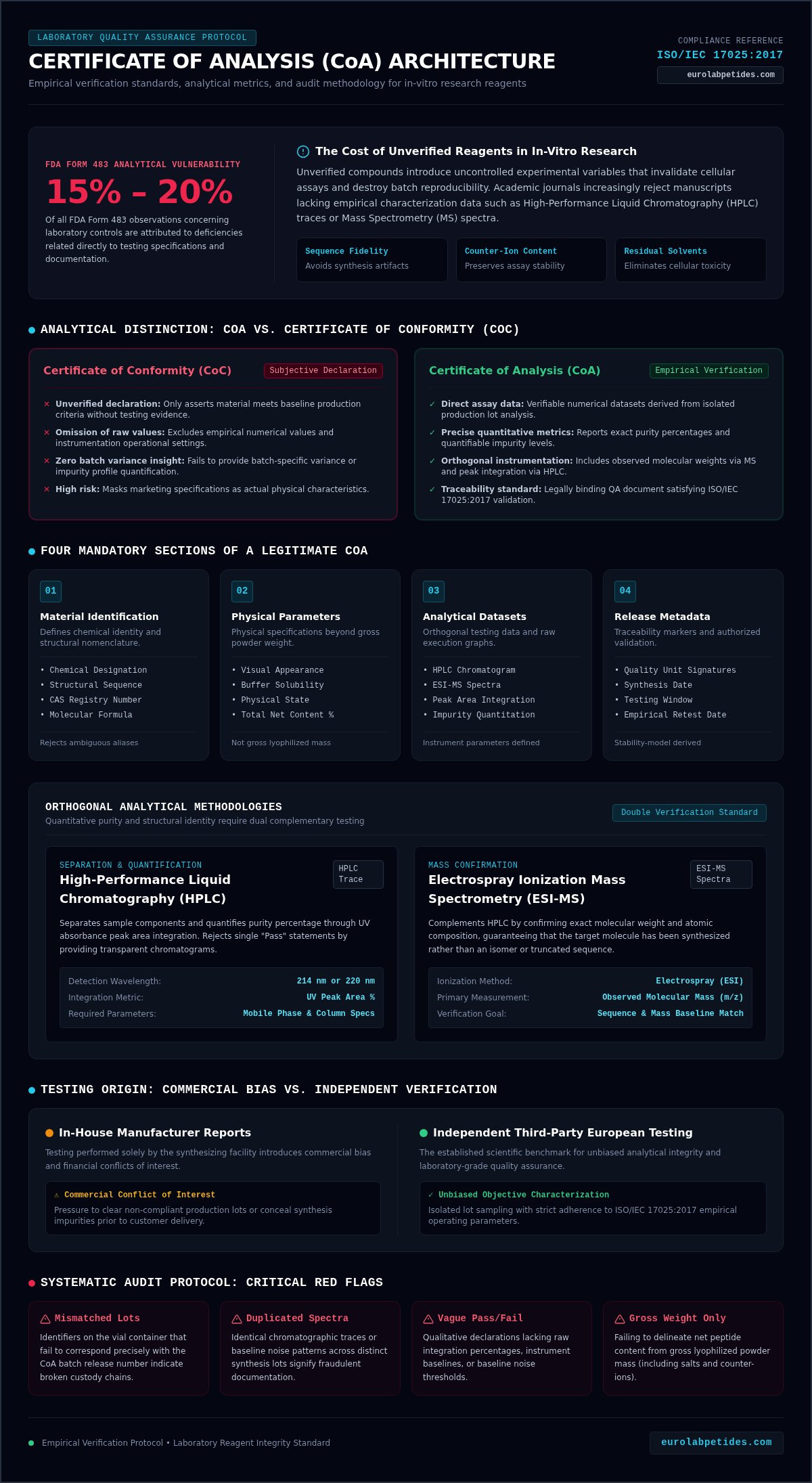
Deficiencies related to testing specifications and documentation account for roughly 15 to 20% of FDA Form 483 observations concerning laboratory controls. For investigators managing rigorous in-vitro studies, unverified reagents don’t just introduce uncontrolled variables; they compromise entire experimental datasets. Understanding what is a certificate of analysis (CoA) goes well beyond archiving routine vendor paperwork. It serves as documented empirical verification, separating genuine chemical purity from contaminated or substandard synthesis. Yet, deciphering complex spectra while distinguishing independent laboratory validation from fabricated supplier paperwork remains an ongoing hurdle.
You shouldn’t have to stake experimental reproducibility on unverified compounds or opaque documentation. In this laboratory guide, you’ll learn how to interpret technical analytical metrics, evaluate High-Performance Liquid Chromatography (HPLC) and Mass Spectrometry (MS) data against empirical baselines, and verify product purity with precision. We preview the critical parameters of certified testing, systematic batch-tracing protocols, and practical methods to detect fraudulent documentation before compounds enter your research protocols.
Key Takeaways
- Understanding what is a certificate of analysis (CoA) provides the empirical baseline necessary to confirm chemical identity, batch purity, and analytical validity for in-vitro research compounds.
- A compliant CoA must feature precise batch identifiers, recognized testing methodologies, and quantitative data rather than ambiguous pass-or-fail declarations.
- Relying exclusively on internal manufacturer reports introduces commercial bias, making independent European third-party laboratory testing the benchmark for rigorous quality assurance.
- A systematic audit protocol allows researchers to detect documentation anomalies, such as mismatched lot numbers or duplicated chromatographic spectra, before compromised materials impact experimental workflows.
- Implementing strict analytical verification standards protects laboratory resources and ensures consistent experimental reproducibility across all investigative phases.
What Is a Certificate of Analysis (CoA) in Scientific Research?
A Certificate of Analysis is an authoritative, legally binding quality assurance document that provides validated empirical test results confirming a substance’s identity, purity, and concentration. In scientific research, clarifying what is a certificate of analysis (CoA) involves looking past standard supply chain paperwork. Unlike static marketing specifications that merely list theoretical targets, a verified Certificate of analysis reflects direct, batch-specific analytical testing performed on an isolated production lot. Empirical evaluation ensures that the physical material matches predefined chemical standards before it enters an experimental pipeline.
Experimental precision demands absolute consistency. When working with research-grade peptides, minor deviations in counter-ion content, sequence fidelity, or residual solvents can invalidate cellular assays and destroy reproducibility. A CoA acts as empirical proof of chemical composition. Regulatory bodies and institutional oversight committees require this documentation to maintain material traceability for in-vitro biochemical reagents, guaranteeing that published observations reflect authentic experimental variables rather than undetected synthesis artifacts.
Definition and Regulatory Purpose
Testing laboratories operate under established quality management systems, predominantly ISO/IEC 17025:2017, to ensure analytical competency and technical validities. High-impact academic journals now routinely reject manuscripts lacking empirical characterization data, such as High-Performance Liquid Chromatography (HPLC) traces or mass spectra. A regulatory compliance document establishes that manufacturing environments observe general statutory rules. In contrast, a technical analytical assay report details quantitative measurements of target molecules, demonstrating analytical validity under documented operating conditions.
Certificate of Analysis vs. Certificate of Conformity
Laboratories frequently confuse a Certificate of Analysis with a Certificate of Conformity (CoC), yet their technical value diverges significantly:
- Certificate of Conformity (CoC): Presents an unverified declaration that a material meets baseline production criteria. It omits raw analytical values, instrumentation settings, and batch-specific variance.
- Certificate of Analysis (CoA): Delivers verifiable numerical datasets derived from direct laboratory assay testing, detailing precise purity percentages, observed molecular weights, and quantifiable impurity profiles.
Rigorous research protocols reject subjective declarations of conformity. Empirical discovery requires granular analytical data to establish reliable scientific baselines across all in-vitro investigative workflows.
Core Components: What Information Must a Valid CoA Contain?
Every legitimate analytical document begins with rigorous material identification. A compliant header specifies the official chemical designation, structural sequence, Chemical Abstracts Service (CAS) registry number, and molecular formula. Crucially, addressing what is a certificate of analysis (CoA) requires tracking physical parameters alongside chemical nomenclature. The document must define visual appearance, solubility in standard reconstitution buffers, physical state, and total net peptide content rather than simply recording gross lyophilized powder weight. Release metadata requires authorized quality unit signatures, synthesis completion dates, testing execution windows, and empirical retest dates based on verified stability models.
Analytical Methodologies: HPLC and Mass Spectrometry
Quantitative purity requires orthogonal testing methodologies. High-Performance Liquid Chromatography (HPLC) separates sample components, quantifying purity percentages through UV absorbance peak area integration at precise wavelengths (typically 214 nm or 220 nm). The report must include the chromatogram, mobile phase parameters, and column dimensions. Complementing HPLC, electrospray ionization Mass Spectrometry (ESI-MS) confirms exact molecular weight, verifying that observed mass-to-charge (m/z) ratios match the calculated theoretical mass precisely without synthesis deletion errors.
Batch Identifiers and Traceability Data
Unbroken material lineage depends on explicit batch identifiers. Each analytical document must link directly to a distinct synthesis run through unique lot numbering matching container labels, a core expectation outlined across standard Good Manufacturing Practice (GMP) guidance. Sourcing in-vitro reagents through verified suppliers like EuroLab Peptides ensures synthesis dates, analytical testing schedules, and temperature-controlled storage parameters align logically, preventing compound degradation before your assays begin.
Evaluating an incoming chemical report requires auditing several foundational fields to verify batch integrity:
- Material Identification: Chemical formula, CAS number, molecular mass, and primary sequence.
- Assay Quantification: Numerical purity percentages via HPLC integration curves and net content calculations.
- Spectrometric Confirmation: Empirical molecular mass verification using high-resolution Mass Spectrometry.
- Chain of Custody Data: Batch lot numbers, authorized quality manager signatures, test dates, and stability storage baselines (-20°C or -80°C).
In-House vs. Independent Third-Party Laboratory Testing
Sole reliance on internal manufacturer testing introduces an undeniable commercial conflict of interest. When the entity synthesizing a compound serves as the sole arbiter of its release criteria, financial pressures can compromise analytical objectivity. True verification requires an independent layer of scientific scrutiny. When determining what is a certificate of analysis (CoA) in a procurement setting, researchers must distinguish between self-issued factory paperwork and unbiased third-party analytical audits. Understanding how to buy research peptides effectively means evaluating suppliers based on multi-tiered validation protocols combining internal synthesis controls with external blind verification.
The Role of Independent Third-Party Verification
Independent testing facilities evaluate chemical lots through blind testing protocols, removing confirmation bias from chromatographic integration. Rather than accepting pre-calculated summary percentages, external labs generate standalone reports with complete raw data profiles. These include baseline-resolved chromatograms, elution profiles, and full spectral acquisitions. Adopting this multi-level validation protocol insulates research budgets from compromised compounds, protecting long-term in-vitro experimental integrity against batches that fail to meet strict stoichiometric targets.
Evaluating Testing Laboratory Accreditations
Competency among testing laboratories isn’t uniform. High-caliber independent facilities operate under ISO/IEC 17025 accreditation, an internationally recognized quality standard reaffirmed in 2023 that governs testing and calibration competence. This certification guarantees regular instrument calibration against national metrology standards and validates analytical methodology. As detailed in the FDA guidance on Certificates of Analysis, verifying supplier documentation requires rigorous laboratory oversight and confirmed testing integrity. External labs participating in Mutual Recognition Arrangements (MRAs) ensure testing outputs maintain verifiable legal and technical standing across international jurisdictions.
A comprehensive procurement assessment demands auditing third-party laboratory credentials against rigorous operational criteria:
- ISO/IEC 17025 Accreditation: Ensures validated analytical methodologies, traceable reference standards, and strict quality management systems.
- Blind Sample Processing: Eliminates commercial bias by withholding expected synthesis values from operating analytical technicians.
- Raw Data Disclosure: Delivers complete baseline-integrated chromatograms and full mass spectra rather than truncated tabular summaries.
How to Audit a Certificate of Analysis: Identifying Red Flags
Confirming reagent validity requires an active, structured intake protocol rather than passive record filing. Understanding what is a certificate of analysis (CoA) involves evaluating the physical authenticity of the document alongside the chemical data. Falsified paperwork frequently mimics official formatting, yet discrepancies appear under forensic review. A standardized verification framework prevents contaminated or mislabeled research reagents from compromising in-vitro experimental setups.
Follow this systematic four-step methodology to audit incoming analytical documentation:
- Audit Physical Identifiers: Match the lot number, compound designation, and physical tare specifications exactly across the vial label, external pouch, and report header.
- Inspect Baseline Noise: Check chromatographic baselines for natural instrument noise; unnaturally smooth, flatlines indicate graphical erasure or template manipulation.
- Recalculate Stoichiometric Values: Verify that reported molecular masses correspond with theoretical amino acid residue weights, accounting for specific counter-ions (such as trifluoroacetate or acetate).
- Conduct Direct Laboratory Inquiries: Cross-reference the unique assay reference number directly with the issuing testing facility to verify the document’s existence in their quality archive.
Common Discrepancies and Forgery Indicators
Document alterations often leave clear visual artifacts. Look closely for mismatched typography, differing font weights, skewed digital alignment, or compression halos around specific numerical purity fields. Fraudulent suppliers frequently reuse a single chromatogram across separate production lots. Because instrument baseline drift and detector noise are fundamentally random, two distinct analytical runs will never produce identical baseline micro-peaks. Any document showing identical chromatograms for separate lots is unequivocally fabricated.
Cross-Referencing and Direct Lab Authentication
Direct communication with the issuing testing facility provides immediate confirmation. Request confirmation that the specific lot identifier, analytical report number, and reported purity match their secure internal records. Confirm that the sample intake date aligns logically with the chemical synthesis timeline; analytical reports dated prior to the recorded synthesis run reveal immediate fabrication. Review raw mass spectra to ensure molecular ion peaks [M+H]+ and sodium adducts align with theoretical chemical calculations.
Evaluating research reagents demands complete transparency. To secure fully documented compounds verified through independent European testing, access authenticated research batches before initiating sensitive laboratory protocols.
The Standard for Analytical Integrity in Chemical Supply
Transparent analytical reporting underpins modern biochemical inquiry. When evaluating what is a certificate of analysis (CoA) within advanced chemical sourcing, researchers recognize it as the primary barrier preventing unverified reagents from invalidating experimental setups. Substandard synthesis runs, residual trifluoroacetic acid (TFA), and undetected truncated sequences cause cell viability anomalies that mimic experimental effects. Comprehensive analytical documentation provides the empirical control needed to isolate genuine biochemical mechanisms from reagent-driven artifacts.
Every certified reagent carries strict operational limitations. Compounds are manufactured and supplied strictly for in-vitro research and laboratory development purposes only; they are never intended for human consumption, clinical application, or therapeutic administration. Adhering to these defined legal and operational boundaries preserves laboratory regulatory compliance while safeguarding institutional integrity.
Rigorous Analytical Protocols for In-Vitro Investigation
Modern quality assurance relies on a multi-tiered verification framework rather than single-point testing. Initial post-synthesis characterization must be corroborated by secondary, independent European laboratory validation. Deploying both High-Performance Liquid Chromatography (HPLC) and Mass Spectrometry (MS) across internal and external environments creates an objective testing standard. This multi-level protocol ensures lot-to-lot consistency, stable net peptide fractions, and authentic chemical structures before materials reach downstream cell lines or enzymatic assays.
Procuring Verified Compounds with Complete Documentation
Analytical transparency should govern every procurement decision. Selecting specialized biochemical suppliers requires evaluating access to verifiable, batch-specific documentation rather than marketing assurances. Direct access to raw spectral data streamlines internal audits, accelerates methodology defense during peer review, and simplifies laboratory compliance records. When procurement focuses on verified analytical data, research teams eliminate chemical ambiguity, protecting experimental repeatability and ensuring every measured cellular response stems from an authenticated compound.
High-integrity sourcing protocols center on several critical quality assurance pillars:
- Strict In-Vitro Boundaries: Explicit restrictions limiting chemical materials exclusively to laboratory development and scientific research workflows.
- Multi-Level Analytical Review: Systematic evaluation utilizing both primary synthesis data and independent European third-party chromatographic verification.
- Direct Traceability: Immediate alignment between physical lot codes, intact cold-chain logistics, and archived raw spectral datasets.
- Reproducibility Assurance: Verifiable empirical baselines that eliminate reagent variance across successive scientific studies.
Securing Empirical Integrity for Future Laboratory Research
Establishing rigorous material intake protocols protects downstream experimental workflows from synthetic artifacts and irreproducible data. Understanding what is a certificate of analysis (CoA) equips research teams to interpret complex chromatographic curves, evaluate purity against theoretical thresholds, and identify manipulated documentation before reagents enter cell culture or assay systems. High-precision research doesn’t rely on unverified supplier claims; it demands transparent, reproducible empirical proof.
Protecting scientific integrity requires an unwavering testing standard. EuroLab Peptides supports biochemical research across Europe through a multi-level quality control protocol combining in-house testing with independent third-party laboratory verification. Every batch comes with complete, batch-specific HPLC and Mass Spectrometry documentation, restricted strictly to in-vitro research and laboratory development use. Review Analytical Standards at EuroLab Peptides to equip your facility with certified compounds that deliver consistent, verifiable scientific outcomes.
Frequently Asked Questions
What is the difference between an analytical CoA and a technical specification sheet?
A technical specification sheet defines the target parameters and acceptable tolerance ranges a manufacturer expects to achieve before production begins. In contrast, evaluating what is a certificate of analysis (CoA) reveals that it captures actual empirical measurements obtained from testing a finished batch. While specification sheets provide static theoretical targets, a CoA presents documented analytical data representing an isolated, real-world synthesis run.
Can a Certificate of Analysis guarantee that a chemical reagent is 100% pure?
No analytical testing protocol can legitimately claim absolute 100% purity. Chemical synthesis inherently produces trace impurities, counter-ions, and bound moisture that modern chromatography detects at finite thresholds. High-purity research materials typically report values exceeding 98% or 99%. A document claiming 100% purity often signals manipulated data or insufficient instrument sensitivity that failed to resolve minor trace components.
How do I interpret the purity percentage reported on an HPLC chromatogram?
Purity percentages on a chromatogram represent the area under the primary analyte peak divided by the total integrated peak area detected at a specific wavelength. Analytical chemists calculate this by integrating all discernible UV absorption peaks above the instrument baseline noise. A confirmed 98% purity indicates that 98% of the detected UV-absorbing material eluting through the column matches the target compound’s retention characteristics.
Why is net peptide content lower than the gross material weight on a CoA?
Net peptide content measures the actual percentage of pure peptide molecules present within the gross lyophilized powder mass. Lyophilized peptides naturally retain counter-ions, such as acetate or trifluoroacetate (TFA), alongside residual hydration water molecules that add physical weight. Consequently, a vial containing 10 milligrams of total dry material may yield an 80% net peptide content, leaving 8 milligrams of active peptide sequence.
How can researchers verify that a third-party CoA is genuine and unaltered?
Authenticating third-party paperwork requires cross-referencing the report reference number and batch lot code directly with the accredited testing facility. Legitimate analytical laboratories maintain secure digital archives of all outbound assay reports. Contacting the issuing quality control director to confirm matching retention times, integration figures, and completion dates ensures that the documentation wasn’t edited or repurposed by an unauthorized reseller.
What are the most common signs of a falsified Certificate of Analysis?
Digital manipulation typically creates telltale graphical errors, such as mismatched typefaces, unnatural alignment around purity figures, and compression artifacts. In chromatographic charts, an entirely flat baseline devoid of instrument background noise indicates graphical erasure. Furthermore, discovering identical chromatograms attached to distinct lot numbers provides indisputable evidence of document forgery, as physical detector noise is never identical across separate runs.
Are Certificates of Analysis required for chemical compounds used in laboratory research?
Institutional protocols and rigorous scientific methods mandate a verified CoA for all experimental reagents. While non-regulated basic research might not face identical statutory penalties as commercial pharmaceutical manufacturing, peer-reviewed journals increasingly demand documented chemical characterization. Understanding what is a certificate of analysis (CoA) ensures experimental reagents possess verified chemical identity, preserving reproducibility across all in-vitro investigative workflows.
What does ISO/IEC 17025 accreditation mean on an analytical testing certificate?
ISO/IEC 17025 accreditation demonstrates that an analytical facility operates under proven technical competence and follows validated testing standards. Unlike generic managerial certifications, this standard confirms that the laboratory employs qualified personnel, uses calibrated analytical instruments, and follows documented data integrity protocols. Analytical figures from an accredited testing facility provide verified evidentiary weight that researchers can depend on during experimental evaluation.
