

Peptide purity is an experimental variable, not a stand-alone quality score. A reported percentage may look reassuring, yet leave a key question unanswered: did the target peptide, or another component in the sample, drive the observed response? The impact of peptide purity on research can extend beyond signal strength, affecting how results are interpreted and whether another lab can reproduce them.
That uncertainty matters when samples, staff time, and laboratory capacity are limited. Researchers need more than a headline purity figure to judge whether a material is suitable for a specific assay. Purity alone also cannot explain every failed experiment.
This article explains how impurities may affect biological activity and experimental interpretation, and why purity claims should be considered alongside identity testing and lot-specific documentation. It also outlines what to check in analytical reports, including the methods and results recorded in a certificate of analysis. Use these checks to compare supplier documentation and reduce avoidable repeat work without treating purity as the only possible source of error.
Key Takeaways
- Purity is a method-dependent measurement. A percentage alone does not establish how a peptide will perform in a particular assay.
- Consider how impurities, degradation, or uncertain content may affect assay interpretation and comparisons across lots.
- Review lot identification, analytical methods, test dates, and reported results. Separate documented findings from claims the report does not establish.
- When investigating an unexpected result, check sample documentation and handling alongside assay controls before attributing the outcome to purity.
- A consistent review process can help limit avoidable repeat work, but documentation supports evaluation rather than guaranteeing experimental success.
Understanding the impact of peptide purity on research results
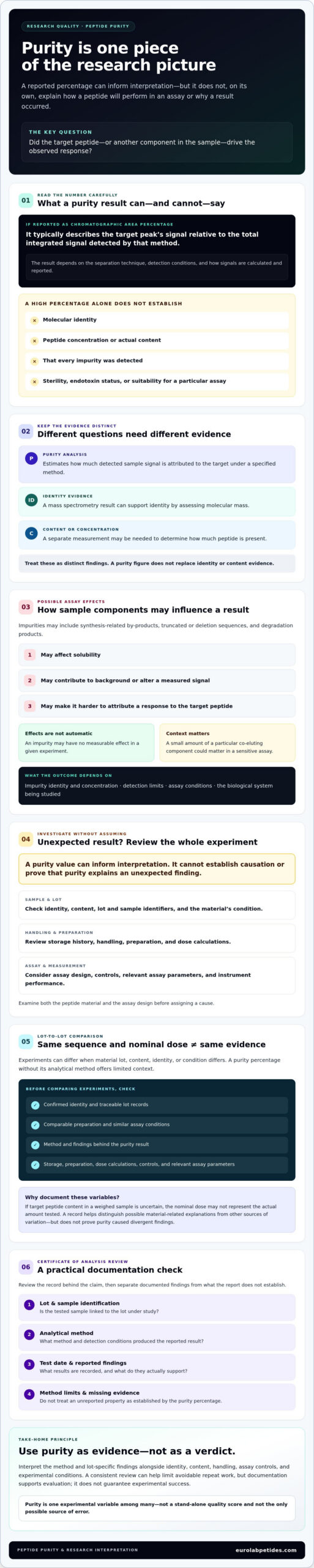
Peptide purity is an analytical estimate of how much of the detected sample signal is attributed to the target peptide under a specified test method. It is not a universal measure of sample quality. The result depends on the separation technique, detection conditions, and how signals are calculated and reported. The impact of peptide purity on research therefore depends on what the measurement captures and how the material behaves in the assay, not just on the stated percentage.
What does a peptide purity result actually measure?
When purity is reported as a chromatographic area percentage, it typically reflects the target peak’s signal relative to the total integrated signal detected by that method. A high percentage does not, by itself, confirm molecular identity, establish peptide concentration, or show that every impurity has been detected. For background on the separation technique, see High-performance liquid chromatography (HPLC).
Identity and quantity require distinct evidence. A mass spectrometry result can support identity by assessing molecular mass, while a separate content or concentration measurement may be needed to determine how much peptide is present. Purity also does not establish sterility, endotoxin status, or suitability for a particular assay. Before interpreting a certificate, check the analytical method, sample identifier, test date, reported findings, and whether the tested sample is linked to the lot under study.
How can impurities affect an assay?
Impurities may include synthesis-related by-products, truncated or deletion sequences, and degradation products. Depending on their properties and concentration, they may affect solubility, contribute to background, alter a measured signal, or make it harder to attribute a response to the target peptide. If a response is stronger or weaker than expected, examine both the peptide material and the assay design.
These effects are not automatic. An impurity may have no measurable effect in a given experiment, while a small amount of a particular co-eluting component could matter in a sensitive assay. The outcome depends on impurity identity and concentration, detection limits, assay conditions, and the biological system being studied.
Purity is one experimental variable among many. Handling, storage, preparation, nominal dose, assay controls, and instrument performance can also shape results. A purity value can inform interpretation, but it cannot establish causation or prove that a purity issue explains an unexpected finding. Assess it as one piece of lot-specific evidence, alongside identity, content, method limitations, and experimental controls.
Why purity can affect reproducibility, comparisons, and experimental conclusions
Two experiments can use the same peptide sequence and nominal dose yet produce different results if the material’s lot, content, identity, or condition differs. A purity percentage without its analytical method offers limited context because different methods may detect or report components differently. Assess the impact of peptide purity on research alongside lot-specific records and the full experimental protocol, rather than comparing percentages in isolation.
How can purity differences confound comparisons between experiments?
Before comparing results across experiments or studies, check whether the materials have confirmed identity, traceable lot records, comparable preparation, and similar assay conditions. If the amount of target peptide in a weighed sample is uncertain, the nominal dose may not represent the actual amount tested. Degradation or variation in related components can add further uncertainty. These differences may complicate interpretation, but they do not prove that purity caused divergent findings.
Reproducibility depends on documenting material and protocol variables, not purity alone. Record the method and findings behind a purity result, lot and sample identifiers, storage and preparation conditions, dose calculations, controls, and relevant assay parameters. This record helps distinguish a possible material-related explanation from other sources of variation and shows whether a conclusion is supported by the available evidence.
Which other variables can resemble a purity problem?
Start with a structured review rather than assigning blame to the peptide. Check storage history, handling, reconstitution or other preparation steps, concentration calculations, sample integrity, assay execution, and control performance. Equipment calibration, operator technique, and differences in reagents or instrument settings can also affect results. Where possible, test competing explanations systematically by changing one factor at a time and documenting the outcome.
The resource implications extend beyond the sample itself. Repeat work can use staff time, instrument access, consumables, and other research materials, while delaying project decisions. Science News discusses an estimate of the annual cost of irreproducible research in the United States. That broad estimate does not show that peptide purity caused any particular failed experiment. It highlights why traceable materials and protocols matter.
For in-vitro research, EuroLab Peptides states that its quality-control process includes in-house and independent third-party testing. Check which methods and lot-specific findings are available before drawing conclusions from a purity claim. Reviewing research-grade peptides for in-vitro research can be one part of sourcing, alongside review of controls and protocol documentation.
How to assess purity claims and investigate a failed experiment
A failed or inconsistent result is a reason to review the evidence, not proof that peptide purity was responsible. Use a consistent sequence: identify the tested lot, inspect its documentation, assess what the analytical method establishes, then review assay controls and execution. This helps separate documented material characteristics from assumptions and other plausible sources of experimental variability.
What should researchers check in a purity report?
Confirm that the report identifies the tested material and can be linked to the supplied lot. Check the test date, analytical method, reported result, and any stated limitations. If details are missing, ask the supplier whether lot-specific documentation is available and clarify which findings the report supports. A purity result alone does not establish identity, concentration, sterility, or the absence of every potential contaminant.
Read the certificate as a record of specific measurements, not as blanket evidence for claims it does not address. For each lot, record:
- Sample and lot identifiers, including how they match the material used in the experiment.
- Test details, such as the method, date, reported result, and documented limitations.
- Laboratory conditions, including receipt, storage, preparation, and the date the sample was tested.
- Experimental context, including dose calculation, assay conditions, controls, and relevant equipment or protocol changes.
This record makes later comparisons easier to interpret. For broader sourcing criteria, consult how to buy research peptides.
How should a laboratory investigate inconsistent results?
Review control performance and protocol execution first, then check sample handling, preparation, equipment, and material documentation. Compare the lot records with those for prior experiments. If a material-related difference remains plausible, plan a controlled follow-up that tests the relevant factor while keeping other conditions consistent. Document findings and uncertainty. One failed run cannot establish a single cause.
Evaluate the impact of peptide purity on research through this evidence-based process, not by inferring a cause from a percentage or unexpected assay response alone. EuroLab Peptides describes quality control that includes in-house and independent third-party testing. Researchers should verify which methods, test dates, and lot-specific results are available. Products are for in-vitro research and laboratory development only, not for human consumption or clinical use.
What can a failed research experiment cost beyond the peptide sample?
An inconclusive result can use more than the material in the assay. Researcher time, instrument access, consumables, other samples, and laboratory scheduling may all be affected. A repeat can also delay project decisions or dependent experiments. These are potential resource impacts, not evidence that peptide purity caused a particular failure.
Which research resources can be affected by a repeat experiment?
Track what the initial run and any repeat require. A lab-specific record can capture staff hours, instrument time, reagents and consumables, samples used, and scheduling changes. Note whether work had to be repeated, which controls or measurements were inconclusive, and what evidence supports the failure analysis. This creates a factual account of resource use without assigning unsupported monetary values or attributing the outcome to one cause.
Project delays may have downstream effects, especially when later decisions depend on the result. Record these as timeline impacts, distinguishing observed delays from possible future consequences. This keeps the review useful for planning without presenting uncertain opportunity costs as measured losses.
How can researchers assess the cost of an inconclusive result?
Use a worksheet suited to the laboratory’s workflow. Separate documented direct resource use from estimates or uncertain consequences:
- Labor: Time spent preparing, running, reviewing, and repeating the experiment.
- Materials: Peptide sample, assay reagents, consumables, and other samples used.
- Capacity: Instrument access, laboratory scheduling, and repeat-work requirements.
- Decision impact: Project steps delayed, with confirmed effects separated from potential ones.
Then ask whether additional characterization would address a specific uncertainty relevant to the study design. Its value depends on the question being tested, the evidence already available, and whether the result could change the next research decision. A purity check is one element of risk management, not a guarantee of interpretable or successful results. Consider the impact of peptide purity on research alongside assay design, sample handling, and other potential sources of variation.
For in-vitro research and laboratory development, use lot-specific documentation as one input to material evaluation, and verify which methods and results are available for the material under consideration. Review research-grade peptide options for laboratory research and development.
How to make peptide purity part of a defensible research-quality process
A defensible process treats purity as one documented material characteristic, interpreted in the context of the assay and the evidence available. The impact of peptide purity on research is easier to assess when each experiment follows a repeatable workflow: define assay requirements, review lot-specific evidence, document handling and preparation, then interpret results alongside controls. This supports informed evaluation, but cannot guarantee a successful experiment or eliminate other sources of variability.
What should a laboratory document before starting?
Establish a record before the material enters the assay. Include the research question, peptide identity, supplier and lot, available report details, and acceptance criteria relevant to the study. Log sample receipt, preparation, storage, protocol conditions, controls, and deviations using the laboratory’s established procedures. If a method, result, or lot link is missing, record that gap rather than treating it as confirmed evidence.
This baseline supports more disciplined interpretation. It also helps researchers compare lots or repeat work without assuming the material was the only variable. For foundational context, see what peptides are for researchers.
How should researchers evaluate supplier quality information?
Ask whether analytical documentation is available for the specific lot and what the report covers. Review the method, test date, sample identification, reported findings, and limitations. A supplier’s statement about independent testing is a sourcing consideration, but it is distinct from independently verified details in an accessible report. Confirm what testing information is available rather than inferring methods, thresholds, or results that have not been provided.
EuroLab Peptides describes a quality-control process involving in-house and independent third-party laboratory testing. No specific analytical methods, acceptance thresholds, or lot-level results are established here, so researchers should assess available documentation directly. Quality records support traceability and a more transparent assessment, but they do not establish every characteristic relevant to a particular assay.
- Define: Specify assay needs and material acceptance criteria before starting.
- Review: Check lot-specific evidence and note missing or out-of-scope information.
- Document: Record handling, storage, preparation, protocol conditions, and deviations.
- Interpret: Assess outcomes with controls and consider alternative explanations before drawing conclusions.
Qualified researchers can review available product and quality information for in-vitro research and laboratory development. EuroLab Peptides’ products are intended strictly for those purposes, not for human consumption or clinical use.
Build a More Defensible Research Process
The impact of peptide purity on research depends on more than a reported percentage. Purity results are method-dependent, so assess their relevance alongside material identity, lot-specific documentation, sample handling, and assay controls. Reviewing these factors together supports clearer comparisons and more defensible interpretation.
An unexpected result can use staff time, instrument access, samples, and other laboratory resources. A structured investigation helps identify possible contributors without assuming purity caused the failure. Documentation can strengthen evaluation and reduce avoidable repeat work, but it cannot guarantee experimental success.
EuroLab Peptides states that its quality-control process includes in-house and independent third-party laboratory testing. Researchers should review available documentation and verify the methods and lot-specific findings before drawing conclusions. Products are designated strictly for in-vitro research and laboratory development, not for human consumption or clinical use.
Review EuroLab Peptides’ research-grade offerings and available quality information as part of your sourcing evaluation. A consistent, evidence-led process gives your team a stronger basis for interpreting results and planning the next experiment.
Frequently Asked Questions
Can peptide purity affect research results?
Yes. Peptide purity can affect research results if impurities or degradation products influence an assay’s signal, background, solubility, or interpretation. The impact of peptide purity on research depends on the material, assay sensitivity, impurity characteristics, and experimental conditions. Purity is one variable among several. Handling, dose calculation, controls, and assay execution can also shape an outcome, so do not attribute an unexpected result to purity without reviewing other evidence.
What does peptide purity mean in research?
Peptide purity is an analytical estimate of the target peptide’s signal relative to other detected material under a specified method. A reported percentage is method-dependent and may not describe every component in a sample. It also does not, by itself, confirm molecular identity, establish peptide concentration, or demonstrate sterility or endotoxin status. For interpretation, review the method, sample identification, lot linkage, reported findings, and stated limitations.
Does higher peptide purity guarantee better research results?
No. A higher reported purity may reduce some sources of uncertainty, but it does not guarantee a valid or reproducible result. Experimental outcomes also depend on identity, concentration, sample integrity, preparation, storage, assay design, controls, and execution. Assess a purity figure against the requirements of the research application and the method used to generate it. Documentation supports evaluation, but cannot establish that a peptide caused a particular outcome.
How can researchers verify peptide purity?
Review a certificate or analytical report and confirm that it identifies the tested material and corresponds to the supplied lot. Check the method, test date, reported result, and limitations. Chromatographic analysis, such as HPLC, can report a purity-related signal profile; mass spectrometry can support molecular identity. These measurements answer different questions. EuroLab Peptides states that its quality-control process includes in-house and independent third-party testing, but researchers should verify which lot-specific details are available.
What happens if a peptide purity issue affects an experiment?
If a purity concern is plausible, preserve the records and review lot documentation, sample handling, preparation, assay controls, and protocol execution. Determine what the report establishes and what remains uncertain before deciding whether further testing or a controlled repeat is appropriate. Record the evidence and alternative explanations. A single failed run does not establish that purity caused the result, and repeating the assay without addressing possible variables may not resolve the uncertainty.
Can peptide impurities cause inconsistent results between studies?
They can contribute to differences if material characteristics vary between lots or studies and influence the assay. However, divergent results alone do not demonstrate that impurities were responsible. Compare peptide identity, lot records, analytical methods, dose calculations, preparation, storage, assay conditions, and controls. Differences in equipment or protocol execution may also matter. Thorough documentation helps researchers assess competing explanations and decide whether studies are genuinely comparable.
How much can a failed research experiment cost?
There is no single cost that applies to every failed experiment. The resource impact may include researcher time, instrument access, consumables, samples, and repeat work, as well as delays to project decisions. Labs can assess this with a worksheet that records documented labor, materials, instrument time, and scheduling effects. Keep measured resource use separate from uncertain opportunity costs. This creates a useful estimate without assigning unsupported monetary values or assuming purity caused the failure.
