

Reproducible peptide research starts before a vial reaches the bench: it starts with evidence, not a supplier’s headline purity claim. For academic teams, sourcing research peptides for academic labs means checking whether product identity, batch-specific documentation, and delivery conditions support the planned work and its reproducibility.
Supplier quality claims can be difficult to compare, and gaps in batch records can complicate experimental review and institutional procurement. A Certificate of Analysis (COA) is one source of evidence, not an automatic endorsement. Check its batch details and supporting analytical data against the laboratory’s requirements.
This guide offers a consistent process for evaluating suppliers, requesting and reviewing batch-specific COAs, HPLC chromatograms, and mass spectrometry confirmation, and checking whether analytical methods and testing details are clear. It also covers coordinating ordering, shipping conditions, receipt, and storage with relevant laboratory stakeholders and institutional procedures. The aim is to make procurement decisions on documented evidence rather than claims alone.
Key Takeaways for Sourcing Research Peptides for Academic Labs
- Begin sourcing research peptides for academic labs by defining the research application, material specifications, documentation needs, and institutional constraints.
- Compare suppliers using traceable, batch-specific records. Ask what each document establishes instead of treating a purity claim as sufficient evidence.
- Use a staged procurement checklist to coordinate supplier questions, institutional review, ordering, and receipt with the relevant laboratory stakeholders.
- Assess suppliers on specification fit, document traceability, testing transparency, and procurement suitability. Treat reported testing as evidence to review, not a substitute for qualification.
Why academic labs need a documented approach to sourcing research peptides
For an academic lab, peptide sourcing is specification-led procurement for a defined in-vitro research application. The protocol should guide the purchase: identify the required material and the records needed to assess whether the supplied batch matches the intended work. A product label or broad quality claim alone can’t establish that fit.
Identity and batch consistency matter because differences between the expected and received material can complicate interpretation of results. Records help researchers trace what was used if results are reviewed, repeated, or compared across experiments. Understanding peptide production can also inform supplier questions; Peptide synthesis provides background on methods such as solid-phase synthesis. For foundational terminology, see this comprehensive guide to peptides for researchers.
Research-use materials must be distinguished from medicines, clinical products, and products for human consumption. Stating a research purpose does not make a material suitable for every protocol or establish clinical or therapeutic status. Assess suitability for the laboratory’s specific in-vitro application and institutional process.
What makes academic peptide procurement different?
Procurement is shared work. Principal investigators define project needs and oversight; researchers translate protocols into material specifications and assess technical evidence; procurement staff apply purchasing procedures; and institutional safety teams review handling or other safety considerations where required. The protocol and institutional purchasing rules determine what can be ordered, which documents are needed, and how receipt is managed. Intended research use alone doesn’t qualify a supplier.
Supplier qualification is the documented evaluation of a supplier’s evidence and procurement fit against a laboratory’s defined requirements.
Which sourcing risks can a lab control?
Labs can reduce ambiguity by defining specifications before requesting quotations. Vague material descriptions, documents that don’t identify the relevant batch, and unsupported terms such as “high quality” leave important questions unanswered. Ask what evidence supports each claim and whether records refer to the material being considered. If information is missing, record the gap rather than treating an assurance as verification.
Supplier evidence and experimental controls serve different purposes. Suppliers can provide product and batch records; researchers remain responsible for controlling protocol execution, sample handling, storage, and other experimental variables under their procedures. Procurement records support traceability, but they don’t replace sound experimental design or institutional review.
Define peptide specifications before comparing research suppliers
Supplier comparisons are useful only when each candidate is assessed against the same requirements. For sourcing research peptides for academic labs, translate the approved in-vitro protocol and institutional purchasing constraints into a written specification before requesting or weighing supplier claims.
Fix specifications before comparing supplier claims. A purity figure by itself doesn’t confirm peptide identity, sequence, salt form, or suitability for a particular research application. Nor does it predict experimental performance, which depends on the protocol and other variables controlled by the laboratory.
Translate the protocol into a purchasing specification
Use the project protocol and its approved terminology to prepare a concise purchasing brief:
- 1. Define the research question. State the intended in-vitro application so the material request stays linked to the planned work.
- 2. Identify the required material. Record the peptide identity and sequence, and specify the salt form if relevant. Note the required quantity and how the material should be identified in purchasing and study records.
- 3. Set documentation expectations. List the identity, batch, or analytical records required by the protocol or institutional process. Separate required documents from information that would simply be useful.
- 4. Confirm institutional constraints. Ask the appropriate staff to confirm purchasing, handling, packaging, receipt, and delivery requirements before placing an order.
Batch identifiers support traceability by linking procurement records and study notes to the same supplied material. Confirm that any documents provided correspond to the batch under consideration. For broader purchasing context, consult this guide to buying research peptides.
Separate essential requirements from preferences
Documentation and logistics criteria vary between labs. Treat identity and traceability records as essential where the approved protocol or institutional rules require them, and confirm those requirements with responsible personnel. Then compare preferences such as lead time, packaging format, or supplier support. A preference shouldn’t outweigh a missing essential criterion.
Keep the specification consistent across suppliers. If a quote describes a different form, quantity, or batch-documentation scope, flag the difference rather than treating the offers as equivalent. Researchers can review the supplier’s available research-grade peptide information as one input, then confirm product-specific details and documentation directly before procurement.
Evaluate supplier quality evidence beyond a purity claim
A purity percentage is useful only when the underlying result is interpretable and relevant to the material being considered. For sourcing research peptides for academic labs, assess the claim alongside batch-linked records, stated analytical methods, and answers to specific verification questions. A Certificate of Analysis (COA) can help, but there is no single format researchers should assume every supplier uses.
A test result is evidence about a tested sample under stated conditions, not a blanket guarantee of research suitability. HPLC and LC-MS are analytical methods, but their value depends on what was tested, how the result is reported, and whether the method addresses a question relevant to the material and protocol. A headline purity figure alone doesn’t establish identity, suitability, or experimental performance.
What should researchers inspect in a Certificate of Analysis?
Check whether the COA identifies the material and batch, reports a result, and names the analytical method. Then review the document date and sample traceability, and confirm the document matches the offered product or batch. If a detail is missing or unclear, ask the supplier to explain it. An omission is a follow-up point, not automatic proof that a product failed testing.
| Supplier claim | Supporting record to request or review | Verification question | Unresolved gap to record |
|---|---|---|---|
| Purity or analytical result | Batch-specific COA and any supporting chromatogram or report provided | Which method produced the result, and what sample does it refer to? | Method, sample, or result not clearly identified |
| Material identity | Batch-linked analytical record, such as an LC-MS report where relevant | Does the stated analysis address identity for this material? | Unclear connection between result and batch |
| Independent testing | Report or documentation identifying the testing laboratory and scope | Who performed the analysis, and what was included? | Laboratory or testing scope not specified |
How should labs interpret independent testing?
Independent testing adds an evidence stream, but it doesn’t replace supplier qualification or institutional review. Ask who performed the analysis, which sample was tested, what methods were used, and whether the stated scope matches the claim. If ISO/IEC 17025 accreditation is cited, verify that it applies to the named laboratory and relevant test rather than assuming it covers every service. For more context, see this overview of the importance of third-party peptide testing.
Suppliers may use different testing arrangements. EuroLab Peptides reports in-house and independent third-party laboratory testing. Researchers should confirm which methods and batch-specific documents are available for the material under consideration, and evaluate the records rather than the wording of the claim alone.
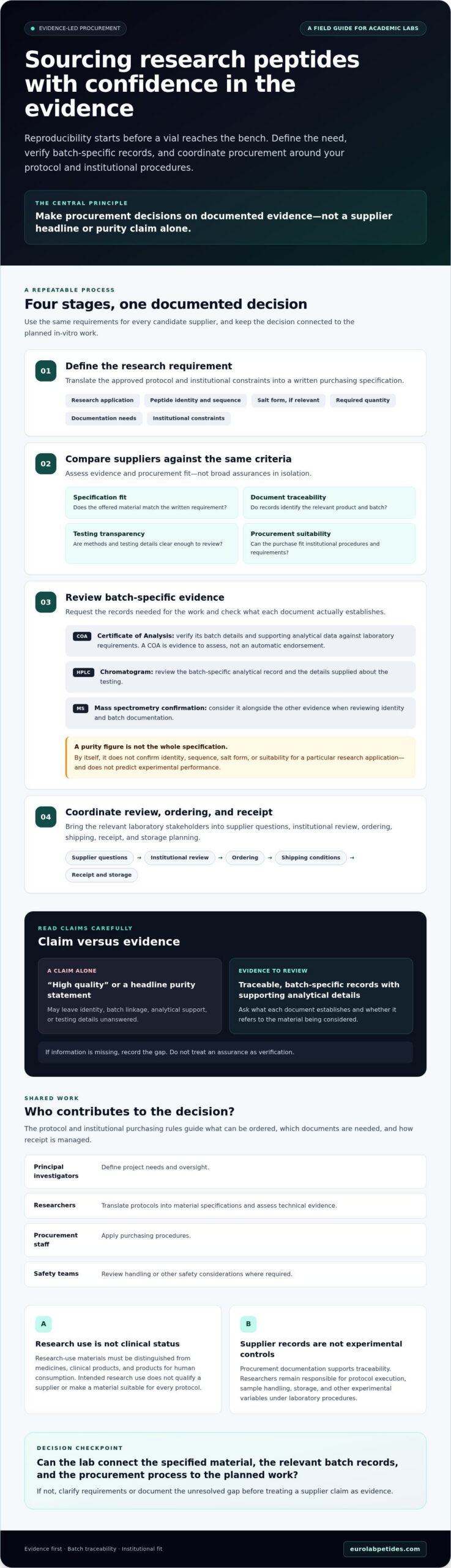
Use a procurement checklist from supplier review to laboratory receipt
A consistent workflow makes peptide procurement easier to review and repeat. For sourcing research peptides for academic labs, assign responsibility at each stage and keep related records together, from protocol and supplier assessment through receipt. Follow institutional procedures, which can vary by organization and location.
Questions to resolve before placing an order
Work through these checks in sequence. Involve procurement or the safety office where institutional procedures call for review, and refer uncertain regulatory or shipping questions to institutional specialists or relevant authorities.
- Review the protocol. Confirm the intended in-vitro research application and the material specifications approved for the project.
- Ask the supplier. Confirm product identity, identifier, batch documentation, available analytical evidence, and current availability. Clarify which records correspond to the batch being considered.
- Confirm institutional fit. Check purchasing approval, chemical-safety review, and any location-specific shipping or import considerations with responsible institutional personnel.
- Document the decision. Record the selected supplier, product identifier, evidence reviewed, outstanding questions, and relevant approval or purchasing references before submitting the order.
Resolve gaps before purchase where possible. Route a missing document or unclear shipping detail to the person responsible for that decision rather than treating it as an informal assumption.
What to check when research materials arrive
Receiving is a verification step, not just a handoff. Compare delivered labels and identifiers with the purchase record and accompanying batch documents. Record the condition on receipt and check for damaged packaging, discrepancies, or missing documentation under the laboratory’s established process.
- Log the date received, supplier, product identifier, and batch information shown on the material and records.
- Note packaging condition and document any discrepancy using the lab’s designated reporting route.
- Keep purchasing and batch records accessible to the project team so the material can be traced in study records.
Don’t use material while an identity or documentation discrepancy remains unresolved. Refer it to the responsible laboratory or institutional contact for review. Store and handle it according to its documentation and institutional procedures; don’t assume one storage condition applies to every peptide or laboratory.
Before ordering, review research-peptide supplier information and confirm product-specific documents, shipping details, and institutional fit with the relevant contacts.
Apply the sourcing framework to research-grade peptide suppliers
Base a supplier decision on evidence matched to the laboratory’s written requirements, not on a single headline claim. For sourcing research peptides for academic labs, use the same short scorecard for each candidate so differences, missing records, and procurement constraints stay visible.
- Specification match: Does the product description align with the required identity, sequence, form, and quantity?
- Traceable documents: Can the supplier provide records that clearly correspond to the product and, where applicable, the relevant batch?
- Testing transparency: Are the testing source, analytical method, and scope explained clearly enough for the lab to assess?
- Procurement fit: Can the order, delivery, and receipt process be reviewed and managed under institutional procedures?
How to assess a supplier without relying on marketing language
Compare evidence for the specific product and batch against the specification, not just the supplier’s general description. If a document omits the method, batch identifier, or testing scope, ask for clarification before completing the assessment. Record the response and any unresolved gap. Broad purity language, supplier location, and polished branding may provide context, but none establishes suitability on its own. Qualification remains a documented decision against the lab’s requirements.
EuroLab Peptides is a Europe-based supplier of research-grade peptides and reports using in-house and independent third-party laboratory testing. These statements are relevant inputs for review, not substitutes for examining available product-specific records or completing institutional qualification. Verify which analytical methods and batch documents are available for the particular material under consideration; don’t infer details that haven’t been confirmed.
What a responsible next step looks like
Prepare a written specification and document request before contacting a supplier or submitting an order for institutional review. Identify the intended in-vitro application, required material details, evidence the lab needs to inspect, and any purchasing or receipt constraints. Specific requests give procurement, research, and relevant institutional contacts a shared basis for review.
Keep the assessment within the stated scope. EuroLab Peptides’ products are intended for in-vitro research and laboratory development, not human consumption or clinical use. Before making a purchasing decision, verify product-specific documentation and confirm that the supplier and proposed delivery fit your institution’s procedures.
Review EuroLab Peptides research materials
Make Your Next Procurement Decision Evidence-Led
Reliable sourcing research peptides for academic labs starts with a clear specification and repeatable review process. Define material and institutional requirements before comparing suppliers, then assess batch-specific documentation and analytical evidence against those criteria. A purity claim or third-party test can inform the decision, but neither replaces the lab’s own qualification and review.
Carry that evidence-based approach through ordering and receipt. Keep supplier, product, batch, and receiving records linked, and follow institutional procedures for approval, handling, and storage. These steps give the research team a traceable basis for procurement decisions without assuming one supplier claim fits every project.
EuroLab Peptides reports a multi-level quality-control process that includes in-house and independent third-party laboratory testing. Its products are intended strictly for in-vitro research and laboratory development, not human consumption or clinical use. Confirm the documents available for the specific material and its suitability under your institution’s procedures before purchasing.
Apply the same documented criteria to each procurement decision. Review EuroLab Peptides research materials and confirm that the product-specific information meets your laboratory’s review needs.
Frequently Asked Questions
How can an academic lab evaluate a research-peptide supplier?
Evaluate the supplier against the lab’s written protocol and procurement requirements, not broad marketing claims. Confirm the product identity and form, ask which batch-specific records and analytical evidence are available, and check whether the supplier can clarify methods, sample traceability, and document-to-product matching. Review purchasing, shipping, and receiving fit with relevant institutional staff. For sourcing research peptides for academic labs, record the evidence and unresolved gaps before deciding whether a supplier meets the project’s criteria.
What should a Certificate of Analysis for a research peptide include?
A Certificate of Analysis (COA) should provide enough detail for the lab to assess what was tested and connect the reported result to the material under consideration. Check for product identity, batch information, reported result, analytical method, and document date where provided. COA formats and contents can vary, so don’t assume every certificate establishes the same facts. Ask the supplier to clarify unclear fields and confirm that the document matches the product or batch being considered.
Is third-party testing enough to qualify a peptide supplier?
No. Independent testing can add useful evidence, but it doesn’t replace supplier qualification or institutional review. Ask who performed the analysis, what sample and methods were involved, and whether the stated scope supports the supplier’s claim. If a laboratory accreditation is cited, verify that it applies to the relevant laboratory and test. Then assess the records against the protocol, purchasing criteria, and documentation requirements established by your institution.
How do researchers compare peptide purity claims between suppliers?
Compare the evidence behind each claim, not just the stated percentage. Check whether the result is linked to a specific batch, which analytical method was used, what sample was tested, and whether supporting records are available. HPLC or mass spectrometry data may help answer particular analytical questions, but their relevance depends on the stated test. A purity figure alone doesn’t establish identity, suitability for a protocol, or expected experimental performance.
What documents should a university laboratory request before ordering research peptides?
Request product identification details and any available batch-specific Certificate of Analysis or supporting analytical records needed to assess the material. Ask which test methods were used and whether documents correspond to the product or batch being considered. The lab should also identify purchasing, safety, shipping, or receiving documentation required by its institution and location. Requirements vary, so confirm the document set with procurement and relevant safety or compliance contacts before placing an order.
Can research peptides be used for human or clinical purposes?
No. Research-grade peptides described for laboratory use are intended for in-vitro research and laboratory development, not human consumption or clinical use. They should not be treated as medicines, clinical products, or materials for diagnosis or treatment. EuroLab Peptides identifies its products as restricted to in-vitro research and laboratory development purposes. Researchers should keep procurement, handling, and use within the product’s stated research scope and applicable institutional procedures.
What should a lab do if received peptide documentation does not match the order?
Pause use of the material and follow the laboratory’s established discrepancy process. Compare the received label, product identifier, batch details, purchase record, and accompanying documents, then record what doesn’t match. Contact the supplier for clarification or corrected records, and notify the responsible laboratory or institutional contact as required by local procedures. Don’t resolve a material identity or documentation discrepancy by assumption; wait for the appropriate review before proceeding.
