

What if a plausible longevity mechanism is mistaken for proof of a longer, healthier life? That distinction is central to Epithalon for longevity research. Interest in the peptide often focuses on proposed effects involving telomerase, telomeres, and melatonin. These biological hypotheses, however, do not establish human health or lifespan outcomes.
Conflicting claims can make the evidence difficult to assess. Early human findings often discussed in this context involved Epithalamin, a pineal extract, not synthetic Epithalon. Those results cannot be assumed to apply to the peptide. Much of the Epithalon literature also comes from a limited research base, so independent replication and careful study design are important.
This article explains the terminology and proposed pathways, then separates cell and other preclinical findings from clinical conclusions. It also clarifies what research-quality documentation can establish: testing may help characterize a material’s identity and purity, but it does not demonstrate biological efficacy or prove a longevity benefit. The goal is to show what Epithalon research suggests and where its limits remain.
Key Takeaways
- Approach Epithalon as a research subject, not an established longevity intervention.
- Separate proposed biological pathways from evidence of effects on lifespan or health.
- Assess Epithalon for longevity research by examining the model, comparator, endpoints, and study limitations.
- Distinguish findings from cell, animal, and human research before drawing broader conclusions.
- Use quality documentation to assess material identity and purity, not to infer biological efficacy.
What Is Epithalon in the Context of Longevity Research?
Epithalon is a synthetic peptide investigated in laboratory research on aging-related processes. It is a research subject, not an established longevity intervention. Studying a proposed biological effect does not demonstrate that the compound extends human lifespan or improves health. In short, Epithalon is a research hypothesis when linked to longevity, not a demonstrated human benefit.
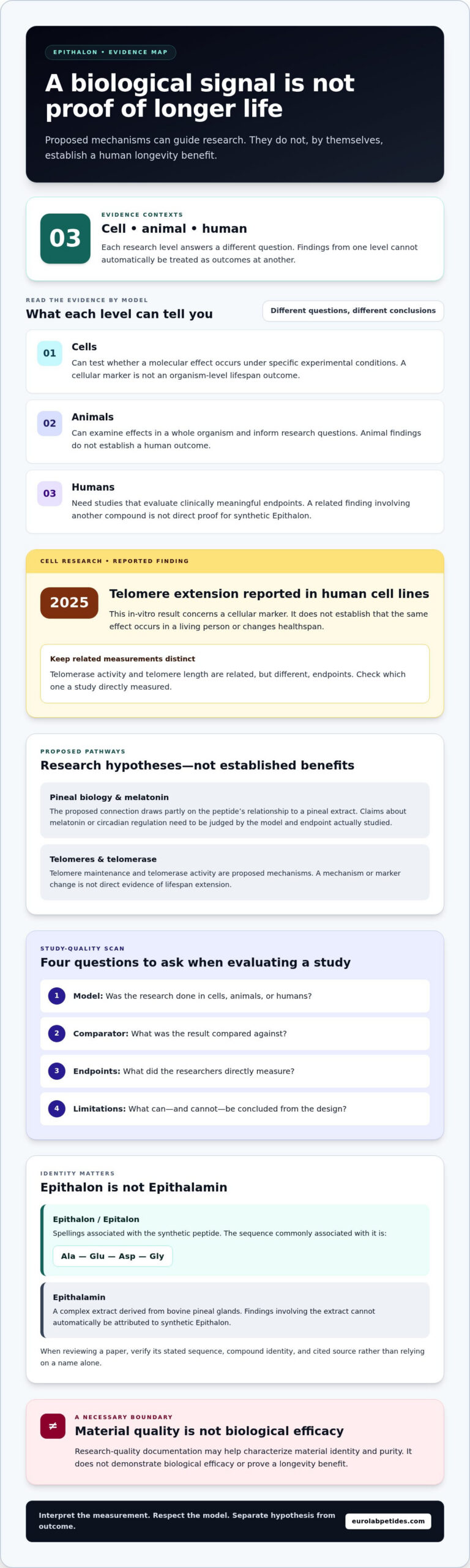
Researchers study aging at different levels, from molecular changes inside cells to outcomes measured across an organism’s lifespan. Cellular markers can help test whether a biological process changes under specific experimental conditions. Animal studies can assess effects in a whole organism, while human studies need to evaluate clinically meaningful endpoints. These evidence types answer different questions and are not interchangeable.
How Is Epithalon Named in Research Literature?
Epithalon and Epitalon are spellings associated with the synthetic peptide in published and secondary material. A general overview of Epitalon describes its reported structure and relationship to the pineal extract Epithalamin, but a general reference is not a substitute for checking primary studies. The sequence commonly associated with the synthetic peptide is Ala-Glu-Asp-Gly. When reviewing a paper, verify its stated sequence, compound identity, and cited source rather than relying on a name alone.
Epithalon should also be distinguished from Epithalamin. The latter is a complex extract derived from bovine pineal glands, while Epithalon is a synthetic peptide. Findings involving an extract cannot automatically be attributed to the synthetic compound. Commercial descriptions may use longevity-related language, but that does not establish that differently described materials are identical or that either has proven effects in humans.
What Does Longevity Research Mean Here?
For Epithalon for longevity research, “longevity” can refer to several distinct lines of inquiry: molecular markers in cells, lifespan or health outcomes in animal models, and clinical endpoints in human research. A change in a cellular marker is not evidence of longer organismal lifespan. Likewise, animal findings may inform research questions without establishing a human outcome.
Researchers evaluating a peptide study benefit from understanding peptide terminology and structure. This guide to peptides for researchers provides broader context for interpreting how a peptide’s identity relates to claims about its biological activity.
Which Biological Pathways Have Researchers Proposed for Epithalon?
Researchers have discussed Epithalon in relation to pineal biology, telomere maintenance, and telomerase activity. These are mechanistic questions, not proof that the peptide extends lifespan. To assess any claim, check what the study directly measured, which experimental model it used, and whether independent research reproduces the result.
What Is the Proposed Connection to Pineal Biology?
The research rationale draws partly on Epithalamin, a pineal-gland extract from which Epithalon was derived. This relationship has prompted interest in whether the synthetic peptide may affect processes associated with pineal function, including melatonin production and circadian regulation. Treat this connection as a research hypothesis, not an established regulatory function of Epithalon.
Some research has proposed that Epithalon may help normalize melatonin production. Evaluate that claim in light of the model and endpoint used in each study. A measured change in melatonin-related markers would not, by itself, establish improved sleep, healthier aging, or longer life. The critical evaluation of the evidence offers broader context for interpreting these proposed effects and the limits of the available research.
How Are Telomeres and Telomerase Discussed?
Telomeres are protective DNA-protein structures at chromosome ends that typically shorten as cells divide. Telomerase is an enzyme that can maintain or extend telomeres in some cell types. In Epithalon literature, telomerase activation is proposed as a possible mechanism. It should not be confused with direct evidence of lifespan extension.
A 2025 study reported telomere extension in human cell lines. This in-vitro finding concerns a cellular marker, not a clinical or organism-level outcome. It may support further investigation of telomere biology, but cell-line observations cannot establish that the same effect occurs in a living person or changes healthspan. When reviewing a paper, check whether it directly measured telomerase activity, telomere length, or both. These are related but distinct endpoints.
For Epithalon for longevity research, a mechanistic claim is most useful when tied to the model and measurement. A cell study can test a molecular hypothesis; an animal study can examine outcomes in a whole organism. Neither alone demonstrates a human longevity benefit. Proposed pathways help define research questions, but they do not substitute for replicated evidence across models and meaningful lifespan or health outcomes.
Does Epithalon Research Prove Longer Human Lifespan?
No. Mechanistic findings and research interest do not establish that Epithalon extends human lifespan. Separate the evidence by compound, model, and measured endpoint: a change in a cell marker is not a lifespan outcome, and a reported human association involving a related pineal extract is not direct proof for synthetic Epithalon.
What Can Preclinical Studies Establish?
In-vitro studies can test whether a proposed effect, such as a change in telomere-related measures, occurs in cells under defined experimental conditions. Animal studies can examine responses in a whole organism and may track outcomes that cell models cannot. Both approaches can help assess biological plausibility and shape further research questions.
Neither model automatically predicts effects in people. Cell lines do not reproduce the complexity of an intact organism, and animal findings may not translate across species. Interpret a reported marker change or animal outcome alongside the study’s design, comparator, sample size, and replication status. A preliminary result may be meaningful without demonstrating longer human life.
What Would Human Evidence Need to Show?
Pay close attention to what was studied. Some often-cited long-term findings from the Khavinson research group involved Epithalamin, a pineal extract, rather than synthetic Epithalon. The reports described lower mortality among elderly participants, but they were not large-scale, randomized, placebo-controlled trials and have not been independently replicated. These limitations matter. The findings cannot be assigned to Epithalon simply because the compounds are related in the research history.
Observational results can identify associations, but they may not isolate a compound’s effect from differences between groups or other influences. Controlled clinical research would need to evaluate the specific synthetic peptide, use an appropriate comparator, report safety and clinically meaningful outcomes, and account for follow-up and statistical uncertainty. Lifespan is distinct from telomerase activity, telomere length, or other intermediate markers.
For Epithalon for longevity research, the defensible conclusion is that exploratory findings may justify further investigation, but they do not prove longer human lifespan, established efficacy, or safety. Read each result at the level it was measured: cell, animal, or human. Then check whether the compound itself matches the claim and whether the study design supports a causal conclusion.
How Should Researchers Evaluate Epithalon Longevity Studies?
Evaluate the study before evaluating the headline. For Epithalon for longevity research, ask whether the design and measured outcomes support the conclusion, rather than whether the result sounds consistent with a proposed mechanism. A structured review helps distinguish preliminary signals from reproducible evidence.
Which Study Details Matter Most?
Start with the research question and the material actually studied. Confirm whether the paper examines synthetic Epithalon or Epithalamin, then identify the model, sample characteristics, comparator, and primary endpoint. A study measuring a cellular marker answers a different question from one tracking an organism-level outcome.
- Model and sample: Note whether the work is in vitro, animal, or human research, and whether the sample is adequately described.
- Comparator and endpoint: Check what the findings were compared against and whether the outcome directly addresses the research question.
- Analysis and reporting: Review how uncertainty is reported, whether all relevant outcomes are presented, and whether the authors discuss limitations.
- Replication: Look for independent studies that test the same claim. Similar findings from one research group are not equivalent to independent confirmation.
Treat small samples, indirect endpoints, or selective reporting as limitations when the paper documents them. A statistically detectable change is not necessarily meaningful for health or lifespan. The endpoint and study design determine what can reasonably be inferred.
What Can Testing and Documentation Tell Researchers?
Material documentation addresses a separate question: what was supplied and which characteristics were assessed? Analytical testing can help characterize identity or purity within the scope and limitations of the methods used. It cannot establish that a compound affects a biological pathway or validate an efficacy claim from a published study.
In-house testing and independent third-party testing can contribute to quality control, but neither substitutes for a well-designed, reproducible biological study. EuroLab Peptides uses both forms of testing as part of its quality-control process. Interpret any report according to its stated methods and results. A certificate or purity result is not evidence of biological activity.
For a deeper look at material documentation and sourcing considerations, read the research peptide sourcing guide. To explore research-grade materials for longevity and vitality research, view EuroLab Peptides’ research materials.
How Does Research-Grade Sourcing Fit Into Epithalon Studies?
Sourcing quality supports reproducibility, but it does not validate a biological hypothesis. In Epithalon for longevity research, material identity and analytical characterization are separate from evidence that a compound affects telomerase, aging, or lifespan. Strong research depends on both appropriately characterized materials and study designs that can test the question being asked.
Which Quality Claims Are Relevant to Research?
When assessing material documentation, look for information that connects the analysis to the material being evaluated, such as batch identification, stated identity, analytical methods, and reported results. The method matters: documentation should make clear what was tested and what the analysis can establish. A purity result, for example, does not by itself show biological activity or explain how a material performs in a particular experimental model.
EuroLab Peptides uses a multi-level quality-control process involving in-house and independent third-party laboratory testing. These approaches can contribute to material characterization, but their evidentiary role remains distinct from efficacy research. A test report is not a replication study, and quality-control documentation cannot demonstrate that a proposed longevity mechanism is correct.
What Is the Appropriate Next Step for Researchers?
Assess the primary literature and material documentation as separate evidence streams. In published studies, verify the compound identity, model, comparator, endpoints, and limitations. For research materials, review the available analytical information in light of the methods used and the questions those methods can answer. Neither source should be asked to prove more than it does.
EuroLab Peptides’ products are intended for in-vitro research and laboratory development only, not human consumption or clinical use. That boundary is essential: research-grade sourcing does not make a material a medicine, establish safety or efficacy, or support human-use conclusions.
For research materials relevant to longevity and vitality investigations, explore EuroLab Peptides research materials.
Apply an Evidence-Led Approach to Longevity Research
Epithalon for longevity research remains an area of investigation, not proof of longer human life. Judge proposed effects on telomeres or other aging-related pathways by what each study directly measured, which model it used, and whether the findings have been independently replicated. A molecular marker can inform a research question, but it cannot stand in for a demonstrated health or lifespan outcome.
Material quality is a separate consideration. EuroLab Peptides uses in-house and independent third-party laboratory testing to support research-material characterization. Such documentation can inform assessment of a material, but it does not establish biological activity or validate a longevity hypothesis. Products are intended strictly for in-vitro research and laboratory development, not human consumption or clinical use.
Keep evidence and material documentation in their proper roles as you plan rigorous research. Explore EuroLab Peptides research materials for research-focused work. Clear questions, careful interpretation, and transparent sourcing provide a sound basis for further investigation.
Frequently Asked Questions
Is Epithalon proven to extend human lifespan?
No. Research interest, proposed mechanisms, or findings in cells and animals do not establish that Epithalon extends human lifespan. Interpret each study according to its model and measured endpoint: a change in a cellular marker is not a clinical outcome. Before relying on a specific finding, check the primary publication for study design, comparator, sample characteristics, and limitations. Claims should not go beyond what the evidence directly supports.
What is Epithalon in longevity research?
Epithalon is a peptide name discussed in research on aging-associated biological processes. In Epithalon for longevity research, distinguish proposed mechanisms from demonstrated health or lifespan outcomes. Check primary sources for the spelling, compound identity, and sequence used in a study, since terminology may vary. Research interest does not make Epithalon an established longevity intervention, and research materials should not be interpreted as suitable for human use.
Is Epithalon the same as Epitalon?
The spellings appear in related research and commercial contexts, but a similar name alone does not prove that two references describe the same material. Compare the terminology and reported compound identity in the primary paper, including any stated sequence, before treating the names as equivalent. Also distinguish synthetic Epithalon from Epithalamin, a pineal extract discussed in some longevity research. Findings about one material should not automatically be attributed to another.
How is Epithalon studied in longevity research?
Assess studies by their research question, model, comparator, and measured endpoints. Cell-based work may investigate molecular changes, while animal research examines outcomes in a whole organism. Human studies address different questions and require appropriate clinical endpoints. These evidence types are not interchangeable. When reading a summary, check the primary publication to confirm what material was studied, what was measured, and what limitations the authors reported.
Does Epithalon affect telomeres or telomerase?
Some research discusses possible links between Epithalon and telomere-related processes, but each claim depends on what a study directly measured. Telomere length and telomerase activity are related but distinct markers. Interpret results in the context of the study model and methods. Even a reported change in either marker would not, by itself, demonstrate longer lifespan or a health benefit in humans. Replication also matters.
Can research-grade Epithalon be used for human consumption?
No. EuroLab Peptides’ products are intended strictly for in-vitro research and laboratory development, not human consumption or clinical use. This article provides no medical advice, treatment recommendation, or human-use instructions. Laboratory findings should not be treated as guidance for personal use, and research materials should not be confused with medicines. Keep the intended research context clear when interpreting study results or material documentation.
Does third-party testing prove that a peptide works?
No. Depending on the method and documentation, analytical testing can help characterize material attributes such as identity or purity. It does not establish biological efficacy or validate a longevity hypothesis. Assess test records separately from the scientific literature, including each study’s design, model, endpoint, and reproducibility. EuroLab Peptides uses both in-house and independent third-party laboratory testing as part of its quality-control process; those checks do not replace evidence from biological research.
