

What if the delivery estimate you’re planning around starts only after the parcel has been dispatched? That distinction can change how you schedule an experiment. Delivery times for research peptides in Europe depend on more than transit: order processing, dispatch timing and destination all play a part.
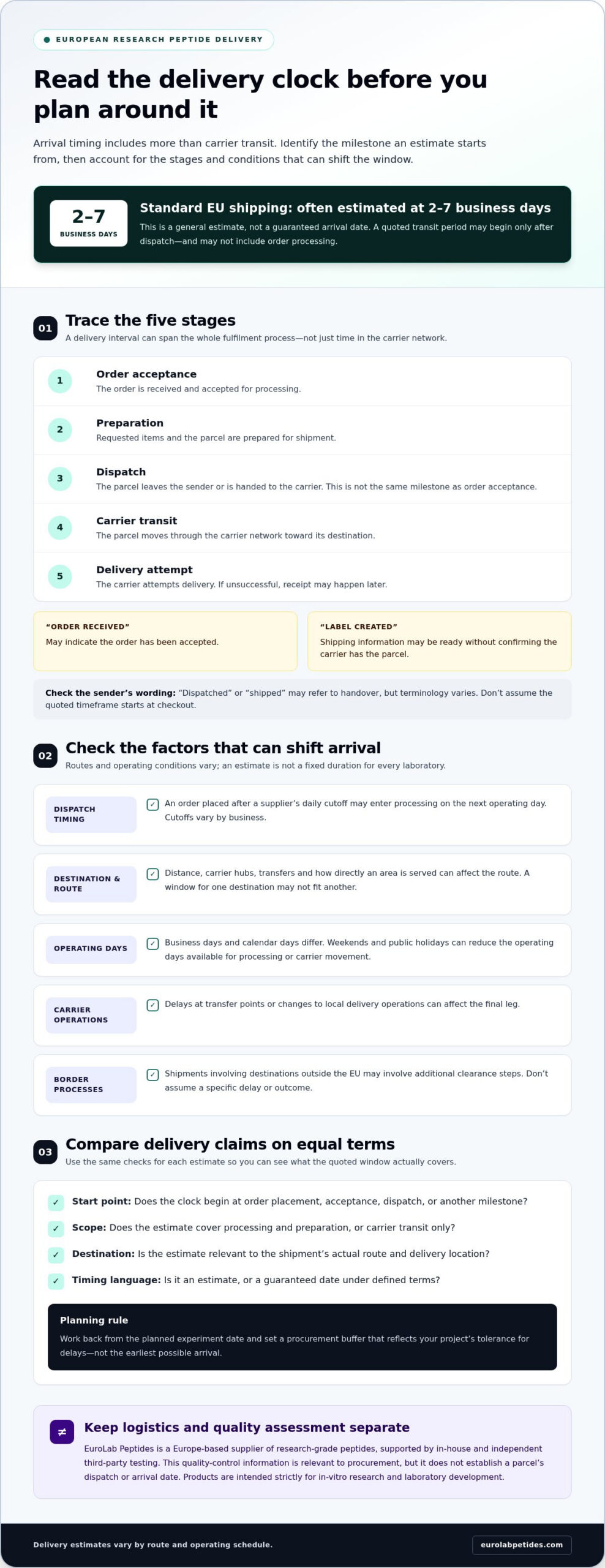
It’s reasonable to want a clear arrival window before procurement. But estimates aren’t guarantees, and a quoted transit period may not include the time between placing an order and dispatch. Standard EU shipping is often estimated at 2-7 business days, but routes and operating schedules vary. Shipments involving destinations outside the EU may also involve additional clearance steps.
This guide explains the stages between order placement and receipt, the factors that can shift arrival dates, and how to compare delivery estimates consistently. You’ll also learn how to build a practical procurement buffer instead of scheduling lab work around the earliest possible arrival. EuroLab Peptides is a Europe-based supplier of research-grade peptides, supported by in-house and independent third-party testing. Its products are intended strictly for in-vitro research and laboratory development.
Key Takeaways
- Interpret delivery times for research peptides in Europe by identifying whether the estimate begins at order placement, dispatch or another milestone.
- Separate processing, preparation, carrier transit and delivery attempts to see where timing can vary.
- Compare delivery claims using consistent criteria, including destination, dispatch wording and whether the estimate is guaranteed.
- Work backwards from the planned experiment date and set a procurement buffer that reflects your project’s tolerance for delays.
- Consider quality-control information separately from logistics: EuroLab Peptides uses in-house and independent third-party testing for its research-grade peptides.
What Do Research Peptide Delivery Times in Europe Include?
Delivery time is the full interval from order processing to parcel arrival, not simply the number of days a carrier spends moving a shipment. For procurement planning, separating that interval into stages helps you understand what an estimate measures and where timing may vary.
A delivery estimate forecasts a stated part of the fulfilment process; a guaranteed delivery date is a commitment to arrive by a specified date under defined terms. Unless an estimate identifies its start point and scope, it may be unclear whether it includes processing.
Order processing and dispatch are different milestones
Processing happens before a parcel enters the carrier network. It can involve accepting the order, preparing the requested items and packaging the shipment. Dispatch marks the point when the parcel is handed to a carrier or otherwise begins its journey. These steps are related, but they aren’t interchangeable.
Pay attention to order-status wording. “Order received” may indicate acceptance, while “label created” can mean shipping information is ready without confirming that the carrier has the parcel. “Dispatched” or “shipped” may refer to handover, but the sender’s terminology determines the exact meaning. Identify which event starts the quoted timeframe instead of assuming it begins at checkout. A transit estimate alone doesn’t tell you how long processing or dispatch will take.
Transit time depends on the delivery destination
After dispatch, carrier transit depends partly on the route and destination. A parcel moving between nearby locations may follow a different route from one travelling across Europe, through a transfer hub or to a less directly served area. Local carrier operations and the timing of any handoff can also affect the final leg.
Movement within Europe and shipments involving additional border processes aren’t necessarily equivalent. A border crossing may involve handling beyond ordinary carrier transit, depending on the shipment and route. Don’t treat a general European estimate as a precise arrival date for every destination.
To assess delivery times for research peptides in Europe, map the stages before comparing quoted windows:
- Order acceptance: The order is received and accepted for processing.
- Preparation: Items and parcel are readied for shipment.
- Dispatch: The shipment leaves the sender or is handed to the carrier.
- Carrier transit: The parcel moves through the carrier’s network toward its destination.
- Delivery attempt: The carrier attempts delivery. If the attempt is unsuccessful, receipt may happen later.
These logistics stages are separate from product quality assessment. For background on the underlying process, Peptide synthesis describes chemical methods and applications. EuroLab Peptides is a Europe-based supplier of research-grade peptides, with in-house and independent third-party laboratory testing. This quality-control information is relevant to procurement, but it doesn’t establish a parcel’s dispatch or arrival date.
Which Factors Can Change Research Peptide Delivery Times Across Europe?
A delivery estimate describes a route under particular operating conditions, not a fixed duration for every laboratory. Destination, carrier routing, order timing and local delivery operations can all affect the interval. The main variables are dispatch timing, destination geography, carrier route, local operating days and any additional border processes. Together, they affect transit but don’t establish a guaranteed arrival date.
Destination and route can matter as much as the dispatch date
A parcel sent to a central urban address may move through a different delivery network from one bound for a remote location or an area served less frequently. Even within the same country, distance from carrier hubs and the number of transfers can influence the route. A quoted window for one destination shouldn’t be treated as a reliable guide to another.
European destinations don’t all follow identical shipping processes. Movement within a region may differ from a route that crosses an external border or involves additional handling. Country-specific requirements and delivery arrangements can change, so use current information relevant to the shipment’s origin, destination and intended research use. Don’t assume a border crossing will produce a particular delay or administrative outcome.
Order timing and carrier operations add variability
Order cutoff timing can affect when processing begins. An order placed after a supplier’s daily cutoff may enter processing on the next operating day rather than the day it was submitted. Cutoffs vary by business, so account for this possibility when planning rather than assuming processing starts immediately.
Calendar days and business days also differ in practice. An order placed near a weekend or public holiday may have fewer operating days available for processing or carrier movement before the next working day. Holidays vary by country and locality, which matters when a route involves more than one delivery region.
Carrier networks can experience disruption, including delays at transfer points or changes to local delivery operations. These are possible variables, not routine outcomes to assume for every parcel. A dispatch notice confirms a fulfilment milestone, but it doesn’t remove uncertainty about later movement or the timing of a delivery attempt.
For a practical estimate, assess the shipment as a combination of factors rather than relying on one headline number:
- Destination: Consider whether the address is central, remote or less frequently served.
- Route: Account for transfers and any additional border processes that may apply.
- Order timing: Consider how weekends, public holidays and cutoff times could affect when processing begins.
- Local operations: Allow for possible carrier-network disruption or a missed delivery attempt.
These distinctions make delivery times for research peptides in Europe easier to assess without turning an estimate into a promise. When planning procurement, review destination and timing assumptions alongside the research materials. EuroLab Peptides is a Europe-based supplier of research-grade peptides. Explore EuroLab Peptides research-grade peptides as part of your procurement assessment.
How to Compare European Peptide Delivery Claims Fairly
A delivery claim is useful only when its scope is clear. Compare like with like: a transit estimate that begins after dispatch isn’t equivalent to a total order-to-arrival estimate, and neither necessarily represents a guaranteed delivery date. Apply the same criteria to each claim, then keep logistics findings separate from evidence about the research material.
Read delivery estimates by their stated start and end points
Check whether the estimate starts at checkout, after order processing or at dispatch. Then identify its endpoint: carrier handoff, an attempted delivery or receipt at the laboratory. If either point is unstated, record it as unclear instead of filling the gap with an assumption. An estimate published by another supplier describes that supplier’s claim, not a delivery promise from EuroLab Peptides.
| Comparison criterion | What to record |
|---|---|
| Estimate start point | Checkout, processing or dispatch |
| Dispatch wording | Order accepted, prepared, shipped or handed to carrier |
| Destination | Country or region the estimate applies to |
| Estimate status | Indicative window or stated guarantee and terms |
This format makes differences visible without ranking claims that describe different stages. A dispatch statement, for example, reports a fulfilment milestone; it doesn’t establish when the parcel will arrive. Keep processing language and carrier-transit estimates in separate fields in your procurement notes.
Evaluate delivery information alongside research quality evidence
Delivery speed and product quality are separate procurement considerations. A short shipping estimate doesn’t establish analytical quality, just as laboratory testing doesn’t determine transit duration. Assess the logistics claim on its own terms, then review available product documentation independently, including batch-level evidence where provided.
For research materials, a Certificate of Analysis (COA) can support documentation review when it identifies the relevant batch and reports analytical findings. Independent third-party testing adds an external testing perspective. Assess what the documentation actually covers rather than treating a general testing statement as proof of every specification. EuroLab Peptides uses in-house and independent third-party laboratory testing. This is relevant quality-control context, not an indicator of delivery speed.
Researchers assessing sourcing can use this guide on how to buy research peptides to structure a broader procurement review. For foundational context on research applications, see what peptides are for researchers. EuroLab Peptides supplies research-grade peptides strictly for in-vitro research and laboratory development.
Apply this comparison method consistently when assessing delivery times for research peptides in Europe. Record unknowns explicitly, don’t turn estimates into arrival promises, and assess quality documentation separately from logistics.
How Should a Laboratory Plan Around Peptide Delivery Uncertainty?
Plan procurement backwards from the experiment date instead of treating a delivery estimate as the date materials will be ready for use. This makes the required receipt date explicit and helps align ordering with the project’s tolerance for schedule changes. A buffer reduces scheduling risk, but it can’t eliminate variability in processing, transit or receiving.
Build a procurement buffer around experimental milestones
Start with the laboratory milestone that depends on the material, then work backwards to set an internal receipt deadline and procurement date. Choose a buffer that reflects the consequences of delay: a flexible study may tolerate less lead time than a fixed instrument booking or coordinated experiment. Base the plan on the stated timing and destination, not on the earliest possible arrival.
- Set the experiment milestone. Identify the planned start date and any dependent activities, such as preparation or instrument access.
- Define the latest acceptable receipt date. Allow time for the laboratory’s own receiving checks before the material is needed.
- Review the delivery estimate’s scope. Separate any stated processing period from carrier transit, and account for the destination and route.
- Select a project-specific buffer. Increase it when rescheduling would affect other work, shared resources or collaborators. Set it according to project tolerance, not a universal number.
- Set a procurement trigger. Work backwards from the receipt deadline, using the estimate as a planning input rather than a guaranteed arrival date.
For example, if an experiment depends on a reserved laboratory resource, set the internal receipt deadline early enough to allow for receiving procedures and issue resolution before the reservation. A more flexible study may have greater capacity to absorb a late arrival. In either case, treat the buffer as contingency, not as proof that a parcel will arrive on schedule.
Record receipt details for repeat-order planning
Maintain an internal record for each order. Note the order date, stated dispatch date, actual arrival date and destination, along with the delivery estimate used for planning. Keep supplier claims distinct from observed events. This history can inform future procurement decisions, although each new route and order remains subject to its own conditions.
- Planned dates: Procurement trigger, expected dispatch and required receipt date.
- Actual dates: Order placement, dispatch and physical receipt.
- Context: Destination and any relevant calendar or project constraints.
Use delivery records for logistics analysis only. Follow applicable product documentation and laboratory procedures separately for peptide handling and storage. Arrival timing doesn’t define those requirements.
For research-grade peptides intended strictly for in-vitro research and laboratory development, include product selection and procurement in the same schedule review. Explore research-grade peptides as you plan laboratory procurement.
Ordering Research Peptides from EuroLab Peptides: Quality and Next Steps
Procurement decisions involve separate questions: whether a product suits the intended laboratory work, what quality information supports its evaluation, and how its delivery estimate fits the project schedule. EuroLab Peptides is a Europe-based supplier of research-grade peptides. Its in-house and independent third-party laboratory testing provides quality-control context, but doesn’t determine dispatch or transit speed.
Use quality documentation as a separate procurement check
Assess quality evidence independently from delivery estimates. Review the available documentation for the material under consideration, including the analytical information it provides and whether it relates to the relevant product or batch. A general statement about testing and a delivery estimate answer different procurement questions; neither substitutes for the other.
EuroLab Peptides uses both in-house and independent third-party laboratory testing. This multi-level approach is relevant to research procurement, while order timing remains subject to processing and destination-specific logistics. Keep the two assessments distinct in purchasing records.
For scheduling, use the same method outlined in this guide: identify what a delivery estimate includes, note its destination assumptions, and set a receipt deadline that leaves room for the laboratory’s own procedures. Treat delivery times for research peptides in Europe as estimates, not guarantees, unless the stated terms explicitly make them so. Procurement planning is more robust when the timeline and quality review are recorded separately.
Choose the next step for your research procurement
Before selecting a research-grade peptide, align the intended in-vitro research or laboratory development application with the material and the documentation available for review. Keep the evaluation specific: identify the research requirement, review relevant quality information, and plan the order around the experiment’s receipt deadline rather than its earliest possible arrival.
A concise internal procurement record can help keep these considerations separate. Capture the product and intended laboratory context, the quality information reviewed, the delivery estimate’s stated scope, and the planned receipt date. This creates a clear basis for future planning without assuming that a later shipment will follow an identical route or schedule.
- Research context: Confirm the material is being considered for in-vitro research or laboratory development.
- Quality review: Assess in-house and independent testing information separately from logistics.
- Schedule: Set procurement timing and a project-appropriate buffer based on the experiment’s tolerance for delay.
EuroLab Peptides’ products are strictly for in-vitro research and laboratory development, not human consumption or clinical use. To review research-grade peptide options for laboratory work, explore EuroLab Peptides.
Build a More Predictable Procurement Process
Make delivery planning part of your laboratory’s procurement protocol, not a decision made only when an experiment is approaching. Set an internal lead-time policy that reflects each project’s schedule flexibility, then revisit it when destinations or research requirements change. This gives your team a consistent framework for interpreting delivery times for research peptides in Europe without treating an estimate as a fixed arrival date.
For each procurement decision, consider logistics and material evaluation as distinct parts of the same workflow. EuroLab Peptides is a Europe-based supplier of research-grade peptides, with multi-level quality control that includes in-house and independent third-party laboratory testing. Its products are strictly for in-vitro research and laboratory development.
Explore the catalogue at a pace that fits your project planning. Explore EuroLab Peptides and take the next step toward a more deliberate research procurement process.
Frequently Asked Questions
How long does delivery of research peptides in Europe take?
For general planning, standard EU shipping estimates commonly fall within 2-7 business days, while express estimates may be 1-4 business days. Order processing can add time before transit begins, and these ranges aren’t a delivery promise from any particular supplier. The phrase delivery times for research peptides in Europe covers different routes and fulfilment stages, so use the estimate for your destination and service rather than assuming one timeframe applies across the region.
Does a dispatch estimate mean my order will arrive within that time?
No. Dispatch describes a shipment leaving the supplier or entering the carrier network; it doesn’t by itself set the arrival date. An update that an order has been dispatched may confirm movement has begun, while the remaining journey and final delivery attempt are still ahead. Use the estimate’s stated endpoint to interpret it, and don’t schedule a time-critical procedure around a dispatch notice alone.
Why can delivery times vary between European countries?
Routes, distance from carrier hubs, transfer points and local delivery operations differ by destination. General regional estimates may be shorter for nearby central destinations and longer for routes with more transit stages. A broad supplier estimate may not reflect the specific address or route. Compare estimates for the actual destination, not only the country, and use current destination-specific information when setting a laboratory receipt deadline.
Can weekends and public holidays delay peptide delivery?
Yes. Processing and carrier services may operate on business-day schedules, so a weekend or public holiday can leave fewer operating days for an order or parcel to progress. A holiday in the origin area, a transit location or the destination may also affect timing. An order placed near a holiday period, for example, may not follow the same calendar as one placed during an ordinary working week.
How should a laboratory plan an experiment around uncertain delivery times?
Set the date the material must be available, then work backwards to establish a procurement trigger that suits the experiment’s schedule flexibility. For a fixed instrument booking, allow more contingency than for work that can be rearranged without affecting other activities. Identify alternative tasks that can proceed if receipt is delayed. A buffer helps manage risk, but no planning interval can remove transport variability.
What should I compare when reviewing peptide supplier delivery claims?
Compare the estimate’s start point and endpoint, the meaning of dispatch wording, the destination it applies to, and whether the stated timing is an estimate or a guarantee. Note whether processing is included and whether the quoted window uses business or calendar days. Save the claim as it appeared when you ordered. That record helps distinguish a changed estimate from the shipment’s actual progress.
Are EuroLab Peptides products intended for clinical or human use?
No. EuroLab Peptides products are strictly for in-vitro research and laboratory development purposes. They aren’t intended for human consumption or clinical use. Keep procurement and handling within the stated research context, and use relevant product information and laboratory procedures when evaluating materials for an experiment. Delivery timing doesn’t change this intended-use limitation.
