

The implementation of the June 2026 EMA manufacturing guidelines has established a new, more stringent benchmark for the characterization and impurity control of synthetic sequences. For investigators, the primary challenge remains the reconciliation of inconsistent chemical purity with the need for reproducible data in complex regeneration models. It’s understood that technical gaps regarding peptide stability in solution often hinder the transition from theoretical modeling to empirical validation. This clinical analysis addresses the critical requirements for peptides for tissue repair research, focusing on the biochemical pathways and molecular mechanisms that drive cellular recovery.
Readers will gain a comprehensive understanding of handling protocols, reconstitution methodologies, and the comparative efficacy of research-grade peptides. We provide a detailed examination of the Recovery Research Stack and its application within current laboratory frameworks. By evaluating the conflicting 2026 FDA regulatory reports alongside verified analytical standards, this article establishes a roadmap for identifying optimal peptides for specific repair models. The following sections detail the technical specifications and sourcing criteria essential for maintaining high-stakes precision in modern biochemical inquiry.
Key Takeaways
- Understand the molecular signaling pathways of short-chain amino acid sequences and their specific interactions with cellular receptors to modulate gene expression.
- Evaluate the biochemical profiles of BPC-157 and TB-500 to determine the most effective peptides for tissue repair research in muscle, tendon, and bone models.
- Establish rigorous laboratory protocols for the storage and reconstitution of lyophilized reagents to ensure maximum stability and prevent chemical degradation.
- Identify the quality benchmarks required by 2026 EMA guidelines, including the necessity of third-party HPLC/MS verification for every chemical batch.
- Leverage the Recovery Research Stack as a multifaceted tool for investigating complex repair pathways in high-stakes precision research environments.
The Role of Peptides in Tissue Repair and Regenerative Research
Peptides are defined as short-chain amino acid sequences consisting of 2 to 50 monomers. In biological systems, these molecules serve as fundamental signaling ligands. When investigating peptides for tissue repair research, the primary focus is their capacity to bind with specific cellular receptors to modulate gene expression. This process is central to the restoration of structural integrity following injury. Research-grade analogues are frequently utilized to isolate these pathways, providing a level of precision that endogenous sequences cannot always maintain in a controlled laboratory environment.
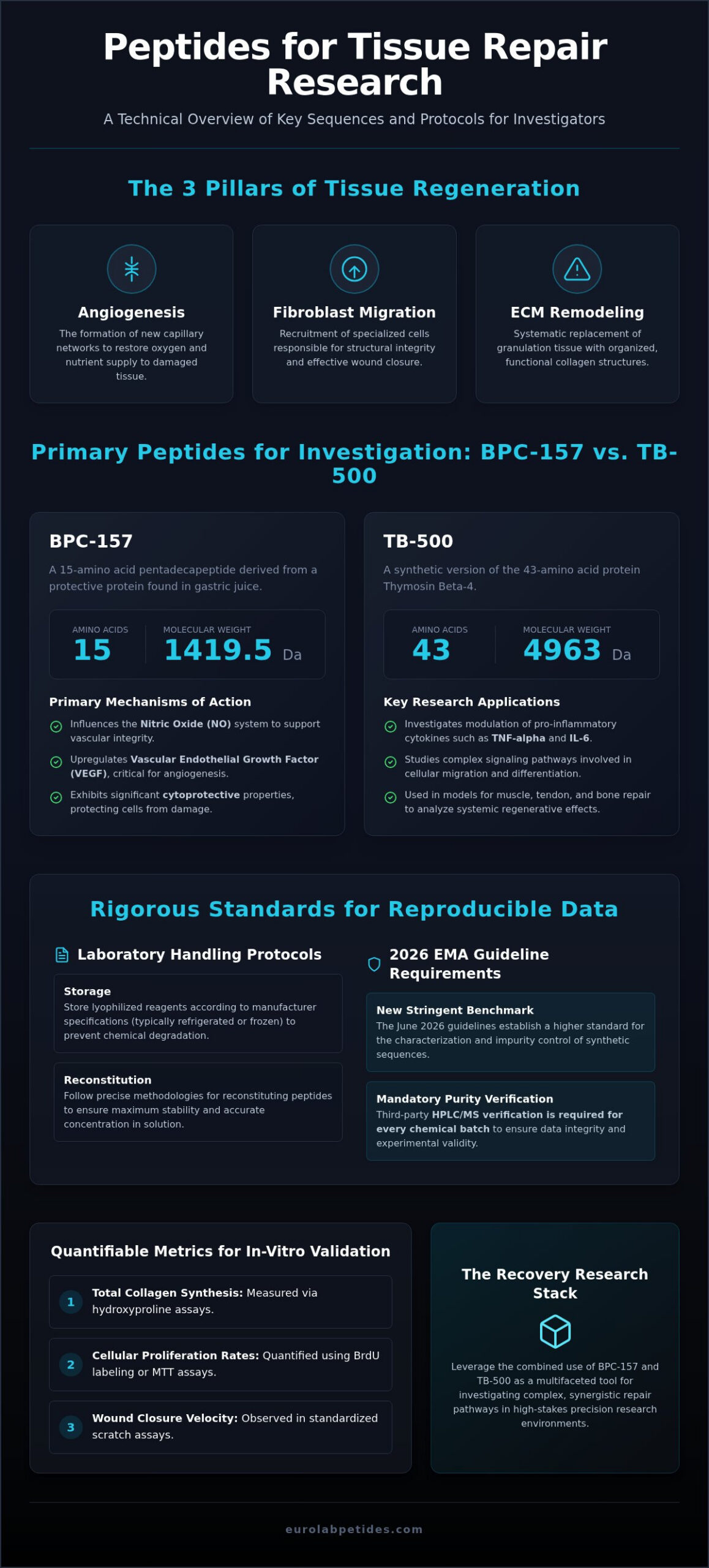
The primary focus of current regeneration research involves three distinct biological pillars:
- Angiogenesis: The formation of new capillary networks to restore oxygenation to damaged tissue.
- Fibroblast migration: The recruitment of specialized cells responsible for structural integrity and wound closure.
- Extracellular matrix (ECM) remodeling: The systematic replacement of granulation tissue with organized collagen structures.
Signaling Pathways in Cellular Regeneration
Successful tissue regeneration requires the coordinated upregulation of specific growth factors, most notably Vascular Endothelial Growth Factor (VEGF) and Transforming Growth Factor-beta (TGF-beta). These proteins drive the transition from the inflammatory phase to the proliferative stage. The historical development of Peptide therapeutics demonstrates that minor alterations in amino acid sequences can significantly impact receptor affinity. In laboratory models, researchers also analyze the modulation of pro-inflammatory cytokines like TNF-alpha and IL-6. It’s critical to observe how these synthetic sequences influence the inflammatory timeline to prevent chronic fibrosis.
In-Vitro vs. In-Vivo Research Considerations
Simulating the multi-layered environment of a living organism within a laboratory setting is technically demanding. Scientists don’t typically rely on a single model; instead, they use standardized cell lines like NIH/3T3 fibroblasts to isolate specific mechanisms. While in-vitro studies provide high resolution, they lack the systemic complexities found in-vivo. When evaluating peptides for tissue repair research, investigators prioritize quantifiable metrics to ensure objective data collection:
- Total collagen synthesis measured through hydroxyproline assays.
- Cellular proliferation rates quantified via BrdU labeling or MTT assays.
- Wound closure velocity observed in standardized scratch assays.
Maintaining a clear distinction between endogenous peptides and synthetic research-grade analogues is essential for data integrity. High-purity chemicals allow for the precise attribution of biological responses to the intended molecular sequence, ensuring that impurities don’t skew the results of high-stakes regeneration studies.
Primary Peptides for Tissue Repair Research: BPC-157 and TB-500
BPC-157 and TB-500 represent the two most prominent sequences utilized in peptides for tissue repair research. These molecules occupy distinct chemical classes and provide researchers with different molecular tools for investigating regenerative signaling. BPC-157 is a 15-amino acid pentadecapeptide with a molecular weight of approximately 1419.5 Da. TB-500 is a synthetic version of the 43-amino acid protein Thymosin Beta-4, possessing a molecular weight of roughly 4963 Da. While their structures differ significantly, their combined use in laboratory stacks allows for a multifaceted investigation into complex tissue regeneration models.
BPC-157: Mechanisms of Angiogenesis and Cytoprotection
The BPC-157 sequence (Gly-Glu-Pro-Pro-Pro-Gly-Lys-Pro-Ala-Asp-Asp-Ala-Gly-Leu-Val) is derived from a protective protein found in gastric juice. It’s primarily characterized by its influence on the nitric oxide (NO) system and the upregulation of vascular endothelial growth factor (VEGF). These pathways are essential for investigating the restoration of vascular integrity in ischemic or damaged tissues. Studies focusing on tendon-to-bone healing often prioritize this pentadecapeptide due to its high stability in various environments. For a more exhaustive sequence analysis and stability data, investigators should refer to BPC-157: A Technical Guide. The compound’s cytoprotective effects are frequently measured through its ability to modulate early growth response-1 (egr-1) expression in cellular models.
TB-500: G-Actin Sequestration and Cellular Migration
TB-500 functions through a mechanism distinct from BPC-157, focusing on the sequestration of G-actin. By maintaining a pool of unpolymerized actin, the peptide facilitates rapid cytoskeleton remodeling. This is a critical factor in keratinocyte and endothelial cell migration during wound healing research. The development of fusion peptides for tissue regeneration underscores the importance of such sequence-specific signaling in advanced materials science. Researchers utilize TB-500 to investigate corneal repair and cardiac tissue regeneration, where cellular mobility is the primary limiting factor for recovery. It’s often included in peptides for tissue repair research because it doesn’t bind to the extracellular matrix, allowing for broader systemic signaling in in-vitro environments.
Investigators seeking to evaluate these mechanisms in tandem often utilize the Recovery Research Stack to ensure chemical consistency across multiple tissue types. This approach allows for the simultaneous observation of angiogenic and migratory pathways in a single experimental framework.
Comparative Analysis: Selecting Peptides for Specific Repair Models
The selection of peptides for tissue repair research requires a systematic evaluation of the target tissue’s physiological demands. Different repair models—whether focusing on musculoskeletal, epithelial, or neural regeneration—demand specific ligand-receptor interactions to initiate the desired biological cascade. Recent advances in peptide research emphasize that the efficacy of a sequence is often determined by its stability within the specific research media and its signaling range. Investigators must distinguish between localized signaling effects, which are ideal for wound-site analysis, and systemic signaling, which is required for investigating multi-organ recovery processes.
Stability profiles are a primary variable in experimental design. While BPC-157 exhibits high resistance to enzymatic degradation and maintains structural integrity across a broad pH range, other sequences are more susceptible to hydrolysis. In laboratory settings, these sequences are typically evaluated in phosphate-buffered saline (PBS) or specialized cell culture supernatants. Maintaining chemical stability is essential for ensuring that the observed cellular responses are a direct result of the intended peptide sequence rather than degradation byproducts.
Peptides for Musculoskeletal vs. Epithelial Research
BPC-157 is established as a primary tool for tendon and ligament research models. Its ability to upregulate growth hormone receptors in fibroblasts makes it the sequence of choice for investigating dense connective tissue repair. Conversely, dermal and epithelial studies often prioritize GHK-Cu. This copper-binding tripeptide is specifically utilized to investigate the modulation of collagen type I and III synthesis within skin models. For researchers focusing on the biochemical nuances of dermal tissue, GHK-Cu: A Primer on its Role in Cellular Studies provides essential data on its role in extracellular matrix remodeling. The choice between these sequences depends entirely on whether the research goal is the restoration of tensile strength in tendons or the acceleration of re-epithelialization.
Evaluating Combined Research Stacks
Complex regeneration studies frequently move beyond single-sequence analysis to evaluate multi-peptide protocols. The Recovery Research Stack serves as a comprehensive investigative framework for these multifaceted models. By utilizing a standardized stack, investigators can analyze the synergistic effects of angiogenic signaling and actin-mediated cellular migration simultaneously. This approach reduces the data fragmentation often found in isolated studies and allows for a more holistic view of the regenerative process. To maintain experimental control, the use of analytical-grade chemicals is non-negotiable; it ensures that cross-reactivity is limited to the active sequences and not influenced by manufacturing impurities.
Laboratory Handling and Experimental Protocols
Ensuring the integrity of peptides for tissue repair research begins with standardized handling protocols. Chemical degradation often occurs because of improper thermal management or mechanical stress during the reconstitution process. Since these sequences are highly sensitive to environmental variables, maintaining a controlled laboratory environment is essential for data reproducibility. Investigators must prioritize the preservation of the peptide’s primary structure to ensure that the biological signaling observed in tissue models is accurate and untainted by degradation byproducts.
Storage and Reconstitution Standards
Lyophilized peptides require storage at -20°C for long-term preservation to minimize peptide bond hydrolysis. Short-term storage at 4°C is acceptable for active studies, provided the vials remain hermetically sealed against moisture. Reconstitution requires high-stakes precision; investigators should use the Peptide Reconstitution Calculator to ensure accurate molar concentrations. The diluent, typically bacteriostatic water or sterile saline, should be introduced slowly along the vial wall to prevent foaming. Don’t vortex the solution; mechanical agitation can lead to aggregation or denaturation of delicate sequences. Once reconstituted, the solution’s stability is limited, and it should be used within the timeframe established by the specific study’s stability testing.
Quality Assurance and Purity Verification
Reproducible results in tissue regeneration models depend on the use of analytical-grade reagents. High-Performance Liquid Chromatography (HPLC) reports provide a verifiable metric of purity, while Mass Spectrometry (MS) confirms the precise molecular weight and sequence identity. Utilizing third-party tested peptides is a non-negotiable standard for investigators who require absolute security in their data. These external validations eliminate the risks associated with manufacturer-only data. This process ensures that every batch meets the 2026 EMA characterization guidelines for impurity control and sequence verification. Secure your research integrity by sourcing analytical-grade laboratory chemicals that undergo rigorous third-party verification for every batch.
Safety protocols in the laboratory must also account for the high potency of these signaling molecules. While these substances are intended strictly for in-vitro or animal research models, handling should always occur within a certified fume hood or biosafety cabinet to prevent accidental inhalation of lyophilized powder. Maintaining these rigorous standards is the only way to ensure that peptides for tissue repair research yield reliable, publishable findings in the competitive landscape of regenerative science.
EuroLab Peptides: Sourcing Analytical-Grade Chemicals for 2026
EuroLab Peptides provides the analytical foundation required for high-stakes biochemical inquiry. As the 2026 regulatory environment introduces stricter characterization standards, the necessity for verifiable purity in peptides for tissue repair research has become paramount. The brand’s multi-level quality control protocol is designed to eliminate the variables associated with chemical synthesis impurities, ensuring that laboratory findings remain objective and reproducible. By adhering to localized European manufacturing standards, the business maintains a transparent supply chain that prioritizes technical accuracy over marketing hyperbole.
The EuroLab Quality Standard
Quality is presented as a verifiable metric rather than a subjective claim. Every chemical sequence undergoes rigorous in-house analysis followed by independent third-party laboratory verification. This dual-layered approach utilizes High-Performance Liquid Chromatography (HPLC) and Mass Spectrometry (MS) to confirm both the purity percentage and the precise molecular identity of the sequence. For investigators conducting longitudinal studies, batch-to-batch consistency is ensured through standardized manufacturing processes. Certificates of Analysis (COA) are provided for every batch, offering the empirical results necessary for institutional validation.
Procurement for Institutional Research
Institutions requiring high-volume reagents can access bulk sourcing options tailored to large-scale investigations. Navigating the procurement process is streamlined through the 2026 guide on how to buy research peptides, which outlines the current standards for purity sourcing and regional regulatory compliance. EuroLab’s localized logistics network ensures that the European research community receives materials with minimal transit-related degradation, maintaining the chemical stability required for precise experimental control.
The Tissue Repair & Recovery Research category includes specialized tools such as the Recovery Research Stack, which is formulated to investigate complex, multi-pathway regeneration models. It’s critical to note that all products are strictly designated for in-vitro research and laboratory development. They aren’t intended for human consumption or medical use. By prioritizing scientific accuracy and regional manufacturing excellence, EuroLab Peptides serves as a reliable partner for serious professional inquiry into regenerative molecular mechanisms. For those interested in practical recovery protocols for athletic training, check out Run Complete for specialized supplement guidance.
Advancing Regenerative Models through Analytical Precision
The transition toward 2026 analytical standards requires a rigorous approach to sequence characterization and experimental design. Investigators must prioritize the reconciliation of molecular mechanisms, such as angiogenic signaling and actin-mediated migration, with precise laboratory handling. Integrating high-purity peptides for tissue repair research into standardized protocols ensures that cellular responses are the direct result of specific ligand-receptor interactions rather than manufacturing impurities. This level of technical control is essential for maintaining data reproducibility in longitudinal studies and complex regeneration models.
EuroLab Peptides facilitates this high-stakes precision by providing third-party HPLC/MS verified sequences, including the specialized Recovery Research Stack for multifaceted pathway analysis. All chemicals are intended strictly for in-vitro laboratory research and development. Secure high-purity peptides for your 2026 research projects at EuroLab Peptides to ensure absolute batch consistency and technical transparency. Establishing these benchmarks is essential for the continued advancement of regenerative science and the validation of complex biochemical inquiries.
Frequently Asked Questions
What is the mechanism of BPC-157 in tissue repair research?
BPC-157 functions by modulating the nitric oxide (NO) system and upregulating vascular endothelial growth factor (VEGF). This mechanism is fundamental for investigating angiogenesis in damaged tissue models. It also interacts with early growth response-1 (egr-1) expression to facilitate fibroblast recruitment and migration. These pathways are essential for observing the restoration of structural integrity in dense connective tissue models during laboratory investigations.
How should TB-500 be stored to ensure long-term stability for laboratory use?
Lyophilized TB-500 must be stored at -20°C to prevent peptide bond hydrolysis and ensure long-term stability. While short-term storage at 4°C is acceptable for active studies, the vials should remain hermetically sealed to exclude moisture. Once reconstituted, the peptide’s shelf life is significantly reduced. It’s recommended that investigators prepare only the volume required for immediate experimental phases to maintain chemical integrity.
Can GHK-Cu and BPC-157 be used together in a single research model?
Researchers frequently utilize GHK-Cu and BPC-157 together to analyze the synergistic interactions between distinct repair pathways. This multi-peptide approach allows for the simultaneous investigation of dermal re-epithelialization and musculoskeletal structural restoration. Using these sequences in tandem provides a broader investigative framework for complex regeneration models. It ensures that both collagen modulation and angiogenic signaling are evaluated within a single experimental environment.
What purity level is required for peptides used in in-vitro studies?
Analytical grade purity of ≥98% is the standard requirement for peptides for tissue repair research used in in-vitro studies. Lower purity levels introduce manufacturing impurities that can skew data by interfering with specific ligand-receptor interactions. Using HPLC/MS verified sequences ensures that the observed biological responses are directly attributable to the peptide sequence. This level of precision is non-negotiable for maintaining the reproducibility of laboratory results.
How do researchers calculate the reconstitution volume for lyophilized peptides?
The reconstitution volume is calculated by dividing the total mass of the lyophilized peptide in mg by the target concentration in mg/mL. For example, a 5mg vial requires 2mL of diluent to reach a 2.5mg/mL concentration. Researchers typically use sterile bacteriostatic water or saline for this process. It’s critical to use calibrated micropipettes to ensure the molarity of the resulting solution is accurate for dosing protocols.
Why is third-party testing essential for peptides in regenerative research?
Third-party testing is essential because it provides an objective, external validation of the peptide’s purity and sequence identity. It eliminates the risk of manufacturer-only data bias and ensures that the chemical meets 2026 EMA characterization standards. For high-stakes peptides for tissue repair research, this verification is the primary safeguard against batch-to-batch inconsistency. It provides investigators with the absolute security required for longitudinal data collection.
Are these peptides intended for clinical use or human consumption?
These peptides are strictly intended for in-vitro laboratory research and development and aren’t for clinical use or human consumption. They’re sold as research chemicals for use in controlled laboratory environments by qualified professionals. The brand doesn’t provide medical advice or pharmaceuticals. Adhering to these designations is critical for regulatory compliance and ensures the materials are used only for their intended scientific purposes.
What is the standard shelf life of a reconstituted research peptide?
The standard shelf life for a reconstituted research peptide is typically 7 to 14 days when stored at 4°C. Stability is highly sequence-dependent; some molecules degrade more rapidly through hydrolysis when in solution. To ensure the highest level of chemical integrity, researchers should use reconstituted solutions as soon as possible. Prolonged storage after reconstitution increases the risk of aggregation and loss of biological activity in repair models.
