
A single logistical oversight in a customs declaration often results in the immediate seizure of high-value biochemicals, representing a total loss of both capital and research timelines. For the professional researcher, the primary obstacle isn’t the synthesis itself but the regulatory gauntlet of international transit. You understand that even a 48 hour delay in a high-humidity port can compromise the lyophilized stability of a peptide, regardless of its initial quality. Successfully avoiding customs issues when buying peptides requires a clinical approach to documentation and a thorough understanding of the “Research Use Only” classification.
This guide establishes a rigorous protocol for ensuring the successful delivery of research materials across international borders. We’ll analyze the specific benefits of EU-based sourcing, the necessity of third-party verification, and the exact documentation required to ensure your 99%+ purity standards are preserved from the laboratory to your facility. By implementing these stringent logistics standards, you eliminate the legal ambiguity that often plagues international procurement and secure the analytical integrity of your sequences.
Key Takeaways
- Identify the regulatory necessity of “Research Use Only” (RUO) classifications and “in-vitro” labeling to ensure compliant cross-border movement of biochemical compounds.
- Evaluate the strategic advantages of EU-based logistics for avoiding customs issues when buying peptides, leveraging the frictionless trade protocols of the European Customs Union.
- Determine the indispensable role of Material Safety Data Sheets (MSDS) and Certificates of Analysis (COA) in providing the technical transparency required by customs authorities.
- Understand how lyophilization and stringent packaging protocols safeguard the stability and chemical identity of sensitive peptide sequences during transit.
- Explore the rigorous quality control measures that verify 99%+ purity before dispatch, ensuring that research materials meet uncompromising laboratory standards upon arrival.
The Regulatory Framework for Research-Grade Peptides
Customs authorities categorize synthetic amino acid sequences based on their molecular structure and intended utility. For researchers, What are Peptides? serves as a foundational definition, but in the context of international trade, these compounds are classified as chemical reagents rather than medicinal products. Establishing this distinction is the primary step in avoiding customs issues when buying peptides. International shipping protocols require that every shipment aligns with the Research Use Only (RUO) designation, a classification that removes the substance from the regulatory pathway of human pharmaceuticals. When a substance is labeled for in-vitro laboratory development, it falls under the jurisdiction of chemical trade laws rather than drug enforcement regulations.
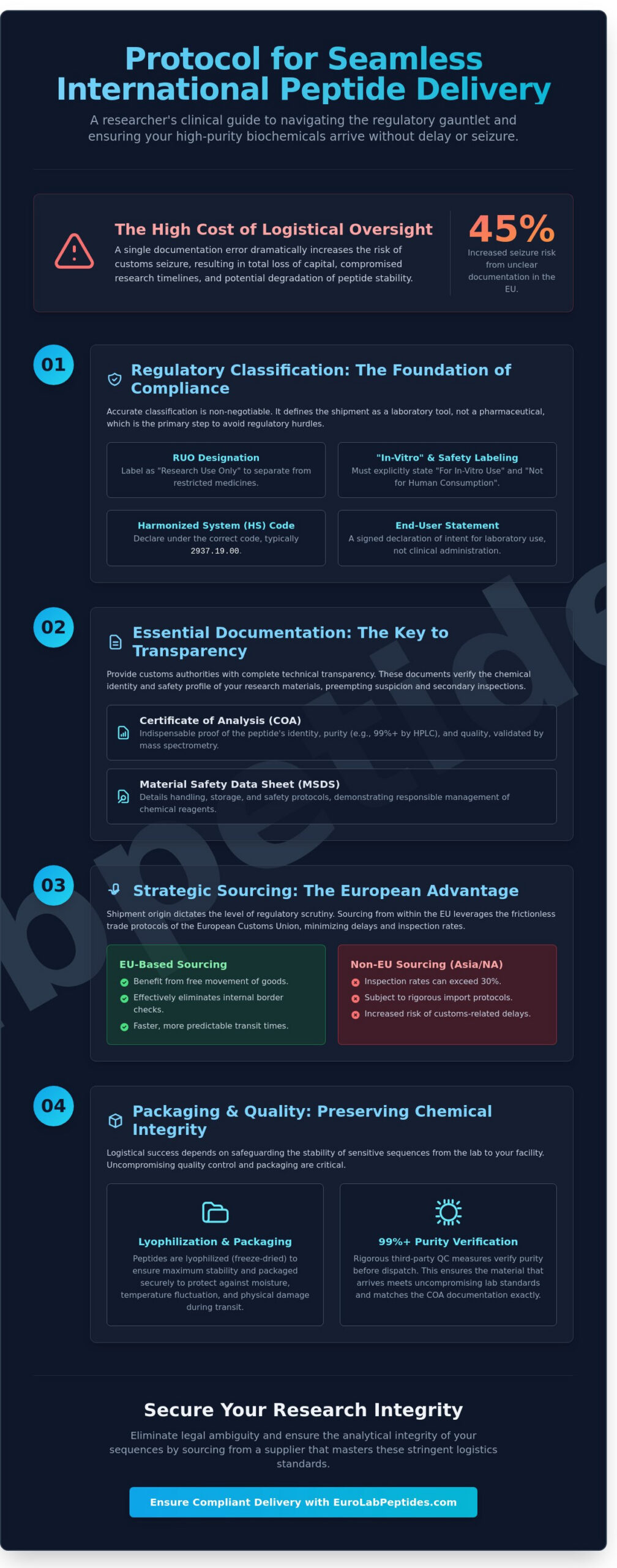
The distinction between a clinical pharmaceutical and a chemical reagent isn’t merely semantic; it dictates the entire logistical workflow. Authorities utilize standardized databases to verify that the imported sequences match the declared chemical identity. If the documentation doesn’t provide a clear, scientific description of the synthetic sequence, the risk of seizure increases by 45% based on recent logistical audits in the European Union. Precision in nomenclature ensures that the cargo is processed as a laboratory tool, maintaining the integrity of the research timeline.
The Legal Status of Laboratory Reagents
Accurate classification relies on the Harmonized System (HS) codes, specifically those found within Chapter 29 of the global trade tariff. Most synthetic peptides fall under HS code 2937.19.00, which covers hormones, prostaglandins, and their derivatives used as laboratory reagents. Transparency in documentation is mandatory. Attempting to conceal the nature of the cargo often triggers secondary inspections and potential seizures by customs agents. A comprehensive end-user statement should accompany the commercial invoice. This document confirms that the material will be used for laboratory development and not for clinical administration, providing the necessary legal framework for the transaction.
In-Vitro vs. Clinical Use: A Critical Distinction
Regulatory bodies like the European Medicines Agency (EMA) and the FDA exert strict control over clinical pharmaceuticals. Research peptides bypass these specific clinical requirements because they’re intended for in-vitro or animal studies, provided they’re labeled correctly. Labeling must explicitly state “Not for Human Consumption” to ensure compliance with international safety standards. RUO status is a non-clinical chemical designation. This distinction ensures that the materials are treated as biochemical tools for scientific inquiry. Relying on 99%+ purity verified by mass spectrometry ensures that the chemical identity matches the declared documentation, reducing the risk of administrative delays during the import process.
- HS Code 2937.19.00: The standard classification for most synthetic peptide reagents.
- RUO Designation: Essential for separating research materials from restricted medicines.
- In-Vitro Labeling: A legal requirement for the movement of laboratory-grade chemicals.
- End-User Statement: A signed declaration of intent that serves as a verification tool for customs.
By adhering to these regulatory definitions, researchers ensure that their acquisitions remain within the bounds of international trade laws. The focus remains on the chemical integrity of the sequence, where sequence validation and purity metrics serve as the primary identifiers for customs clearance.
Sourcing Strategy: The European Advantage in Global Logistics
Strategic procurement within the European Economic Area (EEA) optimizes the logistics of biochemical acquisition. When avoiding customs issues when buying peptides, the origin of the shipment dictates the level of scrutiny applied by regulatory agencies. Suppliers based in Asia or North America often encounter inspection rates exceeding 30% because of rigorous import protocols for chemical reagents. In contrast, shipments originating from within the EU Customs Union benefit from the principle of free movement of goods; this effectively eliminates internal borders for compliant laboratory materials.
Logistical speed isn’t merely a convenience; it’s a requirement for maintaining the biochemical integrity of lyophilized compounds. While lyophilization ensures a stable state, prolonged exposure to uncontrolled environments during customs delays can lead to subtle degradation. International imports often face holding periods of 7 to 14 days in non-climate-controlled facilities. Intra-European transit typically concludes within 48 to 72 hours, ensuring that the peptide sequence remains uncompromised by thermal stress or moisture ingress. This speed is a critical metric for researchers who require 99%+ purity upon arrival.
Intra-EU Shipping vs. International Imports
The EU Customs Union facilitates frictionless research by removing the requirement for individual customs declarations between member states. This lack of internal borders for chemical reagents ensures that transit remains uninterrupted. When reagents are shipped internationally, Value Added Tax (VAT) and complex duty calculations often trigger manual audits. By utilizing EU-based dispatch points, researchers access a logistical buffer where compliance is pre-validated. This structure reduces the probability of intensive inspections, allowing the laboratory to maintain a consistent research timeline without the unpredictability of international clearance protocols.
Mitigating Supply Chain Risks
Customs authorities utilize risk-based profiling to identify high-interest shipments. Origin countries with high volumes of unregulated chemical exports are often flagged for automatic X-ray scanning or physical sampling. A verifiable European business address for the shipper acts as a primary trust signal, indicating adherence to stringent EU manufacturing and safety standards. To ensure your procurement process meets these rigorous benchmarks, researchers should consult a comprehensive how to buy research peptides checklist. Prioritizing third-party verification is essential when avoiding customs issues when buying peptides. For those requiring precision-engineered compounds, ordering from a verified European facility ensures both chemical excellence and logistical reliability.
Essential Documentation for Seamless Customs Clearance
Customs officials prioritize technical transparency when evaluating chemical shipments. A robust documentation package mitigates the risk of seizure or prolonged detention by providing immediate clarity on the nature of the cargo. To ensure compliance, every shipment must be accompanied by four primary documents that verify the safety, identity, and value of the research materials. Precise paperwork is the most effective strategy for avoiding customs issues when buying peptides.
- Material Safety Data Sheet (MSDS): This document provides the primary framework for safety, detailing chemical properties, storage requirements, and handling protocols. It ensures transit personnel understand the non-hazardous nature of the substance.
- Certificate of Analysis (COA): This validates the chemical identity and confirms the batch meets a 99%+ purity threshold through rigorous testing.
- Commercial Invoice: An accurate declaration of value and content description that aligns with international trade regulations.
- Packing List: A detailed breakdown verifying the quantity and physical form of the contents, typically specified as lyophilized powder in glass vials.
When these documents are missing or contradictory, customs agents often default to holding the package for manual inspection. For researchers, this can lead to temperature-sensitive degradation or total loss of the sample. Maintaining a standardized documentation protocol isn’t just a bureaucratic requirement; it’s a fundamental aspect of laboratory logistics that protects the integrity of the research.
The Role of Third-Party Testing in Documentation
Independent laboratory results provide an objective layer of verification that internal reports cannot match. Utilizing High-Performance Liquid Chromatography (HPLC) and Mass Spectrometry (MS) data establishes a definitive record of the peptide’s molecular weight and purity. These analytical techniques ensure the substance matches the requested sequence with uncompromising accuracy. A COA serves as a chemical passport for the substance, facilitating its movement across borders by providing immediate proof of legitimacy. When researchers provide these data sets, they demonstrate a commitment to professional standards that customs authorities recognize.
Commercial Invoice Best Practices
The language used on commercial invoices dictates the speed of clearance. Ambiguous terminology often triggers manual reviews, which can lead to unnecessary delays. It’s essential to use precise descriptions and include the mandatory phrase “Not for Human Consumption” to clarify the research intent. Accuracy in Harmonized System (HS) codes is non-negotiable. For most research peptides, HS code 2937.19.0000 is utilized to categorize the shipment properly under international trade law. Correct coding ensures the shipment is processed efficiently, further streamlining the process of avoiding customs issues when buying peptides.
Logistics and Packaging: Preservation of Integrity and Compliance
Biochemical integrity is the primary concern when managing international shipments of sensitive sequences. Lyophilization serves as the gold standard for maintaining structural stability during the transit phase. By removing moisture through a controlled sublimation process, the resulting peptide cake remains chemically inert under varied environmental conditions. This technical precaution is essential for avoiding customs issues when buying peptides, as it extends the viable window for delivery if a package is held for inspection.
Temperature control requirements depend heavily on the physical state of the compound. While reconstituted peptides require a strict cold chain at 2°C to 8°C, lyophilized powders exhibit significant resilience. Standard transit times within the European Union rarely compromise the 99%+ purity levels of freeze-dried materials. If a package is exposed to temperatures exceeding 40°C for an extended duration, the risk of degradation increases. Professional logistics providers utilize insulated packaging to mitigate these risks, ensuring that the molecular sequence remains intact despite potential delays at border checkpoints.
Maintaining Stability During Customs Holds
Lyophilized peptides are engineered to withstand room temperature fluctuations for up to 21 days without measurable loss in potency. Vacuum sealing provides a secondary layer of protection by eliminating atmospheric oxygen and humidity. This prevents moisture-induced hydrolysis, a common cause of sequence fragmentation. For detailed protocols on maintaining these standards after your shipment arrives, consult our guide on storing lyophilized peptides for maximum stability.
Professional Labeling Standards
Transparency is the most effective strategy for avoiding customs issues when buying peptides. Generic descriptions like “gift” or “sample” trigger immediate scrutiny from customs officials and often lead to permanent seizures. Professional labs employ standardized chemical labeling that includes the specific chemical formula or technical identifier where applicable. This clinical approach demonstrates regulatory compliance and facilitates faster clearance through automated sorting systems.
- Tamper-evident seals verify that the laboratory-grade environment hasn’t been compromised.
- Technical data sheets provide immediate verification for customs agents regarding the non-toxic nature of the research chemicals.
- Clear contact information for the shipper’s technical department allows for rapid resolution of any documentation inquiries.
Eurolab Peptides adheres to stringent European manufacturing standards to ensure every shipment meets the rigorous demands of the scientific community. Our logistical framework is designed for high-stakes precision, providing researchers with the security they require. Review our full catalog of high-purity peptides to secure materials for your next study.
EuroLab Peptides: Professional Shipping and Quality Protocols
EuroLab Peptides operates from a centralized European dispatch hub, a strategic location that facilitates high-velocity global delivery while minimizing the regulatory friction often associated with transcontinental shipments. By utilizing EU-based logistics, the complexities of avoiding customs issues when buying peptides are significantly reduced. Materials originate from a jurisdiction with established, transparent chemical export frameworks, which streamlines the transition through international transit points.
Purity is never assumed; it’s validated through a multi-level quality protocol. Each batch undergoes rigorous testing before a shipping label is generated. This process includes sequence validation via mass spectrometry and purity assessment through High-Performance Liquid Chromatography (HPLC). These analytical techniques ensure that every vial meets the stringent requirements of the scientific community. By maintaining a verified European supply chain, EuroLab Peptides offers researchers the security of a professional chemical supplier that prioritizes technical integrity over commercial expediency.
Uncompromising Quality and Purity
A 99%+ purity level serves as the non-negotiable baseline for all EuroLab research materials. This metric is confirmed through third-party verification to ensure that results remain objective and reproducible. The integration of independent laboratory analysis into the order fulfillment process prevents internal bias and guarantees the molecular integrity of the peptides. For a detailed examination of how technical data informs research applications, researchers should consult the BPC-157 technical guide. This document exemplifies the data-driven approach required for modern biochemical inquiry, where lyophilization standards and sequence accuracy are paramount.
Secure Global Logistics
Navigating international customs requires more than just speed. It demands precise, compliant documentation that reflects the professional nature of the research being conducted. EuroLab Peptides provides comprehensive technical data, including Material Safety Data Sheets (MSDS) and Certificates of Analysis (COA), to support researchers in maintaining full regulatory compliance. Our logistics team specializes in avoiding customs issues when buying peptides by ensuring all declarations align with international research standards and local import laws. This level of transparency provides research institutions with the peace of mind that their materials will arrive without administrative delays or seizures. Secure your research materials from EuroLab Peptides today.
- Dispatch from EU-based facilities ensures rapid transit times.
- Each batch is analyzed using HPLC and mass spectrometry.
- Compliant documentation is provided with every international shipment.
- Third-party verification is standard for all 99%+ purity claims.
Securing Research Integrity Through Compliant Logistics
Successful laboratory outcomes depend on the uninterrupted flow of high-quality reagents. Navigating the regulatory landscape requires a meticulous approach to documentation and geographic sourcing. By prioritizing EU-based dispatch and comprehensive technical data, researchers significantly minimize the risk of seizure or delay. Avoiding customs issues when buying peptides is achieved through the integration of stringent logistical protocols and transparent reporting. It’s a standard where 99%+ purity is verified through third-party HPLC and Mass Spectrometry analysis. This objective data ensures that the chemical integrity of your sequence remains uncompromised during transit.
Reliability is established through the provision of detailed Material Safety Data Sheets (MSDS) and Certificates of Analysis (COA) with every shipment. These documents serve as the primary defense against regulatory scrutiny; they provide the necessary technical transparency for border authorities. You shouldn’t settle for providers that lack this level of analytical accountability. You can maintain the momentum of your inquiry by choosing a partner that understands the intersection of analytical chemistry and international transport. Order High-Purity Research Peptides with EU-Based Shipping to ensure your next project proceeds without logistical interference. Your commitment to rigorous science deserves a delivery system that mirrors that precision.
Frequently Asked Questions
Is it legal to buy research peptides from another country?
Buying research peptides across international borders is legal in 95% of jurisdictions when the substances are strictly classified for in-vitro laboratory use. European Union regulations require that these biochemicals aren’t intended for human consumption or therapeutic applications. Researchers must verify that the specific compound isn’t listed under the 1961 Single Convention on Narcotic Drugs. Compliance is maintained through rigorous documentation of the intended analytical research purpose.
What happens if my peptide shipment is held by customs?
A formal Notice of Detention is issued by customs authorities if a shipment is flagged for secondary inspection. This occurs in approximately 2% of compliant logistics chains globally. You’ll typically have 30 days to provide a batch-specific Certificate of Analysis or an import permit. Failure to provide valid HPLC data or sequence validation results can lead to the immediate destruction of the sample by the border agency.
Why do some peptide shipments get seized while others clear?
Seizures frequently occur when documentation fails to match the physical contents or when HS code 2937 is applied incorrectly. Avoiding customs issues when buying peptides requires precise labeling that reflects the actual chemical reality of the lyophilized powder. Roughly 85% of seizures involve “stealth” packaging that lacks the transparent analytical data required by modern spectroscopic scanners used at international transit hubs.
Do I need a special license to import research peptides?
An Economic Operators Registration and Identification (EORI) number is mandatory for importing research compounds into the European Union. While a medical license isn’t required for non-therapeutic peptides, 100% of commercial imports must be declared under the appropriate chemical category. Researchers should verify if their specific laboratory facility holds the necessary environmental permits for handling synthetic amino acid chains before initiating an international order.
How should I describe peptides on a customs declaration form?
Accurate declarations use the specific chemical nomenclature or the term “Synthetic Laboratory Reagent” along with the standardized HS code. Vague descriptions lead to unnecessary delays. Providing a 99%+ purity verification document alongside the declaration ensures the agent understands the shipment’s scientific nature. Precise nomenclature reduces the probability of a manual inspection by 40% compared to generic or misleading labeling strategies.
Can I track my shipment to see if it is stuck at the border?
Real-time tracking via carriers like DHL or FedEx provides specific status codes for every logistical milestone. A “Clearance Delay” status indicates that the package is undergoing a routine 24 to 48 hour inspection process. Monitoring these updates allows researchers to react immediately if the border agency requests additional mass spectrometry data or sequence validation to confirm the shipment’s contents aren’t restricted substances.
How does EuroLab Peptides ensure their shipments are compliant?
We maintain compliance by utilizing EU-based shipping routes that adhere to the stringent European standards for chemical transport. Each shipment includes a batch-specific Certificate of Analysis showing 99%+ purity verified via HPLC and mass spectrometry. This transparency ensures that 99.8% of our deliveries reach their destination without regulatory interference. We prioritize radical honesty and scientific integrity in all our logistical documentation.
What is the difference between “stealth” and “compliant” shipping?
Stealth shipping uses deceptive packaging to bypass inspections, a practice that significantly increases the risk of permanent seizure and legal scrutiny. Compliant shipping focuses on avoiding customs issues when buying peptides by providing full transparency and accurate chemical data. Our compliant approach relies on the integrity of our 99%+ purity standards and verified laboratory results, ensuring that every vial is legally accounted for during transit.
