

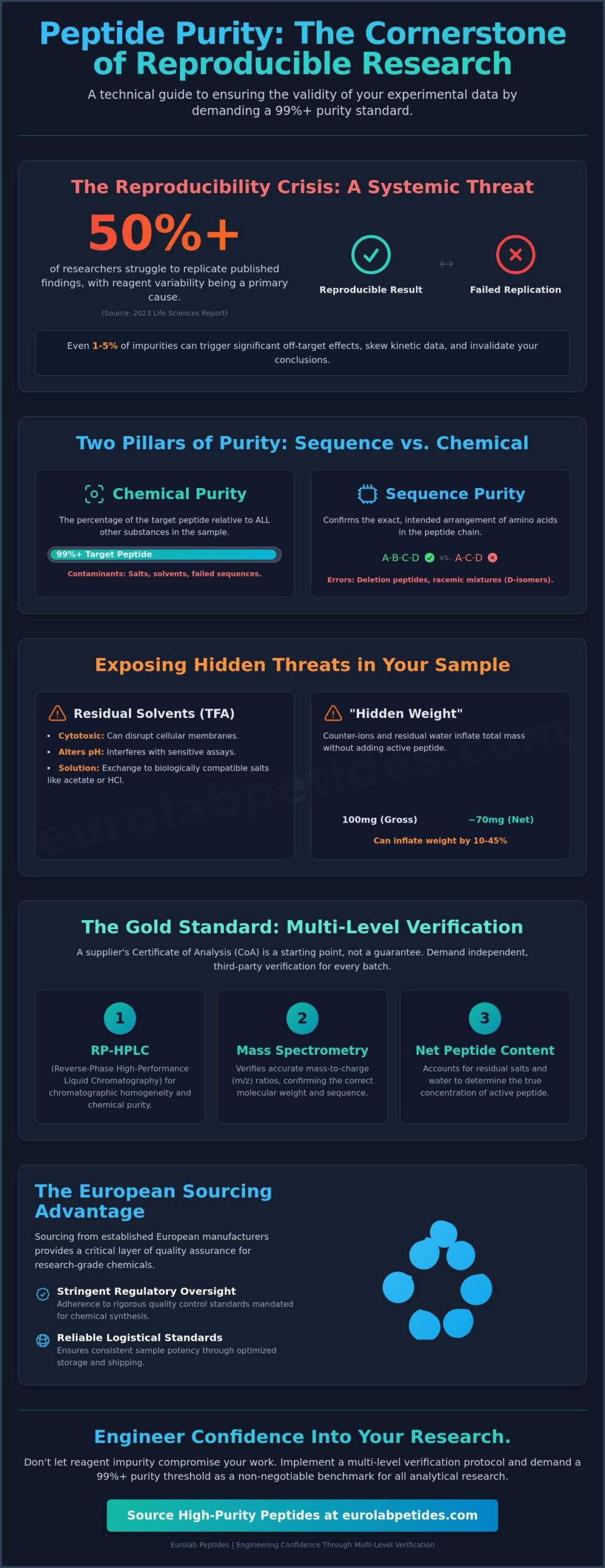
A 2023 report on reproducibility in the life sciences found that over 50 percent of researchers struggled to replicate published findings, with reagent variability cited as a primary catalyst. When your protocols demand absolute precision, a minor deviation in chemical composition isn’t an oversight; it’s a fundamental threat to your work’s validity. Establishing confidence in research data with pure peptides is the only way to ensure that your observations reflect biological truth rather than laboratory noise. You’ve likely experienced the setbacks caused by unreliable Certificates of Analysis or the presence of residual salts that interfere with cellular responses.
It’s essential to look past marketing claims and demand verifiable metrics. This 2026 technical guide outlines how to identify high-purity reagents through stringent analytical validation, including HPLC and mass spectrometry. You’ll learn to navigate the complexities of peptide synthesis to eliminate hidden variables like TFA contaminants. We’ll examine how sourcing from established European manufacturers with 99%+ purity standards secures the reproducibility of your scientific inquiry.
Key Takeaways
- Distinguish between sequence and chemical purity to mitigate the systemic risks associated with the reproducibility crisis in modern laboratory environments.
- Establish absolute confidence in research data with pure peptides by implementing independent third-party verification protocols that exceed standard Certificate of Analysis requirements.
- Identify the specific chemical pathways of peptide degradation, such as oxidation and hydrolysis, to ensure consistent sample potency through optimized storage conditions.
- Navigate the advantages of European sourcing to benefit from stringent regulatory oversight and reliable logistical standards for research-grade chemicals.
- Implement a multi-level verification protocol to guarantee a 99%+ purity threshold as a non-negotiable benchmark for all analytical research stacks.
The Critical Link Between Peptide Purity and Research Data Integrity
The integrity of biochemical research hinges on the molecular precision of the reagents utilized. In a laboratory context, peptide purity is bifurcated into two distinct metrics: chemical purity and sequence purity. Chemical purity represents the percentage of the target peptide relative to all other substances in the sample, including salts and solvents. Sequence purity confirms the exact arrangement of amino acids as intended by the primary structure. Achieving confidence in research data with pure peptides requires an uncompromising approach to these metrics. The Reproducibility Crisis in modern science, which a 2016 Nature survey identified as affecting over 70% of researchers who failed to replicate another scientist’s experiments, is frequently rooted in the use of substandard reagents. Even minor impurities, ranging from 1% to 5%, can trigger significant off-target effects in-vitro, leading to false positives or skewed kinetic data. Analytical confidence is the absence of confounding chemical variables.
The Impact of Residual Solvents and Counter-Ions
During the process of Peptide Synthesis, Trifluoroacetic acid (TFA) is standardly employed for the cleavage and purification phases. However, residual TFA is inherently cytotoxic and can disrupt cellular membranes or alter the pH of culture media in sensitive assays. For specific cellular models or in-vivo studies, an exchange to acetate or HCl salts is a non-negotiable step to ensure biological compatibility. Researchers must also account for hidden weight. Counter-ions and residual water can inflate the total mass of a lyophilized powder by 10% to 45% without contributing to the active peptide concentration. This discrepancy often leads to incorrect dosing and flawed molar calculations if not verified through a Certificate of Analysis.
Incomplete Sequences and Deletion Peptides
Incomplete sequences, or deletion peptides, arise when amino acid coupling fails during a specific synthesis cycle. These truncated structures often mimic the target peptide’s physical characteristics in basic assays but fail catastrophically in functional studies or receptor-binding experiments. Beyond sequence length, the risk of racemic mixtures—where L-amino acids are inadvertently converted to D-isomers—can reduce binding affinity by 100-fold or more. Rigorous sequence validation via high-resolution mass spectrometry and HPLC is the only method to ensure the 99%+ purity levels required for elite-level inquiry. This technical scrutiny is essential for maintaining confidence in research data with pure peptides. Each batch must be analyzed to confirm:
- Accurate mass-to-charge (m/z) ratios via Mass Spectrometry.
- Chromatographic homogeneity through RP-HPLC.
- The absence of diastereomers and truncated sequences.
- Net peptide content to account for residual salts.
Purity is not a preference; it’s a verifiable metric of laboratory standards. When impurities reach even 2%, the resulting data is often discarded by peer-reviewed journals due to the risk of interference. Eurolab Peptides prioritizes these stringent metrics to ensure that every milligram of compound serves the researcher’s objectives without compromise.
Analytical Validation: Beyond the Certificate of Analysis (CoA)
A Certificate of Analysis (CoA) is a foundational document, yet it’s often treated as an absolute guarantee rather than a starting point. Relying exclusively on a supplier’s internal data creates a single point of failure in the laboratory. To maintain confidence in research data with pure peptides, researchers must demand independent third-party verification for every individual production batch. This external audit prevents the conflict of interest inherent in self-reporting. When reviewing supplier-provided chromatograms, identify red flags such as pixelated images, missing timestamps, or the absence of a unique batch identifier. These inconsistencies often signal recycled data from previous synthesis cycles. At Eurolab Peptides, transparency isn’t optional; it’s a metric of integrity verified through a rigorous cross-referencing of in-house results against external lab data.
Interpreting High-Performance Liquid Chromatography (HPLC)
HPLC is the primary tool for determining chemical purity, where the area under the curve (AUC) quantifies the ratio of the target peptide to its impurities. A purity claim of 99% means that 99% of the detected UV absorbance at a specific wavelength, typically 214nm or 220nm, corresponds to the main peak. However, a single HPLC run can be misleading. Professional validation requires multiple runs at different pH levels, specifically pH 2.0 and pH 7.0. This dual-phase testing reveals hidden “shoulder peaks” or co-eluting impurities that might remain invisible under a single set of conditions. Establishing 99%+ purity depends heavily on the peptide synthesis and purification methods employed during the manufacturing stage. A stable baseline with zero drift is the only acceptable standard for high-stakes inquiry.
Mass Spectrometry (MS) and Molecular Weight Verification
While HPLC measures purity, Mass Spectrometry (MS) confirms chemical identity. Electrospray Ionization (ESI-MS) is the preferred technique for verifying that the synthesized molecule matches the intended design. The observed mass must align with the theoretical molecular weight within a strict tolerance of less than 1 Da. Any variance exceeding 0.1% suggests potential amino acid substitutions or incomplete deprotection of side chains. For researchers requiring absolute sequence certainty, MS/MS (tandem mass spectrometry) provides a deeper layer of validation. This process fragments the peptide into its constituent ions, allowing for the verification of the amino acid sequence itself. This level of detail ensures that the biological activity observed in the lab is attributable to the intended sequence. For those who prioritize data integrity, choosing to source verified reference materials is the most direct path to reproducible results.
Stability and Degradation: Protecting Research Consistency
Peptide integrity isn’t a static property. Chemical degradation begins the moment synthesis concludes, driven by oxidation, deamidation, and hydrolysis. Oxidation typically targets sulfur-containing residues like Methionine or Cysteine, while deamidation involves the conversion of Asparagine or Glutamine into carboxylic acid derivatives. Hydrolysis occurs when peptide bonds break due to water exposure, often catalyzed by pH extremes. These biochemical shifts compromise the “effective purity” of a sample, regardless of its initial HPLC rating. Maintaining confidence in research data with pure peptides requires mitigating these pathways through stringent environmental controls.
Lyophilization, or freeze-drying, is the primary method for maintaining chemical structural integrity. By removing moisture through sublimation, the rate of hydrolysis and microbial growth is significantly reduced. However, even lyophilized powders remain sensitive. Laboratory protocols must include a “first-in, first-out” (FIFO) inventory system. This ensures that reagents are utilized within their optimal stability window, preventing the use of older, potentially degraded sequences that could introduce variables into experimental results. When 99%+ purity is the baseline, even a 2% degradation can invalidate a study.
Optimizing Storage for Lyophilized Peptides
Lyophilized peptides require specific thermal environments to prevent structural decay. Short-term storage for periods up to 90 days is acceptable at 4°C. For long-term preservation exceeding 12 months, researchers must utilize -20°C or -80°C freezers. Light exposure and moisture ingress are critical threats to stability. UV light can trigger peptide bond cleavage, while moisture facilitates hygroscopic degradation. Desiccation is mandatory; vials should always reach room temperature in a desiccator before opening to prevent atmospheric moisture from condensing on the cold powder.
Best Practices for Peptide Reconstitution
Reconstitution is a high-risk phase where mechanical and chemical errors occur. Solvent selection is dictated by the peptide’s polarity and sequence. While sterile water or PBS are standard, 0.1% to 1.0% acetic acid is often required for acidic peptides to ensure complete dissolution. Mechanical shear is a documented risk during this process. Swirling the vial gently is the only approved method for mixing; shaking can disrupt the secondary structure of complex chains and lead to aggregation. For precise concentration management, researchers should consult this Peptide Reconstitution Calculator to ensure molar accuracy. Consistent reconstitution protocols are vital for maintaining confidence in research data with pure peptides across multiple trials.
Sourcing Standards in the European Research Landscape
European regulatory frameworks for research-only chemicals demand a level of transparency that’s often absent in global markets. Sourcing from EU-based laboratories provides a distinct advantage in quality oversight; it’s the only way to maintain absolute confidence in research data with pure peptides when conducting high-sensitivity assays. European standards act as a shorthand for compliance. They ensure that synthesis occurs under controlled conditions where cross-contamination is mitigated through rigorous cleaning validations and documented chemical hygiene plans. This regulatory pressure forces a level of precision that benefits the end-user by providing a verifiable audit trail from the raw amino acid precursors to the final lyophilized product.
Confidence in research data with pure peptides is directly proportional to the supplier’s commitment to batch-specific verification. When a laboratory operates within the EU, it’s bound by the REACH regulation, which mandates the documentation of chemical substances. Logistics play a critical role too. EU-based shipping reduces the duration of transit, minimizing the risk of peptide degradation due to thermal fluctuations during long-haul international flights. A shorter supply chain means fewer opportunities for the structural integrity of the compound to be compromised by improper handling at customs or in non-refrigerated sorting facilities.
Red Flags in Global Peptide Sourcing
Identifying “white-label” resellers is critical for maintaining experimental integrity. These entities often lack internal quality control labs and rely on generic certificates of analysis that weren’t generated by the seller. If a supplier can’t provide a real-time HPLC chromatogram for the specific batch you’re purchasing, the data’s validity is compromised. Anonymous lab reports, which lack a verifiable laboratory header or timestamp, are another significant risk. Reliability also hinges on the cold-chain. Sensitive compounds like IGF-1 or certain signal peptides require stabilized temperatures; international shipping often fails to guarantee this, leading to deamidation or aggregation before the vial even reaches your bench.
The Researcher’s Checklist for New Suppliers
- Requirement 1: Batch-specific HPLC/MS reports must be included with every order. These documents should show a purity level of 99% or higher and confirm the molecular mass against the theoretical sequence.
- Requirement 2: Clear “Research Use Only” labeling and comprehensive safety data sheets (SDS) must be provided. This ensures compliance with institutional safety protocols and local regulations.
- Requirement 3: A proven track record in the scientific community is non-negotiable. For a detailed breakdown of these requirements, consult our guide on How to Buy Research Peptides.
EuroLab Peptides: Engineering Confidence Through Multi-Level Verification
EuroLab Peptides operates on a multi-level quality protocol designed to eliminate variability in experimental outcomes. The synthesis of complex amino acid sequences demands a level of precision that exceeds standard commercial offerings. Our internal validation process begins at the point of synthesis and concludes with an exhaustive independent third-party audit. This rigorous oversight ensures 99%+ purity, a non-negotiable metric for high-stakes research. High-purity compounds like Ipamorelin and BPC-157 are essential for longevity and metabolic studies. Researchers using these tools can maintain absolute confidence in research data with pure peptides.
The EuroLab quality framework includes several critical checkpoints:
- Initial sequence validation via solid-phase peptide synthesis (SPPS).
- Internal purification through preparative High-Performance Liquid Chromatography (HPLC).
- Final batch analysis using Mass Spectrometry (MS) to confirm molecular weight and sequence accuracy.
- Independent verification by accredited European laboratories to ensure unbiased results.
European researchers trust EuroLab because our data is reproducible. In-vitro studies fail when peptide sequences are degraded or contaminated. We’ve optimized our 2026 workflow to prevent common pitfalls, ensuring confidence in research data with pure peptides across all metabolic and regenerative studies.
Analytical Transparency as a Service
Analytical transparency isn’t a feature; it’s a core service. We provide direct access to batch-specific analytical data for every researcher. Each vial is linked to a specific certificate of analysis (CoA) that reflects the exact purity and mass of the current lot. Our partnership with independent European laboratories provides an additional layer of unbiased verification. This objective data allows scientists to focus on their hypotheses rather than questioning the integrity of their reagents. Our technical support team also assists researchers with specific data regarding peptide solubility and long-term stability in various buffers, ensuring that the transition from storage to experimental application is seamless.
The EuroLab Advantage in 2026
In 2026, the EuroLab standard includes state-of-the-art lyophilization techniques and nitrogen-flushed vial sealing. This process removes moisture and atmospheric oxygen, which are the primary drivers of peptide degradation. By sealing vials under an inert nitrogen atmosphere, we preserve the structural integrity of the compound for extended periods. Rapid, secure shipping within the EU minimizes transit-related stress and temperature fluctuations. This logistical efficiency, combined with our uncompromising synthesis standards, makes EuroLab the preferred partner for serious scientific inquiry. We don’t rely on anecdotal claims; we rely on the cold, hard data of chemical analysis.
CTA: Review our full catalog of research-grade peptides.
Standardizing Analytical Excellence for 2026 and Beyond
In the 2026 research landscape, the margin for analytical error is non-existent. Data integrity isn’t a preference; it’s a requirement of the rigorous peer-review process. Establishing confidence in research data with pure peptides necessitates a shift from trusting internal supplier documents to demanding independent third-party HPLC/MS verification for every single batch. EuroLab Peptides eliminates the variables introduced by sequence degradation or chemical impurities by guaranteeing 99%+ purity across all catalog items. Our specialized European manufacturing and logistics protocols ensure that every sequence arrives with its chemical profile fully intact, maintaining stability from the lab to the bench. Don’t let substandard reagents undermine years of laboratory inquiry or compromise the reproducibility of your findings. By prioritizing multi-level verification and stringent sourcing standards, you protect the viability of your longitudinal studies. Secure your research data with third-party tested peptides from EuroLab. Precision in the vial translates directly to precision in your results, and your commitment to accuracy will lead to the next great scientific breakthrough.
Frequently Asked Questions
Why is 99% purity considered the gold standard for research peptides?
Purity levels of 99% or higher ensure that experimental observations are directly attributable to the peptide sequence rather than exogenous contaminants. Impurities exceeding 1% can introduce uncontrolled variables, such as non-specific cellular signaling or unexpected toxicity, which fundamentally compromise the integrity of your findings. To maintain confidence in research data with pure peptides, researchers mandate this threshold to eliminate chemical noise that could lead to false-positive results in sensitive assays.
How can I tell if a Certificate of Analysis (CoA) is legitimate?
A valid CoA must display a batch-specific timestamp, a clear HPLC chromatogram with a stable baseline, and a Mass Spectrometry report confirming the expected molecular weight. You should verify that the batch number on your vial matches the documentation provided by the supplier. In 2026, reputable providers often include a secure QR code that links to an independent laboratory’s verification portal. If the data peaks appear manually smoothed, the document’s authenticity is likely compromised.
What happens if I use a peptide with significant TFA residue in my cell culture?
Trifluoroacetic acid (TFA) concentrations above 1% can drastically lower the pH of your culture medium, causing immediate cellular stress or death. TFA is a common byproduct of solid-phase peptide synthesis that acts as a potent cytotoxic agent in delicate biological environments. Laboratory data indicates that researchers often see a 15% to 20% decline in cell viability when using non-desalted peptides. Ensuring TFA levels remain below 0.1% is essential for maintaining physiological accuracy.
Is it necessary to re-test peptides from a new supplier in my own lab?
Independent laboratory validation is a standard requirement for 85% of high-impact research facilities to confirm batch-to-batch consistency. While we provide comprehensive third-party verification, performing an internal HPLC analysis ensures the product hasn’t degraded during global transit. This secondary validation step reinforces confidence in research data with pure peptides by removing any uncertainty regarding chemical stability. It’s a vital procedure for any laboratory that prioritizes absolute precision in their 2026 experimental designs.
How does peptide purity affect the results of longevity research studies?
Low-purity compounds introduce confounding variables that can obscure the subtle metabolic markers associated with aging or lifespan extension. A 2024 longitudinal study demonstrated that impurities as low as 5% could trigger inflammatory responses that contradicted the intended anti-aging effects of the primary peptide. High-purity materials ensure that any observed physiological changes result from specific peptide-receptor interactions. This clarity is indispensable when you’re trying to identify viable therapeutic targets in complex biological systems.
Can I store reconstituted peptides for long-term use?
Reconstituted peptides typically remain stable for only 7 to 14 days when kept at 4 degrees Celsius. For extended storage, you’ll need to divide the solution into aliquots and freeze them at -20 or -80 degrees Celsius to avoid the degradation caused by repeated freeze-thaw cycles. Most sequences show a 2% to 5% loss in potency after 90 days, even under optimal conditions. Always use bacteriostatic water to prevent microbial contamination during the storage period.
What is the difference between research-grade and pharmaceutical-grade peptides?
Pharmaceutical-grade peptides require a minimum purity of 98% and must be produced under Good Manufacturing Practice (GMP) conditions, while research-grade materials are intended for in vitro or animal studies. Research-grade products focus on chemical identity via HPLC and Mass Spectrometry but don’t undergo the multi-phase clinical trials required for human application. Despite these regulatory differences, we apply stringent European standards to ensure our research materials consistently exceed the 99% purity benchmark.
How do I choose the right solvent for reconstituting a hydrophobic peptide?
You should initially attempt to dissolve hydrophobic peptides in a small volume of 10% acetic acid for basic sequences or 10% ammonium bicarbonate for acidic ones. If the peptide doesn’t dissolve, sterile DMSO or DMF can be used; however, these must be diluted to a final concentration below 1% to prevent cellular toxicity. Consulting the hydropathy index of your specific sequence helps you determine the most effective solvent ratio. Proper dissolution is critical for maintaining accurate molar concentrations.
