

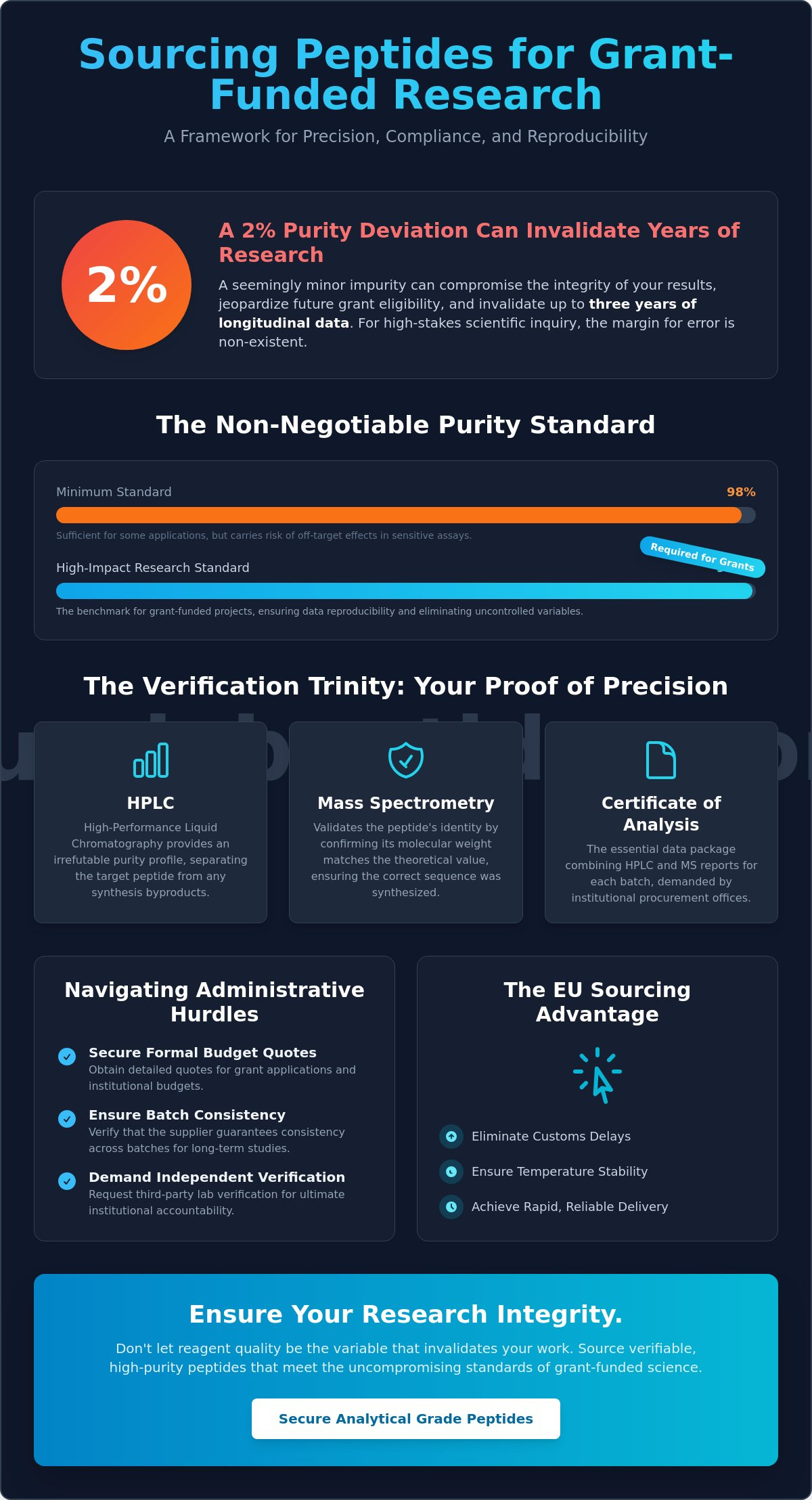
A single 2% deviation in peptide purity can invalidate three years of longitudinal data and jeopardize future grant eligibility. You recognize that the integrity of your results depends entirely on the chemical precision of your reagents. When sourcing peptides for a grant-funded project, the margin for error is non-existent. Procurement offices often demand exhaustive documentation that many suppliers fail to provide; this creates a bottleneck that stalls critical research and compromises the methodical progression of your study.
You’ll learn how to secure a reliable supply of 99%+ purity peptides while satisfying the stringent administrative requirements of institutional funding bodies. We provide a framework for obtaining verifiable Certificates of Analysis (CoA) backed by third-party HPLC and mass spectrometry data. This guide also addresses the logistical advantages of EU-based shipping to eliminate the customs delays that frequently compromise temperature-sensitive shipments. By prioritizing European manufacturing standards, you ensure that every batch meets the uncompromising specifications required for high-stakes scientific inquiry.
Key Takeaways
- Identify the specific technical criteria for research-grade peptides to satisfy the rigorous compliance standards of grant-funding institutions.
- Evaluate the essential role of HPLC and Mass Spectrometry in validating chemical purity and sequence accuracy for reproducible experimental data.
- Navigate the administrative complexities of sourcing peptides for a grant-funded project, from securing formal budget quotes to ensuring batch consistency.
- Mitigate the risks of peptide degradation by leveraging EU-based sourcing to ensure logistical stability and rapid delivery within European borders.
- Establish a protocol for institutional accountability through the use of independent third-party laboratory verification for all analytical metrics.
The Critical Role of Peptide Sourcing in Grant-Funded Research
Sourcing peptides for a grant-funded project demands a level of technical scrutiny that exceeds standard laboratory purchasing. Research-grade peptides, specifically those intended for in-vitro development, are defined by a minimum purity threshold of 98%, though 99% is the standard benchmark for high-sensitivity assays. These molecules aren’t merely reagents; they’re the foundational variables of the experimental design. When public or private grants fund a study, the accountability for every Euro spent shifts toward the verification of materials. Standard peptide synthesis methods provide the sequence, but analytical transparency provides the proof. This transparency is achieved through high-performance liquid chromatography (HPLC) and mass spectrometry (MS) data, which must be provided for every individual batch to ensure the absence of truncated sequences or residual solvents.
The financial stakes involved in these projects are high. A single contaminated batch can invalidate six months of cellular assays, resulting in a direct loss of grant capital and laboratory resources. Analytical transparency serves as the primary metric for selection. This means the researcher receives a full data package, including mass spectra that confirm the molecular weight and HPLC chromatograms that map the purity profile. Without this data, the researcher is working in a vacuum, unable to differentiate between a failed hypothesis and a failed reagent.
Reproducibility: The Benchmark of Funded Science
Trace impurities, such as residual trifluoroacetic acid (TFA) or scavengers, often lead to off-target effects in cellular models, masking the true biological activity of the peptide. Using unverified materials in a three-year project risks the entire dataset’s validity, potentially leading to the loss of subsequent funding rounds. The reproducibility crisis is the phenomenon where experimental results cannot be replicated across different laboratories due to the use of poorly characterized or inconsistent chemical reagents. Peer-reviewers now frequently demand raw HPLC traces as a condition of publication to ensure that the reported bioactivity is attributed to the peptide itself rather than a synthesis byproduct.
Institutional Procurement and Compliance
Institutional procurement offices evaluate chemical suppliers based on rigorous safety and ethics standards, often maintaining approved vendor lists. These offices distinguish between commercial-grade chemicals, often used for bulk industrial applications, and research-grade sourcing, which requires stringent quality control. A vendor must align with the institution’s commitment to scientific integrity. This involves providing comprehensive certificates of analysis (COA) that confirm the identity and purity of the compound before it enters the laboratory’s inventory. Most universities require vendors to demonstrate 99%+ purity as a non-negotiable standard for any sensitive biochemical inquiry.
Technical Specifications: Decoding Analytical Reports
Precision is the baseline for academic success. When sourcing peptides for a grant-funded project, the integrity of the raw material dictates the reproducibility of the entire study. High-Performance Liquid Chromatography (HPLC) remains the gold standard for determining chemical purity. This process separates the target peptide from synthesis byproducts, ensuring that the final material meets stringent requirements. For high-impact research, a 99%+ purity threshold is the standard. Lower grades introduce uncontrolled variables that can invalidate months of data. The rigor required for grant-funded peptide research at Georgia Tech underscores why analytical validation isn’t optional.
Mass Spectrometry (MS) provides the necessary sequence validation by confirming that the molecular weight matches the theoretical value. Without MS data, there’s no proof the correct sequence was synthesized. Following synthesis, lyophilization (freeze-drying) is utilized to remove moisture and solvents. This process creates a stable powder cake that resists degradation during transit and long-term storage at -20°C. Researchers requiring this level of precision can review analytical grade peptides to ensure their experimental foundations are secure.
Interpreting the Certificate of Analysis (CoA)
A Certificate of Analysis (CoA) is a non-negotiable scientific document. Every CoA must clearly list the batch number, purity percentage, and molecular weight. It’s vital to verify third-party laboratory results rather than relying exclusively on in-house claims. When cross-referencing MS peaks, the primary signal must align with the theoretical molecular weight. Any significant secondary peaks suggest the presence of truncated sequences or protected amino acids that didn’t fully deprotect during synthesis.
Purity vs. Net Peptide Content
Chemical purity and net peptide content are distinct metrics that are often confused. A vial labeled 99% pure refers to the ratio of the target peptide to other organic impurities. It doesn’t represent the actual weight of the peptide in the vial. Most synthetic peptides contain residual salts, typically Trifluoroacetic acid (TFA), which can occupy 10% to 30% of the total powder weight. High TFA levels often prove toxic to sensitive in-vitro assays, potentially skewing biological results. When sourcing peptides for a grant-funded project, use this checklist for technical review:
- Verify the HPLC chromatogram shows a single, sharp peak with minimal baseline noise.
- Confirm the MS report matches the theoretical mass within 1 Dalton.
- Check the net peptide content to calculate exact molar concentrations for dosing.
- Ensure the salt form (Acetate, TFA, or HCl) is compatible with your specific cell lines.
By prioritizing these technical specifications, labs maintain compliance with funding body requirements and protect the integrity of their published findings.
The Administrative Paper Trail: Quotes, Audits, and Accounting
Procurement for high-level research requires more than a simple transaction; it demands a rigorous audit trail that aligns with institutional compliance and grant agency mandates. When sourcing peptides for a grant-funded project, researchers must secure formal quotes that detail itemized costs, shipping protocols, and technical specifications. These documents serve as the primary evidence for budget justification during annual reviews or mid-cycle audits. If a specific purity level or sequence complexity is required, documentation for sole-source procurement should be established early. This involves justifying why a specific supplier’s 99%+ purity standards or proprietary synthesis methods are essential for the study’s reproducible results. Institutional accountability is maintained when every gram of material is tied to a verifiable quote and a corresponding Certificate of Analysis.
Managing Grant Budgets and Invoicing
Effective fiscal management often dictates a choice between bulk upfront purchasing and staggered delivery schedules. Bulk procurement can lock in pricing and ensure supply, while staggered delivery preserves laboratory cash flow and prevents long-term storage degradation. All invoices must include verified VAT numbers and official business registration details to satisfy EU audit protocols. Researchers looking to buy research peptides must ensure the vendor provides transparent billing that matches the grant’s line-item allocations. This level of detail prevents administrative delays during the reconciliation phase of the project. Clear communication regarding shipping costs and potential customs duties is also necessary to avoid unforeseen budget overages.
Batch Reservation for Longitudinal Studies
Longitudinal studies spanning 12 to 36 months are vulnerable to inter-batch variability. Even minor fluctuations in TFA (Trifluoroacetic acid) content or residual salt concentration can skew sensitive biological data. To mitigate this, researchers should inquire about the reservation of specific lots. By securing a single, large-scale batch of lyophilized peptide, the laboratory eliminates the risk of switching chemical profiles mid-study. Lot-to-lot consistency is a fundamental requirement for maintaining statistical significance in sensitive assays where precision is non-negotiable. Every batch must be accompanied by its specific analytical validation, featuring HPLC and Mass Spectrometry data. When sourcing peptides for a grant-funded project, verifying the supplier’s capacity to hold reserved stock is a critical step in the initial negotiation to ensure longitudinal integrity.
- Request formal, line-itemed quotes for all grant applications.
- Verify the vendor’s VAT and business registration for EU compliance.
- Prioritize suppliers who offer lot reservation to maintain experimental consistency.
- Ensure every invoice is backed by third-party purity verification.
Logistical Stability: EU Sourcing for European Projects
Peptide integrity depends on the continuity of the supply chain. For researchers sourcing peptides for a grant-funded project, the logistical distance between the synthesis laboratory and the destination isn’t just a matter of convenience; it’s a technical variable that impacts experimental outcomes. Transit times exceeding 72 hours increase the probability of thermal fluctuations. Even when peptides are lyophilized, prolonged exposure to temperatures above 25°C can initiate subtle degradation pathways. EU-based sourcing mitigates these risks by utilizing established intra-continental logistics networks that bypass the unpredictability of intercontinental freight.
European standards provide a regulatory safety net for researchers. These standards mandate rigorous documentation and adherence to high-purity manufacturing processes. This alignment simplifies the audit trail for grant-funded initiatives, where every expenditure and reagent source must be justified. Evaluating a supplier’s shipping protocols is a critical step in the procurement process. Professional suppliers offer cold-chain options and utilize moisture-resistant packaging to maintain the chemical profile of the compound from the moment it leaves the cleanroom.
Customs and Regulatory Compliance in Europe
Importing research chemicals from non-EU regions introduces substantial risk. Customs authorities frequently seize shipments or subject them to extended holds for regulatory verification. These delays often occur in facilities without climate control, leading to potential peptide denaturation. EU-to-EU shipping bypasses these bottlenecks, ensuring a faster transition from the point of synthesis to the laboratory bench. This logistical efficiency is vital for maintaining project timelines defined by strict grant requirements. Once the material is received, researchers must prioritize storing lyophilized peptides according to validated protocols to preserve the 99%+ purity achieved during manufacturing.
Chemical Stability During Transit
Lyophilization serves as the primary defense against chemical instability. By removing moisture through sublimation, the peptide is locked into a solid state that’s less reactive to thermal energy. However, professional-grade packaging is still a requirement. Suppliers must use vacuum-sealed vials and insulated containers to prevent moisture ingress and mechanical stress. Stability studies often utilize compounds like BPC-157 or Ipamorelin to measure the impact of environmental variables on sequence integrity. When sourcing peptides for a grant-funded project, researchers should verify that the supplier’s shipping protocols include cold-chain options for sensitive sequences. This ensures that the analytical profile confirmed via HPLC at the factory remains identical upon arrival at the research facility.
Ensure your research materials arrive with their chemical integrity intact by choosing a supplier with verified European logistics.
View our EU-based shipping protocols and purity standards.
The EuroLab Peptides Standard for Funded In-Vitro Research
EuroLab Peptides operates a multi-level quality control protocol designed to mitigate the risks associated with chemical synthesis in high-stakes environments. Every batch undergoes rigorous screening before it enters the inventory, ensuring that the reagents don’t introduce unwanted variables into a study. Independent third-party laboratory verification is utilized for every production run to ensure that the data provided to the researcher is objective and reproducible. When sourcing peptides for a grant-funded project, the burden of proof rests on the analytical data, not the manufacturer’s claims.
The brand functions as a partner in scientific integrity rather than a simple chemical vendor. By prioritizing the “language of the laboratory,” EuroLab provides the technical precision necessary for researchers to defend their methodologies during peer review. This commitment to transparency is reflected in the following standardized procedures:
- Sequence validation via Mass Spectrometry (MS) to confirm molecular weight.
- Purity assessment through High-Performance Liquid Chromatography (HPLC) analysis.
- Stability testing through optimized lyophilization cycles.
- Batch-specific Certificates of Analysis (CoA) provided automatically.
Uncompromising Purity for Scientific Inquiry
Purity levels are maintained at a minimum of 99%+, a metric verified by high-resolution HPLC and MS. Every vial is accompanied by its corresponding lab results, providing the transparency required for institutional audits and compliance checks. EuroLab’s “clinical, proof-first” approach dictates that no product is released for distribution until its purity and sequence identity are confirmed by external, high-resolution analytical testing. This ensures that the chemical signature of the peptide is consistent across different batches, which is a vital requirement for longitudinal studies.
The use of mass spectrometry allows for the detection of even trace impurities or truncated sequences that could interfere with cellular assays. By providing these results directly to the researcher, EuroLab eliminates the guesswork often found in the procurement of research chemicals. It’s about providing a verifiable metric of quality that stands up to the most stringent academic standards.
Streamlined Procurement for Research Institutions
Grant compliance requires meticulous record-keeping and traceable procurement paths. EuroLab Peptides provides the technical documentation and batch-specific data necessary to satisfy the reporting requirements of major funding bodies. EU-based logistics play a critical role in maintaining the highest chain of custody. By shipping from within the European Union, the brand avoids the regulatory delays and temperature fluctuations often associated with international customs clearance. This logistical efficiency ensures project momentum isn’t stalled by administrative hurdles.
When the success of a multi-year study depends on the reliability of its inputs, sourcing peptides for a grant-funded project requires a supplier that prioritizes data over marketing. Researchers can rely on a streamlined workflow that integrates seamlessly into institutional purchasing systems, providing both the chemical quality and the administrative support needed for modern science.
Advancing Research Integrity Through Standardized Sourcing
The clinical requirements of grant-funded research leave no room for reagent variability. Success relies on the convergence of technical purity and administrative transparency. Each compound must meet a 99%+ purity threshold, verified through independent third-party HPLC and mass spectrometry analysis. These metrics ensure that experimental results remain reproducible and resistant to the inconsistencies often found in unverified materials. It’s a standard that transforms quality from a claim into a verifiable metric.
When sourcing peptides for a grant-funded project, logistical stability is as critical as the chemical profile itself. EU-based shipping protocols maximize compound stability and ensure delivery speed that respects strict project timelines. Comprehensive Certificates of Analysis are provided for every batch, creating a verifiable paper trail for institutional audits and rigorous grant accounting. By prioritizing these stringent standards, you protect both your funding and your findings from the risks of sub-standard synthesis. Establishing a foundation of uncompromising quality ensures that your work stands up to the most demanding peer review processes.
Secure high-purity peptides for your next research project at EuroLab Peptides
Your commitment to scientific excellence deserves a partner that values precision as much as you do.
Frequently Asked Questions
What documentation should I demand from a peptide supplier for a grant audit?
HPLC chromatograms and Mass Spectrometry (MS) reports are mandatory for every batch. These documents verify the chemical identity and the 99%+ purity level required by funding bodies like the NIH or ERC. A Certificate of Analysis (CoA) must accompany every vial to ensure traceability. Without these 2 primary metrics, researchers risk failing compliance audits during the reconciliation of grant expenditures.
How does peptide purity affect the results of an in-vitro study?
Impurities in peptide sequences can trigger off-target effects or unintended cellular responses in 15% to 20% of in-vitro assays. When sourcing peptides for a grant-funded project, high-purity reagents ensure that biological activity is attributed solely to the target peptide. Trifluoroacetic acid (TFA) salts or residual solvents can alter pH levels in culture media. This interference compromises the reproducibility of data and the integrity of the peer-review process.
Is it safe to source research peptides from online suppliers for a funded project?
Sourcing from online suppliers is safe only when the vendor provides verifiable third-party testing for every catalog number. Many digital storefronts act as intermediaries, but Eurolab Peptides maintains direct control over European manufacturing standards. Researchers must confirm that the supplier uses HPLC and MS analysis to validate every batch. It’s essential to avoid vendors who don’t publish real-time lab results on their platforms.
What is the difference between 95% and 99% peptide purity in a lab setting?
The difference lies in the concentration of truncated sequences and deleted amino acids that remain after synthesis. A 95% purity level contains 5% unknown contaminants, which can inhibit enzyme activity or cause cytotoxic reactions in sensitive cell lines. At 99%+ purity, the presence of these artifacts is minimized to less than 1%. This precision is critical for kinetic studies where even minor impurities skew the calculated binding affinity.
Can I get a formal quote for my university procurement department?
Formal PDF quotes are provided upon request to meet the specific requirements of university procurement departments. These documents include detailed technical specifications, shipping timelines, and batch-specific data. Most institutional purchasing systems require a 30-day validity period on all price assessments. Providing this documentation ensures that the procurement process aligns with the financial transparency protocols of the granting agency.
How should grant-funded peptides be stored to ensure long-term stability?
Lyophilized peptides must be stored at -20°C for short-term use or -80°C for long-term preservation to prevent proteolytic degradation. Moisture is the primary cause of peptide instability, so vials should be equilibrated to room temperature in a desiccator before opening. Once reconstituted in sterile water or buffer, peptides are often stable for only 24 to 72 hours at 4°C. Aliquoting the solution into single-use portions prevents repeated freeze-thaw cycles.
Why is third-party testing more reliable than in-house manufacturer testing?
Third-party verification removes the inherent conflict of interest present in manufacturer-led testing. Independent laboratories use standardized HPLC protocols to confirm that the 99%+ purity claim is accurate and unbiased. While in-house testing is a necessary part of the production workflow, external validation provides the objective proof needed for sourcing peptides for a grant-funded project. It’s a non-negotiable standard for researchers who prioritize data reproducibility.
What happens if a batch of peptides fails sequence validation during my study?
If a peptide batch fails sequence validation, the entire experimental series must be halted to prevent the publication of false-positive data. The supplier is expected to provide a replacement batch that meets the original specifications immediately. In a grant-funded environment, documenting the failure is necessary for the final project report. This transparency protects the researcher’s reputation and ensures that the funding is used for high-integrity scientific inquiry.
